Thank you for visiting SNEWPapers!
Sign up free
Literary
December 23, 1785
Fowle's New Hampshire Gazette And General Advertiser
Portsmouth, Rockingham County, New Hampshire
What is this article about?
An essay from an American publication by A. W. offering nine practical rules for merchants to succeed in trade through industry, honesty, careful accounting, and courteous customer service, ending with a moral poem on prudence and diligence.
Clipping
OCR Quality
95%
Excellent
Full Text
From an American Publication.
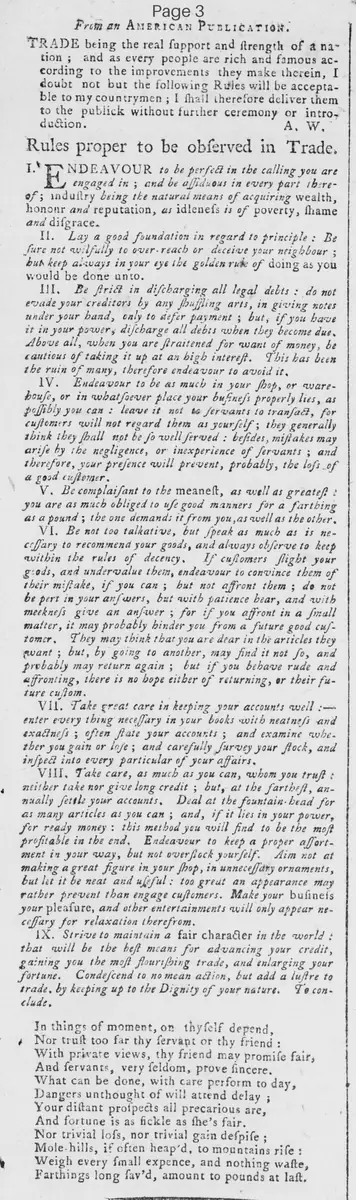
TRADE being the real support and strength of a nation; and as every people are rich and famous according to the improvements they make therein, I doubt not but the following Rules will be acceptable to my countrymen; I shall therefore deliver them to the publick without further ceremony or introduction.
A. W.
Rules proper to be observed in Trade.
I. ENDEAVOUR to be perfect in the calling you are engaged in; and be assiduous in every part thereof; industry being the natural means of acquiring wealth, honour and reputation, as idleness is of poverty, shame and disgrace.
II. Lay a good foundation in regard to principle: Be sure not wilfully to over-reach or deceive your neighbour; but keep always in your eye the golden rule of doing as you would be done unto.
III. Be strict in discharging all legal debts: do not evade your creditors by any shuffling arts, in giving notes under your hand, only to defer payment; but, if you have it in your power; discharge all debts when they become due. Above all, when you are straitened for want of money, be cautious of taking it up at a high interest. This has been the ruin of many, therefore endeavour to avoid it.
IV. Endeavour to be as much in your shop, or warehouse, or in whatsoever place your business properly lies, as possibly you can: leave it not to servants to transact, for customers will not regard them as yourself; they generally think they shall not be so well served: besides, mistakes may arise by the negligence, or inexperience of servants; and therefore, your presence will prevent, probably, the loss of a good customer.
V. Be complaisant to the meanest, as well as greatest: you are as much obliged to use good manners for a farthing as a pound; the one demands it from you, as well as the other.
VI. Be not too talkative, but speak as much as is necessary to recommend your goods, and always observe to keep within the rules of decency. If customers slight your goods, and undervalue them, endeavour to convince them of their mistake, if you can; but not affront them; do not be pert in your answers, but with patience bear, and with meekness give an answer; for if you affront in a small matter, it may probably hinder you from a future good customer. They may think that you are dear in the articles they want; but, by going to another, may find it not so, and probably may return again; but if you behave rude and affronting, there is no hope either of returning, or their future custom.
VII. Take great care in keeping your accounts well:-- enter every thing necessary in your books with neatness and exactness; often state your accounts; and examine whether you gain or lose; and carefully survey your stock, and inspect into every particular of your affairs.
VIII. Take care, as much as you can, whom you trust: neither take nor give long credit; but, at the farthest, annually settle your accounts. Deal at the fountain-head for as many articles as you can; and, if it lies in your power, for ready money: this method you will find to be the most profitable in the end. Endeavour to keep a proper assortment in your way, but not overstock yourself. Aim not at making a great figure in your shop, in unnecessary ornaments, but let it be neat and useful: too great an appearance may rather prevent than engage customers. Make your business your pleasure, and other entertainments will only appear necessary for relaxation therefrom.
IX. Strive to maintain a fair character in the world: that will be the best means for advancing your credit, gaining you the most flourishing trade, and enlarging your fortune. Condescend to no mean action, but add a lustre to trade by keeping up to the Dignity of your nature. To conclude,
In things of moment, on thyself depend,
Nor trust too far thy servant or thy friend:
With private views, thy friend may promise fair,
And servants, very seldom, prove sincere.
What can be done, with care perform to day,
Dangers unthought of will attend delay:
Your distant prospects all precarious are,
And fortune is as fickle as she's fair.
Nor trivial loss, nor trivial gain despise;
Mole-hills, if often heap'd, to mountains rise:
Weigh every small expense, and nothing waste,
Farthings long sav'd, amount to pounds at last.
TRADE being the real support and strength of a nation; and as every people are rich and famous according to the improvements they make therein, I doubt not but the following Rules will be acceptable to my countrymen; I shall therefore deliver them to the publick without further ceremony or introduction.
A. W.
Rules proper to be observed in Trade.
I. ENDEAVOUR to be perfect in the calling you are engaged in; and be assiduous in every part thereof; industry being the natural means of acquiring wealth, honour and reputation, as idleness is of poverty, shame and disgrace.
II. Lay a good foundation in regard to principle: Be sure not wilfully to over-reach or deceive your neighbour; but keep always in your eye the golden rule of doing as you would be done unto.
III. Be strict in discharging all legal debts: do not evade your creditors by any shuffling arts, in giving notes under your hand, only to defer payment; but, if you have it in your power; discharge all debts when they become due. Above all, when you are straitened for want of money, be cautious of taking it up at a high interest. This has been the ruin of many, therefore endeavour to avoid it.
IV. Endeavour to be as much in your shop, or warehouse, or in whatsoever place your business properly lies, as possibly you can: leave it not to servants to transact, for customers will not regard them as yourself; they generally think they shall not be so well served: besides, mistakes may arise by the negligence, or inexperience of servants; and therefore, your presence will prevent, probably, the loss of a good customer.
V. Be complaisant to the meanest, as well as greatest: you are as much obliged to use good manners for a farthing as a pound; the one demands it from you, as well as the other.
VI. Be not too talkative, but speak as much as is necessary to recommend your goods, and always observe to keep within the rules of decency. If customers slight your goods, and undervalue them, endeavour to convince them of their mistake, if you can; but not affront them; do not be pert in your answers, but with patience bear, and with meekness give an answer; for if you affront in a small matter, it may probably hinder you from a future good customer. They may think that you are dear in the articles they want; but, by going to another, may find it not so, and probably may return again; but if you behave rude and affronting, there is no hope either of returning, or their future custom.
VII. Take great care in keeping your accounts well:-- enter every thing necessary in your books with neatness and exactness; often state your accounts; and examine whether you gain or lose; and carefully survey your stock, and inspect into every particular of your affairs.
VIII. Take care, as much as you can, whom you trust: neither take nor give long credit; but, at the farthest, annually settle your accounts. Deal at the fountain-head for as many articles as you can; and, if it lies in your power, for ready money: this method you will find to be the most profitable in the end. Endeavour to keep a proper assortment in your way, but not overstock yourself. Aim not at making a great figure in your shop, in unnecessary ornaments, but let it be neat and useful: too great an appearance may rather prevent than engage customers. Make your business your pleasure, and other entertainments will only appear necessary for relaxation therefrom.
IX. Strive to maintain a fair character in the world: that will be the best means for advancing your credit, gaining you the most flourishing trade, and enlarging your fortune. Condescend to no mean action, but add a lustre to trade by keeping up to the Dignity of your nature. To conclude,
In things of moment, on thyself depend,
Nor trust too far thy servant or thy friend:
With private views, thy friend may promise fair,
And servants, very seldom, prove sincere.
What can be done, with care perform to day,
Dangers unthought of will attend delay:
Your distant prospects all precarious are,
And fortune is as fickle as she's fair.
Nor trivial loss, nor trivial gain despise;
Mole-hills, if often heap'd, to mountains rise:
Weigh every small expense, and nothing waste,
Farthings long sav'd, amount to pounds at last.
What sub-type of article is it?
Essay
What themes does it cover?
Commerce Trade
Moral Virtue
What keywords are associated?
Trade Rules
Business Ethics
Mercantile Advice
Industry Diligence
Honest Commerce
Account Keeping
Customer Service
What entities or persons were involved?
A. W.
Literary Details
Title
Rules Proper To Be Observed In Trade.
Author
A. W.
Key Lines
Lay A Good Foundation In Regard To Principle: Be Sure Not Wilfully To Over Reach Or Deceive Your Neighbour; But Keep Always In Your Eye The Golden Rule Of Doing As You Would Be Done Unto.
Be Strict In Discharging All Legal Debts: Do Not Evade Your Creditors By Any Shuffling Arts...
Take Great Care In Keeping Your Accounts Well: Enter Every Thing Necessary In Your Books With Neatness And Exactness...
In Things Of Moment, On Thyself Depend,
Nor Trust Too Far Thy Servant Or Thy Friend:
Nor Trivial Loss, Nor Trivial Gain Despise;
Mole Hills, If Often Heap'd, To Mountains Rise: