Thank you for visiting SNEWPapers!
Sign up free
Story
July 6, 1894
The Willimantic Journal
Willimantic, Windham County, Connecticut
What is this article about?
In Normandy, a priest discovers the skeleton of Jules Davoust, imprisoned alive 47 years earlier by masked men for marrying Polish noblewoman Sophie Polinski; the priest had unknowingly absolved him before his entombment, but the crime's perpetrators evade justice.
Clipping
OCR Quality
98%
Excellent
Full Text
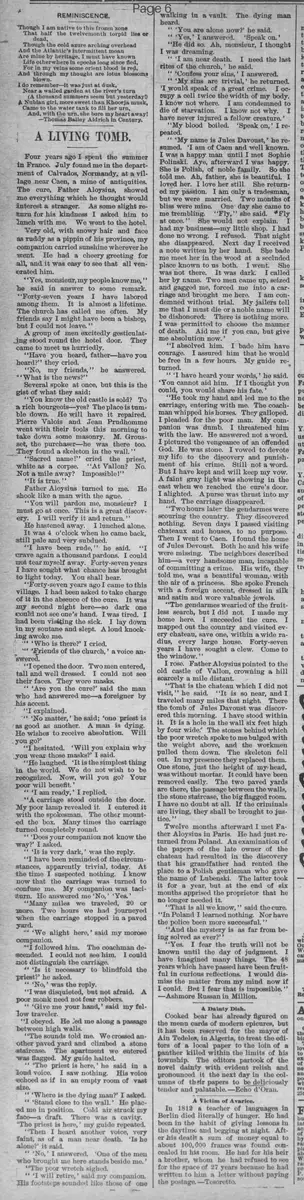
A LIVING TOMB.
Four years ago I spent the summer in France. July found me in the department of Calvados, Normandy, at a village near Caen, a mine of antiquities. The cure, Father Aloysius, showed me everything which he thought would interest a stranger. As some slight return for his kindness I asked him to lunch with me. We went to the hotel. Very old, with snowy hair and face as ruddy as a pippin of his province, my companion carried sunshine wherever he went. He had a cheery greeting for all, and it was easy to see that all venerated him.
"Yes, monsieur, my people know me," he said in answer to some remark. "Forty-seven years I have labored among them. It is almost a lifetime. The church has called me often. My friends say I might have been a bishop, but I could not leave."
A group of men excitedly gesticulating stood round the hotel door. They came to meet us hurriedly.
"Have you heard, father—have you heard?" they cried.
"No, my friends," he answered. "What is the news?"
Several spoke at once, but this is the gist of what they said:
"You know the old castle is sold? To a rich bourgeois—yes? The place is tumble down. He will have it repaired. Pierre Valois and Jean Prudhomme went with their tools this morning to take down some masonry. M. Grousset, the purchaser—he was there too. They found a skeleton in the wall."
"Sacred name!" cried the priest white as a corpse. "At Vallon? No. Not a mile away? Impossible!"
"It is true."
Father Aloysius turned to me. He shook like a man with the ague.
"You will pardon me, monsieur? I must go at once. This is a great discovery. I will verify it and return."
He hastened away. I lunched alone. It was 4 o'clock when he came back, still pale and very subdued.
"I have been rude," he said. "I crave again a thousand pardons. I could not tear myself away. Forty-seven years I have sought what chance has brought to light today. You shall hear.
"Forty-seven years ago I came to this village. I had been asked to take charge of it in the absence of the cure. It was my second night here—so dark one could not see one's hand. I was tired. I had been visiting the sick. I lay down in my soutane and slept. A loud knocking awoke me.
"'Who is there?' I cried.
"'Friends of the church,' a voice answered.
"I opened the door. Two men entered, tall and well dressed. I could not see their faces. They wore masks.
"'Are you the cure?' said the man who had answered me—a foreigner by his accent.
"I explained.
"'No matter,' he said; 'one priest is as good as another. A man is dying. He wishes to receive absolution. Will you go?'
"I hesitated. 'Will you explain why you wear those masks?' I said.
"He laughed. 'It is the simplest thing in the world. We do not wish to be recognized. Now, will you go? Your poor will benefit.'
"'I am ready,' I replied.
"A carriage stood outside the door. My poor lamp revealed it. I entered it with the spokesman. The other mounted the box. Many times the carriage turned completely round.
"'Does your companion not know the way?' I asked.
"'It is very dark,' was the reply.
"I have been reminded of the circumstances, apparently trivial, today. At the time I suspected nothing. I know now that the carriage was turned to confuse me. My companion was taciturn. He answered me 'No,' 'Yes.'
"Many miles we traveled, 20 or more. Two hours we had journeyed when the carriage stopped in a paved yard.
"'We alight here,' said my morose companion.
"I followed him. The coachman descended. I could not see him. I could not distinguish the carriage.
"'Is it necessary to blindfold the priest?' he asked.
"'No,' was the reply.
"I was disquieted, but not afraid. A poor monk need not fear robbers.
"'Give me your hand,' said my fellow traveler.
"I obeyed. He led me along a passage between high walls.
"The sounds told me. We crossed another paved yard and climbed a stone staircase. The apartment we entered was flagged. My guide halted.
"'The priest is here,' he said in a loud voice. I saw nothing. His voice echoed as if in an empty room of vast size.
"'Where is the dying man?' I asked.
"'Stand close to the wall.' He placed me in position. Cold air struck my face—a draft. There was a cavity. 'The priest is here,' my guide repeated.
"Then I heard another voice, very faint, as of a man near death. 'Is he alone?' it said.
"'No,' I answered. 'One of the men who brought me here stands beside me.'
"The poor wretch sighed.
"'I will retire,' said my companion. His footsteps sounded like those of one walking in a vault. The dying man heard.
"'You are alone now?' he said.
"'Yes,' I answered. 'Speak on.'
"He did so. Ah, monsieur, I thought I was dreaming.
"'I am near death. I need the last rites of the church,' he said.
"'Confess your sins,' I answered.
"'My sins are trivial,' he returned. 'I would speak of a great crime. I occupy a cell twice the width of my body. I know not where. I am condemned to die of starvation. I know not why. I have never injured a fellow creature.'
"My blood boiled. 'Speak on,' I repeated.
"'My name is Jules Davoust,' he resumed. 'I am of Caen and well known. I was a happy man until I met Sophie Polinski. Aye, afterward I was happy. She is Polish, of noble family. So she told me. Ah, father, she is beautiful. I loved her. I love her still. She returned my passion. I am only a tradesman, but we were married. Two months of bliss were mine. One day she came to me trembling. "Fly," she said. "Fly at once." She would not explain. I had my business—my little shop. I had done no wrong. I refused. That night she disappeared. Next day I received a note written by her hand. She bade me meet her in the wood at a secluded place known to us both. I went. She was not there. It was dark. I called her by name. Two men came up, seized and gagged me, forced me into a carriage and brought me here. I am condemned without trial. My jailers tell me that I must die or a noble name will be dishonored. There is nothing more. I was permitted to choose the manner of death. Aid me if you can, but give me absolution now.'
"I absolved him. I bade him have courage. I assured him that he would be free in a few hours. My guide returned.
"'I have heard your words,' he said. 'You cannot aid him. If I thought you could, you would share his fate.'
"He took my hand and led me to the carriage, entering with me. The coachman whipped his horses. They galloped. I pleaded for the poor man. My companion was dumb. I threatened him with the law. He answered not a word. I pictured the vengeance of an offended God. He was stone. I vowed to devote my life to the discovery and punishment of his crime. Still not a word. But I have kept and will keep my vow.
"A faint gray light was showing in the east when we reached the cure's door. I alighted. A purse was thrust into my hand. The carriage disappeared.
"Two hours later the gendarmes were scouring the country. They discovered nothing. Seven days I passed visiting chateaux and houses, to no purpose. Then I went to Caen. I found the home of Jules Davoust. Both he and his wife were missing. The neighbors described him—a very handsome man, incapable of committing a crime. His wife, they told me, was a beautiful woman, with the air of a princess. She spoke French with a foreign accent, dressed in silk and satin and wore valuable jewels.
"The gendarmes wearied of the fruitless search, but I did not. I made my home here. I succeeded the cure. I mapped out the country and visited every chateau, save one, within a wide radius, every large house. Forty-seven years I have sought a clew. Come to the window."
I rose. Father Aloysius pointed to the old castle of Vallon, crowning a hill scarcely a mile distant.
"That is the chateau which I did not visit," he said. "It is so near, and I traveled many miles that night. There the tomb of Jules Davoust was discovered this morning. I have stood within it. It is a hole in the wall six feet high by four wide. The stones behind which the poor wretch spoke to me bulged with the weight above, and the workmen pulled them down. The skeleton fell out. In my presence they replaced them. One stone, just the height of my head, was without mortar. It could have been removed easily. The two paved yards are there, the passage between the walls, the stone staircase, the big flagged room. I have no doubt at all. If the criminals are living, they shall be brought to justice."
Twelve months afterward I met Father Aloysius in Paris. He had just returned from Poland. An examination of the papers of the late owner of the chateau had resulted in the discovery that his grandfather had rented the place to a Polish gentleman who gave the name of Lubenski. The latter took it for a year, but at the end of six months apprised the proprietor that he no longer needed it.
"That is all we know," said the cure. "In Poland I learned nothing. Nor have the police been more successful."
"And the mystery is as far from being solved as ever?"
"Yes. I fear the truth will not be known until the day of judgment. I have imagined many things. The 48 years which have passed have been fruitful in curious reflections. I would dismiss the matter from my mind now if I could. But I fear that is impossible."
—Ashmore Russan in Million.
Four years ago I spent the summer in France. July found me in the department of Calvados, Normandy, at a village near Caen, a mine of antiquities. The cure, Father Aloysius, showed me everything which he thought would interest a stranger. As some slight return for his kindness I asked him to lunch with me. We went to the hotel. Very old, with snowy hair and face as ruddy as a pippin of his province, my companion carried sunshine wherever he went. He had a cheery greeting for all, and it was easy to see that all venerated him.
"Yes, monsieur, my people know me," he said in answer to some remark. "Forty-seven years I have labored among them. It is almost a lifetime. The church has called me often. My friends say I might have been a bishop, but I could not leave."
A group of men excitedly gesticulating stood round the hotel door. They came to meet us hurriedly.
"Have you heard, father—have you heard?" they cried.
"No, my friends," he answered. "What is the news?"
Several spoke at once, but this is the gist of what they said:
"You know the old castle is sold? To a rich bourgeois—yes? The place is tumble down. He will have it repaired. Pierre Valois and Jean Prudhomme went with their tools this morning to take down some masonry. M. Grousset, the purchaser—he was there too. They found a skeleton in the wall."
"Sacred name!" cried the priest white as a corpse. "At Vallon? No. Not a mile away? Impossible!"
"It is true."
Father Aloysius turned to me. He shook like a man with the ague.
"You will pardon me, monsieur? I must go at once. This is a great discovery. I will verify it and return."
He hastened away. I lunched alone. It was 4 o'clock when he came back, still pale and very subdued.
"I have been rude," he said. "I crave again a thousand pardons. I could not tear myself away. Forty-seven years I have sought what chance has brought to light today. You shall hear.
"Forty-seven years ago I came to this village. I had been asked to take charge of it in the absence of the cure. It was my second night here—so dark one could not see one's hand. I was tired. I had been visiting the sick. I lay down in my soutane and slept. A loud knocking awoke me.
"'Who is there?' I cried.
"'Friends of the church,' a voice answered.
"I opened the door. Two men entered, tall and well dressed. I could not see their faces. They wore masks.
"'Are you the cure?' said the man who had answered me—a foreigner by his accent.
"I explained.
"'No matter,' he said; 'one priest is as good as another. A man is dying. He wishes to receive absolution. Will you go?'
"I hesitated. 'Will you explain why you wear those masks?' I said.
"He laughed. 'It is the simplest thing in the world. We do not wish to be recognized. Now, will you go? Your poor will benefit.'
"'I am ready,' I replied.
"A carriage stood outside the door. My poor lamp revealed it. I entered it with the spokesman. The other mounted the box. Many times the carriage turned completely round.
"'Does your companion not know the way?' I asked.
"'It is very dark,' was the reply.
"I have been reminded of the circumstances, apparently trivial, today. At the time I suspected nothing. I know now that the carriage was turned to confuse me. My companion was taciturn. He answered me 'No,' 'Yes.'
"Many miles we traveled, 20 or more. Two hours we had journeyed when the carriage stopped in a paved yard.
"'We alight here,' said my morose companion.
"I followed him. The coachman descended. I could not see him. I could not distinguish the carriage.
"'Is it necessary to blindfold the priest?' he asked.
"'No,' was the reply.
"I was disquieted, but not afraid. A poor monk need not fear robbers.
"'Give me your hand,' said my fellow traveler.
"I obeyed. He led me along a passage between high walls.
"The sounds told me. We crossed another paved yard and climbed a stone staircase. The apartment we entered was flagged. My guide halted.
"'The priest is here,' he said in a loud voice. I saw nothing. His voice echoed as if in an empty room of vast size.
"'Where is the dying man?' I asked.
"'Stand close to the wall.' He placed me in position. Cold air struck my face—a draft. There was a cavity. 'The priest is here,' my guide repeated.
"Then I heard another voice, very faint, as of a man near death. 'Is he alone?' it said.
"'No,' I answered. 'One of the men who brought me here stands beside me.'
"The poor wretch sighed.
"'I will retire,' said my companion. His footsteps sounded like those of one walking in a vault. The dying man heard.
"'You are alone now?' he said.
"'Yes,' I answered. 'Speak on.'
"He did so. Ah, monsieur, I thought I was dreaming.
"'I am near death. I need the last rites of the church,' he said.
"'Confess your sins,' I answered.
"'My sins are trivial,' he returned. 'I would speak of a great crime. I occupy a cell twice the width of my body. I know not where. I am condemned to die of starvation. I know not why. I have never injured a fellow creature.'
"My blood boiled. 'Speak on,' I repeated.
"'My name is Jules Davoust,' he resumed. 'I am of Caen and well known. I was a happy man until I met Sophie Polinski. Aye, afterward I was happy. She is Polish, of noble family. So she told me. Ah, father, she is beautiful. I loved her. I love her still. She returned my passion. I am only a tradesman, but we were married. Two months of bliss were mine. One day she came to me trembling. "Fly," she said. "Fly at once." She would not explain. I had my business—my little shop. I had done no wrong. I refused. That night she disappeared. Next day I received a note written by her hand. She bade me meet her in the wood at a secluded place known to us both. I went. She was not there. It was dark. I called her by name. Two men came up, seized and gagged me, forced me into a carriage and brought me here. I am condemned without trial. My jailers tell me that I must die or a noble name will be dishonored. There is nothing more. I was permitted to choose the manner of death. Aid me if you can, but give me absolution now.'
"I absolved him. I bade him have courage. I assured him that he would be free in a few hours. My guide returned.
"'I have heard your words,' he said. 'You cannot aid him. If I thought you could, you would share his fate.'
"He took my hand and led me to the carriage, entering with me. The coachman whipped his horses. They galloped. I pleaded for the poor man. My companion was dumb. I threatened him with the law. He answered not a word. I pictured the vengeance of an offended God. He was stone. I vowed to devote my life to the discovery and punishment of his crime. Still not a word. But I have kept and will keep my vow.
"A faint gray light was showing in the east when we reached the cure's door. I alighted. A purse was thrust into my hand. The carriage disappeared.
"Two hours later the gendarmes were scouring the country. They discovered nothing. Seven days I passed visiting chateaux and houses, to no purpose. Then I went to Caen. I found the home of Jules Davoust. Both he and his wife were missing. The neighbors described him—a very handsome man, incapable of committing a crime. His wife, they told me, was a beautiful woman, with the air of a princess. She spoke French with a foreign accent, dressed in silk and satin and wore valuable jewels.
"The gendarmes wearied of the fruitless search, but I did not. I made my home here. I succeeded the cure. I mapped out the country and visited every chateau, save one, within a wide radius, every large house. Forty-seven years I have sought a clew. Come to the window."
I rose. Father Aloysius pointed to the old castle of Vallon, crowning a hill scarcely a mile distant.
"That is the chateau which I did not visit," he said. "It is so near, and I traveled many miles that night. There the tomb of Jules Davoust was discovered this morning. I have stood within it. It is a hole in the wall six feet high by four wide. The stones behind which the poor wretch spoke to me bulged with the weight above, and the workmen pulled them down. The skeleton fell out. In my presence they replaced them. One stone, just the height of my head, was without mortar. It could have been removed easily. The two paved yards are there, the passage between the walls, the stone staircase, the big flagged room. I have no doubt at all. If the criminals are living, they shall be brought to justice."
Twelve months afterward I met Father Aloysius in Paris. He had just returned from Poland. An examination of the papers of the late owner of the chateau had resulted in the discovery that his grandfather had rented the place to a Polish gentleman who gave the name of Lubenski. The latter took it for a year, but at the end of six months apprised the proprietor that he no longer needed it.
"That is all we know," said the cure. "In Poland I learned nothing. Nor have the police been more successful."
"And the mystery is as far from being solved as ever?"
"Yes. I fear the truth will not be known until the day of judgment. I have imagined many things. The 48 years which have passed have been fruitful in curious reflections. I would dismiss the matter from my mind now if I could. But I fear that is impossible."
—Ashmore Russan in Million.
What sub-type of article is it?
Mystery
Crime Story
Extraordinary Event
What themes does it cover?
Deception
Crime Punishment
Misfortune
What keywords are associated?
Living Tomb
Walled Prisoner
Masked Abduction
Priest Absolution
Unsolved Mystery
What entities or persons were involved?
Father Aloysius
Jules Davoust
Sophie Polinski
Where did it happen?
Chateau Of Vallon, Near Caen, Calvados, Normandy, France
Story Details
Key Persons
Father Aloysius
Jules Davoust
Sophie Polinski
Location
Chateau Of Vallon, Near Caen, Calvados, Normandy, France
Event Date
Forty Seven Years Before The Discovery
Story Details
A priest is lured by masked men to absolve a starving prisoner, Jules Davoust, walled up alive after marrying Sophie Polinski; forty-seven years later, his skeleton is found in the chateau wall, but the culprits remain unknown.