Thank you for visiting SNEWPapers!
Sign up free
Editorial
December 12, 1849
The Miners' Express
Dubuque, Dubuque County, Iowa
What is this article about?
Editorial critiques the complexity and absurdity of laws, advocating for simplification based on justice and common sense over precedents and forms. Copies remarks from New York Sun and hopes state commissions will reform legal intricacies.
Clipping
OCR Quality
92%
Excellent
Full Text
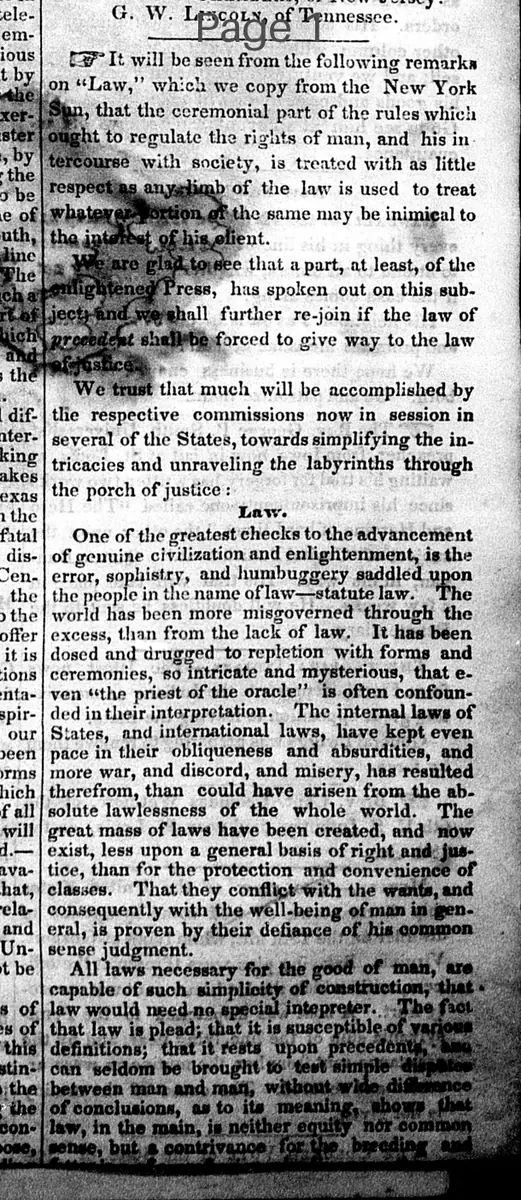
It will be seen from the following remarks on "Law," which we copy from the New York Sun, that the ceremonial part of the rules which ought to regulate the rights of man, and his intercourse with society, is treated with as little respect as any limb of the law is used to treat whatever portion of the same may be inimical to the interest of his client.
We are glad to see that a part, at least, of the enlightened Press, has spoken out on this subject, and we shall further rejoice if the law of precedent shall be forced to give way to the law of Justice.
We trust that much will be accomplished by the respective commissions now in session in several of the States, towards simplifying the intricacies and unraveling the labyrinths through which the porch of justice is.
Law.
One of the greatest checks to the advancement of genuine civilization and enlightenment, is the error, sophistry, and humbuggery saddled upon the people in the name of law—statute law. The world has been more misgoverned through the excess, than from the lack of law. It has been dosed and drugged to repletion with forms and ceremonies, so intricate and mysterious, that even "the priest of the oracle" is often confounded in their interpretation. The internal laws of States, and international laws, have kept even pace in their obliqueness and absurdities, and more war, and discord, and misery, has resulted therefrom, than could have arisen from the absolute lawlessness of the whole world. The great mass of laws have been created, and now exist, less upon a general basis of right and justice, than for the protection and convenience of classes. That they conflict with the want, and consequently with the well-being of man in general, is proven by their defiance of his common sense judgment.
All laws necessary for the good of man, are capable of such simplicity of construction, that law would need no special interpreter. The fact that law is plead: that it is susceptible of various definitions; that it rests upon precedent between man and man, without wide divergence of conclusions, as to its meaning, shows that law, in the main, is neither equity nor common sense, but a contrivance for the breeding
We are glad to see that a part, at least, of the enlightened Press, has spoken out on this subject, and we shall further rejoice if the law of precedent shall be forced to give way to the law of Justice.
We trust that much will be accomplished by the respective commissions now in session in several of the States, towards simplifying the intricacies and unraveling the labyrinths through which the porch of justice is.
Law.
One of the greatest checks to the advancement of genuine civilization and enlightenment, is the error, sophistry, and humbuggery saddled upon the people in the name of law—statute law. The world has been more misgoverned through the excess, than from the lack of law. It has been dosed and drugged to repletion with forms and ceremonies, so intricate and mysterious, that even "the priest of the oracle" is often confounded in their interpretation. The internal laws of States, and international laws, have kept even pace in their obliqueness and absurdities, and more war, and discord, and misery, has resulted therefrom, than could have arisen from the absolute lawlessness of the whole world. The great mass of laws have been created, and now exist, less upon a general basis of right and justice, than for the protection and convenience of classes. That they conflict with the want, and consequently with the well-being of man in general, is proven by their defiance of his common sense judgment.
All laws necessary for the good of man, are capable of such simplicity of construction, that law would need no special interpreter. The fact that law is plead: that it is susceptible of various definitions; that it rests upon precedent between man and man, without wide divergence of conclusions, as to its meaning, shows that law, in the main, is neither equity nor common sense, but a contrivance for the breeding
What sub-type of article is it?
Legal Reform
Social Reform
What keywords are associated?
Legal Reform
Law Complexity
Justice Over Precedent
Statute Law Critique
Common Sense In Law
State Commissions
What entities or persons were involved?
New York Sun
State Commissions
Editorial Details
Primary Topic
Critique Of Legal Complexity And Advocacy For Simplification
Stance / Tone
Critical Of Legal Precedents And Forms, Supportive Of Justice And Common Sense
Key Figures
New York Sun
State Commissions
Key Arguments
Ceremonial Aspects Of Law Are Treated With Little Respect When Conflicting With Client Interests
Law Of Precedent Should Yield To Law Of Justice
State Commissions Can Simplify Legal Intricacies
Excess Of Law Causes More Misgovernment Than Lack
Laws Are Intricate And Mysterious, Confounding Even Experts
Laws Protect Classes Rather Than General Right And Justice
Laws Defy Common Sense
Necessary Laws Can Be Simple Without Special Interpreters
Law Relies On Precedents, Not Equity Or Common Sense