Thank you for visiting SNEWPapers!
Sign up free
Daily Richmond Whig
Richmond, Virginia
What is this article about?
In this installment of a series, 'Filius' argues that tobacco cultivation is unprofitable and soil-exhausting in Virginia, leading to debt, land abandonment, and population stagnation. He urges diversification to crops like cotton, flax, hemp, silk, and wine, supported by cost calculations and historical examples, while critiquing political distractions from agricultural reform.
Clipping
OCR Quality
Full Text
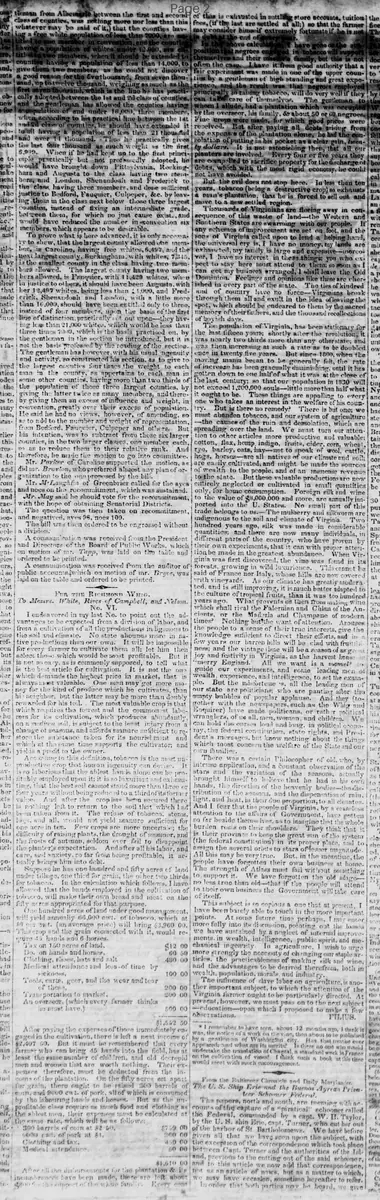
To Messrs. White, Rives of Campbell, and Nelson.
No. VI.
I endeavored in my last No. to point out the advantages to be expected from a division of labor, and from a cultivation of all the productions indigenous to the soil and climate. No state abounds more in native productions than our own: It will be impossible for every farmer to cultivate them all; let him then select those which would be most profitable. But it is not so easy, as is commonly supposed, to tell what is the best article for cultivation. It is not the one which demands the highest price in market, that is always most valuable. One man may get more money for the kind of produce which he cultivates, than his neighbor, but the latter may be more than doubly rewarded for his toil. The most valuable crop is that which requires the fewest and the commonest laborers for its cultivation, which produces abundantly, on a medium soil, is subject to the least injury from a change of seasons, and affords manure sufficient to restore the substance taken for its nourishment and which at the same time supports the cultivator; and yields a profit to the owner.
According to this definition, tobacco is the most unprofitable crop that human ingenuity can devise. It is so laborious that the ablest hand is alone can be profitably employed upon it; it is so luxuriant and exhausting, that the best soil cannot stand more than three or four years without being reduced to a third of its former value. And after the crop has been secured there is nothing left to return to the soil that which had been taken from it. The refuse of tobacco, stems, logs, and all, would not yield manure sufficient for one acre in ten. Few crops are more uncertain; the difficulty of raising plants, the drought of summer, and the frosts of autumn, seldom ever fail to disappoint the planter's expectation. And after all his labor, and care, and anxiety, so far from being profitable, it actually brings him into debt.
Suppose he has one hundred and fifty acres of land under tillage, one third for grain, the other two thirds for tobacco. In the calculation which follows, I have allowed that the hands employed in the cultivation of tobacco, will make their own bread and meat: on the fifty acres appropriated for that purpose.
One hundred acres of land under good management, will yield annually 66,000 cwt. of tobacco, which at $9 per cwt. (an average price) will bring $3,960 00.
This crop and the grain connected with it, would require 45 hands and 6 horses.
Tax on 150 acres of land, $12 00
Do. on hands and horses, 60 50
Clothing, shoes, hats and salt 480 00
Medical attendance and loss-of time by sickness, 100 00
Tools, carts, gear, and the wear and tear of these, 200 00
Transportation to market. 200 00
An overseer, (which every farmer thinks he must have.) 500 00
$1,552 50
After paying the expenses of those immediately engaged in the cultivation, there is left a net income of $2,407 60. But it must be remembered that every farmer who can bring 45 hands into the field, has at least the same number of children, and old decrepit men and women that are worth nothing. Their expenses therefore, must be deducted from the income of the plantation. On the fifty acres set apart for grain, there ought to be raised 300 barrels of corn, and 6000 cwt. of pork, all of which is consumed by the labouring hands and horses. But as the unprofitable class require as much food and clothing as the ablest men, their expenses must be calculated at the same rate, which will be as follows:
300 barrels of corn at $2 50. $750 00
6000 cwt. of pork at $1. 200.00
Clothing and tax. 4.0.00
Medical attendance 60 00
$1,010 00
After such disbursements for the plantation & its incumbrances have been made, there are left about $1,397 60 of the whole sum. Every cent of this is exhausted in settling store accounts, tuition fees, (if these last are settled at all;) so that the farmer may consider himself extremely fortunate if he is not in debt at the end of the year.
In the above calculation I have gone on the supposition that negroes engaged in tobacco will support themselves and their master's family, but this is not often the case. I have it from good authority that a fair experiment was made in one of the upper counties by a gentleman of high standing and great experience, and the result was that negroes employed principally in raising tobacco, will do very well if they can take care of themselves. The gentleman to whom I allude, had a plantation which was occupied by the overseer, his family, & about 50 or 60 negroes. Fine crops were made, for which good prices were received. But after paying all debts arising from the expenses of the plantation alone, he had the consolation of putting in his pocket as a clear gain, fifteen dollars. It is not astonishing then, that all our planters are involved. Every four or five years they are compelled to sacrifice property for the discharge of debts, which with the most rigid economy, he could not have avoided.
But the evil does not stop here. In less than ten years, tobacco (being a destructive crop) so exhausts a man's plantation, that he is forced to sell out and move to a new settled region.
Thousands of Virginians are fleeing away in consequence of this waste of land—the Western and Southern States are swarming with our people. If any schemes of improvement are set on foot, and the sons of Virginia called upon to lend a helping hand, the universal cry is, I have no money, my lands are exhausted, my family is large and expensive—increaseover, I have no interest in these things; you who expect to stay here must attend to them: so soon as I can get my business arranged, I shall leave the Old Dominion. Feelings and opinions like these are cherished in every part of the state. The ties of kindred and of country have no force—Virginians break through them all and exult in the idea of leaving the spot, which should be endeared to them by the sacred memory of their fathers, and the thousand recollections of boyish days.
The population of Virginia, has been stationary for the last fifteen years; shortly after the revolution, it was nearly two thirds more than any other state; and was then increasing at such a rate as to be doubled once in twenty five years. But since 1800, when the moving mania began to be generally felt, the rate of increase has been gradually diminishing, until it has gotten down to one half of what it was at the close of the last century; so that our population in 1830 will not exceed 1,200,000 souls—little more than half what it ought to be. These things are appalling to every one who takes an interest in the welfare of his country. But is there no remedy? There is but one; we must abandon tobacco, and our system of agriculture—the causes of the ruin and desolation, which are spreading over the land. We must turn our attention to other articles more productive and valuable; cotton, flax, hemp, indigo, fruits, cider, corn, wheat, rye, barley, oats, hay—not to speak of wool, cattle, hogs, horses—are all natives of our climate and soil: are easily cultivated, and might be made the sources of wealth to the people, and of an immense revenue to the state. But these valuable productions are now entirely neglected or cultivated in small quantities only, for home consumption. Foreign silk and wine to the value of $8,000,000 and more, are annually imported into the U. States. No small part of this trade belongs to us.— The mulberry and silkworm are indigenous to the soil and climate of Virginia. Two hundred years ago, silk was made in considerable quantities; and there are now many individuals, in different parts of the country, who have proven by their own experiments, that it can with proper attention be made in the greatest abundance. When Virginia was first discovered, the vine was found in its forests, growing in wild luxuriance. This cannot be said of France nor Italy, whose hills are now covered with vineyards. As our climate has greatly moderated, and is still improving, it is much better adapted to the culture of tropical fruits, than it was two hundred years ago. What prevents us then from making wine which shall rival the Falernian and Chian of the Ancients, or the Madeira and Champagne of modern times? Nothing but the want of attention. Arouse the people to a sense of their true interests, give the knowledge sufficient to direct their efforts, and in a few years our barren hills will be clad with fruitfulness; and the vintage time will be a season of as great joy and festivity in Virginia, as the harvest home in 'merry England.' All we want is a manual* to guide our experiments, and some leading men of wealth, experience, and intelligence, to set the example. But the misfortune is, all the leading men of our state are politicians; who are panting after the empty bubbles of popular applause. And they (together with the newspapers, such as the Whig and Enquirer) have made politicians, or rather political wranglers, of us all, men, women, and children. We can hold discourses loud and long, in political economy, the federal constitution, state rights, and President's messages, but know nothing about the things which most concern the welfare of the State and our own families.
There was a certain Philosopher of old, who, by intense application, and a constant observation of the stars and the variation of the seasons, actually brought himself to believe that he had in his own hands, the direction of the heavenly bodies—that is, the distribution of the seasons, and the dispensation of rain, light, and heat, in their due proportion, to all climates. And I fear that the people of Virginia, by a ceaseless attention to the affairs of Government, have gotten so far beside themselves, as to imagine that the whole burden rests on their shoulders. They think that it is their province to keep the great sun of the system (the federal constitution) in its proper place, and to assign the several orbits to stars of lesser magnitude. All this may be very true. But, in the meantime, the people have forgotten their own business at home. The strength of Atlas must fail without something to support it. We have forgotten the old adage—no less true than old—that if the people will attend to their own business the Government will take care of itself.
This subject is so copious a one that at present, I have been barely able to touch on the more important points. At some future time perhaps, I may enter more fully into its discussion, pointing out the losses we have sustained by a neglect of internal improvements, in wealth, intelligence, public spirit, and mechanical ingenuity. In agriculture, I wish to urge more strongly the necessity of changing our staple articles, the practicableness of making silk and wine, and the advantages to be derived therefrom, both in wealth, population, morals, and industry.
The influence of slave labor on agriculture, is another important subject, to which the attention of the Virginia farmer ought to be particularly directed. At present, however, we must pass on to the next subject—education—upon which I proposed to make a few observations.
FILIUS.
*I remember to have seen, about 12 months ago, I think it was, the notice of a work on the vine, then about to be published by a gentleman of Washington city. Has that treatise ever appeared and what are its merits? Is there no one who would undertake the translation of Chaptal, a standard work in France on the cultivation of vines? I think such a book at this time would meet with much encouragement.
What sub-type of article is it?
What themes does it cover?
What keywords are associated?
What entities or persons were involved?
Letter to Editor Details
Author
Filius
Recipient
Messrs. White, Rives Of Campbell, And Nelson
Main Argument
tobacco cultivation is unprofitable, exhausting to soil and finances, causing debt, migration, and population decline in virginia; farmers should abandon it and diversify to more sustainable crops like cotton, flax, hemp, silk, and wine to restore prosperity and growth.
Notable Details