Thank you for visiting SNEWPapers!
Sign up free
Richmond Enquirer
Richmond, Richmond County, Virginia
What is this article about?
In late August 1832, Georgia congressional candidates mostly disavow nullification as a remedy for the oppressive Tariff, deeming it unconstitutional and risky to the Union; one supports it conditionally, another proposes state nullification and potential secession if unchanged by 1834; a supporter of Andrew Jackson affirms Union loyalty.
Clipping
OCR Quality
Full Text
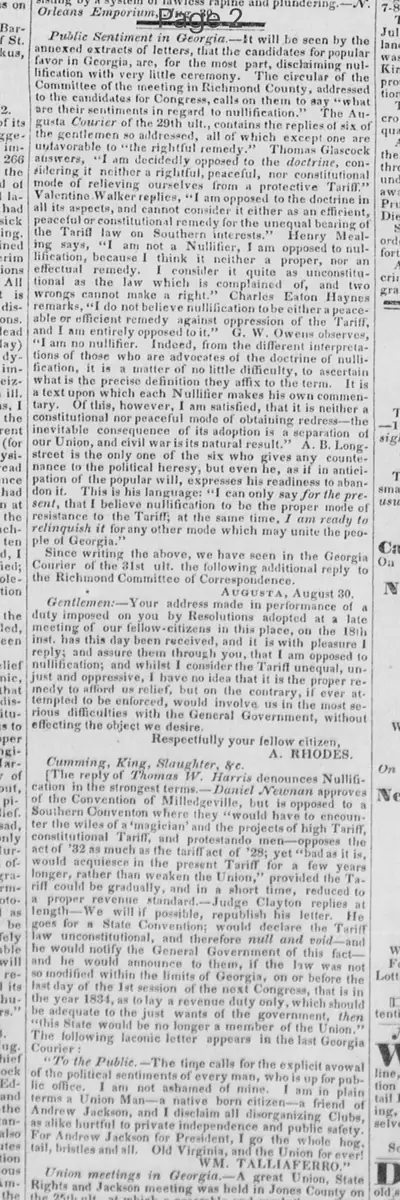
Since writing the above, we have seen in the Georgia Courier of the 31st ult. the following additional reply to the Richmond Committee of Correspondence.
Augusta, August 30.
Gentlemen:—Your address made in performance of a duty imposed on you by Resolutions adopted at a late meeting of our fellow-citizens in this place, on the 18th inst. has this day been received, and it is with pleasure I reply; and assure them through you, that I am opposed to nullification; and whilst I consider the Tariff unequal, unjust and oppressive, I have no idea that it is the proper remedy to afford us relief, but on the contrary, if ever attempted to be enforced, would involve us in the most serious difficulties with the General Government, without effecting the object we desire.
Respectfully your fellow citizen,
A. RHODES.
Cumming, King, Slaughter, &c.
The reply of Thomas W. Harris denounces Nullification in the strongest terms.—Daniel Newnan approves of the Convention of Milledgeville, but is opposed to a Southern Convention where they "would have to encounter the wiles of a 'magician' and the projects of high Tariff, constitutional Tariff, and protestando men—opposes the act of '32 as much as the tariff act of '28; yet "bad as it is, would acquiesce in the present Tariff for a few years longer, rather than weaken the Union," provided the Tariff could be gradually, and in a short time, reduced to a proper revenue standard.—Judge Clayton replies at length—We will if possible, republish his letter. He goes for a State Convention; would declare the Tariff law unconstitutional, and therefore null and void—and he would notify the General Government of this fact—and he would announce to them, if the law was not so modified within the limits of Georgia, on or before the last day of the 1st session of the next Congress, that is in the year 1834, as to lay a revenue duty only, which should be adequate to the just wants of the government, then "this State would be no longer a member of the Union."
The following laconic letter appears in the last Georgia Courier:
"To the Public.—The time calls for the explicit avowal of the political sentiments of every man, who is up for public office. I am not ashamed of mine. I am in plain terms a Union Man—a native born citizen—a friend of Andrew Jackson, and I disclaim all disorganizing Clubs, as alike hurtful to private independence and public safety. For Andrew Jackson for President, I go the whole hog, tail, bristles and all. Old Virginia, and the Union for ever!
WM. TALLIAFERRO."
What sub-type of article is it?
What keywords are associated?
What entities or persons were involved?
Where did it happen?
Domestic News Details
Primary Location
Georgia
Event Date
Late August 1832
Key Persons
Event Details
Candidates for Congress in Georgia respond to a Richmond County committee query on nullification sentiments, with most opposing it as unconstitutional and unpeaceful, while favoring other remedies for the Tariff; A. B. Longstreet supports but ready to abandon; others like Judge Clayton propose state actions including potential secession if Tariff not modified by 1834; WM. TALLIAFERRO declares as Union Man supporting Andrew Jackson.