Thank you for visiting SNEWPapers!
Sign up free
Rhode Island American, Statesman And Providence Gazette
Providence, Providence County, Rhode Island
What is this article about?
Providence Gazette article from December 15, 1830, defends the U.S. Supreme Court's role in maintaining federal union by reviewing cases where it ruled state laws unconstitutional (24 over 36 years) or affirmed them (10), countering critics who seek to undermine judicial supremacy.
Merged-components note: The table component contains the list of Supreme Court cases directly referenced and integrated into the preceding story text on United States Supreme Court decisions and state laws.
Clipping
OCR Quality
Full Text
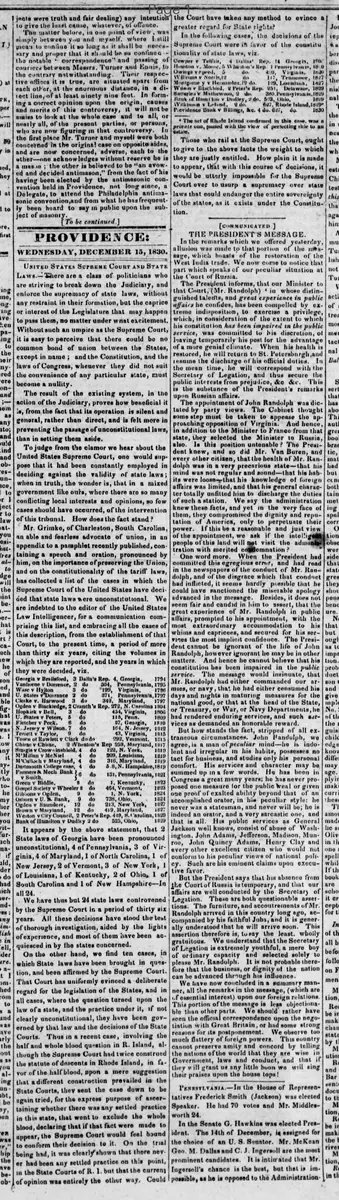
WEDNESDAY, DECEMBER 15, 1830.
United States Supreme Court And State
Laws.—There are a class of politicians who
are striving to break down the Judiciary, and
enforce the supremacy of state laws, without
any restraint in their formation, but the caprice
or interest of the Legislature that may happen
to pass them, no matter under what excitement.
Without such an umpire as the Supreme Court,
it is easy to perceive that there could be no
common bond of union between the States,
except in name; and the Constitution, and the
laws of Congress, whenever they did not suit
the convenience of any particular state, must
become a nullity.
The result of the existing system, in the
action of the Judiciary, proves how beneficial it
is, from the fact that its operation is silent and
general, rather than direct, and is felt more in
preventing the passage of unconstitutional laws,
than in setting them aside.
To judge from the clamor we hear about the
United States Supreme Court, one would suppose
that it had been constantly employed in
deciding against the validity of state laws;
when in truth, the wonder is, that in a mixed
government like ours, where there are so many
conflicting local interests and opinions, so few
cases should have occurred, of the intervention
of this tribunal. How does the fact stand?
Mr. Grimke, of Charleston, South Carolina,
an able and fearless advocate of union, in an
appendix to a pamphlet recently published, containing
a speech and oration, pronounced by
him, on the importance of preserving the Union,
and on the constitutionality of the tariff laws,
has collected a list of the cases in which the
Supreme Court of the United States have decided
that state laws were unconstitutional. We
are indebted to the editor of the United States
Law Intelligencer, for a communication comprising
this list, and embracing all the cases of
this description, from the establishment of that
Court, to the present time, a period of more
than thirty six years, citing the volumes in
which they are reported, and the years in which
they were decided, viz.
It appears by the above statement, that 2
State laws of Georgia have been pronounced
unconstitutional, 4 of Pennsylvania, 3 of Virginia,
4 of Maryland, 1 of North Carolina, 1 of
New Jersey, 2 of Vermont, 3 of New York, 1
of Louisiana, 1 of Kentucky, 2 of Ohio, 1 of
South Carolina and 1 of New Hampshire—In
all 24.
We have thus but 24 state laws controverted
by the Supreme Court in a period of thirty six
years. All these decisions have stood the test
of thorough investigation, aided by the lights
of experience, and most of them have been acquiesced
in by the states concerned.
On the other hand, we find ten cases, in
which State laws have been brought in question,
and been affirmed by the Supreme Court.
That Court has uniformly evinced a deliberate
regard for the legislation of the States, and in
all cases, where the question turned upon the
law of a state, and the practice under it, if not
clearly unconstitutional, they have been governed
by that law and the decisions of the State
Courts. Thus in a recent case, involving the
half and whole blood question in R. Island, although
the Supreme Court had twice construed the
statute of descents in Rhode Island, in favor
of the half blood, upon a mere suggestion
that a different construction prevailed in the
State Courts, they sent the case down to be
again tried, for the express purpose of ascertaining
whether there was any settled practice
in this state, that went to exclude the whole
blood, declaring that if that fact were made to
appear, the Supreme Court would feel bound to
conform their decision to it. On the trial
being had, it was clearly shown that there never
had been any settled practice on this point,
in the State Courts of R. I. but that the current
of opinion was entirely the other way. Could
the Court have taken any method to evince a
greater regard for State rights?
In the following cases, the decisions of the
Supreme Court were in favor of the constitutionality
of state laws, viz.
Cowper v. Telfair, 4 Dallas' Rep. 14 Georgia, 1800
Houston v. Moore, 5 Wheaton's Rep. 1 Pennsylvania, 1820
Owings v. Speed, 5 do. 4:0, Virginia. 1820
Williams v. Norris, 12 do. 117, Tennessee, 1827
Montgomery v. Hernandez. 12 do. 129, Louisiana, 1827
Wilson v. Blackbird, 2 Peters' Rep. 251, Delaware, 1829
Satterlee v. Mathewson, 2 do. 380. Pennsylvania, 1829
Bank of Hamilton v. Dudley, 2 do. 53, Ohio, 1829
Wilkinson v. Leland, 2 do. 627, Rhode Island, 1829*
Providence Bank v. Billings, &c. 4 do. 627, do. 1830
The act of Rhode Island confirmed in this case, was a
private one, passed with the view of perfecting title to an
estate.
Those who rail at the Supreme Court, ought
to give to the above facts the weight to which
they are justly entitled. How plain it is made
to appear, that with this course of decisions, it
would be utterly impossible for the Supreme
Court ever to usurp a supremacy over state
laws that could endanger the entire sovereignty
of the states, as it exists under the Constitution.
| Georgia v Brailsford, 3 | Dallas' Rep. 4, Georgia, 1794 |
| Vanhorne v Dorrance, 2 | do 304, Pennsylvania, 1795 |
| Ware v Hylton, 3 | do 199, Virginia, 1796 |
| U. States v Dorrance, 2 | do 371, Pennsylvania, 1797 |
| Clerke v. Harwood, 3 | do 342, Maryland, 1797 |
| Ogden v Blackledge, 2 | Cranch's Rep. 272, N. Carolina 1804 |
| Hopkirk v Bell, 3 | do 454, Virginia, 1806 |
| U. States v Peters, 5 | do 115, Penn, 1809 |
| Fletcher v Peck, 6 | do 87, Georgia, 1810 |
| N. Jersey v Wilson, 7 | do 164, Jersey, 1812 |
| Terrett v Taylor, 9 | do 43, Virginia, 1815 |
| Town of Pawlett v Clark, 2 | Wheaton's Rep. 259, Maryland, 1817 |
| Chirac v Chirac, 4 | do 122, N. York, 1819 |
| Sturgis v Crowinshield, 4 | do 209, Louisiana, 1819 |
| M'Millan v McNiel, 4 | do 316, Maryland, 1819 |
| M'Culloch v Maryland, 4 | do 5.8, N. Hampshire, 1819 |
| Dartmouth College case, 4 | do 131, Pennsylvania, 1821 |
| Farmers & Mech. Bank v Smith, 6 | do 1, Kentucky, 1823 |
| Green v Biddle, 8 | do 464, Vermont, 1823 |
| Governour &c. v Wheeler, 9 | do 1, N. York, 1824 |
| Gibson v Ogden, 9 | do 738, Ohio, 1824 |
| Osborn v U.S. Bank, 12 | do 213, New York, 1827 |
| Ogden v Saunders, 12 | do 419, Maryland, 1827 |
| Brown v Maryland, 12 | do 449, S. Carolina, 1829 |
| Weston v City Council, 2 | Peter's Rep. 449, S. Carolina, 1829 |
| Bank of Hamilton v Dudley, 2 | do 525, Ohio, 1829 |
What sub-type of article is it?
What themes does it cover?
What keywords are associated?
What entities or persons were involved?
Where did it happen?
Story Details
Key Persons
Location
United States
Event Date
December 15, 1830
Story Details
Article defends Supreme Court's role in federal union, lists 24 state laws ruled unconstitutional over 36 years across various states, and 10 affirmed, showing judicial restraint and respect for state rights.