Thank you for visiting SNEWPapers!
Sign up free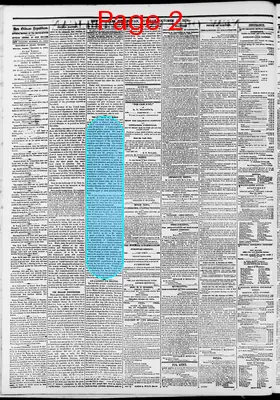
Editorial
October 13, 1874
New Orleans Republican
New Orleans, Orleans County, Louisiana
What is this article about?
This editorial critiques the societal double standard in judging immorality: influential men are often shielded and honored, while women face severe condemnation and exclusion. It regrets this disparity, attributing higher standards to women's role in preserving social virtue across generations, and calls for equal accountability.
Clipping
OCR Quality
98%
Excellent
Full Text
THE JUSTICE OF THE WORLD
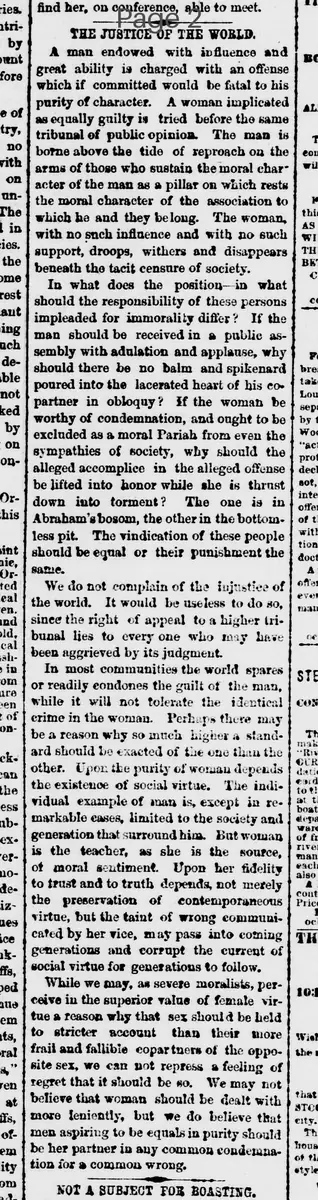
A man endowed with influence and great ability is charged with an offense which if committed would be fatal to his purity of character. A woman implicated as equally guilty is tried before the same tribunal of public opinion. The man is borne above the tide of reproach on the arms of those who sustain the moral character of the man as a pillar on which rests the moral character of the association to which he and they belong. The woman with no such influence and with no such support, droops, withers and disappears beneath the tacit censure of society. In what does the position-in what should the responsibility of these persons impleaded for immorality differ? If the man should be received in a public assembly with adulation and applause, why should there be no balm and spikenard poured into the lacerated heart of his co-partner in obloquy? If the woman be worthy of condemnation, and ought to be excluded as a moral Pariah from even the sympathies of society, why should the alleged accomplice in the alleged offense be lifted into honor while she is thrust down into torment? The one is in Abraham's bosom, the other in the bottomless pit. The vindication of these people should be equal or their punishment the same. We do not complain of the injustice of the world. It would be useless to do so, since the right of appeal to a higher tribunal lies to every one who may have been aggrieved by its judgment. In most communities the world spares or readily condones the guilt of the man, while it will not tolerate the identical crime in the woman. Perhaps there may be a reason why so much higher a standard should be exacted of the one than the other. Upon the purity of woman depends the existence of social virtue. The individual example of man is, except in remarkable cases, limited to the society and generation that surround him. But woman is the teacher, as she is the source of moral sentiment. Upon her fidelity to trust and to truth depends, not merely the preservation of contemporaneous virtue, but the taint of wrong communicated by her vice, may pass into coming generations and corrupt the current of social virtue for generations to follow. While we may, as severe moralists, perceive in the superior value of female virtue a reason why that sex should be held to stricter account than their more frail and fallible copartners of the opposite sex, we can not repress a feeling of regret that it should be so. We may not believe that woman should be dealt with more leniently, but we do believe that men aspiring to be equals in purity should be her partner in any common condemnation for a common wrong.
A man endowed with influence and great ability is charged with an offense which if committed would be fatal to his purity of character. A woman implicated as equally guilty is tried before the same tribunal of public opinion. The man is borne above the tide of reproach on the arms of those who sustain the moral character of the man as a pillar on which rests the moral character of the association to which he and they belong. The woman with no such influence and with no such support, droops, withers and disappears beneath the tacit censure of society. In what does the position-in what should the responsibility of these persons impleaded for immorality differ? If the man should be received in a public assembly with adulation and applause, why should there be no balm and spikenard poured into the lacerated heart of his co-partner in obloquy? If the woman be worthy of condemnation, and ought to be excluded as a moral Pariah from even the sympathies of society, why should the alleged accomplice in the alleged offense be lifted into honor while she is thrust down into torment? The one is in Abraham's bosom, the other in the bottomless pit. The vindication of these people should be equal or their punishment the same. We do not complain of the injustice of the world. It would be useless to do so, since the right of appeal to a higher tribunal lies to every one who may have been aggrieved by its judgment. In most communities the world spares or readily condones the guilt of the man, while it will not tolerate the identical crime in the woman. Perhaps there may be a reason why so much higher a standard should be exacted of the one than the other. Upon the purity of woman depends the existence of social virtue. The individual example of man is, except in remarkable cases, limited to the society and generation that surround him. But woman is the teacher, as she is the source of moral sentiment. Upon her fidelity to trust and to truth depends, not merely the preservation of contemporaneous virtue, but the taint of wrong communicated by her vice, may pass into coming generations and corrupt the current of social virtue for generations to follow. While we may, as severe moralists, perceive in the superior value of female virtue a reason why that sex should be held to stricter account than their more frail and fallible copartners of the opposite sex, we can not repress a feeling of regret that it should be so. We may not believe that woman should be dealt with more leniently, but we do believe that men aspiring to be equals in purity should be her partner in any common condemnation for a common wrong.
What sub-type of article is it?
Moral Or Religious
Feminism
Social Reform
What keywords are associated?
Gender Double Standard
Female Virtue
Moral Judgment
Social Injustice
Purity Of Character
Women's Role
Editorial Details
Primary Topic
Gender Double Standards In Moral Accountability
Stance / Tone
Regretful Critique Of Unequal Treatment
Key Arguments
Men With Influence Are Protected From Moral Reproach While Women Are Harshly Censured.
Societal Standards Demand Higher Purity From Women Due To Their Role In Preserving Social Virtue.
Women's Moral Lapses Can Corrupt Future Generations, Unlike Men's Limited Impact.
Equal Vindication Or Punishment Should Apply To Both Sexes For The Same Offense.
Regret The Disparity, But Advocate Men Share Accountability To Match Women's Standards.