Thank you for visiting SNEWPapers!
Sign up free
The Lake Charles Echo
Lake Charles, Calcasieu County, Louisiana
What is this article about?
Interview with Louisiana Senator James B. Eustis at Manchester-by-the-Sea, discussing Democratic Party factions in Louisiana, support for Gov. McEnery's administration, the race problem, and unified backing for President Cleveland's renomination in 1888 despite past differences.
Merged-components note: These components form a continuous interview article with Senator Eustis.
Clipping
OCR Quality
Full Text
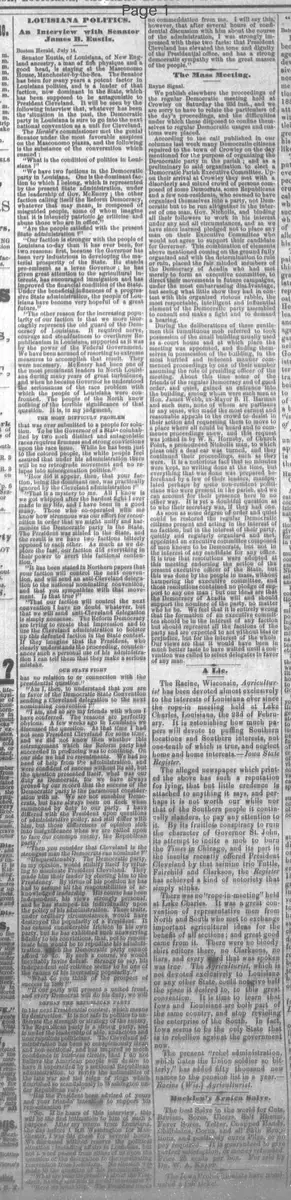
Boston Herald, July 14.
Senator Eustis, of Louisiana, of New England ancestry, a man of fine physique and a good head, is staying at the Masconomo House, Manchester-by-the-Sea. The Senator has been for many years a potent factor in Louisiana politics, and is a leader of that faction, now dominant in the State, which has been supposed to be antagonistic to President Cleveland. It will be seen by the following interview that, whatever has been the situation in the past, the Democratic party in Louisiana is sure to go into the next national convention as a unit for Cleveland. The Herald's commissioner met the genial Senator under the most favorable auspices on the Masconomo piazza, and the following is the substance of the conversation which ensued:
"What is the condition of politics in Louisiana?"
"We have two factions in the Democratic party in Louisiana. One is the dominant faction to which I belong, which is represented by the present State administration, under the leadership of Gov. McEnery; the other faction calling itself the Reform Democracy, whatever that may mean, is composed of misguided people, some of whom imagine that it is intensely patriotic to criticise and abuse those who are in office."
"Are the people satisfied with the present State administration?"
"Our faction is stronger with the people of Louisiana to-day than it has ever been, for two reasons: first, because the Governor has been very industrious in developing the material prosperity of the State. He stands pre-eminent as a levee Governor; he has given great attention to the agricultural interests, has encouraged immigration and has improved the financial condition of the State. Under the beneficial influences of a progressive State administration, the people of Louisiana have become very hopeful of a great future.
The other reason for the increasing popularity of our faction is that we more thoroughly represent the old guard of the Democracy of Louisiana. It required nerve, courage and steadfastness to overthrow Republicanism in Louisiana, supported as it was by the power of the Federal Government. We have been accused of resorting to extreme measures to accomplish that result. They were necessary. McEnery had been one of the most prominent leaders in North Louisiana during many years of great turbulence, and when he became Governor he understood the seriousness of the race problem with which the people of Louisiana were confronted. The people of the North know nothing of the terrible significance of that question. It is, in my judgment, THE MOST DIFFICULT PROBLEM that was ever submitted to a people for solution. "To be the Governor of a State cohabited by two such distinct and antagonistic races requires firmness and strong convictions upon the race issue. While he has been just to the colored people, the white people feel assured that under his administration there will be no retrograde movement and no relapse into miscegenation politics."
"How did it appear, then, that your faction, being the dominant one, was practically ignored by the Cleveland administration?"
"That is a mystery to me. All I know is we got whipped after the hardest fight I ever made in my life, and I have been in a good many. Those who co-operated with me know how strenuous was our effort for recognition in order that we might unify and harmonize the Democratic party in the State. The President was misled in the State, and the result is we have two factions bitterly opposed to each other. As much as we de- plore the fact, our faction did everything in their power to avert this factional contention.
It has been stated in Northern papers that your faction will control the next convention, and will send an anti-Cleveland delegation to the national nominating convention, and that you sympathize with that movement. Is that true?"
"That our faction will control the next convention I have no doubt whatever, but that we will send anti-Cleveland delegation is simply nonsense. The Reform Democracy are trying to create that impression and to use the Cleveland administration to bolster up this defeated faction in the State contest. If they imagine that the President, who clearly understands the proceeding, countenances such a personal use of his administration I can tell them that they make a serious mistake. OUR STATE FIGHT has no relation to or connection with the presidential question.
Am I, then, to understand that you are in favor of the Democratic State Convention sending a Cleveland delegation to the next nominating convention?"
I am, and so are my friends with whom I have conferred. The reasons are perfectly obvious. A few weeks ago in Louisiana we discussed the question. At that time I had not seen President Cleveland for some time, and we did not know then whether this estrangement which the Reform party had succeeded in producing was to continue. On our side we had no resentments. We had no need of help from the administration, and were confident of success without its aid, but the question presented itself, what was our duty as Democrats, for we have always proved by our record that the success of the Democratic party is the paramount consideration with us. We are not sunshine Democrats, but have always been on deck when summoned by duty to our party. I have differed with the President upon questions of administrative policy, and still differ with him, but those differences of opinion sink into insignificance when we are called upon to face our common enemy, the Republican party.'
Then you consider that Cleveland is the strongest man the Democrats can nominate?
"Unquestionably. The Democratic party, in my opinion, would stultify itself by refusing to nominate President Cleveland. They made him their leader by electing him to the Presidency. By virtue of his position he has had to assume all the responsibilities of acknowledged leadership. His course has been independent, his views strongly personal, and he has stamped his individuality upon the policy of his administration. These traits, under ordinary circumstances, would have destroyed the popularity of a President. It has caused considerable friction in his own party, but he has exhibited such unswerving fidelity to his convictions, that, not to renominate him would be to repuditate his administration, which the Democratic party cannot afford to do. By such a course, we would inevitably invite defeat. Strange to say, his independent self-reliance seems to be one of the causes of his increasing popularity."
What do you think of the prospect of success in 1888?
While our party will present a united front, and every Democrat will do his duty, we will DEFEAT THE REPUBLICAN PARTY in the next Presidential contest, which means its destruction. It is not safe in politics to underestimate the strength or strategy of the enemy. The Republican party is a strong party, and is under the leadership of able, audacious and unscrupulous politicians. "The Cleveland administration has been so conspicuously clean and non-sectional, and has inspired so much confidence in business circles, that I do not believe the American people will desire to have it superseded by a sectional Republican administration, to revive the animosities of the late war and the reign of rings which flourished so scandalously in Washington under Republican rule.
"Has the President been advised of yours and your friends intention to support his renomination?"
No. If he hears of this interview, this will be the first intimation to him of such a purpose. After my return from Louisiana, the day before I left Washington for Manchester, I was his guest for several hours. We discussed without reserve the political situation; inaudible affair in Lou isiana, but not a word passed from either of us upon the question of the delegation to the nominating convention from Louisiana. NO ADVICE Ioin to tie gacslio; wt Lie Fanbuilaatton whad are yudr Lmprenath atouf Jie Frer zl:, 2:avirx xr lsi, ".i2 Mntorcoufee
no commendation from me. I will say this, however, that after several hours of confidential discussion with him about the course of the administration, I was strongly impressed with these two facts: that President Cleveland has elevated the tone and dignity of the Presidential office, and has a strong democratic sympathy with the great masses of the people."
What sub-type of article is it?
What themes does it cover?
What keywords are associated?
What entities or persons were involved?
Where did it happen?
Story Details
Key Persons
Location
Manchester By The Sea, Massachusetts; Louisiana
Event Date
July 14
Story Details
Senator Eustis discusses Louisiana Democratic factions, praises Gov. McEnery's handling of state prosperity and race issues, explains past tensions with Cleveland administration, affirms support for Cleveland's renomination, and predicts Democratic victory in 1888.