Thank you for visiting SNEWPapers!
Sign up free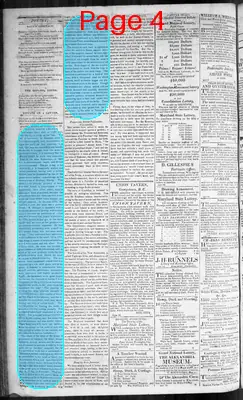
Story
November 19, 1822
Alexandria Gazette & Advertiser
Alexandria, Virginia
What is this article about?
Historical account of the Valenciana silver mine in Mexico, discovered in 1760 by M. Obregan and developed with partner Otero, yielding vast profits by 1804 despite harsh labor conditions and technical challenges.
Clipping
OCR Quality
98%
Excellent
Full Text
SILVER MINES OF VALENCIA, IN MEXICO, NORTH AMERICA.
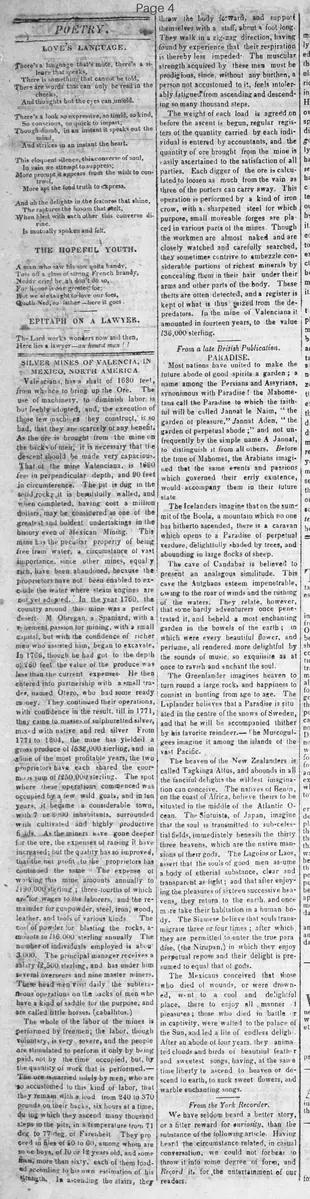
Valenciana, has a shaft of 1680 feet, from whence to bring up the Ore. The use of machinery, to diminish labor, is but feebly adopted, and, the execution of those few machines they construct, is so bad, that they are scarcely of any benefit. As the ore is brought from the mine on the backs of men, it is necessary that the descent should be made very spacious. That of the mine Valenciana, is 1680 feet in perpendicular depth, and 90 feet in circumference. The pit is dug in the solid rock; it is beautifully walled, and when completed, having cost a million dollars, may be considered as one of the greatest and boldest undertakings in the history even of Mexican Mining. This mine has the peculiar property of being free from water, a circumstance of vast importance, since other mines, equally rich, have been abandoned, because the proprietors have not been enabled to exclude the water where steam engines are not yet adopted. In the year 1760, the country around this mine was a perfect desert. M. Obregan, a Spaniard, with a vehement passion for mining, with a small capital, but with the confidence of richer men who assisted him, began to excavate. In 1766, though he had got to the depth of 260 feet, the value of the produce was less than the current expenses. He then entered into partnership with a small trader, named Otero, who had some ready money. They continued their operations, with confidence in the result, till in 1771, they came to masses of sulphuretted silver, mixed with native and red silver. From 1771 to 1804, the mine has yielded a gross produce of £538,000 sterling, and in some of the most profitable years, the two proprietors have each shared the enormous sum of £250,000 sterling. The spot where these operations commenced was occupied by a few wild goats, and in ten years, it became a considerable town, with 7 or 8000 inhabitants, surrounded with cultivated and highly productive fields. As the miners have gone deeper for the ore, the expenses of raising it have increased; but the quality has so improved, that the net profit to the proprietors has continued the same. The expense of working this mine amounts annually to £190,000 sterling; three-fourths of which are for wages to the laborers, and the remainder for gunpowder, steel, iron, wood, leather, and tools of various kinds. The cost of powder for blasting the rocks, amounts to £16,000 sterling annually. The number of individuals employed is about 3,000. The principal manager receives a salary £2,500 sterling, and has under him several overseers and nine master miners. These head men visit daily the subterranean operations on the backs of men who have a kind of saddle for the purpose, and are called little horses, (caballitos.) The whole of the labor of the mines is performed by freemen; the labor, though voluntary, is very severe, and the people are stimulated to perform it only by being paid, not by the time occupied, but, by the quantity of work that is performed. The ore is carried solely by men, who are so accustomed to this kind of labor, that they remain with a load from 240 to 370 pounds on their backs, six hours at a time, during which they ascend many thousand steps in the pits, in a temperature from 71 deg. to 77 deg. of Fahrenheit. They proceed in files of 50 to 60, among whom are some boys, of 10 or 12 years old, and some men, more than sixty, each of them loaded according to his own estimation of his strength. In ascending the stairs, they throw the body forward, and support themselves with a staff, about a foot long. They walk in a zig-zag direction, having found by experience that their respiration is thereby less impeded: The muscular strength acquired by these men must be prodigious, since, without any burthen, a person not accustomed to it, feels intolerably fatigued from ascending and descending so many thousand steps. The weight of each load is agreed on before the ascent is begun, regular registers of the quantity carried by each individual is entered by accountants, and the quantity of ore brought from the mine is easily ascertained to the satisfaction of all parties. Each digger of the ore is calculated to loosen as much from the vein as three of the porters can carry away. This operation is performed by a kind of iron crow, with a sharpened steel for which purpose, small moveable forges are placed in various parts of the mines. Though the workmen are almost naked and are closely watched and carefully searched, they sometimes contrive to embezzle considerable portions of richest minerals by concealing them in their hair under their arms and other parts of the body. These thefts are often detected, and a register is kept of what is thus seized from the depredators. In the mine of Valenciana it amounted in fourteen years, to the value 136,000 sterling.
Valenciana, has a shaft of 1680 feet, from whence to bring up the Ore. The use of machinery, to diminish labor, is but feebly adopted, and, the execution of those few machines they construct, is so bad, that they are scarcely of any benefit. As the ore is brought from the mine on the backs of men, it is necessary that the descent should be made very spacious. That of the mine Valenciana, is 1680 feet in perpendicular depth, and 90 feet in circumference. The pit is dug in the solid rock; it is beautifully walled, and when completed, having cost a million dollars, may be considered as one of the greatest and boldest undertakings in the history even of Mexican Mining. This mine has the peculiar property of being free from water, a circumstance of vast importance, since other mines, equally rich, have been abandoned, because the proprietors have not been enabled to exclude the water where steam engines are not yet adopted. In the year 1760, the country around this mine was a perfect desert. M. Obregan, a Spaniard, with a vehement passion for mining, with a small capital, but with the confidence of richer men who assisted him, began to excavate. In 1766, though he had got to the depth of 260 feet, the value of the produce was less than the current expenses. He then entered into partnership with a small trader, named Otero, who had some ready money. They continued their operations, with confidence in the result, till in 1771, they came to masses of sulphuretted silver, mixed with native and red silver. From 1771 to 1804, the mine has yielded a gross produce of £538,000 sterling, and in some of the most profitable years, the two proprietors have each shared the enormous sum of £250,000 sterling. The spot where these operations commenced was occupied by a few wild goats, and in ten years, it became a considerable town, with 7 or 8000 inhabitants, surrounded with cultivated and highly productive fields. As the miners have gone deeper for the ore, the expenses of raising it have increased; but the quality has so improved, that the net profit to the proprietors has continued the same. The expense of working this mine amounts annually to £190,000 sterling; three-fourths of which are for wages to the laborers, and the remainder for gunpowder, steel, iron, wood, leather, and tools of various kinds. The cost of powder for blasting the rocks, amounts to £16,000 sterling annually. The number of individuals employed is about 3,000. The principal manager receives a salary £2,500 sterling, and has under him several overseers and nine master miners. These head men visit daily the subterranean operations on the backs of men who have a kind of saddle for the purpose, and are called little horses, (caballitos.) The whole of the labor of the mines is performed by freemen; the labor, though voluntary, is very severe, and the people are stimulated to perform it only by being paid, not by the time occupied, but, by the quantity of work that is performed. The ore is carried solely by men, who are so accustomed to this kind of labor, that they remain with a load from 240 to 370 pounds on their backs, six hours at a time, during which they ascend many thousand steps in the pits, in a temperature from 71 deg. to 77 deg. of Fahrenheit. They proceed in files of 50 to 60, among whom are some boys, of 10 or 12 years old, and some men, more than sixty, each of them loaded according to his own estimation of his strength. In ascending the stairs, they throw the body forward, and support themselves with a staff, about a foot long. They walk in a zig-zag direction, having found by experience that their respiration is thereby less impeded: The muscular strength acquired by these men must be prodigious, since, without any burthen, a person not accustomed to it, feels intolerably fatigued from ascending and descending so many thousand steps. The weight of each load is agreed on before the ascent is begun, regular registers of the quantity carried by each individual is entered by accountants, and the quantity of ore brought from the mine is easily ascertained to the satisfaction of all parties. Each digger of the ore is calculated to loosen as much from the vein as three of the porters can carry away. This operation is performed by a kind of iron crow, with a sharpened steel for which purpose, small moveable forges are placed in various parts of the mines. Though the workmen are almost naked and are closely watched and carefully searched, they sometimes contrive to embezzle considerable portions of richest minerals by concealing them in their hair under their arms and other parts of the body. These thefts are often detected, and a register is kept of what is thus seized from the depredators. In the mine of Valenciana it amounted in fourteen years, to the value 136,000 sterling.
What sub-type of article is it?
Historical Event
Curiosity
What themes does it cover?
Triumph
Exploration
Fortune Reversal
What keywords are associated?
Silver Mine
Valenciana
Mexico Mining
Obregan Discovery
Labor Conditions
Ore Transport
Mining Profits
What entities or persons were involved?
M. Obregan
Otero
Where did it happen?
Valenciana, Mexico, North America
Story Details
Key Persons
M. Obregan
Otero
Location
Valenciana, Mexico, North America
Event Date
1760 To 1804
Story Details
M. Obregan began excavating the Valenciana mine in 1760 in a desert area; partnered with Otero in 1766; discovered rich silver veins in 1771; the mine yielded £538,000 sterling from 1771-1804 with annual expenses of £190,000 and 3,000 workers carrying ore on their backs in harsh conditions.