Thank you for visiting SNEWPapers!
Sign up free
Story
August 3, 1852
Alexandria Gazette
Alexandria, Alexandria County, District Of Columbia
What is this article about?
Mr. Winthrop's oration before Harvard Alumni critiques the American press's vast influence, warning of its potential for corruption and licentiousness while praising its power for good when guided by moral responsibility. Quotes English statesmen on press accountability. Published August 3, 1852.
Clipping
OCR Quality
98%
Excellent
Full Text
THE GAZETTE:
TUESDAY MORNING, AUGUST 3, 1852.
THE PRESS.
Mr. Winthrop, in his late oration before the Alumni of Harvard College, thus comments on the Press of America:
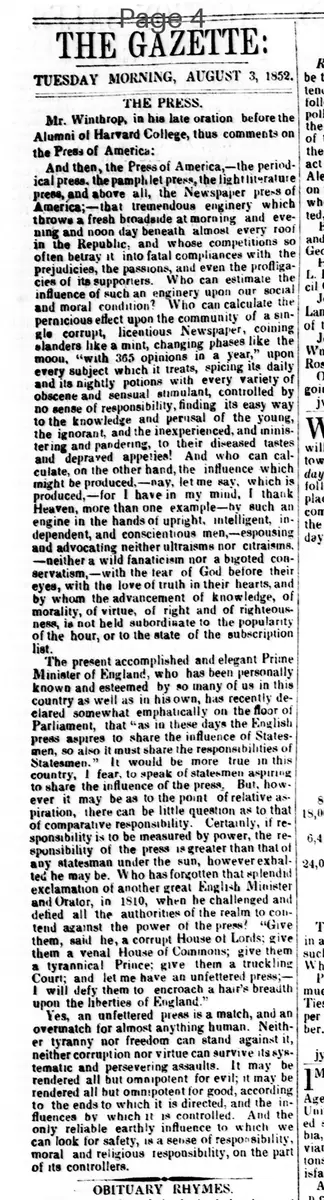
And then, the Press of America,—the periodical press, the pamphlet press, the light literature press, and above all, the Newspaper press of America;—that tremendous enginery which throws afresh broadside at morning and evening and noon day beneath almost every roof in the Republic, and whose competitions so often betray it into fatal compliances with the prejudices, the passions, and even the profligacies of its supporters. Who can estimate the influence of such an enginery upon our social and moral condition? Who can calculate the pernicious effect upon the community of a single corrupt, licentious Newspaper, coining slanders like a mint, changing phases like the moon, "with 365 opinions in a year," upon every subject which it treats, spicing its daily and its nightly potions with every variety of obscene and sensual stimulant, controlled by no sense of responsibility, finding its easy way to the knowledge and perusal of the young, the ignorant, and the inexperienced, and ministering and pandering, to their diseased tastes and depraved appetites! And who can calculate, on the other hand, the influence which might be produced,—nay, let me say, which is produced,—for I have in my mind, I thank Heaven, more than one example—by such an engine in the hands of upright, intelligent, independent, and conscientious men,—espousing and advocating neither ultraisms nor citraisms. —neither a wild fanaticism nor a bigoted conservatism,—with the fear of God before their eyes, with the love of truth in their hearts, and by whom the advancement of knowledge, of morality, of virtue, of right and of righteousness, is not held subordinate to the popularity of the hour, or to the state of the subscription list
"The present accomplished and elegant Prime Minister of England, who has been personally known and esteemed by so many of us in this country as well as in his own, has recently declared somewhat emphatically on the floor of Parliament, that "as in these days the Kinglist prods aspires to share the influence of Statesmen, so also it must share the responsibilities of Statesmen." It would be more true in this country, I fear, to speak of statesmen aspiring to share the influence of the press. But, however it may be as to the point of relative aspiration, there can be little question as to that of comparative responsibility. Certainly, if responsibility is to be measured by power, the responsibility of the press is greater than that of any statesman under the sun, however exalted he may be. Who has forgotten that splendid exclamation of another great English Minister and Orator, in 1810, when he challenged and defied all the authorities of the realm to contend against the power of the press! "Give them, said he, a corrupt House of Lords; give them a venal House of Commons; give them a tyrannical Prince: Give them a truckling Court; and let me have an unfettered press; I will defy them to encroach a hair's breadth upon the liberties of England."
Yes, an unfettered press is a match, and an overmatch for almost anything human. Neither tyranny nor freedom can stand against it, neither corruption nor virtue can survive its systematic and persevering assaults. It may be rendered all but omnipotent for evil; it may be rendered all but omnipotent for good, according to the ends to which it is directed, and the influences by which it is controlled. And the only reliable earthly influence to which we can look for safety, is a sense of responsibility, moral and religious responsibility, on the part of its controllers.
TUESDAY MORNING, AUGUST 3, 1852.
THE PRESS.
Mr. Winthrop, in his late oration before the Alumni of Harvard College, thus comments on the Press of America:
And then, the Press of America,—the periodical press, the pamphlet press, the light literature press, and above all, the Newspaper press of America;—that tremendous enginery which throws afresh broadside at morning and evening and noon day beneath almost every roof in the Republic, and whose competitions so often betray it into fatal compliances with the prejudices, the passions, and even the profligacies of its supporters. Who can estimate the influence of such an enginery upon our social and moral condition? Who can calculate the pernicious effect upon the community of a single corrupt, licentious Newspaper, coining slanders like a mint, changing phases like the moon, "with 365 opinions in a year," upon every subject which it treats, spicing its daily and its nightly potions with every variety of obscene and sensual stimulant, controlled by no sense of responsibility, finding its easy way to the knowledge and perusal of the young, the ignorant, and the inexperienced, and ministering and pandering, to their diseased tastes and depraved appetites! And who can calculate, on the other hand, the influence which might be produced,—nay, let me say, which is produced,—for I have in my mind, I thank Heaven, more than one example—by such an engine in the hands of upright, intelligent, independent, and conscientious men,—espousing and advocating neither ultraisms nor citraisms. —neither a wild fanaticism nor a bigoted conservatism,—with the fear of God before their eyes, with the love of truth in their hearts, and by whom the advancement of knowledge, of morality, of virtue, of right and of righteousness, is not held subordinate to the popularity of the hour, or to the state of the subscription list
"The present accomplished and elegant Prime Minister of England, who has been personally known and esteemed by so many of us in this country as well as in his own, has recently declared somewhat emphatically on the floor of Parliament, that "as in these days the Kinglist prods aspires to share the influence of Statesmen, so also it must share the responsibilities of Statesmen." It would be more true in this country, I fear, to speak of statesmen aspiring to share the influence of the press. But, however it may be as to the point of relative aspiration, there can be little question as to that of comparative responsibility. Certainly, if responsibility is to be measured by power, the responsibility of the press is greater than that of any statesman under the sun, however exalted he may be. Who has forgotten that splendid exclamation of another great English Minister and Orator, in 1810, when he challenged and defied all the authorities of the realm to contend against the power of the press! "Give them, said he, a corrupt House of Lords; give them a venal House of Commons; give them a tyrannical Prince: Give them a truckling Court; and let me have an unfettered press; I will defy them to encroach a hair's breadth upon the liberties of England."
Yes, an unfettered press is a match, and an overmatch for almost anything human. Neither tyranny nor freedom can stand against it, neither corruption nor virtue can survive its systematic and persevering assaults. It may be rendered all but omnipotent for evil; it may be rendered all but omnipotent for good, according to the ends to which it is directed, and the influences by which it is controlled. And the only reliable earthly influence to which we can look for safety, is a sense of responsibility, moral and religious responsibility, on the part of its controllers.
What sub-type of article is it?
Historical Event
What themes does it cover?
Moral Virtue
What keywords are associated?
Press
Influence
Responsibility
Newspaper
Moral
America
Oration
What entities or persons were involved?
Mr. Winthrop
Where did it happen?
America
Story Details
Key Persons
Mr. Winthrop
Location
America
Event Date
1852
Story Details
Mr. Winthrop's oration critiques the American press's influence for good or evil, emphasizing the need for moral and religious responsibility among its controllers, with references to English statesmen on press power.