Thank you for visiting SNEWPapers!
Sign up free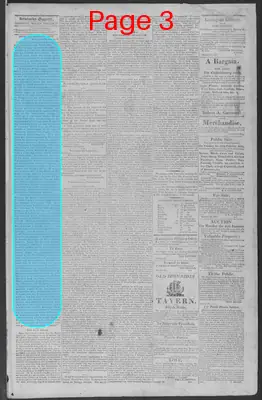
Kentucky Gazette
Lexington, Fayette County, Kentucky
What is this article about?
Congress debates bill to implement new US-Britain commerce treaty, reviving 1795 dispute over treaty powers vs. legislative authority. William Pinkney supports federalist view; John Randolph defends republican position favoring House supremacy. Bill expected to pass.
Clipping

OCR Quality
Full Text
Washington City, January 11.
The debates in Congress for two days past, have been very interesting. The bill for carrying the treaty of commerce with Great Britain into effect, has occupied the attention of the House. As the subject upon which the debate turns, involves a principle which deeply affects our liberty, it may not be altogether uninteresting to your patriotic readers to state the outlines of the subject.
When the British treaty, commonly called Jay's treaty, was ratified, as it contained principles contrary to the regulations of the American commercial laws, it was necessary, in order to the carrying of it into effect, either that those laws should be newly modeled by Congress, or that the treaty making power, confided by the constitution to the President and Senate, should be acknowledged paramount to the Legislative powers confided to Congress by the same constitution. The old federalists of that day, (commonly considered as advocates of executive power and anti-republican principles) warmly advocated the doctrine, that whatever treaty might be made conformably to the constitution, though it might go to the entire change of our commercial code, at once becoming the supreme law of the land, must of necessity bear down every previous law which it opposed; which was, in effect, to modify or repeal many of the laws of Congress, without the consent of the House of Representatives. This doctrine was warmly opposed by the republicans, as interfering with the constitutional prerogative of the representatives of the people, and introducing a principle dangerous to the rights of man. Mr. Madison, then a member of Congress, took a warm and leading part in the republican ranks. His doctrine, like that of the whole republican phalanx was, that no act of the Executive could oblige the constitutional power of Congress, to regulate commerce and levy duties on imports and tonnage, the last of which can originate only in the House of Representatives; that no provisions of a treaty, interfering with the laws of Congress on these points, can become binding without legislative interference to accommodate the laws to such provisions. The point was warmly contested, and the republican doctrine prevailed, which, it was believed, settled the question.
The treaty of commerce, just ratified involves the same necessity: and the President has laid it before Congress, for the purpose of obtaining their interference in such modification of the laws as it calls for. A bill to that effect has passed to its third reading: and on the question of its final passage, the old federal doctrine of '95, has been advanced, and warmly maintained in opposition to the bill. William Pinkney of Maryland, formerly minister plenipotentiary at London, delivered a lengthy and very animated speech, advocating the old federal doctrine. John Randolph, in opposition to Mr. Pinkney, has delivered two lengthy speeches on the subject, in both of which he warmly advocates the old republican doctrine. Since Mr. Randolph has succeeded in his election, it will be happy if he shall continue to run with the republicans, in the course which he has thus begun. Many were disappointed in the course which Mr. Pinkney takes in this case, but it is hoped he will generally be found with the republicans. You will perceive, that I avoid stating the consequences which I believe to be involved in the federal doctrine upon this subject, or the arguments which militate against it; but have only endeavored to lay the question open to the understanding of those who have paid but little attention to it. There remains no doubt of the passage of the bill, which will be another decision in favor of the omnipotence of the representative branch of our government, in the exercise of its constitutional powers. It is said, that Mr. Pinkney, though a republican, has long since committed himself upon this subject, by declaring his opinion with the federalists, even when Jay's treaty was before Congress; and it is well known, that Mr. Randolph has always been an avowed enemy of the exercise of any power, by either the President or Senate, when the most distant interpretation could give it to the House of Representatives. These considerations may account for the course which those two gentlemen take on this occasion.
What sub-type of article is it?
What keywords are associated?
What entities or persons were involved?
Where did it happen?
Domestic News Details
Primary Location
Washington City
Event Date
January 11
Key Persons
Outcome
bill expected to pass, affirming republican doctrine of legislative supremacy over treaty provisions conflicting with commerce laws.
Event Details
Debates in Congress on bill to modify laws for new US-Britain commerce treaty, echoing 1795 Jay's treaty dispute on treaty vs. legislative powers. Pinkney advocates federalist view; Randolph supports republican position requiring House consent.