Thank you for visiting SNEWPapers!
Sign up free
Letter to Editor
March 26, 1795
Gazette Of The United States And Daily Evening Advertiser
Philadelphia, Philadelphia County, Pennsylvania
What is this article about?
A letter to Mr. Fenno advocating for public schools funded by general taxes to educate all children, particularly the poor, arguing that government has a duty to promote knowledge essential for liberty, reducing crime and societal costs, while allowing sects to maintain their own institutions.
Clipping
OCR Quality
98%
Excellent
Full Text
For the Gazette of the United States.
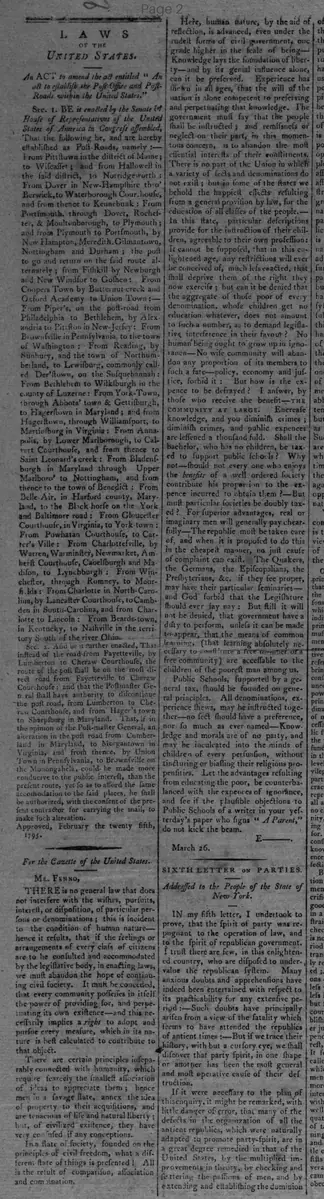
Mr. Fenno,
THERE is no general law that does not interfere with the wishes, pursuits, interest, or disposition, of particular persons or denominations; this is incident to the condition of human nature-- hence it results, that if the feelings or arrangements of every class of citizens are to be consulted and accommodated by the legislative body, in enacting laws, we must abandon the hope of continuing civil society. It must be conceded, that every community possesses in itself the power of providing for, and perpetuating its own existence-and this necessarily implies a right to adopt and pursue every measure, which in its nature is best calculated to contribute to that object.
There are certain principles inseparably connected with humanity, which require scarcely the smallest association of ideas to appreciate them; hence men in a savage state, annex the idea of property to their acquisitions, and are tenacious of life and natural liberty; but, of civilized existence, they have very confined if any conceptions.
In a state of society, founded on the principles of civil freedom, what a different state of things is presented! All is the result of comparison, association and combination.
Here, human nature, by the aid of reflection, is advanced, even under the rudest forms of civil government, one grade higher in the scale of being-- Knowledge lays the foundation of liberty-and by its genial influence alone, can it be preserved. Experience has shown in all ages, that the will of the nation is alone competent to preserving and perpetuating that knowledge. The government must say that the people shall be instructed; and remissness or neglect on their part, in this momentous concern, is to abandon the most essential interests of their constituents.
There is no part of the Union in which a variety of sects and denominations do not exist; but in some of the states we behold the happiest effects resulting from a general provision by law, for the education of all classes of the people.-- In this state, particular descriptions provide for the instruction of their children, agreeable to their own profession:
It cannot be supposed, that in this enlightened age, any restrictions will ever be conceived of, much less enacted, that shall deprive them of the right they now exercise; but can it be denied that the aggregate of those poor of every denomination, whose children get no education whatever, does not amount to such a number, as to demand legislative interference in their favour? No human being ought to grow up in ignorance-No wise community will abandon any proportion of its members to such a fate--policy, economy and justice, forbid it: But how is the expense to be defrayed? I answer, by those who receive the benefit-THE COMMUNITY AT LARGE. 'Encrease knowledge, and you diminish crimes; diminish crimes, and public expenses are lessened a thousand fold. Shall the bachelor, who has no children, be taxed to support public schools? Why not--should not every one who enjoys the benefits of a well ordered society contribute his proportion to the expense incurred to obtain them?--But must particular societies be doubly taxed? For superior advantages, real or imaginary men will generally pay cheerfully-The republic must be taken care of, and when it is proposed to do this in the cheapest manner, no just cause of complaint can exist. The Quakers, the Germans, the Episcopalians, the Presbyterians, &c. if they see proper, may have their particular seminaries-- and God forbid that the Legislature should ever say nay: But it will not be denied, that government have a duty to perform, unless it can be made to appear, that the means of common learning, (that learning absolutely necessary to constitute a free member or a free community) are accessible to the children of the poorest man among us.
Public Schools, supported by a general tax, should be founded on general principles. All denominations, experience shows, may be instructed together--no sect should have a preference, nor so much as ever named. Knowledge and morals are of no party, and may be inculcated into the minds of children of every persuasion, without tincturing or biasing their religious propensities. Let the advantages resulting from educating the poor, be counterbalanced with the expenses of ignorance, and see if the plausible objections to Public Schools of a writer in your yesterday's paper who signs "A Parent," do not kick the beam.
E.
March 26.
Mr. Fenno,
THERE is no general law that does not interfere with the wishes, pursuits, interest, or disposition, of particular persons or denominations; this is incident to the condition of human nature-- hence it results, that if the feelings or arrangements of every class of citizens are to be consulted and accommodated by the legislative body, in enacting laws, we must abandon the hope of continuing civil society. It must be conceded, that every community possesses in itself the power of providing for, and perpetuating its own existence-and this necessarily implies a right to adopt and pursue every measure, which in its nature is best calculated to contribute to that object.
There are certain principles inseparably connected with humanity, which require scarcely the smallest association of ideas to appreciate them; hence men in a savage state, annex the idea of property to their acquisitions, and are tenacious of life and natural liberty; but, of civilized existence, they have very confined if any conceptions.
In a state of society, founded on the principles of civil freedom, what a different state of things is presented! All is the result of comparison, association and combination.
Here, human nature, by the aid of reflection, is advanced, even under the rudest forms of civil government, one grade higher in the scale of being-- Knowledge lays the foundation of liberty-and by its genial influence alone, can it be preserved. Experience has shown in all ages, that the will of the nation is alone competent to preserving and perpetuating that knowledge. The government must say that the people shall be instructed; and remissness or neglect on their part, in this momentous concern, is to abandon the most essential interests of their constituents.
There is no part of the Union in which a variety of sects and denominations do not exist; but in some of the states we behold the happiest effects resulting from a general provision by law, for the education of all classes of the people.-- In this state, particular descriptions provide for the instruction of their children, agreeable to their own profession:
It cannot be supposed, that in this enlightened age, any restrictions will ever be conceived of, much less enacted, that shall deprive them of the right they now exercise; but can it be denied that the aggregate of those poor of every denomination, whose children get no education whatever, does not amount to such a number, as to demand legislative interference in their favour? No human being ought to grow up in ignorance-No wise community will abandon any proportion of its members to such a fate--policy, economy and justice, forbid it: But how is the expense to be defrayed? I answer, by those who receive the benefit-THE COMMUNITY AT LARGE. 'Encrease knowledge, and you diminish crimes; diminish crimes, and public expenses are lessened a thousand fold. Shall the bachelor, who has no children, be taxed to support public schools? Why not--should not every one who enjoys the benefits of a well ordered society contribute his proportion to the expense incurred to obtain them?--But must particular societies be doubly taxed? For superior advantages, real or imaginary men will generally pay cheerfully-The republic must be taken care of, and when it is proposed to do this in the cheapest manner, no just cause of complaint can exist. The Quakers, the Germans, the Episcopalians, the Presbyterians, &c. if they see proper, may have their particular seminaries-- and God forbid that the Legislature should ever say nay: But it will not be denied, that government have a duty to perform, unless it can be made to appear, that the means of common learning, (that learning absolutely necessary to constitute a free member or a free community) are accessible to the children of the poorest man among us.
Public Schools, supported by a general tax, should be founded on general principles. All denominations, experience shows, may be instructed together--no sect should have a preference, nor so much as ever named. Knowledge and morals are of no party, and may be inculcated into the minds of children of every persuasion, without tincturing or biasing their religious propensities. Let the advantages resulting from educating the poor, be counterbalanced with the expenses of ignorance, and see if the plausible objections to Public Schools of a writer in your yesterday's paper who signs "A Parent," do not kick the beam.
E.
March 26.
What sub-type of article is it?
Persuasive
Informative
Political
What themes does it cover?
Education
Economic Policy
Social Issues
What keywords are associated?
Public Schools
Education Policy
General Taxation
Poor Children
Government Duty
Knowledge Liberty
Crime Reduction
Religious Sects
What entities or persons were involved?
E.
Mr. Fenno
Letter to Editor Details
Author
E.
Recipient
Mr. Fenno
Main Argument
government must provide public schools funded by general taxes to educate all children, especially the poor, as knowledge is essential for liberty and reduces crime and societal costs, while allowing religious sects to maintain their own institutions without interference.
Notable Details
Contrasts Savage State With Civilized Society
Mentions Sects: Quakers, Germans, Episcopalians, Presbyterians
Responds To 'A Parent' From Previous Paper
Argues Bachelors And Childless Should Contribute Via Taxes