Thank you for visiting SNEWPapers!
Sign up free
Editorial
November 19, 1859
The Central Presbyterian
Richmond, Virginia
What is this article about?
A Presbyterian editorial critiques the Southern Churchman's claim that the Sandwich Islands mission illustrates the apostolic origins of Episcopacy. It argues that Episcopacy lacks direct apostolic warrant, challenges its assumptions, and contrasts it with Methodist Episcopacy adopted for expediency.
Clipping
OCR Quality
95%
Excellent
Full Text
"ORIGIN OF EPISCOPACY."
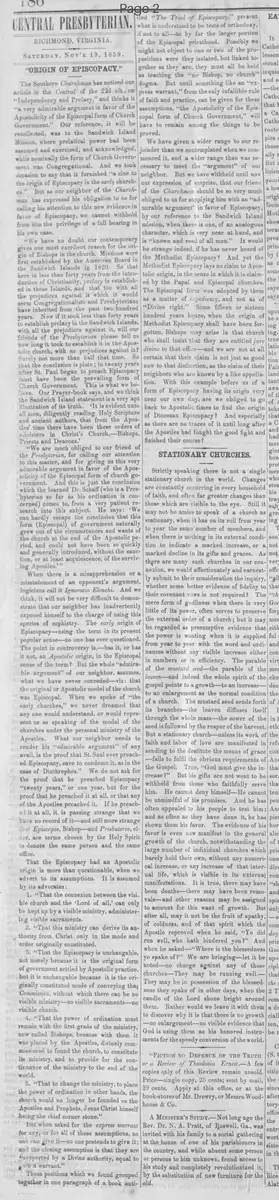
The Southern Churchman has noticed our article in the Central of the 22d ult., on "Independency and Prelacy," and thinks it "a very admirable argument in favor of the Apostolicity of the Episcopal form of Church Government." Our reference, it will be recollected, was to the Sandwich Island Mission, where prelatical power had been assumed and exercised, and acknowledged, while nominally the form of Church Government was Congregational. And we took occasion to say that it furnished "a clue to the origin of Episcopacy in the early churches." But as our neighbor of the Churchman has expressed his obligation to us for calling his attention to this new evidence in favor of Episcopacy, we cannot withhold from him the privilege of a full hearing in his own case.
"We have no doubt our contemporary gives one most excellent reason for the origin of Bishops in the church. Missions were first established by the American Board in the Sandwich Islands in 1820. So that here in less than forty years from the introduction of Christianity, prelacy is established in these Islands, and that too with all the prejudices against it which it would seem Congregationalists and Presbyterians have inherited from the past two hundred years. Now if it took less than forty years to establish prelacy in the Sandwich Islands, with all the prejudices against it, will our friends of the Presbyterian please tell us how long it took to establish it in the Apostolic church, with no prejudices against it? Surely not more than half that time. So that the conclusion is plain; in twenty years after St. Paul began to preach Episcopacy must have been the prevailing form of Church Government. This is what we believe. Our Prayer-book says, and we think the Sandwich Island statement is a very apt illustration of its truth. 'It is evident unto all men, diligently reading Holy Scripture and ancient authors, that from the Apostles' time there have been these orders of ministers in Christ's Church,—Bishops, Priests and Deacons.'
"We are much obliged to our friend of the Presbyterian, for calling our attention to this matter, and for giving us this very admirable argument in favor of the Apostolicity of the Episcopal form of church government. And this is just the conclusion which the learned Dr. Schaff (who is a Presbyterian so far as his ordination is concerned) comes to, from a very patient research into this subject. He says: We can hardly escape the conclusion that this form (Episcopal) of government naturally grew out of the circumstances and wants of the church at the end of the Apostolic period, and could not have been so quickly and generally introduced, without the sanction, or at least acquiescence, of the surviving Apostles.'"
When there is a misapprehension or a misstatement of an opponent's argument logicians call it Ignoratio Elenchi. And we think, it will not be very difficult to demonstrate that our neighbor has inadvertently exposed himself to the charge of using this species of sophistry. The early origin of Episcopacy—using the term in its present popular sense—no one has ever questioned. The point in controversy is.—has it, or has it not, an Apostolic origin, in the Episcopal sense of the term? But the whole "admirable argument" of our neighbor, assumes what we have never conceded viz: that the original or Apostolic model of the church was Episcopal. When we spoke of "the early churches," we never dreamed that any one would understand, or would represent us as speaking of the model of the churches under the personal ministry of the Apostles. What our neighbor needs to render his "admirable argument" of any avail, is the proof that St. Paul ever preached Episcopacy, save to condemn it, as in the case of Diotrephes." We do not ask for the proof that he preached Episcopacy "twenty years," or one year, but for the proof that he preached it at all, or that any of the Apostles preached it. If he preached it at all, it is passing strange that we have no record of it—and still more strange that Episcopos, Bishop—and Presbuteros, elder, are terms chosen by the Holy Spirit to denote the same person and the same office.
That the Episcopacy had an Apostolic origin is more than questionable, when we advert to its assumptions. It is assumed by its advocates:
1. "That the connexion between the visible church and the 'Lord of all,' can only be kept up by a visible ministry, administering visible sacraments."
2. "That this ministry can derive its authority from Christ only in the mode and order originally constituted."
3. "That the Episcopacy is unchangeable, not merely because it is the original form of government settled by Apostolic practice, but it is unchangeable because it is the originally constituted mode of conveying that Commission, without which there can be no visible ministry—no visible sacraments—no visible church"
4. "That the power of ordination must remain with the first grade of the ministry, now called Bishops, because with them it was placed by the Apostles, divinely commissioned to found the church, to constitute its ministry, and to provide for the continuance of the ministry to the end of the world."
5. "That to change the ministry, to place the power of ordination in other hands, the church would no longer be founded on the Apostles and Prophets, Jesus Christ himself being the chief corner stone."
But when asked for the express warrant for any, or for all of these assumptions, no one can give it—no one pretends to give it; and the closing assumption is that they are "supported by a Divine authority, equal to such a warrant."
These positions which we found grouped together in one paragraph of a book entitled "The Trial of Episcopacy," present what is understood to be tests of orthodoxy, if not to all—to by far the larger portion of the Episcopal priesthood. Possibly we might not object to one or two of the positions were they isolated, but linked together as they are, they must all be held as teaching the "no Bishop, no church" dogma. But until something like an "express warrant," from the only infallible rule of faith and practice, can be given for these assumptions, "the Apostolicity of the Episcopal form of Church Government," will have to remain among the things to be proved.
We have given a wider range to our rejoinder than we contemplated when we commenced it, and a wider range than was necessary to meet the "argument" of our neighbor. But we have withheld until now our expression of surprise, that our friend of the Churchman should be so very much obliged to us for supplying him with an "admirable argument" in favor of Episcopacy, by our reference to the Sandwich Island mission, when there is one, of an analogous character, which is very near at hand, and is "known and read of all men." It would be strange indeed, if he has never heard of the Methodist Episcopacy? And yet the Methodist Episcopacy lays no claim to Apostolic origin, in the sense in which it is claimed by the Papal and Episcopal churches. The Episcopal form was adopted by them as a matter of expediency, and not as of "Divine right." Some fifteen or sixteen hundred years hence, when the origin of Methodist Episcopacy shall have been forgotten, Bishops may arise in that church who shall insist that they are entitled jure divino to that office—and we are not at all certain that their claim is not just as good now to that distinction, as the claim of their neighbors who are known by a like appellation.
With this example before us of a form of Episcopacy having its origin very near our own day, are we obliged to go back to Apostolic times to find the origin of Diocesan Episcopacy? And especially as there are no traces of it until long after the Apostles had fought the good fight and finished their course?
The Southern Churchman has noticed our article in the Central of the 22d ult., on "Independency and Prelacy," and thinks it "a very admirable argument in favor of the Apostolicity of the Episcopal form of Church Government." Our reference, it will be recollected, was to the Sandwich Island Mission, where prelatical power had been assumed and exercised, and acknowledged, while nominally the form of Church Government was Congregational. And we took occasion to say that it furnished "a clue to the origin of Episcopacy in the early churches." But as our neighbor of the Churchman has expressed his obligation to us for calling his attention to this new evidence in favor of Episcopacy, we cannot withhold from him the privilege of a full hearing in his own case.
"We have no doubt our contemporary gives one most excellent reason for the origin of Bishops in the church. Missions were first established by the American Board in the Sandwich Islands in 1820. So that here in less than forty years from the introduction of Christianity, prelacy is established in these Islands, and that too with all the prejudices against it which it would seem Congregationalists and Presbyterians have inherited from the past two hundred years. Now if it took less than forty years to establish prelacy in the Sandwich Islands, with all the prejudices against it, will our friends of the Presbyterian please tell us how long it took to establish it in the Apostolic church, with no prejudices against it? Surely not more than half that time. So that the conclusion is plain; in twenty years after St. Paul began to preach Episcopacy must have been the prevailing form of Church Government. This is what we believe. Our Prayer-book says, and we think the Sandwich Island statement is a very apt illustration of its truth. 'It is evident unto all men, diligently reading Holy Scripture and ancient authors, that from the Apostles' time there have been these orders of ministers in Christ's Church,—Bishops, Priests and Deacons.'
"We are much obliged to our friend of the Presbyterian, for calling our attention to this matter, and for giving us this very admirable argument in favor of the Apostolicity of the Episcopal form of church government. And this is just the conclusion which the learned Dr. Schaff (who is a Presbyterian so far as his ordination is concerned) comes to, from a very patient research into this subject. He says: We can hardly escape the conclusion that this form (Episcopal) of government naturally grew out of the circumstances and wants of the church at the end of the Apostolic period, and could not have been so quickly and generally introduced, without the sanction, or at least acquiescence, of the surviving Apostles.'"
When there is a misapprehension or a misstatement of an opponent's argument logicians call it Ignoratio Elenchi. And we think, it will not be very difficult to demonstrate that our neighbor has inadvertently exposed himself to the charge of using this species of sophistry. The early origin of Episcopacy—using the term in its present popular sense—no one has ever questioned. The point in controversy is.—has it, or has it not, an Apostolic origin, in the Episcopal sense of the term? But the whole "admirable argument" of our neighbor, assumes what we have never conceded viz: that the original or Apostolic model of the church was Episcopal. When we spoke of "the early churches," we never dreamed that any one would understand, or would represent us as speaking of the model of the churches under the personal ministry of the Apostles. What our neighbor needs to render his "admirable argument" of any avail, is the proof that St. Paul ever preached Episcopacy, save to condemn it, as in the case of Diotrephes." We do not ask for the proof that he preached Episcopacy "twenty years," or one year, but for the proof that he preached it at all, or that any of the Apostles preached it. If he preached it at all, it is passing strange that we have no record of it—and still more strange that Episcopos, Bishop—and Presbuteros, elder, are terms chosen by the Holy Spirit to denote the same person and the same office.
That the Episcopacy had an Apostolic origin is more than questionable, when we advert to its assumptions. It is assumed by its advocates:
1. "That the connexion between the visible church and the 'Lord of all,' can only be kept up by a visible ministry, administering visible sacraments."
2. "That this ministry can derive its authority from Christ only in the mode and order originally constituted."
3. "That the Episcopacy is unchangeable, not merely because it is the original form of government settled by Apostolic practice, but it is unchangeable because it is the originally constituted mode of conveying that Commission, without which there can be no visible ministry—no visible sacraments—no visible church"
4. "That the power of ordination must remain with the first grade of the ministry, now called Bishops, because with them it was placed by the Apostles, divinely commissioned to found the church, to constitute its ministry, and to provide for the continuance of the ministry to the end of the world."
5. "That to change the ministry, to place the power of ordination in other hands, the church would no longer be founded on the Apostles and Prophets, Jesus Christ himself being the chief corner stone."
But when asked for the express warrant for any, or for all of these assumptions, no one can give it—no one pretends to give it; and the closing assumption is that they are "supported by a Divine authority, equal to such a warrant."
These positions which we found grouped together in one paragraph of a book entitled "The Trial of Episcopacy," present what is understood to be tests of orthodoxy, if not to all—to by far the larger portion of the Episcopal priesthood. Possibly we might not object to one or two of the positions were they isolated, but linked together as they are, they must all be held as teaching the "no Bishop, no church" dogma. But until something like an "express warrant," from the only infallible rule of faith and practice, can be given for these assumptions, "the Apostolicity of the Episcopal form of Church Government," will have to remain among the things to be proved.
We have given a wider range to our rejoinder than we contemplated when we commenced it, and a wider range than was necessary to meet the "argument" of our neighbor. But we have withheld until now our expression of surprise, that our friend of the Churchman should be so very much obliged to us for supplying him with an "admirable argument" in favor of Episcopacy, by our reference to the Sandwich Island mission, when there is one, of an analogous character, which is very near at hand, and is "known and read of all men." It would be strange indeed, if he has never heard of the Methodist Episcopacy? And yet the Methodist Episcopacy lays no claim to Apostolic origin, in the sense in which it is claimed by the Papal and Episcopal churches. The Episcopal form was adopted by them as a matter of expediency, and not as of "Divine right." Some fifteen or sixteen hundred years hence, when the origin of Methodist Episcopacy shall have been forgotten, Bishops may arise in that church who shall insist that they are entitled jure divino to that office—and we are not at all certain that their claim is not just as good now to that distinction, as the claim of their neighbors who are known by a like appellation.
With this example before us of a form of Episcopacy having its origin very near our own day, are we obliged to go back to Apostolic times to find the origin of Diocesan Episcopacy? And especially as there are no traces of it until long after the Apostles had fought the good fight and finished their course?
What sub-type of article is it?
Moral Or Religious
What keywords are associated?
Episcopacy
Apostolic Origin
Sandwich Islands
Presbyterian Debate
Methodist Episcopacy
Church Government
What entities or persons were involved?
Southern Churchman
Central Presbyterian
Sandwich Island Mission
St. Paul
Diotrephes
Dr. Schaff
Methodist Episcopacy
Editorial Details
Primary Topic
Debate On Apostolic Origins Of Episcopacy
Stance / Tone
Critical Of Episcopacy's Apostolic Claims
Key Figures
Southern Churchman
Central Presbyterian
Sandwich Island Mission
St. Paul
Diotrephes
Dr. Schaff
Methodist Episcopacy
Key Arguments
Early Origin Of Episcopacy Not Questioned, But Apostolic Origin In Episcopal Sense Is Disputed.
No Record Of Apostles Preaching Episcopacy; Terms Bishop And Elder Denote Same Office.
Episcopacy's Assumptions Lack Express Apostolic Warrant.
Sandwich Islands Example Shows Prelacy Arising From Circumstances, Not Divine Mandate.
Methodist Episcopacy Adopted For Expediency, Not Apostolic Origin, Analogous To Early Church Developments.