Thank you for visiting SNEWPapers!
Sign up free
The West End News
Frederiksted, Saint Croix County, Virgin Islands
What is this article about?
India's cashew nut industry is expanding rapidly, holding a near-monopoly in global trade. Plans to cultivate 75,000 acres in Kerala, Madras, and Andhra to boost production from 60,000 to 106,000 tons by 1960-61, reducing East African imports and achieving self-sufficiency within ten years. Exports earned $27 million in 1955-56, mainly to US and Britain.
Clipping
OCR Quality
Full Text
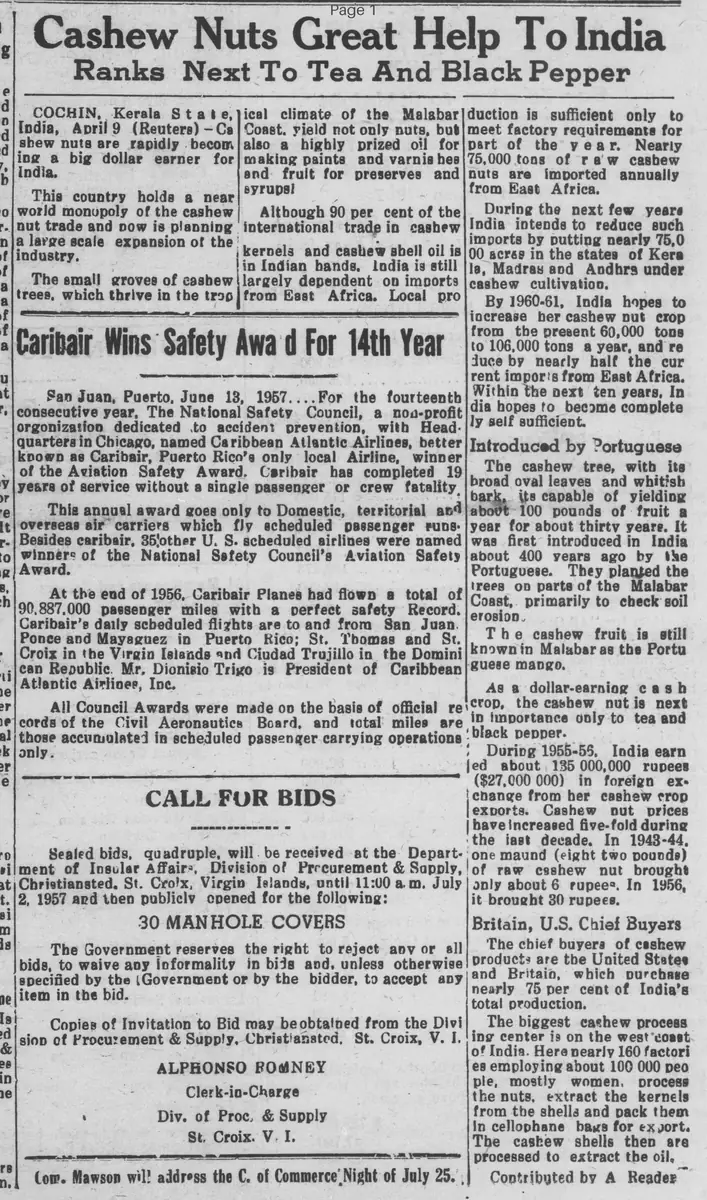
Ranks Next To Tea And Black Pepper
COCHIN, Kerala State, India, April 9 (Reuters) - Cashew nuts are rapidly becoming a big dollar earner for India.
This country holds a near world monopoly of the cashew nut trade and now is planning a large scale expansion of the industry.
The small groves of cashew trees, which thrive in the tropical climate of the Malabar Coast, yield not only nuts, but also a highly prized oil for making paints and varnishes and fruit for preserves and syrups.
Although 90 per cent of the international trade in cashew kernels and cashew shell oil is in Indian hands, India is still largely dependent on imports from East Africa. Local production is sufficient only to meet factory requirements for part of the year.
Nearly 75,000 tons of raw cashew nuts are imported annually from East Africa.
During the next few years India intends to reduce such imports by putting nearly 75,000 acres in the states of Kerala, Madras and Andhra under cashew cultivation.
By 1960-61, India hopes to increase her cashew nut crop from the present 60,000 tons to 106,000 tons a year, and reduce by nearly half the current imports from East Africa.
Within the next ten years, India hopes to become completely self sufficient.
Introduced by Portuguese
The cashew tree, with its broad oval leaves and whitish bark, is capable of yielding about 100 pounds of fruit a year for about thirty years. It was first introduced in India about 400 years ago by the Portuguese. They planted the trees on parts of the Malabar Coast, primarily to check soil erosion.
The cashew fruit is still known in Malabar as the Portuguese mango.
As a dollar-earning cashew crop, the cashew nut is next in importance only to tea and black pepper.
During 1955-56, India earned about 135,000,000 rupees ($27,000,000) in foreign exchange from her cashew crop exports. Cashew nut prices have increased five-fold during the last decade. In 1943-44, one maund (eighty-two pounds) of raw cashew nut brought only about 6 rupees. In 1956, it brought 30 rupees.
Britain, U.S. Chief Buyers
The chief buyers of cashew products are the United States and Britain, which purchase nearly 75 per cent of India's total production.
The biggest cashew processing center is on the west coast of India. Here nearly 160 factories employing about 100,000 people, mostly women, process the nuts, extract the kernels from the shells and pack them in cellophane bags for export.
The cashew shells then are processed to extract the oil.
Contributed by A Reader
What sub-type of article is it?
What keywords are associated?
Where did it happen?
Foreign News Details
Primary Location
Cochin, Kerala State, India
Event Date
April 9
Outcome
india plans to increase cashew nut production to 106,000 tons by 1960-61, reducing east african imports by half and achieving self-sufficiency within ten years; earned $27,000,000 in exports during 1955-56.
Event Details
India holds a near world monopoly in cashew nut trade and plans large-scale expansion by cultivating 75,000 acres in Kerala, Madras, and Andhra. Cashew trees, introduced by Portuguese 400 years ago on Malabar Coast, yield nuts, oil, and fruit. Currently imports 75,000 tons annually from East Africa; 90% of international trade in Indian hands. Chief buyers US and Britain (75% of production); 160 factories on west coast employ 100,000, mostly women. Cashew ranks next to tea and black pepper as dollar earner; prices increased five-fold in last decade.