Thank you for visiting SNEWPapers!
Sign up free
Weekly National Intelligencer
Washington, District Of Columbia
What is this article about?
Transcript of U.S. Senate debate on March 10, 1846, and following day, regarding the Oregon territory dispute with Britain. Senator Pearce presents a memorial from Maryland citizens urging peaceful compromise. Senator Reverdy Johnson advocates for accepting the 49th parallel boundary to avoid war, critiquing war hawks and emphasizing national honor in negotiation.
Clipping
OCR Quality
Full Text
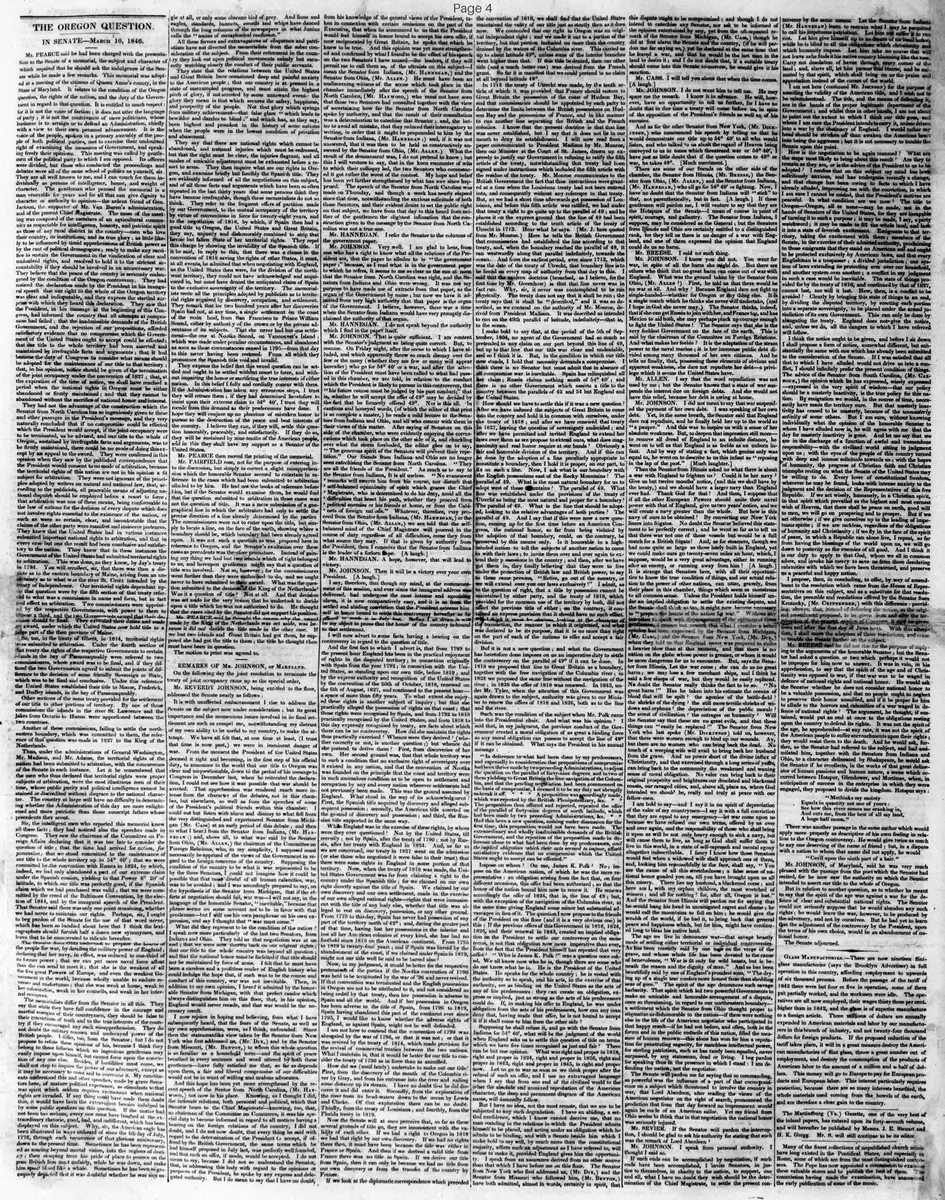
IN SENATE MARCH 10, 1846.
Mr. PEARCE said he had been charged with the presentation to the Senate of a memorial, the subject and character of which required that he should ask the indulgence of the Senate while he made a few remarks. This memorial was adopted at a meeting of the citizens of Queen Anne's county, in the State of Maryland. It relates to the condition of the Oregon question, the rights of the nation, and the duty of the Government in regard to that question. It is entitled to much respect: for it is not the voice of faction; it does not utter the language of party; it is not the contrivance of mere politicians, whose business is to arraign or to defend an Administration, chiefly with a view to their own personal advancement. It is the voice of the people, spoken in a primary assembly of the people of both political parties, met to exercise their undoubted right of examining the measures of Government, and speaking freely their opinions. This meeting was called by gentlemen of the political party to which I am opposed. Its officers were divided, but those who conducted the proceedings and debates were all of the same school of politics as yourself, sir. They are all well known to me, and I can vouch for them individually as persons of intelligence, honor, and weight of character. The gentleman who penned the memorial is a man venerable for years and for all that can give dignity to character or authority to opinion—the ardent friend of Gen. Jackson, the supporter of Mr. Van Buren's administration, and of the present Chief Magistrate. The mass of the meeting was composed of the members of an agricultural community as respectable for intelligence, honesty, and patriotic spirit as those of any rural district in the country—men who love their country, its institutions, and its true glory; as little likely to be influenced by timid apprehensions of British power as by the rant of political demagogues; ready to make any sacrifice to sustain the Government in the vindication of clear and undoubted rights, and resolved to hold it to the strictest accountability if they should be involved in an unnecessary war.
They believe that the peace of the country is seriously endangered by the condition of the Oregon controversy. They had noticed the declaration made by the President in his inaugural speech that our right to the whole of the Oregon territory was clear and indisputable, and they express the startled surprise with which they heard this declaration. They saw that the President, in his message at the beginning of this Congress, had informed the country that all attempts at compromise had failed; that the inadmissible demands of the British Government, and the rejection of our propositions, afforded satisfactory evidence that no compromise which the Government of the United States ought to accept could be effected; that our title to the whole territory had been asserted and maintained by irrefragable facts and arguments; that it had become the duty of Congress to consider what means should be adopted for the maintenance of our title to that territory; that, in his opinion, notice should be given of the termination of the joint occupancy under the convention of 1827; that, at the expiration of the time of notice, we shall have reached a period when the national rights in Oregon must be either abandoned or firmly maintained; and that they cannot be abandoned without the sacrifice of national honor and interest.
They had not the advantage of the construction which the Senator from North Carolina has so ingeniously given to these and other passages in the President's message, and they very naturally concluded that if no compromise could be effected which the President would accept, if the joint occupancy were to be terminated, as he advised, and our title to the whole of Oregon, sustained by irrefragable facts and arguments, was to be firmly maintained, there could be no mode of doing this except by an appeal to the sword. They were confirmed in this opinion when they saw by the published correspondence that the President would consent to no mode of arbitration, because the territorial rights of this nation are not in his opinion a fit subject for arbitration. They were not ignorant of the principles adopted by writers on natural and national law, that, according to the publicists, all peaceable means of adjusting national disputes should be employed before a resort to force; that arbitration was one of these means, being conformable to the law of nations for the decision of every dispute which does not involve rights essential to the existence of the nation, or such as were so certain, clear, and incontestable that the claims of the other party were manifest and insincere pretences.
They knew that the United States had in various instances submitted important national rights to arbitration, and that in every case but one the result had been conclusive and satisfactory to the nation. They knew that in these instances the Government of the United States had submitted territorial rights to arbitration. This was done, as they knew, by Jay's treaty in 1794. You will recollect, sir, that there was then a dispute as to the eastern boundary of Maine, arising from an uncertainty as to what was the river St. Croix intended by the treaty of Independence. Our territorial rights dependent upon that question were by the fifth section of that treaty referred to what was a commission in name and form, but in fact and effect an arbitration. Two commissioners were appointed by the respective Governments, with power to them to dispose a third, and the two Governments agreed that their decision should be final. They executed their duties and made an award, under which the United States now hold title to a large part of the then province of Maine.
So, too, in the treaty of Ghent, in 1814, territorial rights were submitted to arbitration. Under the fourth section of that treaty the rights of the respective Governments to certain islands in the bay of Passamaquoddy were referred to two commissioners, whose award was to be final, and if they differed the two Governments agreed to submit the points of difference to the decision of some friendly Sovereign or State, which was to be final and conclusive. Under this reference the United States established their title to Moose, Frederick, and Dudley islands, in the bay of Passamaquoddy. Other sections of the same treaty provided for the settlement of our title to other portions of territory. By one of these commissions the islands in the river St. Lawrence and the Lakes from Ontario to Huron were apportioned between the two countries. Another of these commissions, failing to settle the northeastern boundary, which was committed to them, the reference of that question was made in 1827 to the King of the Netherlands.
Thus, under the administrations of General Washington, Mr. Madison, and Mr. Adams, the territorial rights of the nation had been submitted to arbitration, with the concurrence of the Senate in each instance. Let it be remembered that the men who thus declared that territorial rights were proper subjects of arbitration, were the most illustrious men of their time, whose public purity and political intelligence cannot be stained or discredited without disgrace to the national character. The country at large will have no difficulty in determining whether the Administration of this day are more enlightened and more patriotic than those conscript fathers whose precedents they scout.
Sir, the intelligent men who reported this memorial knew all these facts; they had noticed also the speeches made in Congress. They saw the chairman of the Committee on Foreign Affairs declaring that it was too late to consider the question of title; that the time had arrived for action, for possession; that we stood committed to the maintenance of our title to the whole territory up to 54° 40'; that we were committed by the convention with Russia in 1824, by which, indeed, we had only abandoned a part of our extreme claim under the Spanish cession, yielding to that Power 6 20' of latitude, to which our title was perfectly good, if the Spanish claim which we had purchased was valid; that we were committed by the creed of the Baltimore Convention, by the election of 1844, and by the inaugural speech of the President. That Senator said there was only one point remaining, whether we had nerve to maintain our rights. Perhaps, sir, I ought to beg pardon of the Senate for the use of that word nerve, which has been so bandied about here that I think the lexicographers should furnish half a dozen new synonyms, and leave that to be consecrated to ridicule hereafter.
The Senator from Ohio undertook to prepare the hearts of the people for war, by deriding the military power of England; declaring that her navy, in effect, was reduced to one-third of its former power; that we can put more naval force afloat than she can send to meet it; that she is the weakest of all the five great Powers of Europe, and even the weakest Government in the world, because wholly unable to endure reverses and misfortunes; that she was weak at home, weak in her colonization, weak in her councils, and weak in her internal resources.
The memorialists differ from the Senator in all this. They say that while they have full confidence in the courage and martial energies of their countrymen and to the true interests they should be of the false coun- try if they encouraged any such misapprehension. They do not doubt the military renown and undecayed power of the British people. I differ, too, from the Senator; but I do not propose to refute these opinions of his, because I think they belong to those fallacies which an ingenious gentleman may easily impose upon himself, but cannot force upon the conviction of any one else. Besides, if hostilities must come, we shall not stop to inquire the power of our adversary, except as it may be necessary to resist and to overcome it. My constituents understood this and other speeches, made by grave Senators here, of mature political experience, as stimulants to that war spirit which seldom requires excitement when national rights are invaded. If any thing could have made them doubt this, it would have been the extravagant heroics indulged in by some public speakers on this question. If the matter had not been too serious, every one must have laughed at the extraordinary rhetoric on this subject good bad and indifferent which been illustrated in ways unheard of since the 4th day of July, 1776, through each recurrence of that glorious anniversary, down to the present time. Sometimes he has been represented as soaring beyond mortal vision, into the regions of destiny: then stooping from his pride of place to pounce on the poor British lion most unfairly, while he was down, and make him spout blood like a whale. Sometimes he has been so grotesquely depicted that it was doubtful whether he was any eagle at all, or only some obscene bird of prey. And lions and eagles, standards, banners, swords and whips have danced through the long columns of the newspapers in what Junius calls the "mazes of metaphorical confusion."
All these fervors and extravagances of eloquence and patriotism have not diverted the memorialists from the sober consideration of the subject. From their retirement in the country they look out upon political movements calmly but earnestly watching closely the conduct of their public servants. They state that the relations between the United States and Great Britain have occasioned deep and painful anxiety to the American people; that our country is at present in a state of unexampled progress, and must attain the highest pitch of glory, if not arrested by some untoward event: the glory they mean is that which secures the safety, happiness, and prosperity of the people. Not that glory which springs from military achievement—that false glare "which leads to bewilder and dazzles to blind;" and which has, as they say, been highest and proudest in the history of some nations when the people were in the lowest condition of privation and abasement.
They say that there are national rights which cannot be abandoned, and national injuries which must be redressed, but that the right must be clear, the injuries flagrant, and all modes of amicable adjustment must be exhausted before a resort to arms. They then inquire what are our rights in Oregon, and examine briefly but forcibly the Spanish title. They are evidently informed of all the negotiations on this subject, and of all those facts and arguments which have been so often repeated in the last thirty years that some persons think they have become irrefragable, though these memorialists do not so think. They refer to the frequent offers of partition made by our Government, to the mutual occupancy of the territory by virtue of conventions in force for twenty-eight years, and to the negotiation of 1818, by which, if Spain then had a good title to Oregon, the United States and Great Britain, they say, unjustly and dishonorably combined to strip that heroic but fallen State of her territorial rights. They repel this charge by showing the invalidity of the Spanish title. If it be said, in reply to this, that there was a clause in the convention of 1818 saving the rights of other States, it must, at all events, be admitted that when negotiating with England, as the United States then were, or the division of the northwest territory, they could not have acknowledged and acquiesced in, but must have denied the antiquated claim of Spain to the exclusive sovereignty of the territory. The memorialists recite all the principles adopted by publicists as to territorial rights acquired by discovery, occupation, and settlement. They remark that for two hundred years after her discoveries Spain had not, at any time, a single settlement on the coast of the main land, from San Francisco to Prince William Sound, either by authority of the crown or by the private adventures of its subjects. That she never had but one settlement—the one at Nootka Sound, on Vancouver's Island which was made under peculiar circumstances, and abandoned as soon as these circumstances ceased in 1795—from that day to this never having been restored. From all which they pronounce the Spanish title void and invalid.
They express the belief that this vexed question can be settled and ought to be settled without resort to force, and without impairing the honor or sacrificing the true interests of either nation. In this belief I fully and cordially concur with them. If the Administration has taken any erroneous steps, I trust they will retrace them; if they had determined heretofore to insist upon their extreme claim to 54 40', I trust they will recede from this demand as their predecessors have done. I hope they will conjure up no phantom of mistaken honor to pursue to the destruction of the peace and best interests of the country. I believe they can, if they will, settle this question honorably, peaceably, and satisfactorily. If they do so, they will be sustained by nine-tenths of the American people, and in this they shall have my support as a Senator of the United States.
Mr. PEARCE then moved the printing of the memorial. Mr. FAIRFIELD rose, not for the purpose of entering into the discussion, but simply to correct a slight misapprehension which the honorable Senator seemed to entertain in reference to the cases which had been submitted to arbitration alluded to by him. He had not the books of reference before him, but if the Senator would examine them, he would find that the question submitted to arbitration in those cases was not the question of title. It was a mere submission of a geographical line in which the arbitrators had only to settle the precise direction of a line already determined by the parties. The commissioners were not to enter upon the title, but simply to locate a line, on the face of the earth, showing where a boundary should be, which boundary had been already agreed upon. It was not such a question as was proposed here in reference to Oregon, and the Senator's exultation over these cases as precedents was therefore premature. Instead of gaining any thing we had lost two islands which of right belonged to us, and hereupon gentlemen might say that a question of title was involved. Not so, however; for the commissioners went further than they were authorized to do, and we ought never to have submitted to their award. What was the question submitted to the decision of the King of the Netherlands? Was it a question of title? Not at all. And that decision was set aside for the very reason that he undertook to decide upon a title which he was not authorized to do. He thought that the cases cited by the Senator did not support his position.
Mr. PEARCE said he thought the reason why the award made by the King of the Netherlands was set aside, was because it did not decide the title made in the other case. If we lost two islands and Great Britain had got them, he supposed she had got the title to them; the title he thought then must have been in question.
The motion to print was agreed to.
REMARKS OF Mr. JOHNSON, OF MARYLAND.
On the following day the joint resolution to terminate the treaty of joint occupancy came up as the special order, Mr. REVERDY JOHNSON, being entitled to the floor, addressed the Senate nearly as follows:
It is with unaffected embarrassment I rise to address the Senate on the subject now under consideration; but its great importance and the momentous issues involved in its final settlement are such as compel me, notwithstanding my distrust of my own ability to be useful to my country, to make the attempt. We have all felt that, at one time at least, (I trust that time is now past,) we were in imminent danger of war. From the moment the President of the United States deemed it right and becoming, in the first step of his official duty, to announce to the world that our title to Oregon was clear and unquestionable, down to the period of his message to Congress in December last, when he reiterated the declaration, I could not see how it was possible that war should be averted. That apprehension was rendered much more intense from the character of the debates, not in this chamber, but elsewhere, as well as from the speeches of some of the President's political friends within this chamber. I could not but listen with alarm and dismay to what fell from the very distinguished and experienced Senator from Michigan (Mr. Cass) at an early period of this debate; and then to what I hear from the Senator from Indiana, (Mr. HANNEGAN;) and, above all, to what was said by the Senator from Ohio, (Mr. ALLEN,) the chairman of the Committee on Foreign Relations, who, in my simplicity, I supposed must necessarily be apprized of the views of the Government in regard to the foreign concerns of the country. Supposing the condition of the country to be what it was represented to be by the three Senators, I could not imagine how it could be possible that that most direful of all human calamities, war, was to be avoided: and I was accordingly prepared to say, on the hypothesis of the Senator from Michigan, that if the efforts at negotiation should fail, war was—I will not say, in the language of the honorable Senator, "inevitable,"because that phrase seems on some account not to be in favor with that gentleman—but I will use his own paraphrase on his own expression, and say I thought that "war must come."
What did they represent to be the condition of the nation? I speak now more particularly of the last two Senators, from Indiana and Ohio. They told us that negotiation was at an end; that we were now thrown back on our original rights; that our title to the whole country was beyond all question; and that the national honor must be forfeited if that title should not be maintained by force of arms. I felt that he must have been a careless and a profitless reader of English history who could indulge the hope that, if such was to be the course and conduct of this country, war was not inevitable. Then, in addition to my own opinion, I heard it admitted by the honorable Senator from Michigan, with that perfect candor which always distinguishes him on this floor, that, in his opinion, England would never recede, and that war would be the necessary result.
I now rejoice in hoping and believing, from what I have subsequently heard, that the fears of the Senate, as well as my own apprehensions, were, as I think, unfounded. Since then the statesmanlike view taken by the Senator from New York who first addressed us, (Mr. Dix,) and by the Senator from Missouri, (Mr. BENTON,) to whom this whole question is as familiar as a household term—and the spirit of peace breathed in every sentence and word uttered by both these gentlemen—have fully satisfied me that, so far as depends upon them, a fair and liberal compromise of our difficulties would not be in want of willing and zealous advocates. And this hope has been yet more strengthened by the recent speech of the Senator from North Carolina, (Mr. HAYWOOD, not now in his place.) Knowing, as I thought I did, the intimate relations, both personal and political, which that Senator bears to the Chief Magistrate—knowing, too, that, as chairman of the Committee on Commerce, it was his special duty to become informed in regard to all matters having a bearing on the foreign relations of the country, I did not doubt, and I do not now doubt, that every thing he said with regard to the determination of the President to accept, if offered by the British Government, the same terms which he had himself proposed in July last, was perfectly well founded, and that such an offer, if made, would be accepted. I do not mean to say, because I did not so understand the Senator, that, in addressing this body with regard to the opinions or purposes of the President, he spoke by any express and delegated authority. But I do mean to say that I have no doubt, from his knowledge of the general views of the President, taken in connexion with certain omissions on the part of the Executive, that when he announced to us that the President would feel himself in honor bound to accept his own offer, if now reciprocated by Great Britain, he spoke that which he knew to be true. And this opinion was yet more strengthened and confirmed by what I found to be the effect of his speech on the two Senators I have named—the leaders, if they will permit me to call them so, of the ultraists on this subject—I mean the Senator from Indiana, (Mr. HANNEGAN,) and the Senator from Ohio, (Mr. ALLEN.) He must have been an undiscerning witness of the scene which took place in this chamber immediately after the speech of the Senator from North Carolina, (Mr. HAYWOOD,) who must not have seen that those two Senators had consulted together with the view of ascertaining how far the Senator from North Carolina spoke by authority, and that the result of their consultation was a determination to catechise that Senator; and, the better to avoid all mistake, that they reduced their interrogatory to writing, in order that it might be propounded to him by the Senator from Indiana, (Mr. HANNEGAN;) and, if it was not answered, that it was then to be held as constructively answered by the Senator from Ohio, (Mr. ALLEN.) What the result of the denouement was, I do not pretend to know; but this I will venture to say, that in the keen encounter of wits to which their colloquy led, the two Senators who commenced it got rather the worst of the contest. My hope and belief has been yet further strengthened by what has now since happened. The speech of the Senator from North Carolina was made on Thursday, and though a week has nearly elapsed since that time, notwithstanding the anxious solicitude of both those Senators, and their evident desire to set the public right on that subject, we have from that day to this heard from neither of the gentlemen the slightest intimation that the construction given to the message by the Senator from North Carolina was not a true one.
Mr. HANNEGAN. I refer the Senator to the columns of the government paper.
Mr. JOHNSON. Very well. I am glad to hear, from one who has a right to know what all the relations of the President are, that the paper he alludes to is "the government paper?" because, as I read what is in the government paper to which he refers, it seems to me as clear as the sun at noon that the Senator from North Carolina was right, and the Senators from Indiana and Ohio were wrong. It was not my purpose to have made use of extracts from that paper, as the organ of the Government by name; but now we have it admitted from very high authority that that paper is the organ of the Government. I believe, however, there was a time when the Senator from Indiana would have very promptly disclaimed the authority of that organ.
Mr. HANNEGAN. I do not speak beyond the authority which I find in the paper itself.
Mr. JOHNSON. That is quite sufficient. I am content with the Senator's judgment as being quite correct. But, to resume. On Friday night, after the scene to which I have alluded, and which apparently threw so much dismay over the few or the many (whether they are few or many will appear hereafter) who go for 54° 40' or a war, and after the attention of the President must have been called to what had passed in this chamber, we are told, in relation to the conduct which the President is likely to pursue in this controversy, that "his future course must be judged by his past conduct;" that is, whether he will accept the offer of 49 may be decided by the fact that he formerly offered 49°. Nor is this all. In cautious and honeyed words, (of which the editor of that print is so complete a master,) he reads a mild lecture to the Senators from Indiana and Ohio, and all who concur with them in their views of this matter. After saying of Senators on this side of the chamber, who were evidently enjoying the corruscations which took place on the other side of it, and chuckling over what the storm foreboded, the editor goes on to say, "The generous spirit of the Senators will prevent their repetition." Our friends from Indiana and Ohio are no longer seen catechising the Senator from North Carolina. "They are all the friends of the President." As much as to say to the Senator from Indiana, It is all useless. "No evanescent remarks will swerve him from his course, nor disturb that 'self-balanced equanimity of spirit which graces the Chief Magistrate, who is determined to do his duty, amid all the difficulties that beset his path, whether they proceed from political enemies or his friends at home, or from the Cabinets of foreign nations."
Whatever, therefore, may proceed from the Senator from Indiana, (Mr. HANNEGAN,) or the Senator from Ohio, (Mr. ALLEN,) we are told that the self-balanced mind of the Chief Magistrate will proceed in the course of duty regardless of all difficulties, come they from what source they may. If that is given by authority from the President, then I conceive that the Senator from Indiana is the leader of a forlorn hope. [A laugh.]
Mr. HANNEGAN. A hope, however, that will lead to victory.
Mr. JOHNSON. Then it will be a victory over your own President. [A laugh.]
I say, therefore, that though my mind, at the commencement of this session, and ever since the inaugural address was delivered, had undergone the most intense and agonizing alarm, it is now comparatively easy, and it is so from the settled and abiding conviction that the President esteems himself in honor bound to settle this controversy hereafter as he offered to settle it in July last. Before I sit down it will be my object to prove that the honor of the country is bound to that settlement.
I will now advert to some facts having a bearing on the controversy in regard to the question of title. And the first fact to which I advert is, that from 1789 to the present hour England has been in the practical enjoyment of rights in the disputed territory; in connexion originally with Spain from the year 1792; in connexion with the United States, as standing upon our own title, before 1819; and by the express authority and recognition of the United States by the convention of the 20th of October, 1818, renewed on the 6th of August, 1827, and continued to the present hour— a space of more than fifty years. To what extent she enjoyed these rights is another subject of inquiry; but that she practically alleged the possession of rights on that coast; that those rights were recognised by Spain, and from 1792 to 1818 practically recognised by the United States, and from 1818 to this day expressly recognised by treaty, are facts about which there can be no controversy. How did she maintain the rights thus practically exercised? Whence were they derived? (whether correctly or not, is another question;) but whence did she pretend to derive them? First, from discoveries of her own. Her second ground was, that that whole territory was in such a condition that no exclusive right of sovereignty over it existed in any nation, and that the convention of Nootka was founded on the principle that the coast and territory were in such anomalous condition as to be open to settlement and occupation by any and every nation wherever settlements had not previously been made. This was the ground assumed by England. What stood in the way of its acknowledgment? First, the Spanish title acquired by discovery and alleged subsequent possession; secondly, the American title asserted on the ground of discovery and possession; and third, the Russian title supported in the same way.
While England was in the exercise of these rights, by whom were they ever questioned? Not by the United States, till recently; not by Spain, after the treaty of 1790; not by Russia, after her treaty with England in 1824. And, as far as we are concerned, our treaty in 1827 went on the admission (or else those who negotiated it were false to their trust) that there were some rights in England in some portion of that territory. Now, when the treaty of 1818 was made, the United States Government was far from claiming a right to the country under the Spanish title; for we claimed on our own right directly against the title of Spain. We claimed by our own discovery and our own settlement, made in the exercise of our own alleged national rights—rights that were inconsistent with the title of any body else, whether that title was alleged to rest on discovery, possession, or any other ground. From 1775 to this day, Spain has never had possession of any part of the territory north of 42°; and, during the greater part of that time, having lost her possessions in the interior and lost all her American colonies of every kind, she has had no foothold since 1819 on the American continent. From 1795 to 1819 is twenty-four years; and if Spain was barred by the abandonment of the coast, if we claimed under Spain in 1819, might not our title well be said to be barred also?
Now, in my judgment, it would be better for the respective pretensions of the parties if the Nootka convention of 1790 was held to be terminated by the war of '96 and never revived. If that convention was terminated and the English possessions in Oregon are not to be attributed to it, and not considered as being ceded by that treaty, then her possession is adverse to Spain and all the world. And if her possession in Oregon has been adverse to the title of Spain, from 1796 to 1819, Spain having abandoned this part of the continent ever since 1795, I would like to know whether the adverse rights of England, as against Spain, might not be well defended.
I am not here to contend that the convention of 1790 was abrogated by the war of 1796, or that it was not; or that it was revived by the treaty of 1814, which made provision for the revival of commercial treaties between the two nations. What I maintain is, that it would be better for our title to consider the treaty of 1790 as in force than as annulled.
How did we (until lately) undertake to make out our title? First, from the discovery of the mouth of the Columbia river by Gray, and from his entrance into the river and sailing some distance up its stream. I have no doubt that he did discover it and did enter it. Secondly, from the exploration of the river from its head-waters down to the ocean by Lewis and Clarke. Of that exploration there can be no doubt. Thirdly, from the treaty of Louisiana; and fourthly, from the Florida treaty in 1819.
Now the Senate will at once perceive that, so far as these several grounds of title go, they are inconsistent with the validity of each other. If we had a right to Oregon in 1818 we had that right by our own discovery. If we had no rights there then, it must have been because the title was either in France or Spain. And then if we derived a valid title from France there was no title in Spain. If we derive our title from Spain, then it can only be because we had no title from our own discovery or from the transfer of the country by France.
If we look at the diplomatic correspondence which preceded the convention of 1818. we shall find that the United States maintained the validity of our title just as stoutly then as it does now. We contended that our right to Oregon was an original independent right; and we made it out to a portion of the territory, but that portion included no more than the country drained by the waters of the Columbia river. This carried us up to about latitude 49°, unless some of the interior branches went higher than that. If this title be denied, then our other title (and a much better one) was derived from the French grant. So far it is manifest that we could pretend to no claim at all beyond latitude 49°.
In 1713 the treaty of Utrecht was made, by the tenth article of which it was provided that France should restore to Great Britain the possession of the coast of Hudson Bay, and that commissaries should be appointed by each party to determine the limits between the British possessions on Hudson Bay and the possessions of France, and in like manner to run another line separating the British and the French colonies. I know that the present doctrine is that that line was never established, but I say that it does not lie in our mouth to deny its establishment. I will now read from a paper communicated to President Madison by Mr. Monroe, then our Minister at the Court of St. James, drawn up expressly to justify our Government in refusing to ratify the fifth article of the treaty, notwithstanding that treaty had been signed under instructions which included the fifth article with the residue of the treaty. Mr. Monroe communicates to the British Government the fact that those instructions were granted at a time when the Louisiana treaty had not been entered into, and consequently without any reference to that treaty. But, as we had a short time afterwards got possession of Louisiana, and before this fifth article was ratified, we had under that treaty a right to go quite up to the parallel of 49; and he places it on the express ground that the line of 49 had been established according to the tenth article of the treaty of Utrecht in 1713. Hear what he says. [Mr. J. here quoted from Mr. Monroe.] Here he tells the British Government that commissaries had established the line according to that treaty, and, when the boundary reached the parallel of 49, it ran westwardly along that parallel indefinitely, towards the ocean. And from the earliest period, ever since 1713, which was the date of the treaty of Utrecht, that boundary line is to be found on every map of authority from that day to this. I said that the modern doctrine (broached, as I believe, for the first time by Mr. Greenhow) is that that line never was in fact run. Why, sir, it never was contemplated to be run physically. The treaty does not say that it shall be run; the treaty says that it shall be "described," and it was so described, as we contend on the authority of Mr. Monroe, derived from President Madison. It was described as intended to run on the 49th parallel of latitude, indefinitely—that is, to the ocean.
I make bold to say that, at the period of the 5th of September, 1804, no agent of the Government had so much as pretended to any claim on our part beyond this line of 49, but up to that line that our title was clear and undeniable, and so I think it is. But, in the condition in which our title now stands, I hold that necessity demands a compromise. I think there is no Senator but must admit that in absence of all compromise war is inevitable. Spain has relinquished all her claim; Russia claims nothing south of 54° 40'; and there is no other Government which asserts a title to the country between the parallels of 49 and 54 but England and the United States.
How should we have to settle this if it was a new question? After we have induced the subjects of Great Britain to come into the country and hold it in common with ourselves, under the treaty of 1818; and after we have renewed that treaty in 1827, leaving the question of sovereignty undecided; and after we have permitted and invited England to extend her laws over them as we propose to extend ours, what does magnanimity and real honor require at our hands? Obviously a fair and honorable division of the territory. And if this can be done by the adoption of a line peculiarly appropriate to constitute a boundary, then I hold it is proper, on our part, to fix on such a line. Now, I ask what is our boundary with the English possessions east of the Rocky Mountains? The parallel of 49. What is the most natural boundary for us to adopt west of those mountains? The parallel of 49. What line was established under the provisions of the treaty of Utrecht as being the most natural and proper for a boundary? The parallel of 49. What is the line that should be adopted, looking to the relative advantages of both parties? The parallel of 49. And I say that if this were now a new question, coming up for the first time before an American Congress, the national honor, so far from being violated by the adoption of that boundary could, on the contrary, be preserved by this means only.
Is it honorable in a high-minded nation to tell the subjects of another nation to come in with their laws; to invite them over and over again to extend their possessions in the country; and then, after we have got them in, they fondly believing that they were to live under the protection of British law and British power, to say to those same persons, "Retire, go out of the country, or we will extend over you our laws exclusively!" I admit, as to the question of right, that a title by possession cannot be maintained by either party, and the treaty of 1818, which provided for the common use of the territory by both, did not affect the previous title of either; on the contrary, it contained an express provision that it should have no such effect. I think it must be obvious, looking at the character of the transaction, the manner in which it originated, and what was declared to be its purpose, that it is no more than right on the part of each of the nations to offer and accept a fair division.
But it is not a new question; and what the Government has heretofore done imposes on us an imperative duty to settle the controversy on the parallel of 49 if it can be done. In 1818 we proposed that line to Great Britain as a boundary, together with the free navigation of the Columbia river; in 1824 we proposed the same line without the navigation of the river; in 1826 the offer of 1818 was renewed. In 1843, under Mr. Tyler, when the attention of this Government was again drawn to the subject, authority was given to our Minister to renew the offers of 1818 and 1826, both as to the line and the river. Such was the condition of the subject when Mr. Polk came into the Presidential chair. And what was his opinion? I said that, in my judgment, the previous conduct of the Government created a moral obligation of as great a binding force as any moral obligation can possess to accept the line of 49 if it can be obtained. What says the President in his annual message:
"In deference to what had been done by my predecessors, and especially in consideration that propositions of compromise had been thrice made by two preceding Administrations, to adjust the question on the parallel of forty-nine degrees, and in two of them yielding to Great Britain the free navigation of the Columbia, and that the pending negotiation had been commenced on the basis of compromise, I deemed it to be my duty not abruptly to break it off. A proposition was accordingly made, which was rejected by the British Plenipotentiary, &c. The proposition thus offered and rejected, repeated the offer of the parallel of forty-nine degrees of north latitude, which had been made by two preceding Administrations, &c. Had this been a new question, coming under discussion for the first time, this proposition would not have been made. The extraordinary and wholly inadmissible demands of the British Government, and the rejection of the proposition made in deference alone to what had been done by my predecessors, and the implied obligation which their acts seemed to impose, afford satisfactory evidence that no compromise which the United States ought to accept can be effected."
Impose on whom? On me, James K. Polk? No; impose on the American nation, of which he was the mere representative: an obligation arising from the fact that, on four different occasions, this offer had been authorized; so that the honor of the nation bound him now to renew it. He renews accordingly the offer of 1824, that is, the line of 49; but, with the exception of the navigation of the Columbia river, at the same time giving England some minor but substantial advantages in lieu of it. The question I now propose to the friends of the President on this floor (and it is a very obvious one) is this: If the previous offers of this Government in 1818, 1824, 1826, and their renewal in 1843, created an implied obligation on the President to settle our controversy on the same terms, is not that obligation now more imperative than ever, from the fact that the President himself has repeated that very offer? "Who is James K. Polk?" was a question once asked. We all know now who he is, though there are some who do not know what he is. He is the President of the United States. He speaks for the whole country; he is vested with the authority so to speak, and his acts, in the exercise of that authority, are as binding on the United States as the acts of any of his predecessors: they can create an obligation, express or implied, just as strong as the acts of his predecessors could do. If, in making his offer to England, he was under obligation from the acts of his predecessors, how can any man deny that, having made that offer, he is not bound to accept it if it shall come to him from the other side?
Supposing he shall refuse it, and go with the Senator from Indiana for 54 40', what will be the judgment of the world when England asks us to settle this question of title on terms which we have five times recognised as just and fair? There can be but one opinion. What was right and proper in 1818, right and proper in 1824, right and proper in 1826, right and proper in 1843, right and proper in 1845, is right and proper now. Let us go to war as soon as we think proper after the refusal of such an offer, and I use no extravagant language when I say that from one end of the civilized world to the other the absolute and unmixed reprobation of the American character, the deep and permanent disgrace of the American name, will assuredly follow.
But I have no idea, not the most remote, that we are to be subjected to any such degradation. I have an abiding, a settled confidence, which I know cannot deceive me, that no man standing in the relations in which the President admits himself to be placed, and acting under an obligation which he admits to be binding, and with a Senate beside him which I make bold to say will, by much more than the constitutional majority, affirm such an adjustment as I have referred to, will refuse to make it, provided England gives him the opportunity. I speak from an assurance derived from no other source than that which I have before me on this floor. The Senator from New York who first addressed us, (Mr. Dix,) and the Senator from Missouri who followed him, (Mr. BENTON,) have both admitted, almost in words, certainly in spirit, that this dispute ought to be compromised; and though I do not intend to catechise any Senator, nor ask to be informed of the opinion entertained by any, yet from the oft-repeated remark of the Senator from Michigan, (Mr. Cass,) though he did at first alarm the Senate and the country, (if he will pardon me for saying so,) yet he declared at the same time that he feared a war, and that he would be the last man in the land to desire it; and I do not doubt that, if a suitable treaty should come into this Senate to-morrow, he would give it his sanction.
Mr. CASS. I will tell you about that when the time comes. [A laugh.]
Mr. JOHNSON. I do not want him to tell me. He may spare me the remark. I know it in advance. He will, however, have an opportunity to tell us further, for I have no doubt that in due time a treaty will come before us, in spite of the opposition of the President's friends as well as of his enemies. And as for the other Senator from New York, (Mr. DICKINSON,) who commenced his speech by telling us that he would demonstrate our title up to 54° 40' to all who would listen, and who talked to us about the regard of Heaven being conveyed to us in tones which threatened war or 54° 40', I have just as little doubt that if the question comes to 49° or war, he takes 49°. [Much merriment.]
There are some of our friends on the other side of the chamber, the Senator from Illinois, (Mr. BREESE,) the Senator from Ohio, (Mr. ALLEN,) and the Senator from Indiana, (Mr. HANNEGAN,) who all go for 54° 40' or fighting. Now, I have no doubt that the Senator from Indiana will "stick" to that, not parenthetically, but in act. [A laugh.] If these gentlemen will pardon me, I will venture to say that they are the Hotspurs of the Senate—I mean of course in point of spirit, courage, and gallantry. The Senator from Indiana, I suppose, may be considered as the General; but the Senators from Illinois and Ohio are certainly entitled to a distinguished rank, for they tell us there is no danger of a war with England, and one of them expressly the opinion that England could do us no harm.
Mr. BREESE. I said no such thing.
Mr. JOHNSON. I know you did not. You went for war, in spite of all the harm she might do. But there are others who think that no great harm can come out of war with England. What was the ground taken by the Senator from Ohio, (Mr. ALLEN?) First, he told us that there would be no war at all. And why? Because England dare not fight us single-handed—whether for Oregon or any thing else. It is a single match which he thinks she never will undertake, (and I hope in God she never may.) The Senator thinks, indeed, that if she can get Russia to join with her, and France too, and has Mexico to aid both, she may perhaps pluck up courage enough to fight the United States! The Senator says that she is the very feeblest Government on the face of the earth. This is said by the chairman of the Committee on Foreign Relations. And what makes her feeble? It is the adaptation of the steam power to the naval marine; it is her immense public debt divided among many thousand of her own citizens. And he tells us finally, that, possessing these elements of obvious and apparent weakness, she dare not repudiate her debt—a privilege which it seems the United States have.
Mr. ALLEN. I say that the word repudiation was not used by me; but the Senator knows that a state of war suspends the interest due on foreign debts.
Mr. JOHNSON. I did not mean to say that war suspended the payment of her own debt. I was speaking of her own debt. Yet, in the same breath, the Senator said that England dare not repudiate, and he finally held her up to the world as "a pauper."
And this was to inspire us with a sense of her absolute weakness. But, to deepen that impression still more—to remove all dread of England to an infinite distance, he went on to tell us that England is as feeble as an unborn infant. And by way of stating a fact, which genius only was equal to, he went on to describe to us this infant as "reposing in the lap of the past." [Much laughter.]
Then the Senator from Illinois asked us what there is about a war with England to frighten us? Could it be her navy? Give us but twelve months' notice, (and this we shall have by the treaty,) and we should have a larger navy than England ever had. Thank God for that! And then, I suppose that if all the other European Powers should unite their naval power with that of England, give us two years' notice, and we will create a navy greater than the whole. But how is this navy of ours to be obtained? By converting our New York liners into frigates. No doubt the Senator believed this statement to be perfectly correct; and he went so far as to tell us that there was not one of those vessels but would be a full match for a British frigate! And, as for steamers, though we had none quite so large as those lately built in England, yet we could make ours go twenty-seven miles an hour, which, I suppose, would be a very great advantage, either in running after an enemy, or running away from him! [A laugh.]
It is strange that Senators here, with all their opportunities to know the true condition of things, and our actual relation to the power of other nations, can utter, gravely, from their place in this chamber, things which seem so monstrous to all common sense. Unless the President holds himself under an implied obligation to settle the existing dispute, and the Senate shall think so too, it might now become necessary to "prepare the hearts of the nation for war." Without any intention to speak with disrespect of the opinions of the honorable Senator, I cannot but remark that what I consider a better opinion has been expressed by the Senator from Michigan, (Mr. Cass,) and the Senator from New York, (Mr. Dix,) when they told us that England never was prepared to strike a heavier blow than at this moment, and that there is no nation on the globe whose power is greater, or whom it would be more dangerous for us to encounter.
But, says the Senator from Illinois, Let the war come; she can do us no great harm; we may lose a few merchant ships, and I think he said a few sloops of war, but they would be easily replaced. No doubt the Senator really thinks the fact to be so. No great harm! Has he taken into his estimate the oceans of blood that will be spilt? the agonies of the battle-field? the shrieks of the dying? the still more terrific shrieks of widows and orphans? the depreciation of the public morals? the arrest of civilization! the outrages on humanity? Will the Senator say that these are no great evils, and that these things can "easily be replaced?" The Senator from New York who last spoke (Mr. Dickinson) told us, however, that there were women enough to bind up our wounds. Ay, but there are no women who can bring back the dead. No touch of a weeping wife will avail to bring back her husband from the grave. And no power short of the divine influx of Christianity, and that exercised through a long series of years, can bring back to the community the weakened and waning sense of moral obligation. No valor can bring back to their original prosperity and brightness our desolated and blackened coasts, our ravaged cities, and, above all, place us, where God intended we should be, really and truly at peace with our fellow-men.
I am bold to say—and I say it in no spirit of depreciation of the valor of my countrymen—I say it with a full conviction that they are equal to any emergency—let war come upon us because we have refused our own terms, offered by us over and over again, and the responsibility of those who shall bring it upon us will be not only heavy enough to sink a navy, but will cause them to live, as long as God shall suffer them to live in this world, in a state of self-reproach and mental agony altogether indescribable. I fancy I know how those Senators would feel when a widowed wife shall approach one of them, and, looking him reproachfully in the face, shall say, "You are the cause of all this wretchedness; a false sense of national honor goaded you on, till you have brought upon us all this misery. There lies my husband, a blackened corse; and here am I, with my orphan children, the most wretched of women; and all for nothing! for, after all, Oregon is lost." And the Senator from Illinois will pardon me for saying that he would hang his head in unmitigated regret and shame; he would call the mountains to fall on him; he would give the wealth of the world, if he had it, to bring back that general peace and happiness which, but for him, might have continued long to bless his native land.
The age we live in denounces war—that savage beastly mode of settling either territorial or individual controversies. As has been recently said by one now on the verge of the grave, and whose whole life has been devoted to the cause of benevolence, "War is fit only for wild beasts, but is beneath the reason and the dignity of man." And as has been beautifully said by one of England's proudest sons, "The drying up of a single tear confers more honest fame than shedding seas of gore." The spirit of the age denounces such savage barbarity. That spirit which led two powerful Governments to make an amicable and honorable arrangement of a dispute, once so threatening, in regard to our northeastern boundary— a settlement which the Senator from Ohio thought proper to stigmatize as dishonorable to the nation—if there were nothing else in the life of the American negotiator who participated in that happy result—if he had not before, and often, both in the forum and in the public councils of this nation, filled the measure of human renown—this alone has won for him a reputation for penetrating sagacity, for matchless intellectual power, for sterling patriotism, such as has rarely been equalled, never surpassed, by any statesman, dead or living. I beg pardon for speaking thus in the presence in which I stand: I am defending the nation, not the negotiator.
The Senate will pardon me for saying that so commanding, so powerful was the influence of a part of that correspondence on a subject which threatened to involve the country in war, that Lord Aberdeen, after reading the views of the American negotiator on the right of search, pronounced the prediction that from that day forward no impressment would again be made of an American sailor. Yet my friend from Ohio seems to think that in that negotiation the national honor was seriously injured.
Mr. SEVIER. If the Senator will pardon the interruption, I should be glad to ask his authority for stating that such was the remark of Lord Aberdeen.
Mr. JOHNSON. I speak from personal authority. I thought I said so.
If such ends can be accomplished by negotiation, if such ends have been accomplished, I invite Senators, in justice to themselves, in charity to the nation, to support, one and all, what I have no doubt they wish should be the determination of the Chief Magistrate, to settle the present controversy by the same means. Let the Senator from Indiana (Mr. Hannegan) learn to restrain what I may be permitted to call his impetuous patriotism. Let him not suffer it to run riot. Let him give himself up to no dream of national honor, while he is blind to all the obligations which Christianity and which humanity impose. Let him take no course that will not leave as he finds it his native country blooming like the rose. Carry not desolation of havoc through every corner of the land; and, above all, let him pursue that course, and be animated by that spirit, which shall bring on us the praise and approbation instead of the curses of the world.
I am not here (continued Mr. Johnson) for the purpose of assailing the validity of the American title, and I wish not to be misunderstood. The title, and the means of defending it, are in the hands of the proper legitimate department of the Government; and whilst thus in other hands, I am not about to point out the extent to which I think our title goes, and where I am sure the President intends to carry it, unless driven into a war by the obstinacy of England. I would rather my head should be stricken off than awaken the American heart into being the aggressor; but it is not necessary to trouble the Senate upon this point.
How is the negotiation to be again resumed? What are the steps most likely to bring about this result? Are they to remain as they are, or is the advice of the President to us to be adopted? I confess that on this subject my mind has been solicitously anxious, and has undergone recently a change, and that change has been owing to facts to which I have already alluded, impressing me with the conviction, in which I am sure I cannot be misled, that the President's motives are peaceful. In what condition are we now? The title to Oregon—Oregon, all or none may be made not in the hands of Senators of the United States, for they are incapable of turning it to such a purpose; it may be made, I say, a party watchword; it may be made to fill the whole land, and lash it into a state of feverish excitement. Emigrants to that territory, taking the excitement with them; members of the Senate, in the exercise of their admitted authority, proclaiming to those emigrants that they stand on American soil and ought to be protected exclusively by American laws, and that every Englishman is a trespasser a divided jurisdiction; one system of laws extending its protecting arm over our household, and another system over another; a conflict in my judgment in such a case would be inevitable.
The state of things provided for by the treaty of 1818, and continued by that of 1827, cannot last, nor will it last. How, then, is a conflict to be avoided? Clearly by bringing this state of things to an end, by dividing the disputed territory, by erecting each portion into a separate sovereignty, to be placed under the armed jurisdiction of its own Government. This can only be done by abrogating the treaty. England does not give the notice, and, unless we do, all the dangers to which I have referred will follow.
I think the notice ought to be given, and before I sit down I shall propose a form of notice, somewhat different, but substantially the same with one which has already been submitted to the consideration of the Senate. If I was satisfied that all that to which I have alluded would not drive us into a conflict, I should infinitely prefer the present condition of things. The advice of the Senator from South Carolina, (Mr. CALHOUN,) the opinion which he has expressed, wisely expressed—expressed in the very spirit of wisdom—that our policy should be a masterly inactivity, is the true policy for this nation. By emigration we would, in the course of time, necessarily have made the territory ours. But that masterly inactivity has ceased to be masterly, because of the unmasterly activity of some others. But I am sure, without knowing individually what the opinion of the honorable Senator to whom I have alluded now is, he will agree with me that the day for masterly inactivity is gone.
And let me say that we are in the discharge of a function of awful and tremendous responsibility—with the civilized world sitting in judgment upon us; with the eyes of the people of this country turned with deep and intense solicitude towards us; with the hopes of humanity, the progress of Christian faith and Christian triumphs resting on what the Senate of the United States may be willing to do. Every lover of constitutional freedom, wherever he may be found, looks with intense anxiety to the judgment and the decision of the Representatives of this free Republic. If we act wisely, humanely, in a Christian spirit, in that spirit which prevailed as the highest and most earnest wish of Heaven, that there shall be peace on earth, good will to men, we will go on prospering and to prosper. But if we act otherwise; if we give ourselves up to the leading of impetuous spirits; if we are reckless, regardless of the obligations of humanity and Christianity; if we fly in the face of the spirit of peace, in which a Republic can alone live, I repeat, so far from having the blessings of the world upon us, we will go down to posterity as the enemies of all good. And I think it is our duty to apply to that God, whom we all in common adore, and invoke his mercy to save us from those desolating calamities with which we have been threatened, and preserve us a peaceful and happy nation.
I propose, then, in concluding, to offer, by way of amendment to the resolution which came from the House of Representatives on this subject, and as a substitute for that resolution, the preamble and resolutions offered by the Senator from Kentucky, (Mr. CRITTENDEN,) with this difference: providing, always, that, instead of deferring the notice, as the original amendment proposed, to be given from and after the termination of the present session of Congress, it may be given from and after the first day of June next. With this alteration, I shall move the adoption of those resolutions, and cease to trouble the Senate further on the subject.
Mr. BREESE said he did not rise for the purpose of replying to the arguments of the honorable Senator; but the Senator had asked a question or two which perhaps it would not be improper for him now to answer. It was in vain, in his apprehension, to say that the spirit of the age and of Christianity was opposed to war, if that war was to be waged in defence of national rights and national honor. He would ask the Senator whether he does not consider national honor to be a valuable possession, and that no people ought to neglect to preserve their honor unsullied, and if it be proper for him to allude to the horrors and calamities of a war waged in defence of national rights? The argument, he thought, if sustained, would put an end at once to the obligations resting upon the country to defend its rights. It was not the spirit of the age, he apprehended—at any rate, it was not the spirit of the American people to suffer encroachments upon their rights; they would resist them to the death. And he would ask, further, as the Senator had referred to the subject, and had assimilated him, together with the Senators from Indiana and Ohio, to a character delineated by Shakspeare, he would ask the Senator if he recollects, in the works of that great delineator of human passions and human nature, a scene which occurred between Hotspur, Glendower, and Mortimer, when, in anticipation of success in the enterprise in which they were engaged, they proposed to divide the kingdom. Hotspur says:
"Methinks my moiety Equals in quantity not one of yours: See how this river comes me cranking in, And cuts me, from the best of all my land, A huge half moon."
There was another passage in the same author which would apply more properly as descriptive of his own feeling in relation to the Oregon controversy. He would give twice as much to any one deserving of the name of friend; but, in a dispute with a nation to whom that name did not apply, he would "Cavil upon the ninth part of a hair."
Mr. JOHNSON, of Maryland, said he was very much pleased with the passage from the poet which the Senator had recited, for he now saw the authority on which the Senator intended to assert our title to the whole of Oregon. But in relation to another question, as to whether he meant to say that the spirit of the age was against a war for the defence of clear and substantial national rights. The Senator could not seriously suppose that he would abandon any such rights; he would leave the war, however, to be produced by the adversary, and not by ourselves. But he had yet to learn that the adjustment of the controversy by the President, upon the terms of his own choice, would be an abandonment of national honor.
The Senate adjourned.
What sub-type of article is it?
What themes does it cover?
What keywords are associated?
What entities or persons were involved?
Where did it happen?
Story Details
Key Persons
Location
U.S. Senate
Event Date
March 10, 1846
Story Details
Senator Pearce presents a memorial from Maryland citizens advocating peaceful settlement of the Oregon dispute via compromise and arbitration, critiquing war rhetoric. Senator Johnson delivers a lengthy speech supporting the 49th parallel boundary, arguing it honors past U.S. offers, avoids unnecessary war, and upholds national integrity, while rebuking pro-war senators.