Thank you for visiting SNEWPapers!
Sign up free
The Enquirer
Richmond, Henrico County, Virginia
What is this article about?
Intercepted Russian dispatches intended for Minister Alopeus in Stockholm, seized from a courier on 7th March in Swedish territories, reveal details of Russia's invasion of Finland, diplomatic maneuvers to align Sweden against England, and espionage efforts. The King of Sweden published them with commentary.
Clipping
OCR Quality
Full Text
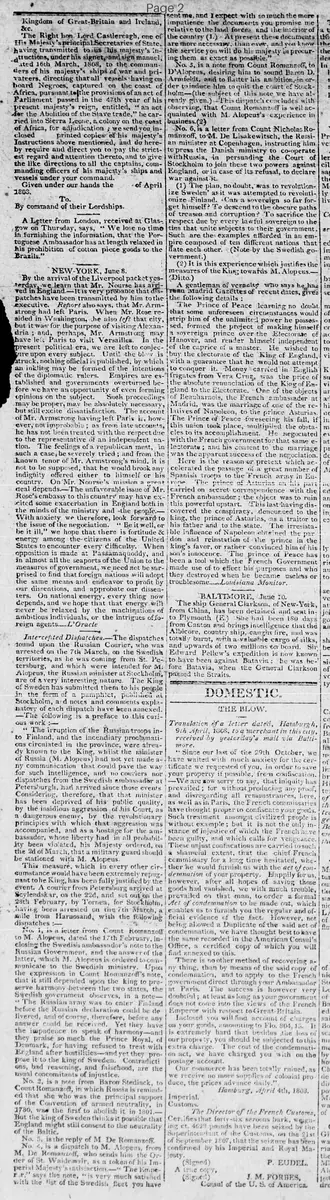
The following is a preface to this curious work:
"The irruption of the Russian troops into Finland, and the incendiary proclamations circulated in the province, were already known to the King, whilst the minister of Russia (M. Alopeus) had not yet made any communication that could pave the way for such intelligence, and no couriers nor dispatches from the Swedish ambassador at Petersburgh, had arrived since those events. Considering, therefore, that that minister has been deprived of his public quality, by the insidious aggression of his Court, as a dangerous enemy, by the revolutionary principles with which that aggression was accompanied, and as a hostage for the ambassador, whose liberty had in all probability been violated, his Majesty ordered, on the 2d of March, that a military guard should be stationed with M. Alopeus.
This measure, which in every other circumstance would have been extremely repugnant to the King, has been fully justified by the event. A courier from Petersburg arrived at Selendskar, on the 22d, and set out on the 28th February, by Tornea, for Stockholm, having been arrested on the 7th March, a mile from Harnosand, with the following dispatches:
No. 1, is a letter from Count Romanzoff to M. Alopeus, dated the 17th February, enclosing the Swedish ambassador's note to the Russian Government, and the answer of the latter, which M. Alopeus is ordered to communicate to the Swedish ministry. Upon the expression in Count Romanzoff's note, that it still depended upon the king to preserve harmony between the two states, the Swedish government observes, in a note--
The Russian army was to enter Finland before the Russian declaration could be delivered, and of course, therefore, before any answer could be received. Yet they have the impudence to speak of harmony--and they praise so much the Prince Royal, of Denmark, for having refused to treat with England after hostilities--and yet they propose it to the king of Sweden. Contradictions, bad reasoning, and falsehood, are the usual concomitants of injustice.
No. 2, is a note from Baron Stedinck, to Count Romanzoff, in which Russia is reminded that she who was the principal support of the Convention of armed neutrality, in 1780, was the first to abolish it in 1801. But the king of Sweden thinks it possible that England might still consent to the neutrality of the Baltic.
No. 3. is the reply of M. De Romanzoff.
No. 4. is a dispatch to M. Alopeus, from M. De Romanzoff, who sends him the Order of St. Wlademir, as a token of his Imperial Majesty's satisfaction. "The Emperor," says the note, "is very much satisfied with the list of the Swedish fleet you have sent me, and I expect with so much the more impatience the documents you promise me relative to the land forces and the interior of the country (1.) At present these documents are more necessary than ever, and you know the service you will do his majesty in procuring them as exact as possible."
No. 5, is a note from Count Romanzoff, to D'Alopeus, desiring him to sound Baron D. Armfeldt, and to flatter his ambition, in order to induce him to quit the court of Stockholm--(the subject of this note we have already given.) This dispatch concludes with observing, that Count Romanzoff is well acquainted with M. Alopeus's experience in business. (2)
No. 6, is a letter from Count Nicholas Romanzoff, to M. De Lisakewitsch, the Russian minister at Copenhagen, instructing him to press the Danish ministry to co-operate with Russia, in persuading the Court of Stockholm to join these two powers against England, or in case of its refusal, to declare war against it.
(1) The plan, no doubt, was to revolutionize Sweden as it was attempted to revolutionize Finland. Can a sovereign so far forget himself? To descend to the obscure paths of treason and corruption? To sacrifice the respect due by every lawful sovereign to the ties that unite subjects to their government. Such are the examples afforded in an empire composed of ten different nations that hate each other. (Note--by the Swedish government.)
(2) It is this experience which justifies the measures of the King towards M. Alopeus. (Ditto.)
What sub-type of article is it?
What keywords are associated?
What entities or persons were involved?
Where did it happen?
Foreign News Details
Primary Location
Stockholm
Event Date
7th March
Key Persons
Outcome
dispatches intercepted and published by the king of sweden with explanatory notes; russian minister alopeus placed under military guard on 2d of march.
Event Details
Russian courier arrested on 7th March in Swedish territories with dispatches from St. Petersburg intended for M. Alopeus. Dispatches include communications on Russian invasion of Finland, responses to Swedish notes, reminders of armed neutrality, orders for intelligence on Swedish forces, attempts to influence Baron Armfeldt, and instructions to pressure Denmark against England. King of Sweden publishes them in a pamphlet with commentary.