Thank you for visiting SNEWPapers!
Sign up free
The Copper Country Evening News
Calumet, Houghton County, Michigan
What is this article about?
Frank Morris, a 19-year-old influenced by dime novels, murders elderly Bernard Loker and wounds his wife in Fayette County, Pa., in 1894 to rob him. Convicted despite insanity defense, Morris is executed by hanging in Uniontown jail in 1896, confessing beforehand.
Clipping
OCR Quality
Full Text
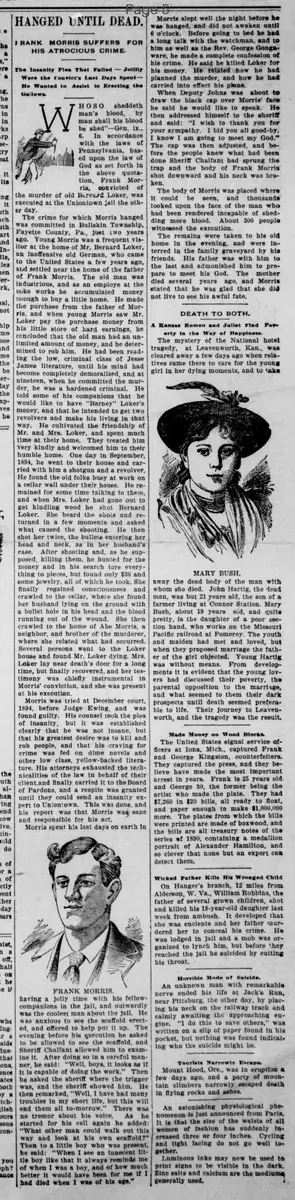
FRANK MORRIS SUFFERS
FOR
HIS ATROCIOUS CRIME
The Insanity Plea That Failed -Jolly
Were the
Convict's Last Days Spent-
He Wanted to Assist in Erecting the
Gallows.
"Whoso
sheddeth
man's
blood,
by
man shall his blood
be shed"-Gen. ix.,
6.
In
accordance
with the laws of
Pennsylvania, bas-
ed upon the law of
God as set forth in
the
above quota-
tion,
Frank Mor-
ris,
convicted
of
the murder of old Bernard Loker, was
executed at the Uniontown jail the oth-
er day.
The crime for which Morris hanged
was committed in Bullskin Township,
Fayette County. Pa., just two years
ago. Young Morris was a frequent vis-
itor at the home of Mr. Bernard Loker,
an inoffensive old German, who came
to the United States a few years ago,
and settled near the home of the father
of Frank Morris. The old man was
industrious, and as an employe at the
coke works he accumulated money
enough to buy a little home. He made
the purchase from the father of Mor-
ris, and when young Morris saw Mr.
Loker pay the purchase money from
his little store of hard earnings, he
concluded that the old man had an un-
limited amount of money, and he deter-
mined to rob him. He had been read-
ing the low, criminal class of Jesse
James literature, until his mind had
become completely demoralized, and at
nineteen, when he committed the mur-
der, he was a hardened criminal. He
told some of his companions that he
would like to have "Barney" Loker's
money, and that he intended to get two
revolvers and make his living in that
way. He cultivated the friendship of
Mr. and Mrs. Loker. and spent much
time at their home. They treated him
very kindly and welcomed him to their
humble home. One day in September,
1894, he went to their house and car-
ried with him a shotgun and a revolver.
He found the old folks busy at work on
a cellar wall under their house. He re-
mained for some time talking to them,
and when Mrs. Loker had gone out to
get kindling wood he shot Bernard
Loker. She heard the shots and re-
turned in a few moments and asked
what caused the shooting. He then
shot her twice, the bullets entering her
head and neck, as in her husband's
case. After shooting and, as he sup-
posed, killing them, he hunted for the
money and in his search tore every-
thing to pieces, but found only $30 and
some jewelry, all of which he took. She
finally regained consciousness and
crawled to the cellar. where she found
her husband lying on the ground with
a bullet hole in his head and the blood
running out of the wound. She then
crawled to the home of Abe Morris, a
neighbor, and brother of the murderer,
where she related what had occurred.
Several persons went to the Loker
house and found Mr. Loker dying. Mrs.
Loker lay near death's door for a long
time. but finally recovered, and her tes-
timony was chiefly instrumental in
Morris' conviction, and she was present
at his execution.
Morris was tried at December court,
1894. before Judge Ewing. and was
found guilty. His counsel took the plea
of insanity. but it was established
clearly that he was not insane. but
that his greatest desire was to kill and
rob people, and that his craving for
crime was fed on dime novels and
other low class, yellow-backed litera-
ture. His attorneys exhausted the tech-
nicilities of the law in behalf of their
client,and finally carried it to the Board
of Pardons, and a respite was granted
until they could send an insanity ex-
pert to Uniontown. This was done, and
his report was that Morris was sane
and responsible for his act.
Morris spent his last days on earth in
having a jolly time with his fellow-
companions in the jail, and outwardly
was the coolest man about the jail. He
was anxious to see the scaffold erect-
ed, and offered to help put it up. The
evening before his execution he asked
to be allowed to see the scaffold, and
Sheriff Chalfant allowed him to exam-
ine it. After doing so in a careful man-
ner, he said: "Well, boys, it looks as if
it is capable of doing the work." Then
he asked the sheriff where the trigger
was, and the sheriff showed him. He
then remarked, "Well, I have had many
troubles in my short life, but this will
end them all to-morrow." There was
no tremor about his voice. As he
started for his cell again he added:
"What other man could walk out this
way and look at his own scaffold?"
Then to a little boy who was present,
he said: "When I see an innocent lit-
tle boy like that it always reminds me
of when I was a boy, and of how much
better it would have been for me if I
had died when I was of his age."
FRANK MORRIS.
Morris slept well the night before he
was hanged, and did not awaken until
6 o'clock. Before going to bed he had
a long talk with the watchman, and to
him as well as the Rev. George Gonga-
ware, he made a complete confession of
his crime. He said he killed Loker for
his money. He related how he had
planned the murder, and how he had
carried into effect his plans.
When Deputy Johns was about to
draw the black cap over Morris' face
he said he would like to speak. He
then addressed himself to the sheriff
and said: "I wish to thank you for
your sympathy. I bid you all good-by.
I know I am going to meet my God."
The cap was then adjusted, and be-
fore the people knew what had been
done Sheriff Chalfant had sprung the
trap and the body of Frank Morris
shot downward and his neck was bro-
ken.
The body of Morris was placed where
it could
be
seen, and thousands
looked upon the face of the man who
had been rendered incapable of shed-
ding more blood. About 300 people
witnessed the execution.
The remains were taken to his old
home in the evening, and were in-
terred in the family graveyard by his
friends. His father was with him to
the last and admonished him to pre-
prepare to meet his God. The mother
died several
years
ago, and Morris
stated that he was glad that she did
not live to see his awful fate.
What sub-type of article is it?
What themes does it cover?
What keywords are associated?
What entities or persons were involved?
Where did it happen?
Story Details
Key Persons
Location
Bullskin Township, Fayette County, Pa.; Uniontown Jail
Event Date
September 1894 (Crime); December 1894 (Trial); 1896 (Execution)
Story Details
Frank Morris, influenced by criminal literature, murders elderly Bernard Loker and his wife for money in their home. Mrs. Loker survives and testifies, leading to Morris's conviction despite insanity plea. He is hanged at Uniontown jail after confessing his crime.