Thank you for visiting SNEWPapers!
Sign up free
Story
May 10, 1913
Spirit Of The Age
Woodstock, Windsor County, Vermont
What is this article about?
Ernest Farleigh, the 'failure' son of a merchant family, is disowned and heads West. After years of struggle, he returns wealthy, saves the bankrupt family business from his brother James's mismanagement, reconciles with his father, and wins back his love, Minna Gray.
Clipping
OCR Quality
100%
Excellent
Full Text
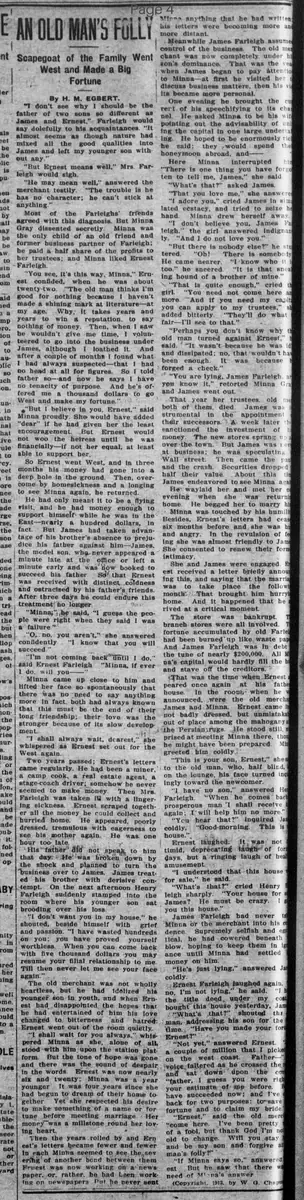
AN OLD MAN'S FOLLY
Scapegoat of the Family Went West and Made a Big Fortune
By H. M. EGBERT.
"I don't see why I should be the father of two sons so different as James and Ernest," Farleigh would say dolefully to his acquaintances. "It almost seems as though nature had mixed all the good qualities into James and left my younger son without any."
"But Ernest means well," Mrs. Farleigh would sigh.
"He may mean well," answered the merchant testily. "The trouble is he has no character; he can't stick at anything."
Most of the Farleighs' friends agreed with this diagnosis. But Minna Gray dissented secretly. Minna was the only child of an old friend and former business partner of Farleigh; he paid a half share of the profits to her trustees; and Minna liked Ernest Farleigh.
"You see, it's this way, Minna," Ernest confided, when he was about twenty-two. "The old man thinks I'm good for nothing because I haven't made a shining mark at literature—at my age. Why, it takes years and years to win a reputation, to say nothing of money. Then, when I saw he wouldn't give me time, I volunteered to go into the business under James, although I loathed it. And after a couple of months I found what I had always suspected—that I had no head at all for figures. So I told father so—and now he says I have no tenacity of purpose. And he's offered me a thousand dollars to go West and make my fortune."
"But I believe in you, Ernest," said Minna proudly. She would have added "dear" if he had given her the least encouragement. But Ernest would not woo the heiress until he was financially—if not her equal, at least able to support her.
So Ernest went West, and in three months his money had gone into a deep hole in the ground. Then, overcome by homesickness and a longing to see Minna again, he returned.
He had only meant it to be a flying visit, and he had money enough to support himself while he was in the East—nearly a hundred dollars, in fact. But James had taken advantage of his brother's absence to prejudice his father against him—James, the model son, who never appeared a minute late at the office or left a minute early and was now booked to succeed his father. So that Ernest was received with distinct coldness and ostracised by his father's friends.
After three days he could endure this treatment no longer.
"Minna," he said, "I guess the people were right when they said I was a failure."
"Oh, no, you aren't," she answered confidently. "I know that you will succeed."
"I'm not coming back until I do," said Ernest Farleigh. "Minna, if ever I do, will you—"
Minna came up close to him and lifted her face so spontaneously that there was no need to say anything more. In fact, both had always known that this must be the end of their long friendship; their love was the stronger because of its slow development.
"I shall always wait, dearest," she whispered as Ernest set out for the West again.
Two years passed; Ernest's letters came regularly. He had been a miner, a camp cook, a real estate agent, a stage-coach driver; somehow he never seemed to make money. Then Mrs. Farleigh was taken in with a lingering sickness. Ernest scraped together all the money he could collect and hurried home. He appeared, poorly dressed, tremulous with eagerness to see his mother again. He was one hour too late.
His father did not speak to him that day; he was broken down by the shock and planned to turn the business over to James. James treated his brother with derisive contempt. On the next afternoon Henry Farleigh suddenly stamped into the room where his younger son sat brooding over his loss.
"I don't want you in my house," he shouted, beside himself with grief and passion. "I have wasted hundreds on you; you have proved yourself worthless. When you can come back with five thousand dollars—you may resume your filial relationship to me. Till then never let me see your face again."
The old merchant was not wholly heartless, but he had idolized his younger son in youth, and when Ernest had disappointed the hopes that he had entertained of him his love changed to bitterness and hatred.
Ernest went out of the room quietly.
"I shall wait for you always," whispered Minna as she, alone of all, stood with him upon the station platform. But the tone of hope was gone and there was the sound of despair in the words. Ernest was now nearly six and twenty; Minna was a year younger. It was four years since she had begun to dream of their home together. Yet she respected his desire to make something of a name or fortune before meeting marriage. Her money was a millstone round her loving heart.
Then the years rolled by and Ernest's letters became fewer and fewer. In each Minna seemed to see the severing of another bond between them. Ernest was now working on a newspaper, or, rather, he had been working on newspapers. But he never sent Minna anything that he had written; his letters were becoming more and more distant.
Meanwhile James Farleigh assumed control of the business. The old merchant was now completely under his son's dominance.
That was the time when James began to pay attention to Minna—at first he visited her to discuss business matters, then his visits became more personal.
One evening he brought the current of his speechifying to its climax. He asked Minna to be his wife, pointing out the advisability of uniting the capital in one large undertaking. He hoped to be enormously rich, he said; they would spend their honeymoon abroad, and—
Here Minna interrupted him.
"There is one thing you have forgotten to tell me, James," she said.
"What's that?" asked James.
"That you love me," she answered.
"I adore you," cried James in simulated ecstasy, and tried to seize her hand. Minna drew herself away.
"I don't believe you, James Farleigh," the girl answered indignantly. "And I do not love you."
"But there is nobody else?" he stuttered.
"Oh! There is somebody."
He came nearer.
"I know who it is too," he sneered.
"It is that sneering hound of a brother of mine."
"That is quite enough," cried the girl. "You need not come here any more. And if you need my capital you can apply to my trustees," she added bitterly. "They'll do what's fair—I'll see to that."
"Perhaps you don't know why the old man turned against Ernest," said James. "It wasn't because he was idle and dissipated; no, that wouldn't have been enough. It was because he forged a check."
"You are lying, James Farleigh, and you know it," retorted Minna Gray, and James went out.
That year her trustees, old men both of them, died. James was instrumental in the appointment of their successors. A week later he sanctioned the investment of Minna's money. The new stores sprang up over the town. But James was no better at business; he was speculating in Wall street. Then came the panic and the crash. Securities dropped half their value. About this time James endeavored to see Minna again. He waylaid her and met her one evening when she was returning home. He begged her to marry him.
Minna was touched by his humiliation. Besides, Ernest's letters had ceased six months before and she was hurt and angry. In the revulsion of feeling she was almost friendly to James. She consented to renew their former intimacy.
She and James were engaged. Ernest received a letter briefly announcing this, and saying that the marriage was to take place the following month. That brought him hurrying home. And it happened that he arrived at a critical moment.
The store was bankrupt. The branch stores were all involved. The fortune accumulated by old Farleigh had been burned up like waste paper. And James Farleigh was in debt to the tune of nearly $200,000. All Minna's capital would hardly fill the breach and stave off the creditors.
That was the time when Ernest appeared once again at his father's house. In the room, when he was announced, were the old merchant, James and Minna. Ernest came in not badly dressed, but unmistakably out of place among the mahogany and the Persian rugs. He stood still, surprised at meeting Minna there, though he might have been prepared. Minna greeted him coldly.
"This is your son, Ernest," she said to the old man, who, half blind, lay on the lounge, his face turned inquiringly toward the newcomer.
"I have no son," answered Henry Farleigh. "When he comes back a prosperous man I shall receive him again; I will help him no more."
"You hear that?" inquired James coldly. "Good-morning. This is not your house."
Ernest laughed. It was not the timid, deprecating laugh of former days, but a ringing laugh of hearty amusement.
"I understood that this house was for sale," he said.
"What's that?" cried Henry Farleigh sharply. "Your house for sale, James? He must be crazy."
"I bought this house," said Ernest. "I have the title deed, under my coat. I bought this house yesterday, James."
"What's that?" shouted the old man, addressing his son for the first time. "Have you made your fortune, Ernest?"
"Not yet," answered Ernest, "a couple of million that I picked up on the west coast. Father—"
His voice faltered as he crossed the room and sat down upon the couch.
"Father, I guess you were right in your estimate of me before. I have succeeded now; and I've come back for two purposes: to save your fortune and to claim my bride."
"Ernest," said the old merchant, "come here. I've been pretty much of a fool, but thank God I'm not too old to change. Will you stay and be my son and forgive an old man's folly?"
"If Minna says so," answered Ernest. But he saw that there was no need of Minna's answer.
(Copyright, 1913, by W. G. Chapman.)
Scapegoat of the Family Went West and Made a Big Fortune
By H. M. EGBERT.
"I don't see why I should be the father of two sons so different as James and Ernest," Farleigh would say dolefully to his acquaintances. "It almost seems as though nature had mixed all the good qualities into James and left my younger son without any."
"But Ernest means well," Mrs. Farleigh would sigh.
"He may mean well," answered the merchant testily. "The trouble is he has no character; he can't stick at anything."
Most of the Farleighs' friends agreed with this diagnosis. But Minna Gray dissented secretly. Minna was the only child of an old friend and former business partner of Farleigh; he paid a half share of the profits to her trustees; and Minna liked Ernest Farleigh.
"You see, it's this way, Minna," Ernest confided, when he was about twenty-two. "The old man thinks I'm good for nothing because I haven't made a shining mark at literature—at my age. Why, it takes years and years to win a reputation, to say nothing of money. Then, when I saw he wouldn't give me time, I volunteered to go into the business under James, although I loathed it. And after a couple of months I found what I had always suspected—that I had no head at all for figures. So I told father so—and now he says I have no tenacity of purpose. And he's offered me a thousand dollars to go West and make my fortune."
"But I believe in you, Ernest," said Minna proudly. She would have added "dear" if he had given her the least encouragement. But Ernest would not woo the heiress until he was financially—if not her equal, at least able to support her.
So Ernest went West, and in three months his money had gone into a deep hole in the ground. Then, overcome by homesickness and a longing to see Minna again, he returned.
He had only meant it to be a flying visit, and he had money enough to support himself while he was in the East—nearly a hundred dollars, in fact. But James had taken advantage of his brother's absence to prejudice his father against him—James, the model son, who never appeared a minute late at the office or left a minute early and was now booked to succeed his father. So that Ernest was received with distinct coldness and ostracised by his father's friends.
After three days he could endure this treatment no longer.
"Minna," he said, "I guess the people were right when they said I was a failure."
"Oh, no, you aren't," she answered confidently. "I know that you will succeed."
"I'm not coming back until I do," said Ernest Farleigh. "Minna, if ever I do, will you—"
Minna came up close to him and lifted her face so spontaneously that there was no need to say anything more. In fact, both had always known that this must be the end of their long friendship; their love was the stronger because of its slow development.
"I shall always wait, dearest," she whispered as Ernest set out for the West again.
Two years passed; Ernest's letters came regularly. He had been a miner, a camp cook, a real estate agent, a stage-coach driver; somehow he never seemed to make money. Then Mrs. Farleigh was taken in with a lingering sickness. Ernest scraped together all the money he could collect and hurried home. He appeared, poorly dressed, tremulous with eagerness to see his mother again. He was one hour too late.
His father did not speak to him that day; he was broken down by the shock and planned to turn the business over to James. James treated his brother with derisive contempt. On the next afternoon Henry Farleigh suddenly stamped into the room where his younger son sat brooding over his loss.
"I don't want you in my house," he shouted, beside himself with grief and passion. "I have wasted hundreds on you; you have proved yourself worthless. When you can come back with five thousand dollars—you may resume your filial relationship to me. Till then never let me see your face again."
The old merchant was not wholly heartless, but he had idolized his younger son in youth, and when Ernest had disappointed the hopes that he had entertained of him his love changed to bitterness and hatred.
Ernest went out of the room quietly.
"I shall wait for you always," whispered Minna as she, alone of all, stood with him upon the station platform. But the tone of hope was gone and there was the sound of despair in the words. Ernest was now nearly six and twenty; Minna was a year younger. It was four years since she had begun to dream of their home together. Yet she respected his desire to make something of a name or fortune before meeting marriage. Her money was a millstone round her loving heart.
Then the years rolled by and Ernest's letters became fewer and fewer. In each Minna seemed to see the severing of another bond between them. Ernest was now working on a newspaper, or, rather, he had been working on newspapers. But he never sent Minna anything that he had written; his letters were becoming more and more distant.
Meanwhile James Farleigh assumed control of the business. The old merchant was now completely under his son's dominance.
That was the time when James began to pay attention to Minna—at first he visited her to discuss business matters, then his visits became more personal.
One evening he brought the current of his speechifying to its climax. He asked Minna to be his wife, pointing out the advisability of uniting the capital in one large undertaking. He hoped to be enormously rich, he said; they would spend their honeymoon abroad, and—
Here Minna interrupted him.
"There is one thing you have forgotten to tell me, James," she said.
"What's that?" asked James.
"That you love me," she answered.
"I adore you," cried James in simulated ecstasy, and tried to seize her hand. Minna drew herself away.
"I don't believe you, James Farleigh," the girl answered indignantly. "And I do not love you."
"But there is nobody else?" he stuttered.
"Oh! There is somebody."
He came nearer.
"I know who it is too," he sneered.
"It is that sneering hound of a brother of mine."
"That is quite enough," cried the girl. "You need not come here any more. And if you need my capital you can apply to my trustees," she added bitterly. "They'll do what's fair—I'll see to that."
"Perhaps you don't know why the old man turned against Ernest," said James. "It wasn't because he was idle and dissipated; no, that wouldn't have been enough. It was because he forged a check."
"You are lying, James Farleigh, and you know it," retorted Minna Gray, and James went out.
That year her trustees, old men both of them, died. James was instrumental in the appointment of their successors. A week later he sanctioned the investment of Minna's money. The new stores sprang up over the town. But James was no better at business; he was speculating in Wall street. Then came the panic and the crash. Securities dropped half their value. About this time James endeavored to see Minna again. He waylaid her and met her one evening when she was returning home. He begged her to marry him.
Minna was touched by his humiliation. Besides, Ernest's letters had ceased six months before and she was hurt and angry. In the revulsion of feeling she was almost friendly to James. She consented to renew their former intimacy.
She and James were engaged. Ernest received a letter briefly announcing this, and saying that the marriage was to take place the following month. That brought him hurrying home. And it happened that he arrived at a critical moment.
The store was bankrupt. The branch stores were all involved. The fortune accumulated by old Farleigh had been burned up like waste paper. And James Farleigh was in debt to the tune of nearly $200,000. All Minna's capital would hardly fill the breach and stave off the creditors.
That was the time when Ernest appeared once again at his father's house. In the room, when he was announced, were the old merchant, James and Minna. Ernest came in not badly dressed, but unmistakably out of place among the mahogany and the Persian rugs. He stood still, surprised at meeting Minna there, though he might have been prepared. Minna greeted him coldly.
"This is your son, Ernest," she said to the old man, who, half blind, lay on the lounge, his face turned inquiringly toward the newcomer.
"I have no son," answered Henry Farleigh. "When he comes back a prosperous man I shall receive him again; I will help him no more."
"You hear that?" inquired James coldly. "Good-morning. This is not your house."
Ernest laughed. It was not the timid, deprecating laugh of former days, but a ringing laugh of hearty amusement.
"I understood that this house was for sale," he said.
"What's that?" cried Henry Farleigh sharply. "Your house for sale, James? He must be crazy."
"I bought this house," said Ernest. "I have the title deed, under my coat. I bought this house yesterday, James."
"What's that?" shouted the old man, addressing his son for the first time. "Have you made your fortune, Ernest?"
"Not yet," answered Ernest, "a couple of million that I picked up on the west coast. Father—"
His voice faltered as he crossed the room and sat down upon the couch.
"Father, I guess you were right in your estimate of me before. I have succeeded now; and I've come back for two purposes: to save your fortune and to claim my bride."
"Ernest," said the old merchant, "come here. I've been pretty much of a fool, but thank God I'm not too old to change. Will you stay and be my son and forgive an old man's folly?"
"If Minna says so," answered Ernest. But he saw that there was no need of Minna's answer.
(Copyright, 1913, by W. G. Chapman.)
What sub-type of article is it?
Family Drama
Romance
Personal Triumph
What themes does it cover?
Family
Fortune Reversal
Triumph
What keywords are associated?
Family Conflict
Western Fortune
Romantic Redemption
Business Failure
Brotherly Rivalry
What entities or persons were involved?
Ernest Farleigh
James Farleigh
Henry Farleigh
Mrs. Farleigh
Minna Gray
Where did it happen?
East (Family Home), West (Mining And Various Jobs)
Story Details
Key Persons
Ernest Farleigh
James Farleigh
Henry Farleigh
Mrs. Farleigh
Minna Gray
Location
East (Family Home), West (Mining And Various Jobs)
Story Details
Ernest, the underachieving son, is disowned by his father Henry and rival brother James. He goes West, faces hardships, but returns wealthy after years, buys the family home, saves the bankrupt business, reconciles with his father, and claims Minna, who was briefly engaged to James.