Thank you for visiting SNEWPapers!
Sign up free
The Kentucky Gazette
Lexington, Fayette County, Kentucky
What is this article about?
On November 10, 1796, the Kentucky Senate debated a contested gubernatorial election. Benjamin Logan claimed he was duly elected on the first ballot with the most votes, but electors took a second unconstitutional ballot declaring James Garrard governor. The Senate discussed their authority under law and constitution, ultimately deeming the law unconstitutional and resolving to repeal it.
Merged-components note: These components form a single continuous story reporting on senate proceedings, spanning multiple pages with sequential reading orders.
Clippings
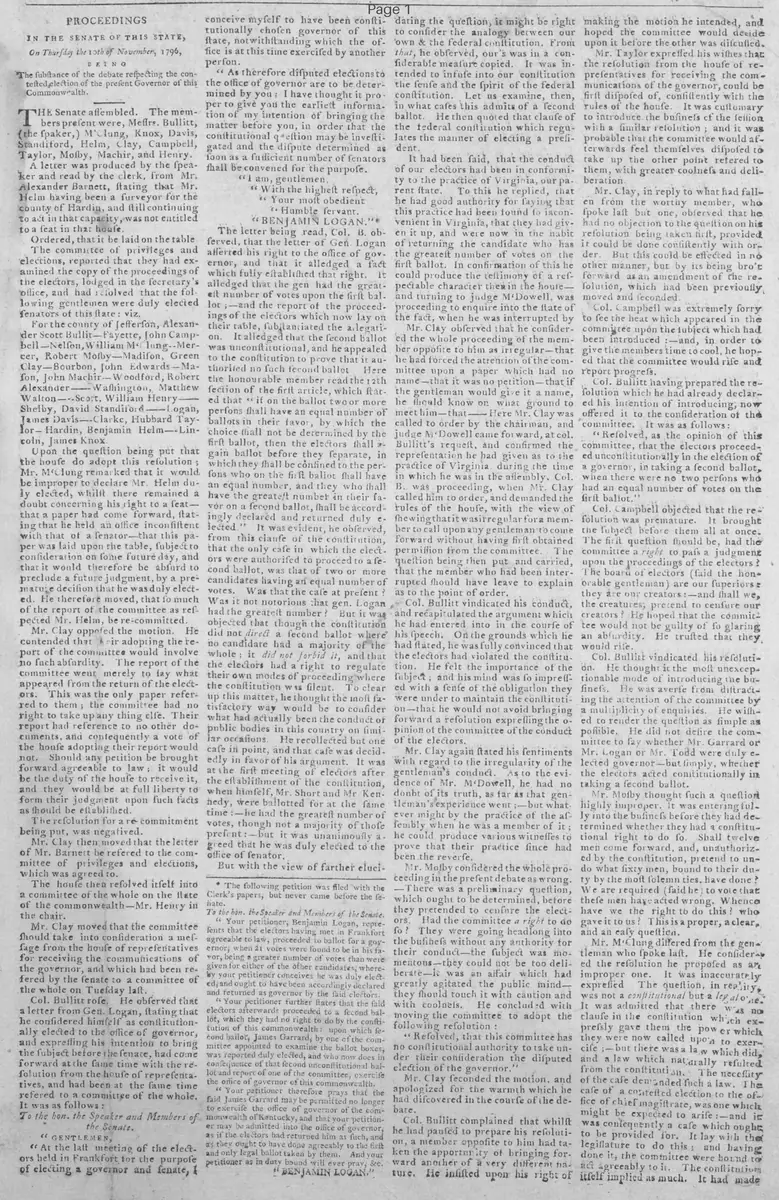
1 of 3
OCR Quality
Full Text
On Thursday the 10th of November, 1796,
BEING
The substance of the debate respecting the contested election of the present Governor of this Commonwealth.
THE Senate assembled. The members present were, Messrs. Bullitt, (the speaker,) McClung, Knox, Davis, Standiford, Helm, Clay, Campbell, Taylor, Mosby, Machir, and Henry.
A letter was produced by the speaker and read by the clerk, from Mr. Alexander Barnett, stating that Mr. Helm having been a surveyor for the county of Hardin, and still continuing to act in that capacity, was not entitled to a seat in that house.
Ordered, that it be laid on the table.
The committee of privileges and elections, reported that they had examined the copy of the proceedings of the electors, lodged in the secretary's office, and had resolved that the following gentlemen were duly elected senators of this state: viz.
For the county of Jefferson, Alexander Scott Bullitt—Fayette, John Campbell—Nelson, William McClung—Mercer, Robert Mosby—Madison, Green Clay—Bourbon, John Edwards—Mason, John Machir—Woodford, Robert Alexander—Washington, Matthew Walton—Scott, William Henry—Shelby, David Standiford—Logan, James Davis—Clarke, Hubbard Taylor—Hardin, Benjamin Helm—Lincoln, James Knox.
Upon the question being put that the house do adopt this resolution
Mr. McClung remarked that it would be improper to declare Mr. Helm duly elected, whilst there remained a doubt concerning his right to a seat—that a paper had come forward, stating that he held an office inconsistent with that of a senator—that this paper was laid upon the table, subject to consideration on some future day. and that it would therefore be absurd to preclude a future judgment, by a premature decision that he was duly elected. He therefore moved, that so much of the report of the committee as respected Mr. Helm, be re-committed.
Mr. Clay opposed the motion. He contended that by adopting the report of the committee would involve no such absurdity. The report of the committee went merely to say what appeared from the return of the electors. This was the only paper referred to them: the committee had no right to take up any thing else. Their report had reference to no other documents, and consequently a vote of the house adopting their report would not. Should any petition be brought forward agreeable to law; it would be the duty of the house to receive it, and they would be at full liberty to form their judgment upon such facts as should be established.
The resolution for a re-commitment being put, was negatived.
Mr. Clay then moved that the letter of Mr. Barnett be referred to the committee of privileges and elections, which was agreed to.
The house then resolved itself into a committee of the whole on the state of the commonwealth—Mr. Henry in the chair.
Mr. Clay moved that the committee should take into consideration a message from the house of representatives for receiving the communications of the governor, and which had been referred by the senate to a committee of the whole on Tuesday last.
Col. Bullitt rose. He observed that a letter from Gen. Logan, stating that he considered himself as constitutionally elected to the office of governor, and expressing his intention to bring the subject before the senate, had come forward at the same time with the resolution from the house of representatives, and had been at the same time referred to a committee of the whole. It was as follows:
To the hon. the Speaker and Members of the Senate.
"GENTLEMEN,
" At the last meeting of the electors held in Frankfort for the purpose of electing a governor and senate,
I conceive myself to have been constitutionally chosen governor of this state, notwithstanding which the office is at this time exercised by another person.
" As therefore disputed elections to the office of governor are to be determined by you; I have thought it proper to give you the earliest information of my intention of bringing the matter before you, in order that the constitutional question may be investigated and the dispute determined as soon as a sufficient number of senators shall be convened for the purpose.
"I am, gentlemen,
" With the highest respect,
" Your most obedient
"Humble servant.
"BENJAMIN LOGAN."*
The letter being read, Col. B. observed, that the letter of Gen. Logan asserted his right to the office of governor, and that it alleged a fact which fully established that right. It alleged that the gen had the greatest number of votes upon the first ballot ;-and the report of the proceedings of the electors which now lay on their table, substantiated the allegation.
It alleged that the second ballot was unconstitutional, and he appealed to the constitution to prove that it authorized no such second ballot Here the honourable member read the 12th section of the first article, which stated that "if on the ballot two or more persons shall have an equal number of ballots in their favor, by which the 'choice shall not be determined by the first ballot, then the electors shall again ballot before they separate, in which they shall be confined to the persons who on the first ballot shall have an equal number, and they who shall have the greatest number in their favor on a second ballot, shall be accordingly declared and returned duly elected" It was evident, he observed, from this clause of the constitution, that the only case in which the electors were authorized to proceed to a second ballot, was that of two or more candidates having an equal number of votes. Was that the case at present? Was it not notorious that gen. Logan had the greatest number? But it was objected that though the constitution did not direct a second ballot where no candidate had a majority of the whole; it did not forbid it, and that the electors had a right to regulate their own modes of proceeding where the constitution was silent. To clear up this matter, he thought the most satisfactory way would be to consider what had actually been the conduct of public bodies in this country on similar occasions. He recollected but one case in point, and that case was decidedly in favor of his argument. It was at the first meeting of electors after the establishment of the constitution, when himself, Mr. Short and Mr Kennedy, were ballotted for at the same time:-he had the greatest number of votes, though not a majority of those present:-but it was unanimously agreed that he was duly elected to the office of senator.
But with the view of farther elucidating the question, it might be right
* The following petition was filed with the Clerk's papers, but never came before the senate.
To the hon. the Speaker and Members of the Senate.
" Your petitioner, Benjamin Logan, represents that the electors having met in Frankfort agreeable to law, proceeded to ballot for a governor; when 21 votes were found to be in his favor, being a greater number of votes than were given for either of the other candidates, whereby your petitioner conceives he was duly elected; and ought to have been accordingly declared and returned as governor by the said electors.
" Your petitioner further states that the said electors afterwards proceeded to a second ballot, which they had no right to do by the constitution of this commonwealth: upon which second ballot, James Garrard; by one of the committee appointed to examine the ballot boxes, was reported duly elected, and who now does in consequence of that second unconstitutional ballot and report of one of the committee, exercise the office of governor of this commonwealth.
" Your petitioner therefore prays that the said James Garrard may be permitted no longer to exercise the office of governor of the commonwealth of Kentucky, and that your petitioner may be admitted into the office of governor, as if the electors had returned him as such, and as they ought to have done agreeably to the first and only legal ballot taken by them. . And your petitioner as in duty bound will ever pray; &c:
"BENJAMIN LOGAN."
to consider the analogy between our own & the federal constitution. From that, he observed, our's was in a considerable measure copied. It was intended to infuse into our constitution the sense and the spirit of the federal constitution. Let us examine, then, in what cases this admits of a second ballot. He then quoted that clause of the federal constitution which regulates the manner of electing a president.
It had been said, that the conduct of our electors had been in conformity to the practice of Virginia, our parent state. To this he replied, that he had good authority for saying that this practice had been found so inconvenient in Virginia, that they had given it up, and were now in the habit of returning the candidate who has the greatest number of votes on the first ballot. In confirmation of this he could produce the testimony of a respectable character then in the house—and turning to judge McDowell, was proceeding to enquire into the state of the fact, when he was interrupted by
Mr. Clay observed that he considered the whole proceeding of the member opposite to him as irregular—that he had forced the attention of the committee upon a paper which had no name—that it was no petition—that if the gentleman would give it a name, he should know on what ground to meet him—that—Here Mr. Clay was called to order by the chairman, and judge McDowell came forward, at col. Bullitt's request, and confirmed the representation he had given as to the practice of Virginia. during the time in which he was in the assembly. Col. B. was proceeding, when Mr. Clay called him to order, and demanded the rules of the house, with the view of shewing that it was irregular for a member to call upon any gentleman to come forward without having first obtained permission from the committee. The question being then put and carried, that the member who had been interrupted should have leave to explain as to the point of order.
Col. Bullitt vindicated his conduct, and recapitulated the argument which he had entered into in the course of his speech. On the grounds which he had stated, he was fully convinced that the electors had violated the constitution. He felt the importance of the subject; and his mind was so impressed with a sense of the obligation they were under to maintain the constitution—that he would not avoid bringing forward a resolution expressing the opinion of the committee of the conduct of the electors.
Mr. Clay again stated his sentiments with regard to the irregularity of the gentleman's conduct. As to the evidence of Mr. McDowell, he had no doubt of its truth, as far as that gentleman's experience went;-but whatever might by the practice of the assembly when he was a member of it ; he could produce various witnesses to prove that their practice since had been the reverse.
Mr. Mosby considered the whole proceeding in the present debate as wrong.—There was a preliminary question, which ought to be determined, before they pretended to censure the electors. Had the committee a right to do so? They were going headlong into the business without any authority for their conduct—the subject was momentous—they could not be too deliberate—it was an affair which had greatly agitated the public mind—they should touch it with caution and with coolness. He concluded with moving the committee to adopt the following resolution :
"Resolved, that this committee has no constitutional authority to take under their consideration the disputed election of the governor."
Mr. Clay seconded the motion, and apologized for the warmth which he had discovered in the course of the debate.
Col. Bullitt complained that whilst he had paused to prepare his resolution, a member opposite to him had taken the opportunity of bringing forward another of a very different nature. He insisted upon his right of
making the motion he intended, and hoped the committee would decide upon it before the other was discussed.
Mr. Taylor expressed his wishes that the resolution from the house of representatives for receiving the communications of the governor, could be first disposed of, consistently with the rules of the house. It was customary to introduce the business of the session with a similar resolution ; and it was probable that the committee would afterwards feel themselves disposed to take up the other point referred to them, with greater coolness and deliberation.
Mr. Clay, in reply to what had fallen from the worthy member, who spoke last but one, observed that he had no objection to the question on his resolution being taken first, provided it could be done consistently with order. But this could be effected in no other manner, but by its being brought forward as an amendment of the resolution, which had been previously moved and seconded.
Col. Campbell was extremely sorry to see the heat which appeared in the committee upon the subject which had been introduced :-and, in order to give the members time to cool, he hoped that the committee would rise and report progress.
Col. Bullitt having prepared the resolution which he had already declared his intention of introducing, now offered it to the consideration of the committee. It was as follows:
"Resolved, as the opinion of this committee, that the electors proceeded unconstitutionally in the election of a governor, in taking a second ballot, when there were no two persons who had an equal number of votes on the first ballot."
Col. Campbell objected that the resolution was premature. It brought the Subject before them all at once. The first question should be, had the committee a right to pass a judgment upon the proceedings of the electors ? The board of electors (said the honorable gentleman) are our superiors: they are our creators:-and shall we, the creatures; presume to censure our creators ? He hoped that the committee would not be guilty of so glaring an absurdity. He trusted that they would rise.
Col. Bullitt vindicated his resolution. He thought it the most unexceptionable mode of introducing the business. He was averse from distracting the attention of the committee by a multiplicity of enquiries. He wished to render the question as simple as possible. He did not desire the committee to say whether Mr. Garrard or Mr. Logan or Mr. Todd were duly elected governor—but simply, whether the electors acted constitutionally in taking a second ballot.
Mr. Mosby thought such a question highly improper. It was entering fully into the business before they had determined whether they had a constitutional right to do so. Shall twelve men come forward, and, unauthorized by the constitution, pretend to undo what sixty men, bound to their duty by the most solemn ties, have done? We are required (said he) to vote that these men have acted wrong. Whence have we the right to do this? who gave it to us? This is a proper, clear and an easy question.
Mr. McClung differed from the gentleman who spoke last. He considered the resolution he proposed as an improper one. It was inaccurately expressed. The question, in reality, was not a constitutional but a legal one. It was admitted that there was no clause in the constitution which expressly gave them the power which they were now called upon to exercise ;-but there was a law which did, and a law which naturally resulted from the constitution. The necessity of the case demanded such a law. The case of a contested election to the office of chief magistrate, was one which might be expected to arise:-and it was consequently a case which ought to be provided for. It lay with the legislature to do this ; and having done it, the committee were bound to act agreeably to it. The constitution itself implied as much. It had made
no immediate provision for the case; but the 18th section of the first article had said, "Each house shall judge of the qualifications of its members; contested elections shall be determined by a committee to be selected, formed and regulated in such manner as shall be directed by law." The expression contested elections (he observed) was a general one. It included the contested election of a governor as well as that of a senator or representative. The law had accordingly directed how such contest should be determined. They were to be determined by the Senate in a committee of the whole on the state of the commonwealth. The law being passed, the senate were bound by it. That such a tribunal should exist as the law had constituted the senate, was absolutely necessary to the purposes of good government. Had the law been judicious in its selection of a tribunal? It had. It was just, it was right, it was necessary that the senate should have the power. The senate was that body which stood in the nearest relation to the governor. The senators were the sharers in his power;—they were his constitutional advisers;—the appointments which he made, were made by and with the advice and consent of the senate. All men (he observed) are liable to mistakes and to errors. The board of electors are not exempted from the common imperfection of man. They might appoint to the post of chief magistrate, a person who might be disqualified by age, by office or by residence. Did the constitution forbid that provision should be made for such cases? Did it stamp its sanction upon error, by declaring that, when once committed, it should be perpetual? Where was that clause of the constitution which involved such an absurdity? Where did the constitution say that the senate should not determine contested elections of governor, or that the legislature should devise no mode of settling such contests? It had been alleged, indeed, that the constitution in its very outset was repugnant to it: that in declaring that no person or collection of persons being of the legislative, the executive or judiciary department, should exercise any power properly belonging to either of the others, it had precluded the interference of the legislature in the present instance. But to which of those departments does it belong to decide on a contested election of a governor? Does it (said the gentleman) belong to the judiciary? No: for in what form could such a contest be introduced in a court of judicature? Could it be introduced by an action of detinue? Could it be introduced by an action of trespass? Upon what principle, or by what rule were the jury to assess the damages? The very statement of the question evinced that the case of a contested election did not belong to the judiciary. No: it was the province of that department to determine disputes respecting our property, and to award a compensation for injuries received.— but the subject of contested elections must necessarily rest with the wisdom of the legislature. It was their duty to establish a method of investigating and of deciding them. They had constituted the senate a tribunal for the purpose. It was right, it was just, it was necessary that the power should be lodged some where: —it could no where be so properly lodged as with the senate—and it became the senate. —It was a branch of their duty as citizens and legislators, not to decline the exercise of those functions which their country had imposed upon them. He concluded with moving as an amendment to the resolution before the committee, to strike out the whole of it from the word "resolved," and to add the following: [This amendment we have not received.] Mr. Mosby differed entirely from the gentleman who spoke last, as to the right of the senate to take up the business. It was utterly repugnant to the clause of the constitution which he had quoted. That clause forbade an encroachment of the legislature upon the executive authority. And was the measure now proposed no encroachment? Did it not encroach upon the executive department? Did it not, in fact, by declaring who should and who should not be the executive officer, seem like an assumption of the whole executive power? Was this consistent with the constitution? Were not the expressions of the constitution pointedly opposed to it? Did it not say that no such interference should take place, 'except in the instances herein after expressly permitted'? Where was the permission given? He challenged any gentleman in the committee to produce the clause. The measure proposed was in itself absurd. It was absurd to set aside the election of a governor who had acted in the office for five months. Had the people meant that such an election should be disputed; they would have provided a mode of doing it, more orderly and more effectual. They would not have suffered a man to usurp the office nearly six months, and to perform a multitude of official acts which might afterwards be invalidated by a vote in the senate that he was not legally elected. He conjured gentlemen to reflect upon the consequences of the scheme in contemplation. The state would be in confusion.— Would it not be more prudent as well as more constitutional, not to arrogate a power which did not belong to them? He hoped that the committee would be cautious, and vote on the safe side. Let us (said he) maintain our dignity as legislators. We are not to adopt the quibbles of an attorney. We are to act upon the solid principles of unperverted justice. He trusted that the committee could not hesitate a moment which course of conduct to pursue. Mr. Clay was doubtful to which motion he should speak. One had been made to declare the proceedings of the electors unconstitutional: another, had offered an amendment of the resolution which he had seconded. The latter, in point of order, seemed to claim the attention of the committee. It went to maintain the legal right of the senate to examine and correct the proceedings of the electoral board. But the senate could derive no legal right from a law which the legislature had no constitutional right to enact. Was the law in question consistent with the constitution? Was it consistent with that general provision that the legislative authority should never entrench upon the executive or the judicial but in the cases expressly permitted? It was not. It was, therefore, null and void, and could merit no attention. He was authorized in pronouncing it so, by the concluding clause of the twelfth article, which declared, that "all laws contrary thereto, or contrary to this constitution, shall be void." It must therefore stand as a dead letter. The constitution had evidently confined the powers of each house of assembly, with regard to contested elections to such cases as concerned its own members. "Each house shall judge of the qualifications of its members: contested elections shall be determined by a committee, to be selected, formed and regulated in such manner as shall be directed by law." The connection in which the words stood, showed what kind of contested elections the committee could determine upon. They could determine upon those only which related to their own body. Would the constitution, then, have been so particular in empowering them to act thus far, and have been silent as to the more important case of a governor, if it had intended that the Senate should have any concern with it? Would the people have thought it necessary to give them an express authority to judge of the qualifications of one single member of the senate, and to determine a contest for a single seat, and have thought it unnecessary to express their intentions of permitting them to canvass, to rectify or to reverse the proceedings of the board of electors in appointing the supreme executive? No: in not having granted, they had withheld the power. The reason was obvious. The cases were clearly distinct. The governor was to enter upon his functions in June. The senate were to assemble in November. A senator improperly returned, might be displaced upon his first entrance on the duties of the office; the mistake might be rectified before it produced any considerable effect, and the people be at once legally represented. But they could have no opportunity of displacing a governor till he had acted as such for nearly six months. In the former case, the constitution had given the power to the senate, because it could be effectually exercised: in the latter case it had withheld the power, for it would have produced only a partial effect. The very principle upon which the senate assumed the power of rectifying the proceedings of the electors in the choice of a governor, was the offspring of arrogance and vanity. It was arrogance to say, that the senate would be so circumspect, so wise, so virtuous, as to see clearly, to judge justly, and to act righteously, when the electors had conducted themselves with precipitation, with folly and with injustice. Was there any solid foundation for ascribing this perfection to the senate? For his own part, he could indulge no such exalted ideas of that body. For his own part, he was convinced that the electors had acted with consistency, and with propriety. What objection did gentleman make to their proceedings? The single circumstance of their having taken a second ballot, without any express authority from the constitution. Were the board of electors, then, to make no regulations for their own government, when acting as a public body, without express authority from the constitution? If they were, they had as much right to make this as to make any other regulation: If they were not—if gentlemen went so far as to say, that they must have an express warrant for every official proceeding; he could reply, that the constitution itself afforded a sufficient warrant. The constitution said, that "each house shall choose its speaker and other officers;" and upon this clause the house of electors, were warranted in choosing a speaker, or president, a clerk, a door keeper &c. The constitution said, that each house may determine the rules of its proceedings:" & upon this clause, the house of electors were warranted in determining as one rule of their proceedings, that no candidate should be returned as duly elected, unless supported by a majority of the votes of those present. That the house of electors, as well as the house of senators, or the house of representatives, should possess this power, was absolutely necessary. Rules were requisite for the regulation of every public body: and it was most expedient that every public body should establish its own rules. The electors had done this:— they had established rules:—they had acted in conformity to them. Had they done otherwise, they could have come to no decision. They might have sat to all eternity and have done nothing. This would have been the inevitable consequence of that narrow, that confined, that illiberal mode of construction, which some would put upon the constitution. The electors had acted more liberally and more wisely. They had conceived themselves authorized to determine the rules of their own proceedings. They had done so:—they had determined, that if upon the first ballot there should not be a majority of electors in favor of any one person; they would ballot again:—and the second ballot was the consequence of that previous determination. Col. Bullitt admitted that the electors might make rules for their own direction, provided those rules did not clash with the constitution. The rule in question evidently did. The constitution said, "If on the ballot two or more persons shall have an equal number of ballots in their favor, then the electors shall ballot again before they separate." The rule in question said, "If on the ballot no person shall have a majority, then the electors shall ballot again." Here the constitution and the rule were in opposition:—and it was time that the constitution should triumph. The proceedings of the electors had long been the source of altercation, and of heart-burning through the country. It was high time to still the ferment of the public mind, and to terminate the contest by a declaration on the part of a body legally authorised, that the electors had acted unconstitutionally. This would at once effect that calm, so ardently desired by the patrons of peace and unanimity. Mr. Mosby wished to effect the same purpose; but he had very different ideas as to the mode of doing it. Surely it was not to be effected by a decision, the very apprehension of which, had produced the ferment. No:— That ferment must be allayed not by a vote of censure on the electors, but by the short, the plain, and the easy enquiry, whether they were authorised to pass such a vote. This was the question which was first proposed, and he insisted upon his right to have it first determined. Mr. Clay, with a view of ascertaining whether the committee were prepared to vote upon the resolution, called for the previous question, "Whether the main question shall now be put?" Mr. M'Clung again insisted, that the law on which they proposed to act, was the law of the land:—that it was repugnant to no article of the constitution:—that it had been always considered as a regular and constitutional law, and had been suffered to stand upwards of three years unrepealed, and unobjected to. In what light, then, would their conduct be viewed, if now, when they found the law inconvenient, they should suspend its operation and require a repeal? The senate had no power to repeal it: The whole legislature had enacted, and the whole legislature must concur in a repeal. A single branch was utterly incompetent to this purpose. As they were unauthorised to repeal the law, they were equally unauthorised to disregard it. Nothing but an evident repugnance, to the constitution would justify such a disregard. Let gentlemen point out that repugnance,—let them show, without the aid of remote inferences and forced constructions, the hostility of the law to the constitution, and he would be satisfied. But this was impossible. The necessity of the case required such a law. Contests respecting the election of a governor would naturally arise. And shall two gentlemen (said he) dispute through the whole course of four years, about their right to the office of chief magistrate? Shall we be four years in a state of confusion? No: —it is the duty of the legislature to anticipate and to ward off evils of such magnitude. They have anticipated them: they have made provision against them: and shall a committee of the senate, a committee of one branch of the legislature, pretend to set the law aside? With respect to that latitude of construction which some gentlemen would use in construing the twelfth section of the first article, in order to make way for the idea, that the second ballot was not inconsistent with it; he could see no propriety in it. In his apprehension the constitution was plain, and he knew not how it could be possible, by any torturing of language, to make it speak a different sense. He insisted therefore upon the amendment he had proposed, asserting that the committee had authority to decide on the contested election of a governor. Mr. Mosby had no doubt as to the right of the committee to disregard the law in question, having on his mind a full persuasion that it was unconstitutional. It had been asked, why it was unconstitutional? It was unconstitutional because it defeated the very object of the constitution:— it defeated the very object of all good government. Did not the constitution say, that it was "instituted for the peace, safety, and happiness of the people." The immediate tendency of this law, was the very reverse. It had destroyed their peace: it had endangered their safety: it had interrupted their happiness. It was dangerous in its operation,—it was therefore unconstitutional. But it was likewise unconstitutional, because it interfered with the province of the electors: it assumed a power which the people had not delegated. The people had vested the choice of a governor in the electors, and they had not empowered the senate or any other body of men to review their proceedings. He defied any gentleman to produce a single clause from the constitution, which gave them this authority: and if the people had not given it, they had retained it to themselves. Mr. M'Clung replied that an argument founded on the effect of a law, though a good one for repealing it, was no argument to prove it unconstitutional. If it be a bad law, let us repeal it—but let us not aim at suspending its operation, and prohibiting the execution of it, while it remains sanctioned by legislative authority. This would be utterly unconstitutional. Shall a committee of the senate (said he) assume a dispensing power? Would a court of justice be permitted to do this? Should we not reprobate it as assuming a power which would tend to the subversion of government? And shall we be guilty of an assumption of power which we should regard as so dangerous in another branch of the government? Mr. Clay maintained that the resolution proposed, involved no such assumption of power. Should it pass, the committee would report it to the house, and if the house adopted the resolution, they would consequently vote, that the law which authorised them to interfere with the electoral proceedings, was unconstitutional; a vote that would of course be followed by a bill to repeal the act in question, which, after having passed the senate, would be sent to another house for their concurrence. In no part of
In no procedure could he discern any
anything illegal or irregular.
Mr. M'Clung replied that the gentleman who was last up, in proposing
a repeal of the law, gave up the idea,
as to its being a mere nullity. If the
law be void in itself, where was the
occasion for repealing it? But it seems
it must be repealed: it is therefore in
force till that repeal takes place: and
in force, the senate is bound to obey it.
Mr. Clay observed, that the gentleman
had misunderstood him. The law
was certainly void in itself: upon that
principle they were justified in disregarding it. Thus far it was their duty to go as a committee of the senate;
but the senate itself, united with the
other branches of the legislature,
ought to go farther: they ought not
to suffer their statute book to be dis
graced, by a law, which should never
have existed. The law was unconstitutional, and should therefore be repealed.
Col. Bullitt rose, and spoke with an
energy which it would be impossible
to translate into a written detail of his
observations. Never, through the
whole course of his political life, had
he felt more alarmed, than at the at-
tempt which was now proposed in the
committee. Their duty had sum-
moned them to act upon a law which did
not suit their inclination. What was
the expedient proposed in this difficulty? It was an expedient which would
disgrace the committee, & cast a stain
upon the legislative conduct of the senate, which would never be removed:
It was proposed to suspend a law till
it could be repealed. Was it possible
to devise a project more dangerous,-
a project which would strike more effectively at the root of public justice,
or which would render the possession
of every right, more uncertain and
precarious? The law does not agree
with our partialities. It favors an individual not a favorite of the senate.
He has certain claims on the justice of
this committee, upon the ground of
that law. The law must be repealed:-
but a repeal will not answer the pur-
pose:-it must be suspended. This is
the object of the motion now before
us. I am astonished (said the honor-
able gentleman) at observing so little
agitation in the senate, on viewing the
proposal of the gentleman opposite
to me.-I tremble for the welfare and
safety of my country, when I contem-
plate the abyss into which we are a-
bout to be precipitated. The imagi-
nation cannot paint a measure more
dangerous; and more subversive of
public faith and legislative integrity.
I know of no evil I would not take in
preference to it. Were Pandora's box
on one side and the resolution on the
other, I should prefer putting my hand
into the former, and risking the evil
that would present itself, but taking up
the motion which a member of this
committee has laid on the table.
Mr. Clay would by no means imitate
the example of the gentleman who had
spoken before him. It had evidently
been his aim to carry away the com-
mittee by their feelings. For his own
part he wished them to exercise a cool
and dispassionate judgment: Their
judgment would dictate that the law
was unconstitutional, that they could
not act upon it, and that it ought to
be repealed.
Some short observations were further made by Col. Campbell, Col. Bullitt and Mr. M'Clung, when the com-
mittee divided on Mr. M'Clung's a-
mendment: the members were,
For the amendment 4
Against it 7
Majority 3
The original resolution of Mr. Mosby being then put, the members were,
For it 6
Against it 5
Majority 1
Col. Bullitt then brought forward
his resolution, declaring that the electors acted unconstitutionally in ta-
king a second ballot.
Mr. Mosby and Col. Campbell, both
objected to the introduction of a question which they had already determined they had no right to take into con-
sideration.
Mr. Taylor had no objection to the
question being taken, though he was
perfectly satisfied that they had no
judicial authority in the business, and
had not the smallest doubt respecting
the propriety of the electors proceed-
ings. The gentleman who had spo-
ken most fully on the question, with
a view of showing that they had no
right to proceed to a second ballot,
had referred to the federal constitu-
tion (from which, he had observed,
ours was chiefly borrowed) to prove
that a second ballot was not counte-
nanced by that instrument. His own
idea was very different: for it appear-
ed to him that the federal constitution
actually had sanctioned that very pro-
ceeding which they were called upon
to blame in the electors. It expressly
said, "The person having the great-
est number of votes shall be the president, if such number be a majority of the whole number of electors appointed'', and again, a majority of all the
states shall be necessary to a choice".
The federal constitution, therefore
made against the gentleman who quoted it: it was a precedent to the electors in making no return of a gover-
nor, till a majority had concurred in
the choice of one.
The question was then put, and ne-
gatived without a division.
The resolution from the house of
representatives for receiving the com-
munications of the governor, was
then brought forward and adopted.
The committee rose and reported
progress; and the resolutions which
had passed in the committee, being put,
were adopted by the house.
Mr. M'Clung having remarked, that
since they had declared the law re-
specting elections, unconstitutional, it
was necessary that it should be repeal-
ed, brought forward the following re-
solution, which passed unanimously:—
"Resolved, that so much of the law
of the general assembly, as empowers
the senate in a committee of the whole
to decide on a contested election of
a governor, is unconstitutional and
ought to be repealed." He then pro-
posed that it should be immediately
sent to the house of representatives,
and in case they should concur with
the senate, that a bill should be bro't
in for the purpose.
It was replied that no inconveni-
ence would result from a short delay,
=-that it might obstruct the progress
of business of more immediate conse-
quence,-and that if a discordance of
sentiments between the two houses
should be the result. it would lead to
an altercation which might be produc-
tive of very unpleasant effects.
The question being put, passed in
the negative; and the senate adjourn-
ed.
What sub-type of article is it?
What themes does it cover?
What keywords are associated?
What entities or persons were involved?
Where did it happen?
Story Details
Key Persons
Location
Frankfort, Kentucky
Event Date
1796 11 10
Story Details
The Kentucky Senate debates Benjamin Logan's claim to the governorship, arguing the electors' second ballot was unconstitutional as Logan had the most votes on the first. After heated discussion on the Senate's authority, they declare the relevant law unconstitutional and resolve to repeal it, without deciding the election.