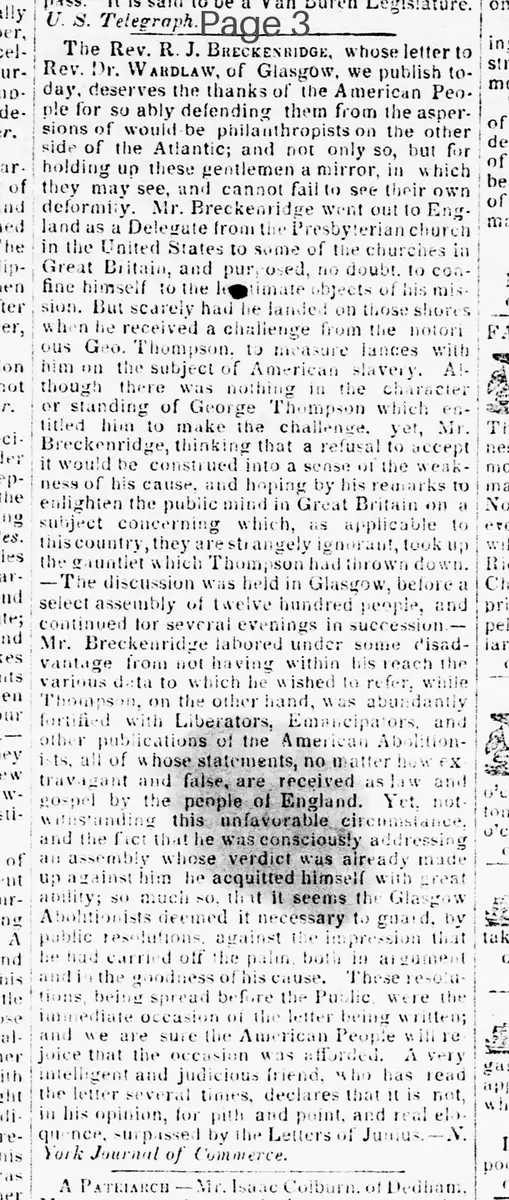
The Rev. R. J. Breckenridge, whose letter to Rev. Dr. Wardlaw, of Glasgow, we publish to-day, deserves the thanks of the American People for so ably defending them from the aspersions of would-be philanthropists on the other side of the Atlantic; and not only so, but for holding up these gentlemen a mirror, in which they may see, and cannot fail to see their own deformity. Mr. Breckenridge went out to England as a Delegate from the Presbyterian church in the United States to some of the churches in Great Britain, and proposed, no doubt, to confine himself to the legitimate objects of his mission. But scarcely had he landed on those shores when he received a challenge from the notorious Geo. Thompson, to measure lances with him on the subject of American slavery. Although there was nothing in the character or standing of George Thompson which entitled him to make the challenge, yet, Mr. Breckenridge, thinking that a refusal to accept it would be construed into a sense of the weakness of his cause, and hoping by his remarks to enlighten the public mind in Great Britain on a subject concerning which, as applicable to this country, they are strangely ignorant, took up the gauntlet which Thompson had thrown down.—The discussion was held in Glasgow, before a select assembly of twelve hundred people, and continued for several evenings in succession—Mr. Breckenridge labored under some disadvantage from not having within his reach the various data to which he wished to refer, while Thompson, on the other hand, was abundantly fortified with Liberators, Emancipators, and other publications of the American Abolitionists, all of whose statements, no matter how extravagant and false, are received as law and gospel by the people of England. Yet, notwithstanding this unfavorable circumstance and the fact that he was consciously addressing an assembly whose verdict was already made up against him he acquitted himself with great ability; so much so, that it seems the Glasgow Abolitionists deemed it necessary to guard, by public resolutions, against the impression that he had carried off the palm, both in argument and in the goodness of his cause. These resolutions, being spread before the Public, were the immediate occasion of the letter being written; and we are sure the American People will rejoice that the occasion was afforded. A very intelligent and judicious friend, who has read the letter several times, declares that it is not, in his opinion, for pith and point, and ready eloquence, surpassed by the Letters of Junius.—N. York Journal of Commerce.