Thank you for visiting SNEWPapers!
Sign up free
Mcallen Daily Press
Mcallen, Hidalgo County, Texas
What is this article about?
Philadelphia faces a $25 million deficit for the 1939 budget, leading to a proposed income tax ordinance that sparked public outrage and demands for repeal. The city council considered alternatives like spreading the deficit, selling assets, or a sales tax via a straw vote.
Clipping
OCR Quality
Full Text
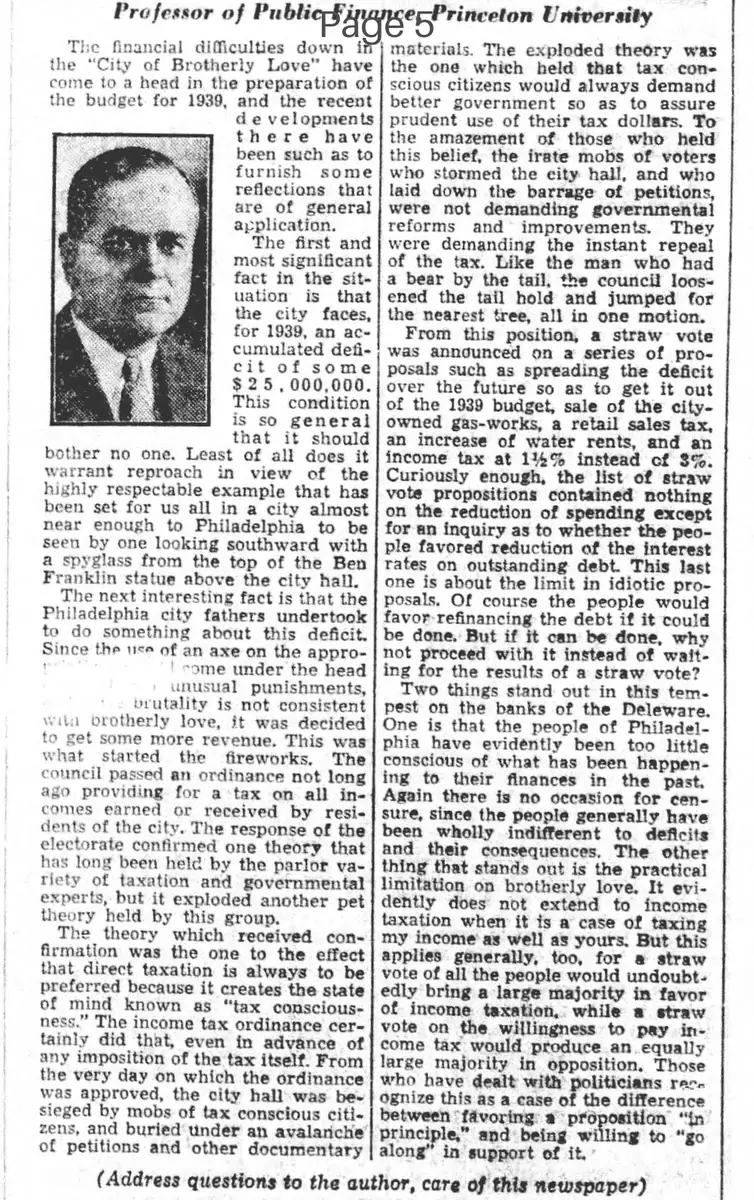
The first and most significant fact in the situation is that the city faces, for 1939, an accumulated deficit of some $25,000,000.
This condition is so general that it should bother no one. Least of all does it warrant reproach in view of the highly respectable example that has been set for us all in a city almost near enough to Philadelphia to be seen by one looking southward with a spyglass from the top of the Ben Franklin statue above the city hall.
The next interesting fact is that the Philadelphia city fathers undertook to do something about this deficit. Since the use of an axe on the appropriations under the head of unusual punishments, brutality is not consistent with brotherly love, it was decided to get some more revenue. This was what started the fireworks. The council passed an ordinance not long ago providing for a tax on all incomes earned or received by residents of the city. The response of the electorate confirmed one theory that has long been held by the parlor variety of taxation and governmental experts, but it exploded another pet theory held by this group.
The theory which received confirmation was the one to the effect that direct taxation is always to be preferred because it creates the state of mind known as "tax consciousness." The income tax ordinance certainly did that, even in advance of any imposition of the tax itself. From the very day on which the ordinance was approved, the city hall was besieged by mobs of tax conscious citizens, and buried under an avalanche of petitions and other documentary materials.
The exploded theory was the one which held that tax conscious citizens would always demand better government so as to assure prudent use of their tax dollars. To the amazement of those who held this belief, the irate mobs of voters who stormed the city hall, and who laid down the barrage of petitions, were not demanding governmental reforms and improvements. They were demanding the instant repeal of the tax. Like the man who had a bear by the tail, the council loosened the tail hold and jumped for the nearest tree, all in one motion.
From this position, a straw vote was announced on a series of proposals such as spreading the deficit over the future so as to get it out of the 1939 budget, sale of the city-owned gas-works, a retail sales tax, an increase of water rents, and an income tax at 1 1/2% instead of 3%.
Curiously enough, the list of straw vote propositions contained nothing on the reduction of spending except for an inquiry as to whether the people favored reduction of the interest rates on outstanding debt. This last one is about the limit in idiotic proposals. Of course the people would favor refinancing the debt if it could be done. But if it can be done, why not proceed with it instead of waiting for the results of a straw vote?
Two things stand out in this tempest on the banks of the Delaware. One is that the people of Philadelphia have evidently been too little conscious of what has been happening to their finances in the past. Again there is no occasion for censure, since the people generally have been wholly indifferent to deficits and their consequences. The other thing that stands out is the practical limitation on brotherly love. It evidently does not extend to income taxation when it is a case of taxing my income as well as yours. But this applies generally, too, for a straw vote of all the people would undoubtedly bring a large majority in favor of income taxation, while a straw vote on the willingness to pay income tax would produce an equally large majority in opposition. Those who have dealt with politicians recognize this as a case of the difference between favoring a proposition "in principle," and being willing to "go along" in support of it.
What sub-type of article is it?
What keywords are associated?
Where did it happen?
Domestic News Details
Primary Location
Philadelphia
Event Date
1939 Budget Preparation
Outcome
income tax ordinance passed but faced immediate public backlash and demands for repeal; straw vote proposed on alternatives including deficit spreading, asset sales, sales tax, water rent increase, and reduced income tax rate.
Event Details
Philadelphia's city council addressed a $25 million accumulated deficit for 1939 by passing an income tax ordinance, which provoked mobs of citizens and petitions demanding its repeal rather than governmental reforms. A straw vote was announced on various proposals to handle the deficit, excluding major spending cuts.