Thank you for visiting SNEWPapers!
Sign up free
The New Hampshire Gazette And General Advertiser
Portsmouth, Exeter, Rockingham County, New Hampshire
What is this article about?
A London review of British national affairs focusing on America discusses language sympathies, French influence in Russia, the February coalition between Lord North and Mr. Fox, criticisms of the peace terms granting American independence, and the fall of Lord Shelburne amid political instability.
Merged-components note: Direct textual continuation of the same article on national affairs respecting America.
Clipping
OCR Quality
Full Text
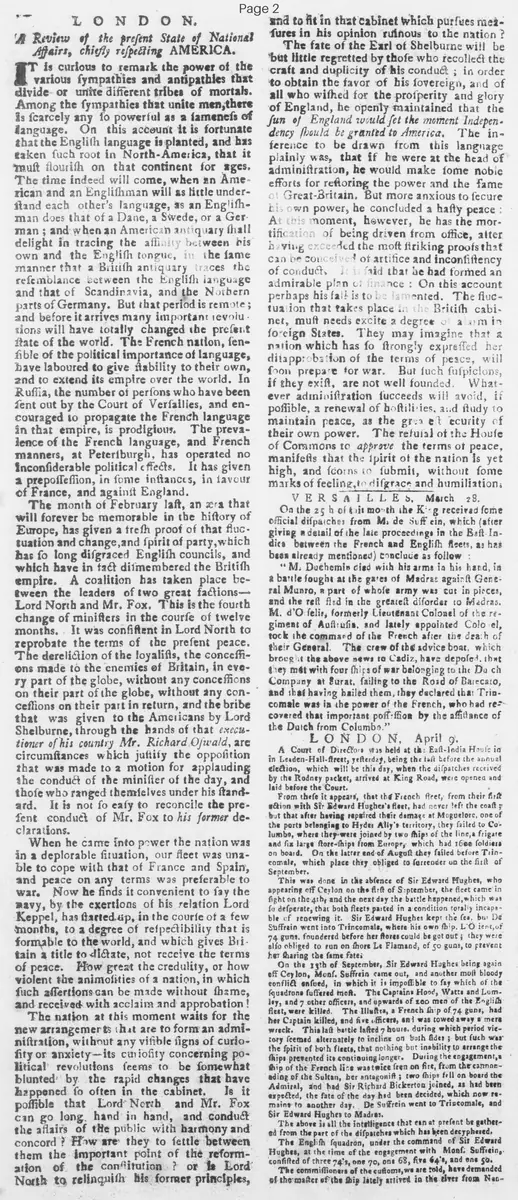
A Review of the present State of National Affairs, chiefly respecting AMERICA.
It is curious to remark the power of the various sympathies and antipathies that divide or unite different tribes of mortals. Among the sympathies that unite men, there is scarcely any so powerful as a sameness of language. On this account it is fortunate that the English language is planted, and has taken such root in North-America, that it must flourish on that continent for ages. The time indeed will come, when an American and an Englishman will as little understand each other's language, as an Englishman does that of a Dane, a Swede, or a German; and when an American antiquary shall delight in tracing the affinity between his own and the English tongue, in the same manner that a British antiquary traces the resemblance between the English language and that of Scandinavia, and the Northern parts of Germany. But that period is remote; and before it arrives many important revolutions will have totally changed the present state of the world. The French nation, sensible of the political importance of language, have laboured to give stability to their own, and to extend its empire over the world. In Russia, the number of persons who have been sent out by the Court of Versailles, and encouraged to propagate the French language in that empire, is prodigious. The prevalence of the French language, and French manners, at Petersburg, has operated no inconsiderable political effects. It has given a prepossession, in some instances, in favour of France, and against England. The month of February last, an era that will forever be memorable in the history of Europe, has given a fresh proof of that fluctuation and change, and spirit of party, which has so long disgraced English councils, and which have in fact dismembered the British empire. A coalition has taken place between the leaders of two great factions—Lord North and Mr. Fox. This is the fourth change of ministers in the course of twelve months. It was consistent in Lord North to reprobate the terms of the present peace. The dereliction of the loyalists, the concessions made to the enemies of Britain, in every part of the globe, without any concessions on their part in return, and the bribe that was given to the Americans by Lord Shelburne, through the hands of that executioner of his country Mr. Richard Oswald, are circumstances which justify the opposition that was made to a motion for applauding the conduct of the minister of the day, and those who ranged themselves under his standard. It is not so easy to reconcile the present conduct of Mr. Fox to his former declarations. When he came into power the nation was in a deplorable situation, our fleet was unable to cope with that of France and Spain, and peace on any terms was preferable to war. Now he finds it convenient to say the navy, by the exertions of his relation Lord Keppel, has started up, in the course of a few months, to a degree of respectability that is formidable to the world, and which gives Britain a title to dictate, not receive the terms of peace. How great the credulity, or how violent the animosities of a nation, in which such assertions can be made without shame, and received with acclamation and approbation! The nation at this moment waits for the new arrangements that are to form an administration, without any visible signs of curiosity or anxiety—its curiosity concerning political revolutions seems to be somewhat blunted by the rapid changes that have happened so often in the cabinet. Is it possible that Lord North and Mr. Fox can go long hand in hand, and conduct the affairs of the public with harmony and concord? How are they to settle between them the important point of the reformation of the constitution? or is Lord North to relinquish his former principles,
and to sit in that cabinet which pursues measures in his opinion ruinous to the nation? The fate of the Earl of Shelburne will be but little regretted by those who recollect the craft and duplicity of his conduct: in order to obtain the favor of his sovereign, and of all who wished for the prosperity and glory of England, he openly maintained that the sun of England would set the moment Independence should be granted to America. The inference to be drawn from this language plainly was, that if he were at the head of administration, he would make some noble efforts for restoring the power and the fame of Great-Britain. But more anxious to secure his own power, he concluded a hasty peace: At this moment, however, he has the mortification of being driven from office, after having exceeded the most striking proofs that can be conceived of artifice and inconsistency of conduct. It is said that he had formed an admirable plan of finance: On this account perhaps his fall is to be lamented. The fluctuation that takes place in the British cabinet, must needs excite a degree of alarm in foreign States. They may imagine that a nation which has so strongly expressed her disapprobation of the terms of peace, will soon prepare for war. But such suspicions, if they exist, are not well founded. Whatever administration succeeds will avoid, if possible, a renewal of hostilities, and study to maintain peace, as the greatest security of their own power. The refusal of the House of Commons to approve the terms of peace, manifests that the spirit of the nation is yet high, and scorns to submit, without some marks of feeling, to disgrace and humiliation.
What sub-type of article is it?
What keywords are associated?
What entities or persons were involved?
Where did it happen?
Foreign News Details
Primary Location
London
Event Date
The Month Of February Last
Key Persons
Outcome
coalition between lord north and mr. fox; fourth change of ministers in twelve months; fall of earl of shelburne; house of commons refusal to approve peace terms; concessions to america including independence; dereliction of loyalists.
Event Details
Review of British political instability following peace with America, highlighting language sympathies uniting English speakers, French cultural influence in Russia favoring France over England, February coalition of factions led by Lord North and Mr. Fox amid criticisms of hasty peace terms by Shelburne granting American independence, naval recovery under Keppel, and national discontent with concessions without reciprocation.