Thank you for visiting SNEWPapers!
Sign up free
Literary
June 26, 1787
The New York Packet
New York, New York County, New York
What is this article about?
An essay exploring the human tendency to fail in keeping resolutions due to the overpowering force of habit. It argues that self-knowledge is rare, most people avoid introspection, and true change is gradual, not sudden, emphasizing caution to avoid bad habits.
Clipping
OCR Quality
98%
Excellent
Full Text
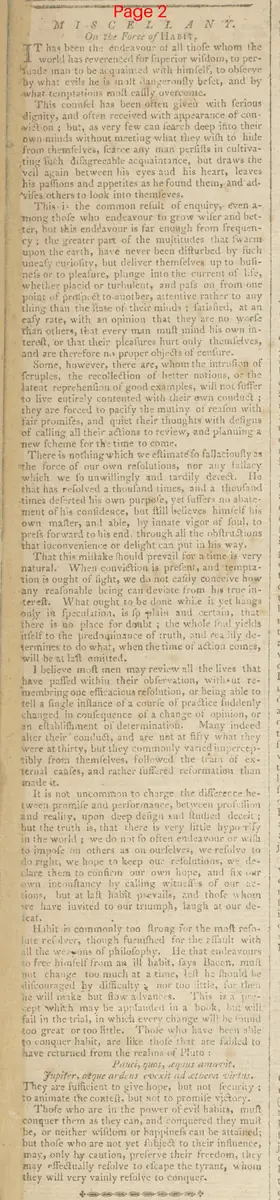
MISCELLANY
On the Force of Habit.
It has been the endeavour of all those whom the world has reverenced for superior wisdom, to persuade man to be acquainted with himself, to observe by what evils he is most dangerously beset, and by what temptations most easily overcome.
This counsel has been often given with serious dignity, and often received with appearance of conviction; but, as very few can search deep into their own minds without meeting what they wish to hide from themselves, scarce any man persists in cultivating such disagreeable acquaintance, but draws the veil again between his eyes and his heart, leaves his passions and appetites as he found them, and advises others to look into themselves.
This is the common result of enquiry, even among those who endeavour to grow wiser and better, but this endeavour is far enough from frequency; the greater part of the multitudes that warm upon the earth, have never been disturbed by such uneasy curiosity, but deliver themselves up to business or to pleasure, plunge into the current of life, whether placid or turbulent, and pass on from one point of prospect to another, attentive rather to anything than the state of their minds; satisfied, at an easy rate, with an opinion that they are no worse than others, that every man must mind his own interest, or that their pleasures hurt only themselves, and are therefore no proper objects of censure.
Some, however, there are, whom the intrusion of scruples, the recollection of better notions, or the latent reprehension of good examples, will not suffer to live entirely contented with their own conduct; they are forced to pacify the mutiny of reason with fair promises, and quiet their thoughts with designs of calling all their actions to review, and planning a new scheme for the time to come.
There is nothing which we estimate so fallaciously as the force of our own resolutions, nor any fallacy which we so unwillingly and tardily detect. He that has resolved a thousand times, and a thousand times deserted his own purpose, yet suffers no abatement of his confidence, but still believes himself his own master, and able, by innate vigor of soul, to press forward to his end, through all the obstructions that inconvenience or delight can put in his way.
That this mistake should prevail for a time is very natural. When conviction is present, and temptation out of sight, we do not easily conceive how any reasonable being can deviate from his true interest. What ought to be done while it yet hangs only in speculation, is so plain and certain, that there is no place for doubt; the whole soul yields itself to the predominance of truth, and readily determines to do what, when the time of action comes, will be at last omitted.
I believe most men may review all the lives that have passed within their observation, without remembering one efficacious resolution, or being able to tell a single instance of a course of practice suddenly changed in consequence of a change of opinion, or an establishment of determination. Many indeed alter their conduct, and are not at fifty what they were at thirty, but they commonly varied imperceptibly from themselves, followed the train of external causes, and rather suffered reformation than made it.
It is not uncommon to charge the difference between promise and performance, between profession and reality, upon deep design and studied deceit; but the truth is, that there is very little hypocrisy in the world; we do not so often endeavour or wish to impose on others as on ourselves, we resolve to do right, we hope to keep our resolutions, we declare them to confirm our own hope, and fix our own inconstancy by calling witnesses of our actions, but at last habit prevails, and those whom we have invited to our triumph, laugh at our defeat.
Habit is commonly too strong for the most resolute resolver, though furnished for the assault with all the weapons of philosophy. He that endeavours to free himself from an ill habit, says Bacon, must not change too much at a time, lest he should be discouraged by difficulty nor too little, for then he will make but slow advances. This is a precept which may be applauded in a book, but will fail in the trial, in which every change will be found too great or too little. Those who have been able to conquer habit, are like those that are fabled to have returned from the realms of Pluto:
Pauci, quos aequus amavit
Jupiter, atque ardens evexit ad aethera virtus.
They are sufficient to give hope, but not security: to animate the contest, but not to promise victory. Those who are in the power of evil habits, must conquer them as they can, and conquered they must be, or neither wisdom nor happiness can be attained; but those who are not yet subject to their influence, may, only by caution, preserve their freedom, they may effectually resolve to escape the tyrant, whom they will very vainly resolve to conquer.
On the Force of Habit.
It has been the endeavour of all those whom the world has reverenced for superior wisdom, to persuade man to be acquainted with himself, to observe by what evils he is most dangerously beset, and by what temptations most easily overcome.
This counsel has been often given with serious dignity, and often received with appearance of conviction; but, as very few can search deep into their own minds without meeting what they wish to hide from themselves, scarce any man persists in cultivating such disagreeable acquaintance, but draws the veil again between his eyes and his heart, leaves his passions and appetites as he found them, and advises others to look into themselves.
This is the common result of enquiry, even among those who endeavour to grow wiser and better, but this endeavour is far enough from frequency; the greater part of the multitudes that warm upon the earth, have never been disturbed by such uneasy curiosity, but deliver themselves up to business or to pleasure, plunge into the current of life, whether placid or turbulent, and pass on from one point of prospect to another, attentive rather to anything than the state of their minds; satisfied, at an easy rate, with an opinion that they are no worse than others, that every man must mind his own interest, or that their pleasures hurt only themselves, and are therefore no proper objects of censure.
Some, however, there are, whom the intrusion of scruples, the recollection of better notions, or the latent reprehension of good examples, will not suffer to live entirely contented with their own conduct; they are forced to pacify the mutiny of reason with fair promises, and quiet their thoughts with designs of calling all their actions to review, and planning a new scheme for the time to come.
There is nothing which we estimate so fallaciously as the force of our own resolutions, nor any fallacy which we so unwillingly and tardily detect. He that has resolved a thousand times, and a thousand times deserted his own purpose, yet suffers no abatement of his confidence, but still believes himself his own master, and able, by innate vigor of soul, to press forward to his end, through all the obstructions that inconvenience or delight can put in his way.
That this mistake should prevail for a time is very natural. When conviction is present, and temptation out of sight, we do not easily conceive how any reasonable being can deviate from his true interest. What ought to be done while it yet hangs only in speculation, is so plain and certain, that there is no place for doubt; the whole soul yields itself to the predominance of truth, and readily determines to do what, when the time of action comes, will be at last omitted.
I believe most men may review all the lives that have passed within their observation, without remembering one efficacious resolution, or being able to tell a single instance of a course of practice suddenly changed in consequence of a change of opinion, or an establishment of determination. Many indeed alter their conduct, and are not at fifty what they were at thirty, but they commonly varied imperceptibly from themselves, followed the train of external causes, and rather suffered reformation than made it.
It is not uncommon to charge the difference between promise and performance, between profession and reality, upon deep design and studied deceit; but the truth is, that there is very little hypocrisy in the world; we do not so often endeavour or wish to impose on others as on ourselves, we resolve to do right, we hope to keep our resolutions, we declare them to confirm our own hope, and fix our own inconstancy by calling witnesses of our actions, but at last habit prevails, and those whom we have invited to our triumph, laugh at our defeat.
Habit is commonly too strong for the most resolute resolver, though furnished for the assault with all the weapons of philosophy. He that endeavours to free himself from an ill habit, says Bacon, must not change too much at a time, lest he should be discouraged by difficulty nor too little, for then he will make but slow advances. This is a precept which may be applauded in a book, but will fail in the trial, in which every change will be found too great or too little. Those who have been able to conquer habit, are like those that are fabled to have returned from the realms of Pluto:
Pauci, quos aequus amavit
Jupiter, atque ardens evexit ad aethera virtus.
They are sufficient to give hope, but not security: to animate the contest, but not to promise victory. Those who are in the power of evil habits, must conquer them as they can, and conquered they must be, or neither wisdom nor happiness can be attained; but those who are not yet subject to their influence, may, only by caution, preserve their freedom, they may effectually resolve to escape the tyrant, whom they will very vainly resolve to conquer.
What sub-type of article is it?
Essay
What themes does it cover?
Moral Virtue
Temperance
What keywords are associated?
Habit
Resolutions
Self Deception
Moral Improvement
Philosophy
Reformation
Literary Details
Title
On The Force Of Habit.
Subject
The Force Of Habit And Failure Of Resolutions
Key Lines
There Is Nothing Which We Estimate So Fallaciously As The Force Of Our Own Resolutions, Nor Any Fallacy Which We So Unwillingly And Tardily Detect.
Habit Is Commonly Too Strong For The Most Resolute Resolver, Though Furnished For The Assault With All The Weapons Of Philosophy.
He That Endeavours To Free Himself From An Ill Habit, Says Bacon, Must Not Change Too Much At A Time, Lest He Should Be Discouraged By Difficulty Nor Too Little, For Then He Will Make But Slow Advances.
Pauci, Quos Aequus Amavit
Jupiter, Atque Ardens Evexit Ad Aethera Virtus.
Those Who Are In The Power Of Evil Habits, Must Conquer Them As They Can, And Conquered They Must Be, Or Neither Wisdom Nor Happiness Can Be Attained