Thank you for visiting SNEWPapers!
Sign up free
Letter to Editor
January 19, 1793
Gazette Of The United States
New York, New York County, New York
What is this article about?
A letter to the Gazette critiques the army memorial's claim that certificates paid only 3/ in the pound instead of 6/, arguing they evidenced the full demand on settlement and the principle is unfounded.
Clipping
OCR Quality
98%
Excellent
Full Text
For the GAZETTE of the UNITED STATES.
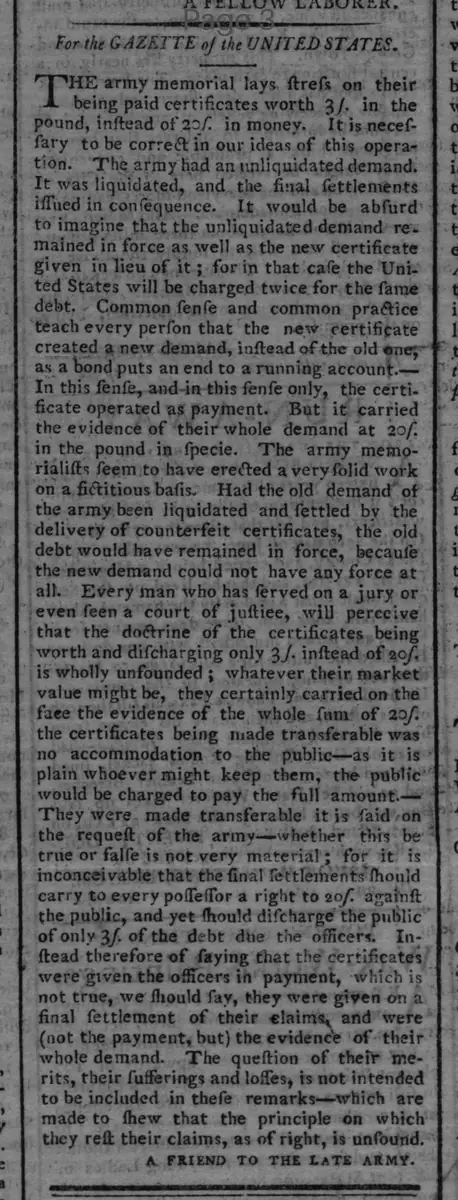
THE army memorial lays stress on their being paid certificates worth 3/. in the pound, instead of 6/. in money. It is necessary to be correct in our ideas of this operation. The army had an unliquidated demand. It was liquidated, and the final settlements issued in consequence. It would be absurd to imagine that the unliquidated demand remained in force as well as the new certificate given in lieu of it ; for in that case the United States will be charged twice for the same debt. Common sense and common practice teach every person that the new certificate created a new demand, instead of the old one, as a bond puts an end to a running account.—In this sense, and in this sense only, the certificate operated as payment. But it carried the evidence of their whole demand at 6/. in the pound in specie. The army memorialists seem to have erected a very solid work on a fictitious basis. Had the old demand of the army been liquidated and settled by the delivery of counterfeit certificates, the old debt would have remained in force, because the new demand could not have any force at all. Every man who has served on a jury or even seen a court of justice, will perceive that the doctrine of the certificates being worth and discharging only 3/. instead of 6/. is wholly unfounded; whatever their market value might be, they certainly carried on the face the evidence of the whole sum of 6/. the certificates being made transferable was no accommodation to the public—as it is plain whoever might keep them, the public would be charged to pay the full amount. They were made transferable it is said on the request of the army whether this be true or false is not very material; for it is inconceivable that the final settlements should carry to every possessor a right to 6/. against the public, and yet should discharge the public of only 3/. of the debt due the officers. Instead therefore of saying that the certificates were given the officers in payment, which is not true, we should say, they were given on a final settlement of their claims, and were (not the payment, but) the evidence of their whole demand. The question of their merits, their sufferings and losses, is not intended to be included in these remarks which are made to shew that the principle on which they rest their claims, as of right, is unsound.
A FRIEND TO THE LATE ARMY.
THE army memorial lays stress on their being paid certificates worth 3/. in the pound, instead of 6/. in money. It is necessary to be correct in our ideas of this operation. The army had an unliquidated demand. It was liquidated, and the final settlements issued in consequence. It would be absurd to imagine that the unliquidated demand remained in force as well as the new certificate given in lieu of it ; for in that case the United States will be charged twice for the same debt. Common sense and common practice teach every person that the new certificate created a new demand, instead of the old one, as a bond puts an end to a running account.—In this sense, and in this sense only, the certificate operated as payment. But it carried the evidence of their whole demand at 6/. in the pound in specie. The army memorialists seem to have erected a very solid work on a fictitious basis. Had the old demand of the army been liquidated and settled by the delivery of counterfeit certificates, the old debt would have remained in force, because the new demand could not have any force at all. Every man who has served on a jury or even seen a court of justice, will perceive that the doctrine of the certificates being worth and discharging only 3/. instead of 6/. is wholly unfounded; whatever their market value might be, they certainly carried on the face the evidence of the whole sum of 6/. the certificates being made transferable was no accommodation to the public—as it is plain whoever might keep them, the public would be charged to pay the full amount. They were made transferable it is said on the request of the army whether this be true or false is not very material; for it is inconceivable that the final settlements should carry to every possessor a right to 6/. against the public, and yet should discharge the public of only 3/. of the debt due the officers. Instead therefore of saying that the certificates were given the officers in payment, which is not true, we should say, they were given on a final settlement of their claims, and were (not the payment, but) the evidence of their whole demand. The question of their merits, their sufferings and losses, is not intended to be included in these remarks which are made to shew that the principle on which they rest their claims, as of right, is unsound.
A FRIEND TO THE LATE ARMY.
What sub-type of article is it?
Persuasive
Informative
Political
What themes does it cover?
Economic Policy
Military War
What keywords are associated?
Army Certificates
Final Settlements
Public Debt
Army Memorial
Revolutionary Claims
What entities or persons were involved?
A Friend To The Late Army
Gazette Of The United States
Letter to Editor Details
Author
A Friend To The Late Army
Recipient
Gazette Of The United States
Main Argument
the army certificates were not payment of only 3/ in the pound but evidence of the full 6/ demand on final settlement, making the memorial's claim principle unsound.
Notable Details
Analogy To Bond Ending Running Account
Reference To Jury And Court Of Justice
Certificates Made Transferable At Army's Request