Thank you for visiting SNEWPapers!
Sign up free
Gainesville Daily Sun
Gainesville, Alachua County, Florida
What is this article about?
President Taft tours New Orleans' French Quarter, shows deep interest in its history and preservation, visits military sites, speaks on state history, attends concert at Tulane, then departs tired for Jackson, MS. (Nov. 1)
Merged-components note: Continuation of narrative story about President Taft's visit to New Orleans across pages.
Clippings
1 of 2
OCR Quality
Full Text
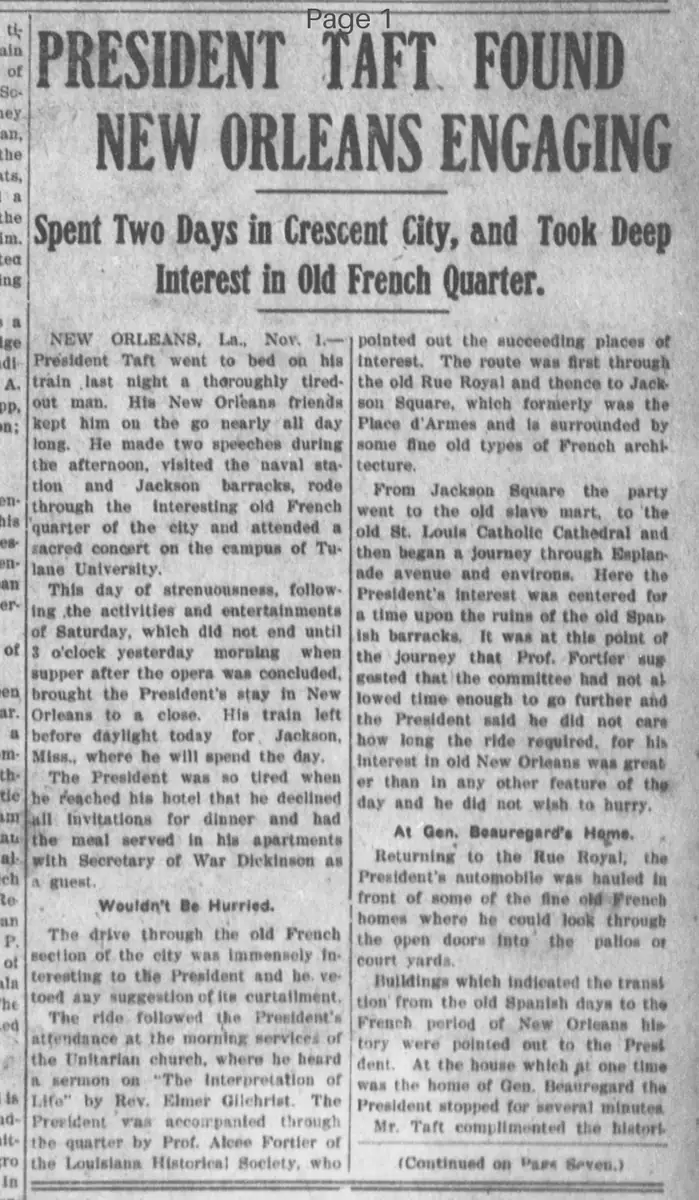
Spent Two Days in Crescent City, and Took Deep Interest in Old French Quarter.
NEW ORLEANS, La., Nov. 1.
President Taft went to bed on his train last night a thoroughly tired-out man.
His New Orleans friends kept him on the go nearly all day long.
He made two speeches during the afternoon, visited the naval station and Jackson barracks, rode through the interesting old French quarter of the city and attended a sacred concert on the campus of Tulane University.
This day of strenuousness, following the activities and entertainments of Saturday, which did not end until 3 o'clock yesterday morning when supper after the opera was concluded, brought the President's stay in New Orleans to a close.
His train left before daylight today for Jackson, Miss., where he will spend the day.
The President was so tired when he reached his hotel that he declined all invitations for dinner and had the meal served in his apartments with Secretary of War Dickinson as a guest.
Wouldn't Be Hurried.
The drive through the old French section of the city was immensely interesting to the President and he vetoed any suggestion of curtailment.
The ride followed the President's attendance at the morning services of the Unitarian church, where he heard a sermon on "The Interpretation of Life" by Rev. Elmer Gilchrist.
The President was accompanied through the quarter by Prof. Alcee Fortier of the Louisiana Historical Society, who pointed out the succeeding places of interest.
The route was first through the old Rue Royal and thence to Jackson Square, which formerly was the Place d'Armes and surrounded by some fine old types of French architecture.
From Jackson Square the party went to the old slave mart, to the old St. Louis Catholic Cathedral and then began a journey through Esplanade avenue and environs.
Here the President's interest was centered for a time upon the ruins of the old Spanish barracks.
It was at this point of the journey that Prof. Fortier suggested that the committee had not allowed time enough to go further and the President said he did not care how long the ride required, for his interest in old New Orleans was greater than in any other feature of the day and he did not wish to hurry.
At Gen. Beauregard's Home.
Returning to the Rue Royal, the President's automobile was halted in front of some of the old French homes where he could look through the open doors into the patios of court yards.
Buildings which indicated the transition from the old Spanish days to the French period of New Orleans history were pointed out to the President.
At the house which at one time was the home of Gen. Beauregard the President stopped for several minutes.
Mr. Taft complimented the historical society.
(Continued on Page Seven).
President Taft Found New Orleans Engaging.
Continued from Page One.
Society upon the preservation of records of old New Orleans and expressed regret to see that here and there modern buildings were springing up in the old quarter and the old landmarks were being torn down. He declared it seemed like a desecration. Historical ride ended, the President boarded a revenue cutter and was taken to the New Orleans naval station where he debarked and made full inspection.
400 Voices Sing "Dixie."
Cutter next conveyed him to Jackson barracks, where he was received by Col. Foote, commanding the coast artillery force stationed there, and where he reviewed the troops of the garrison. At Jackson barracks the President was entertained at a Creole luncheon given by the ladies and the Historical Society. While the luncheon was in progress, Prof. Fortier read a most interesting paper on the history of the city and the President often stopped to listen for long periods. Prof. Fortier had concluded, Taft made a speech in which he paid tribute to Louisiana for the role the State had played in the history of the country. Back in New Orleans the President left the cutter to again enter an automobile and was whisked away to Tulane campus, where a crowd of many thousands had assembled for the sacred concert. A chorus of 400 men and women sang "Dixie" as the President arrived. From a stand erected in the center of the campus and facing the big football grand stand the President made his second speech of the day and retired on his special train at 10 o'clock.
What sub-type of article is it?
What themes does it cover?
What keywords are associated?
What entities or persons were involved?
Where did it happen?
Story Details
Key Persons
Location
New Orleans, Louisiana
Event Date
Nov. 1
Story Details
President Taft spends a strenuous day in New Orleans touring the historic French Quarter with Prof. Fortier, expressing regret over modern encroachments on landmarks; visits naval station and Jackson Barracks for inspections and luncheon; delivers speeches on Louisiana's history; attends sacred concert at Tulane University before departing for Jackson, Mississippi.