Thank you for visiting SNEWPapers!
Sign up free
Editorial
November 6, 1826
The Virginian
Lynchburg, Virginia
What is this article about?
Editors of The Virginian defend their independent pro-Adams stance in the 1828 election, thank patrons, allow opposing views in columns, note favorable election results in Ohio and New Jersey, critique Jackson supporters, comment on press incidents, and mention news like Monroe's potential Panama appointment. (248 characters)
Clipping
OCR Quality
98%
Excellent
Full Text
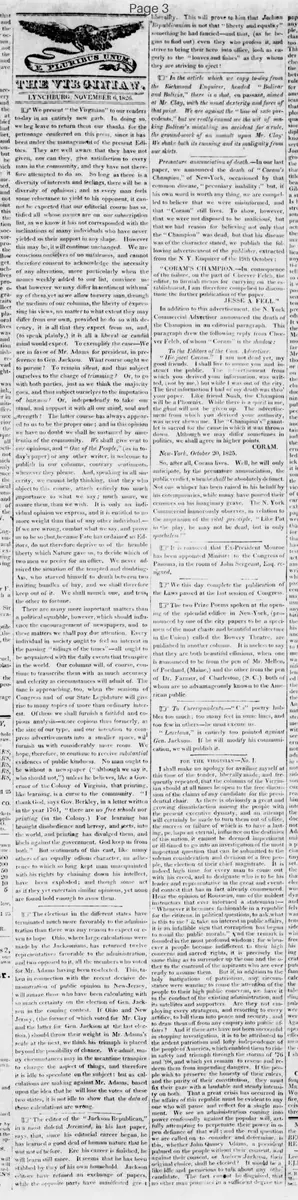
THE VIRGINIAN
LYNCHBURG, NOVEMBER 6, 1826.
We present "the Virginian" to our readers to-day in an entirely new garb. In doing so, we beg leave to return them our thanks for the patronage conferred on this press, since it has been under the management of the present Editors. They are well aware that they have not given, nor can they, give satisfaction to every man in the community, and they have not therefore attempted to do so. So long as there is a diversity of interests and feelings, there will be a diversity of opinions; and as every man feels some reluctance to yield to his opponent, it cannot be expected that our editorial course has satisfied all whose names are on our subscription list, as we know it has not corresponded with the inclinations of many individuals who have never yielded us their support in any shape. However this may be, it will continue unchanged. We are conscious ourselves of no unfairness, and cannot therefore consent to acknowledge the necessity of any alteration, more particularly when the names weekly added to our list, convince us that however we may differ in sentiment with many of them, yet as we allow to every man, through the medium of our columns, the liberty of expressing his views, no matter to what extent they may differ from our own, provided he do so with decency, it is all that they expect from us, and (to speak plainly,) it is all a liberal or candid mind would expect. To exemplify the case—We are in favor of Mr. Adams for president, in preference to Gen. Jackson. What course ought we to pursue? To remain silent, and thus subject ourselves to the charge of trimming? Or, to go with both parties, just as we think the majority goes, and thus subject ourselves to the imputation of baseness? Or, independently to take our stand, and support it with all our mind, soul and strength? The latter course has always appeared to us to be the proper one; and in this opinion we have no doubt we shall be sustained by nine tenths of the community. We shall give vent to our opinions, and "One of the People." (as in to-day's paper) or any other writer, is welcome to publish in our columns, contrary sentiments, whenever they please. And, speaking in all sincerity, we cannot help thinking, that they who object to this course, attach entirely too much importance to what we say; much more, we assure them, than we wish. It is only an individual opinion we express, and it is entitled to no more weight than that of any other individual—If we are wrong, combat what we say, and prove us to be so; but, because Fate has ordained us Editors, do not therefore deprive us of the humble liberty which Nature gave us, to decide which of two men we prefer for an office. We never admired the situation of the tempted and doubting Ass, who starved himself to death between two inviting bundles of hay, and we shall therefore keep out of it. We shall munch one, and trust the other to fortune. There are many more important matters than a political squabble, however, which should influence the encouragement of newspapers, and to these matters we shall pay due attention. Every individual in society ought to feel an interest in the passing "tidings of the times"—all ought to be acquainted with the daily events that transpire in the world. Our columns will, of course, continue to transcribe them with as much accuracy and celerity as circumstances will admit of. The time is approaching, too, when the sessions of Congress and of our State Legislature will give rise to many topics of more than ordinary interest. Of these we shall furnish a faithful and copious analysis—more copious than formerly, as the size of our type, and our intention to compress advertisements into a smaller space, will furnish us with considerably more room. We hope, therefore, to continue to receive substantial evidences of public kindness. No man ought to be without a newspaper ("although we say it, who should not,") unless he believes, like a Governor of the Colony of Virginia, that printing, like learning, is a curse to the community. "I thank God, says Gov. Berkeley, in a letter written in the year 1671, "there are no free schools nor printing (in the Colony.) For learning has brought disobedience and heresy, and sects into the world, and printing has divulged them, and libels against the government. God keep us from both." But sentiments of this cast, like many others of an equally odious character, an adherence to which so long kept man unacquainted with his rights by chaining down his intellect, have been exploded; and though some act as if they yet entertain similar opinions, yet none are found bold enough to avow them.
The elections in the different states have terminated much more favorably to the administration than there was any reason to expect or even to hope. Ohio, where large calculations were made by the Jacksonians, has returned twelve representatives favorable to the administration, and two opposed to it, all the members who voted for Mr. Adams having been re-elected. This, taken in connection with the recent decisive demonstration of public opinion in New-Jersey, will amaze those who have been calculating with so much certainty on the election of Gen. Jackson in the coming contest. If Ohio and New Jersey, (the former of which voted for Mr. Clay and the latter for Gen. Jackson at the last election,) should throw their weight in Mr. Adams's scale at the next, we think his triumph is placed beyond the possibility of chance. We admit, many circumstances may in the meantime transpire to change the aspect of things, and therefore it is idle to speculate on the subject: but as calculations are making against Mr. Adams, based upon the idea that he will lose the votes of these two states, it is not idle to show that the data of these calculations are wrong.
The editor of the "Jackson Republican," in a most doleful Jeremiad, in his last paper, says, that, since his editorial career began, he has learned a good deal of human nature that he wot not of before. Ere his career is finished, he will learn still more. It seems that he has been stabbed by they of his own household. Jackson editors have refused an exchange of papers, while the opposite party have manifested great liberality. This will prove to him that Jackson Republicanism is not that "liberty and equality" something he had fancied—and that, (as he begins to find out) even they who profess it, and strive to bring their hero into office, look as eagerly to the "loaves and fishes" as they whom they are striving to eject!
In the article which we copy to-day from the Richmond Enquirer, headed "Bolivar and Bolivia," there is a shot, en passant, aimed at Mr. Clay, with the usual dexterity and force of that print. We are against the "line of safe precedents," but we really cannot see the wit of making Bolivar's mistaking an accident for a rule, the ground-work of an assault upon Mr. Clay. We shake both its cunning and its malignity from our skirts.
Premature annunciation of death.—In our last paper, we announced the death of "Coram's Champion," of New-York, occasioned by that common disease, "pecuniary inability;" but, if his own word is worth any thing, we are compelled to believe that we were misinformed, and that "Coram" still lives. To show, however, that we were not disposed to be malicious, but that we had reason for believing not only that the "Champion" was dead, but that his disease was of the character stated, we publish the following advertisement of the publisher, extracted from the N. Y. Enquirer of the 19th October:
"CORAM'S CHAMPION.—In consequence of the failure, on the part of Cheever Felch, the editor, to furnish means for carrying on the establishment, I am therefore compelled to discontinue the further publication of the paper.
JESSE A. FELL."
In addition to this advertisement, the N. York Commercial Advertiser announced the death of the Champion in an editorial paragraph. This paragraph drew the following reply from Cheever Felch, of whom "Coram" is the shadow:
To the Editors of the Com. Advertiser.
"Hic jacet Coram." I am not dead yet, my good friends. I shall live to amuse you and instruct the public. The advertisement from which you derived your information, was written, (not by me,) but while I was out of the city. The first information I had of my death was through your paper. Like friend Noah, the Champion will be a Phoenix. While there is a spirit in me, the ghost will not be given up. The advertisement from which you derived your authority, was never shewn me. The "Champion's" gauntlet is sacred for the cause in which it was thrown down. Although we may differ sometimes in politics, we shall agree in higher points.
CORAM.
New-York, October 20, 1825.
So, after all, Coram lives. Well, he will only anticipate, by the premature annunciation, the public verdict, when he shall be absolutely defunct. Not one whisper has been raised in his behalf by his cotemporaries, while many have poured their censures on his imaginary grave. The N. York Commercial humorously observes, in relation to the suspension of the vital principle, "Like Pat in the play, he may not be dead, but is only speechless"
It is rumored that Ex-President Monroe has been appointed Minister to the Congress of Panama, in the room of John Sergeant, Esq. resigned.
We this day complete the publication of the Laws passed at the last session of Congress.
The two Prize Poems spoken at the opening of the splendid edifice in New-York, (pronounced by one of the city papers to be a specimen of the most chaste and beautiful architecture in the Union) called the Bowery Theatre, are published in another column. It is useless to say that they are both beautiful effusions, when one is announced to be from the pen of Mr. Mellen, of Portland, (Maine,) and the other from the pen of Dr. Farmer, of Charleston, (S. C.) both of whom are so advantageously known to the American public.
To Correspondents.—"C s" poetry hobbles too much; too many feet in some lines, and too few in others—he must excuse us.
"Laretona," is entirely too pointed against Gen. Jackson. If he will modify his communication, we will publish it.
LYNCHBURG, NOVEMBER 6, 1826.
We present "the Virginian" to our readers to-day in an entirely new garb. In doing so, we beg leave to return them our thanks for the patronage conferred on this press, since it has been under the management of the present Editors. They are well aware that they have not given, nor can they, give satisfaction to every man in the community, and they have not therefore attempted to do so. So long as there is a diversity of interests and feelings, there will be a diversity of opinions; and as every man feels some reluctance to yield to his opponent, it cannot be expected that our editorial course has satisfied all whose names are on our subscription list, as we know it has not corresponded with the inclinations of many individuals who have never yielded us their support in any shape. However this may be, it will continue unchanged. We are conscious ourselves of no unfairness, and cannot therefore consent to acknowledge the necessity of any alteration, more particularly when the names weekly added to our list, convince us that however we may differ in sentiment with many of them, yet as we allow to every man, through the medium of our columns, the liberty of expressing his views, no matter to what extent they may differ from our own, provided he do so with decency, it is all that they expect from us, and (to speak plainly,) it is all a liberal or candid mind would expect. To exemplify the case—We are in favor of Mr. Adams for president, in preference to Gen. Jackson. What course ought we to pursue? To remain silent, and thus subject ourselves to the charge of trimming? Or, to go with both parties, just as we think the majority goes, and thus subject ourselves to the imputation of baseness? Or, independently to take our stand, and support it with all our mind, soul and strength? The latter course has always appeared to us to be the proper one; and in this opinion we have no doubt we shall be sustained by nine tenths of the community. We shall give vent to our opinions, and "One of the People." (as in to-day's paper) or any other writer, is welcome to publish in our columns, contrary sentiments, whenever they please. And, speaking in all sincerity, we cannot help thinking, that they who object to this course, attach entirely too much importance to what we say; much more, we assure them, than we wish. It is only an individual opinion we express, and it is entitled to no more weight than that of any other individual—If we are wrong, combat what we say, and prove us to be so; but, because Fate has ordained us Editors, do not therefore deprive us of the humble liberty which Nature gave us, to decide which of two men we prefer for an office. We never admired the situation of the tempted and doubting Ass, who starved himself to death between two inviting bundles of hay, and we shall therefore keep out of it. We shall munch one, and trust the other to fortune. There are many more important matters than a political squabble, however, which should influence the encouragement of newspapers, and to these matters we shall pay due attention. Every individual in society ought to feel an interest in the passing "tidings of the times"—all ought to be acquainted with the daily events that transpire in the world. Our columns will, of course, continue to transcribe them with as much accuracy and celerity as circumstances will admit of. The time is approaching, too, when the sessions of Congress and of our State Legislature will give rise to many topics of more than ordinary interest. Of these we shall furnish a faithful and copious analysis—more copious than formerly, as the size of our type, and our intention to compress advertisements into a smaller space, will furnish us with considerably more room. We hope, therefore, to continue to receive substantial evidences of public kindness. No man ought to be without a newspaper ("although we say it, who should not,") unless he believes, like a Governor of the Colony of Virginia, that printing, like learning, is a curse to the community. "I thank God, says Gov. Berkeley, in a letter written in the year 1671, "there are no free schools nor printing (in the Colony.) For learning has brought disobedience and heresy, and sects into the world, and printing has divulged them, and libels against the government. God keep us from both." But sentiments of this cast, like many others of an equally odious character, an adherence to which so long kept man unacquainted with his rights by chaining down his intellect, have been exploded; and though some act as if they yet entertain similar opinions, yet none are found bold enough to avow them.
The elections in the different states have terminated much more favorably to the administration than there was any reason to expect or even to hope. Ohio, where large calculations were made by the Jacksonians, has returned twelve representatives favorable to the administration, and two opposed to it, all the members who voted for Mr. Adams having been re-elected. This, taken in connection with the recent decisive demonstration of public opinion in New-Jersey, will amaze those who have been calculating with so much certainty on the election of Gen. Jackson in the coming contest. If Ohio and New Jersey, (the former of which voted for Mr. Clay and the latter for Gen. Jackson at the last election,) should throw their weight in Mr. Adams's scale at the next, we think his triumph is placed beyond the possibility of chance. We admit, many circumstances may in the meantime transpire to change the aspect of things, and therefore it is idle to speculate on the subject: but as calculations are making against Mr. Adams, based upon the idea that he will lose the votes of these two states, it is not idle to show that the data of these calculations are wrong.
The editor of the "Jackson Republican," in a most doleful Jeremiad, in his last paper, says, that, since his editorial career began, he has learned a good deal of human nature that he wot not of before. Ere his career is finished, he will learn still more. It seems that he has been stabbed by they of his own household. Jackson editors have refused an exchange of papers, while the opposite party have manifested great liberality. This will prove to him that Jackson Republicanism is not that "liberty and equality" something he had fancied—and that, (as he begins to find out) even they who profess it, and strive to bring their hero into office, look as eagerly to the "loaves and fishes" as they whom they are striving to eject!
In the article which we copy to-day from the Richmond Enquirer, headed "Bolivar and Bolivia," there is a shot, en passant, aimed at Mr. Clay, with the usual dexterity and force of that print. We are against the "line of safe precedents," but we really cannot see the wit of making Bolivar's mistaking an accident for a rule, the ground-work of an assault upon Mr. Clay. We shake both its cunning and its malignity from our skirts.
Premature annunciation of death.—In our last paper, we announced the death of "Coram's Champion," of New-York, occasioned by that common disease, "pecuniary inability;" but, if his own word is worth any thing, we are compelled to believe that we were misinformed, and that "Coram" still lives. To show, however, that we were not disposed to be malicious, but that we had reason for believing not only that the "Champion" was dead, but that his disease was of the character stated, we publish the following advertisement of the publisher, extracted from the N. Y. Enquirer of the 19th October:
"CORAM'S CHAMPION.—In consequence of the failure, on the part of Cheever Felch, the editor, to furnish means for carrying on the establishment, I am therefore compelled to discontinue the further publication of the paper.
JESSE A. FELL."
In addition to this advertisement, the N. York Commercial Advertiser announced the death of the Champion in an editorial paragraph. This paragraph drew the following reply from Cheever Felch, of whom "Coram" is the shadow:
To the Editors of the Com. Advertiser.
"Hic jacet Coram." I am not dead yet, my good friends. I shall live to amuse you and instruct the public. The advertisement from which you derived your information, was written, (not by me,) but while I was out of the city. The first information I had of my death was through your paper. Like friend Noah, the Champion will be a Phoenix. While there is a spirit in me, the ghost will not be given up. The advertisement from which you derived your authority, was never shewn me. The "Champion's" gauntlet is sacred for the cause in which it was thrown down. Although we may differ sometimes in politics, we shall agree in higher points.
CORAM.
New-York, October 20, 1825.
So, after all, Coram lives. Well, he will only anticipate, by the premature annunciation, the public verdict, when he shall be absolutely defunct. Not one whisper has been raised in his behalf by his cotemporaries, while many have poured their censures on his imaginary grave. The N. York Commercial humorously observes, in relation to the suspension of the vital principle, "Like Pat in the play, he may not be dead, but is only speechless"
It is rumored that Ex-President Monroe has been appointed Minister to the Congress of Panama, in the room of John Sergeant, Esq. resigned.
We this day complete the publication of the Laws passed at the last session of Congress.
The two Prize Poems spoken at the opening of the splendid edifice in New-York, (pronounced by one of the city papers to be a specimen of the most chaste and beautiful architecture in the Union) called the Bowery Theatre, are published in another column. It is useless to say that they are both beautiful effusions, when one is announced to be from the pen of Mr. Mellen, of Portland, (Maine,) and the other from the pen of Dr. Farmer, of Charleston, (S. C.) both of whom are so advantageously known to the American public.
To Correspondents.—"C s" poetry hobbles too much; too many feet in some lines, and too few in others—he must excuse us.
"Laretona," is entirely too pointed against Gen. Jackson. If he will modify his communication, we will publish it.
What sub-type of article is it?
Partisan Politics
Press Freedom
What keywords are associated?
Adams Support
Jackson Opposition
Presidential Election
Editorial Policy
Press Liberty
State Elections
Ohio New Jersey
Panama Congress
What entities or persons were involved?
Mr. Adams
Gen. Jackson
Mr. Clay
Bolivar
Ex President Monroe
John Sergeant
Editorial Details
Primary Topic
Editorial Independence And Support For Adams In 1828 Presidential Election
Stance / Tone
Defensive Of Independent Pro Adams Stance And Press Liberty
Key Figures
Mr. Adams
Gen. Jackson
Mr. Clay
Bolivar
Ex President Monroe
John Sergeant
Key Arguments
Editors Support Adams Over Jackson Independently Without Trimming Or Baseness
Diversity Of Opinions Requires Allowing Contrary Views In Columns With Decency
Recent Elections In Ohio And New Jersey Favor Administration, Countering Jackson Predictions
Critique Of Jackson Republican Editor's Experiences With Party Disloyalty
Rejection Of Enquirer's Assault On Clay Via Bolivar Analogy
Coram's Champion Newspaper Prematurely Announced Dead But Revives
Monroe Rumored For Panama Congress Minister
Publication Of Congressional Laws And Prize Poems Completed