Thank you for visiting SNEWPapers!
Sign up free
Literary
February 26, 1833
The Rhode Island Republican
Newport, Newport County, Rhode Island
What is this article about?
Historical memoir detailing the 1649 Rhode Island General Assembly in Warwick, including elections of officers like Roger Williams as Moderator and John Smith as President, colonial orders on trade with Indians, prisons, and fines for refusing office. Notes King Charles's beheading and excerpts on New England Puritan customs like bans on long hair and tobacco.
Clipping
OCR Quality
98%
Excellent
Full Text
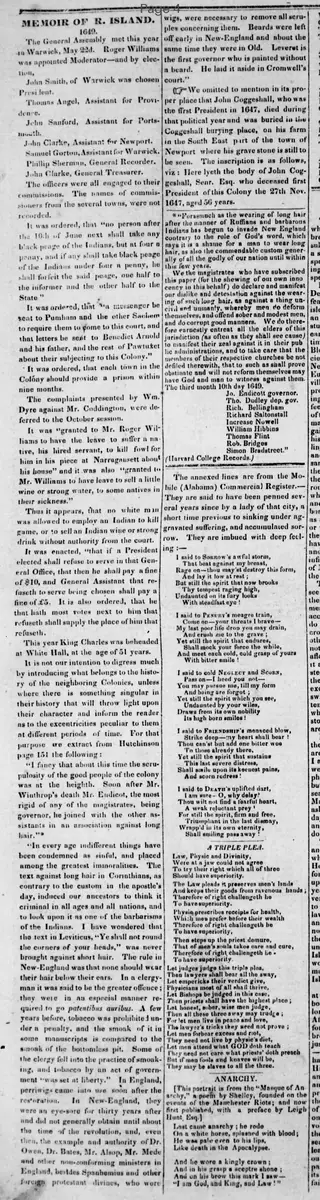
MEMOIR OF RHODE ISLAND.
1649.
The General Assembly met this year in Warwick, May 22d. Roger Williams was appointed Moderator—and by election, John Smith, of Warwick was chosen President. Thomas Angel, Assistant for Providence. John Sanford, Assistant for Portsmouth. John Clarke, Assistant for Newport. Samuel Gorton, Assistant for Warwick. Phillip Sherman, General Recorder. John Clarke, General Treasurer.
The officers were all engaged to their commissions. The names of commissioners from the several towns, were not recorded.
It was ordered, that "no person after the 10th of June next shall take any black peage of the Indians, but at four a penny, and if any shall take black peage of the Indians under four a penny, he shall forfeit the said peage, one half to the informer and the other half to the State."
It was ordered, that "a messenger be sent to Pumham and the other Sachem to require them to come to this court, and that letters be sent to Benedict Arnold and his father, and the rest of Pawtuxet about their subjecting to this Colony."
It was ordered, that each town in the Colony should provide a prison within nine months.
The complaints presented by Wm. Dyre against Mr. Coddington, were deferred to the October session.
It was "granted to Mr. Roger Williams to have the leave to suffer a native, his hired servant, to kill fowl for him in his piece at Narragansett about his house" and it was also "granted to Mr. Williams to have leave to sell a little wine or strong water, to some natives in their sickness."
Thus it appears, that no white man was allowed to employ an Indian to kill game, or to sell an Indian wine or strong drink without authority from the court.
It was enacted, "that if a President elected shall refuse to serve in that General Office, that then he shall pay a fine of £10, and General Assistant that refuseth to serve being chosen shall pay a fine of £5. It is also ordered, that he that hath most votes next to him that refuseth shall supply the place of him that refuseth."
This year King Charles was beheaded at White Hall, at the age of 51 years.
It is not our intention to digress much by introducing what belongs to the history of the neighboring Colonies, unless where there is something singular in their history that will throw light upon their character and inform the reader as to the eccentricities peculiar to them at different periods of time. For that purpose we extract from Hutchinson page 151 the following:
"I fancy that about this time the scrupulosity of the good people of the colony was at the height. Soon after Mr. Winthrop's death Mr. Endicot, the most rigid of any of the magistrates, being governor, he joined with the other assistants in an association against long hair."*
"In every age indifferent things have been condemned as sinful, and placed among the greatest immoralities. The text against long hair in Corinthians, as contrary to the custom in the apostle's day, induced our ancestors to think it criminal in all ages and all nations, and to look upon it as one of the barbarisms of the Indians. I have wondered that the text in Leviticus, "Ye shall not round the corners of your heads," was never brought against short hair. The rule in New-England was that none should wear their hair below their ears. In a clergyman it was said to be the greater offence; they were in an especial manner required to go patentibus auribus. A few years before, tobacco was prohibited under a penalty, and the smoke of it in some manuscripts is compared to the smoke of the bottomless pit. Some of the clergy fell into the practice of smoking, and tobacco by an act of government "was set at liberty." In England, perriwigs came into use soon after the restoration. In New-England, they were an eye-sore for thirty years after and did not generally obtain until about the time of the revolution, and, even then, the example and authority of Dr. Owen, Dr. Bates, Mr. Alsop, Mr. Mede and other non-conforming ministers in England, besides Spanhemius and other foreign protestant divines, who wore wigs, were necessary to remove all scruples concerning them. Beards were left off early in New-England and about the same time they were in Old. Leveret is the first governor who is painted without a beard. He laid it aside in Cromwell's court."
1649.
The General Assembly met this year in Warwick, May 22d. Roger Williams was appointed Moderator—and by election, John Smith, of Warwick was chosen President. Thomas Angel, Assistant for Providence. John Sanford, Assistant for Portsmouth. John Clarke, Assistant for Newport. Samuel Gorton, Assistant for Warwick. Phillip Sherman, General Recorder. John Clarke, General Treasurer.
The officers were all engaged to their commissions. The names of commissioners from the several towns, were not recorded.
It was ordered, that "no person after the 10th of June next shall take any black peage of the Indians, but at four a penny, and if any shall take black peage of the Indians under four a penny, he shall forfeit the said peage, one half to the informer and the other half to the State."
It was ordered, that "a messenger be sent to Pumham and the other Sachem to require them to come to this court, and that letters be sent to Benedict Arnold and his father, and the rest of Pawtuxet about their subjecting to this Colony."
It was ordered, that each town in the Colony should provide a prison within nine months.
The complaints presented by Wm. Dyre against Mr. Coddington, were deferred to the October session.
It was "granted to Mr. Roger Williams to have the leave to suffer a native, his hired servant, to kill fowl for him in his piece at Narragansett about his house" and it was also "granted to Mr. Williams to have leave to sell a little wine or strong water, to some natives in their sickness."
Thus it appears, that no white man was allowed to employ an Indian to kill game, or to sell an Indian wine or strong drink without authority from the court.
It was enacted, "that if a President elected shall refuse to serve in that General Office, that then he shall pay a fine of £10, and General Assistant that refuseth to serve being chosen shall pay a fine of £5. It is also ordered, that he that hath most votes next to him that refuseth shall supply the place of him that refuseth."
This year King Charles was beheaded at White Hall, at the age of 51 years.
It is not our intention to digress much by introducing what belongs to the history of the neighboring Colonies, unless where there is something singular in their history that will throw light upon their character and inform the reader as to the eccentricities peculiar to them at different periods of time. For that purpose we extract from Hutchinson page 151 the following:
"I fancy that about this time the scrupulosity of the good people of the colony was at the height. Soon after Mr. Winthrop's death Mr. Endicot, the most rigid of any of the magistrates, being governor, he joined with the other assistants in an association against long hair."*
"In every age indifferent things have been condemned as sinful, and placed among the greatest immoralities. The text against long hair in Corinthians, as contrary to the custom in the apostle's day, induced our ancestors to think it criminal in all ages and all nations, and to look upon it as one of the barbarisms of the Indians. I have wondered that the text in Leviticus, "Ye shall not round the corners of your heads," was never brought against short hair. The rule in New-England was that none should wear their hair below their ears. In a clergyman it was said to be the greater offence; they were in an especial manner required to go patentibus auribus. A few years before, tobacco was prohibited under a penalty, and the smoke of it in some manuscripts is compared to the smoke of the bottomless pit. Some of the clergy fell into the practice of smoking, and tobacco by an act of government "was set at liberty." In England, perriwigs came into use soon after the restoration. In New-England, they were an eye-sore for thirty years after and did not generally obtain until about the time of the revolution, and, even then, the example and authority of Dr. Owen, Dr. Bates, Mr. Alsop, Mr. Mede and other non-conforming ministers in England, besides Spanhemius and other foreign protestant divines, who wore wigs, were necessary to remove all scruples concerning them. Beards were left off early in New-England and about the same time they were in Old. Leveret is the first governor who is painted without a beard. He laid it aside in Cromwell's court."
What sub-type of article is it?
Essay
What themes does it cover?
Political
Liberty Freedom
What keywords are associated?
Rhode Island
General Assembly
Roger Williams
Colonial Laws
Indian Relations
King Charles Execution
New England Customs
Literary Details
Title
Memoir Of Rhode Island. 1649.
Form / Style
Historical Prose Narrative
Key Lines
The General Assembly Met This Year In Warwick, May 22d. Roger Williams Was Appointed Moderator—And By Election, John Smith, Of Warwick Was Chosen President.
It Was Ordered, That "No Person After The 10th Of June Next Shall Take Any Black Peage Of The Indians, But At Four A Penny...
This Year King Charles Was Beheaded At White Hall, At The Age Of 51 Years.
"I Fancy That About This Time The Scrupulosity Of The Good People Of The Colony Was At The Height. Soon After Mr. Winthrop's Death Mr. Endicot... Against Long Hair."