Thank you for visiting SNEWPapers!
Sign up free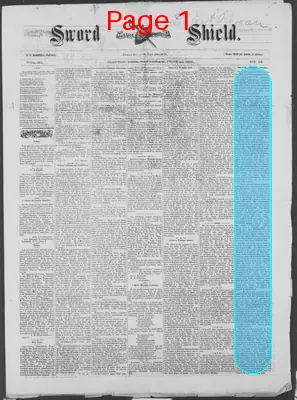
Editorial
June 20, 1885
Sword And Shield
Clinton, Jackson, Hinds County, Mississippi
What is this article about?
An editorial commending a New York Tribune piece on the massive economic costs of the liquor traffic, arguing it exceeds half the national debt and more than all government expenses, urging serious debate on temperance reforms over sneers from opponents.
Clipping

OCR Quality
98%
Excellent
Full Text
Size of the Temperance Question.
The following is an editorial from the New York Tribune and we earnestly commend it to the consideration of the "eliminating" Commercial Herald, State Ledger, Southern Reveille, and as many others as need the cobwebs cleared from their eyes. Gentlemen, read and think over these facts a few minutes:
It does no good for men to sneer at the agitation in regard to the liquor traffic. The subject is too important to be laughed down. It may be that prohibition is not the right way to settle it, or that license is not, or that taxation is not; these are fair questions, upon which a difference of opinion between sincere and candid men is possible. But the subject has become altogether too important to be ignored, or passed over without any serious attempt to settle it. Aside from the law-defying spirit which it has elicited, aside from all its moral and religious aspects, the question considered purely as one of dollars and cents, in its effects upon the national prosperity and wealth, is one of the most important that can be named.
Directly and indirectly, this country spends in the liquor traffic every year a sum exceeding half the national debt. The cost of that traffic to the country, direct and indirect, is greater than the profits of all its capital not invested in real estate. It costs every year more than our whole civil service, our Army, our Navy, our Congress, including the River and Harbor and the Pension bills, our wasteful local governments, and all national, State, county and local debts, besides all the schools in the country. In fact, this nation pays more for liquor than for every kind of government. How is a question of that size to be put aside with a sneer?
As these statements may seem surprising to those who have not looked into the matter, a few figures may be of service. A glass of beer costs the consumer five cents, and there are at least twenty in the gallon, and 64 in the barrel, so that beer retails at about $32 a barrel, while ale costs still more. The consumption of beer and ale last year was about 15,000,000 barrels; cost to consumers about $480,000,000. The cheapest kind of liquor used, ordinary whisky, is rarely sold at five cents, and averages at least seven cents a drink; at half a gill to the "horn," this makes $4.48 per gallon. The consumption last year was about 70,000,000 gallons: cost to consumers about $313,000,000. Adding wines, there is certainly spent for drink more than $800,000,000, and the entire sum raised by taxes of all kinds, national, State, county, city, town and school district, is stated on authority of the Census Bureau to be not more than about $700,000,000.
But the cost of the liquor drunk is not by any means the whole cost of the liquor traffic. An official report, prepared with much labor by the Bureau of Statistics of Massachusetts, under authority from the Legislature, states that eighty-four per cent. of all the crime and criminal expenses in that State come directly from the abuse of liquor. There are at least one in twenty of the able-bodied men in this country who are rendered idle by their habits or incapacitated for work, and these persons, at the ordinary wages of workingmen, would earn, if industrious and fairly employed, over $200,000,000 yearly. The proportion of persons in hospitals who reach them because of excess in drink is very large, but cannot be definitely ascertained.
A traffic that costs in actual payment and in loss of productive labor more than half the National debt every year, is not to be ignored by the economist. It may be assumed that the entire wealth of the country has risen from $30,000,000,000 in 1879 to $50,000,000,000 in 1880, about one-half being in real estate. Probably it does not average profits exceeding four per cent. yearly, taking bad investments with good, but at that rate the yearly interest on all personal property of all kinds is only $1,000,000,000, and the direct or indirect cost of the liquor traffic must be greater.
But the time has gone by in this country when a serious discussion of a question that involves such a vast expense to the nation can be prevented by bullying, intolerance, insolence or ridicule. This very practical people, having begun to think about the matter in earnest, perceives that it is much too important to be put aside at the dictation of saloon-keepers. It is certain that the entire savings of the people and all additions to their wealth are not twice as much as the sum expended for liquor and because of the abuse of liquor. If any just and reasonable proposition can be made that will add one-half to the savings and the prosperity of the nation, it will not be put down by a sneer, nor defeated by a law-breaking mob.
The following is an editorial from the New York Tribune and we earnestly commend it to the consideration of the "eliminating" Commercial Herald, State Ledger, Southern Reveille, and as many others as need the cobwebs cleared from their eyes. Gentlemen, read and think over these facts a few minutes:
It does no good for men to sneer at the agitation in regard to the liquor traffic. The subject is too important to be laughed down. It may be that prohibition is not the right way to settle it, or that license is not, or that taxation is not; these are fair questions, upon which a difference of opinion between sincere and candid men is possible. But the subject has become altogether too important to be ignored, or passed over without any serious attempt to settle it. Aside from the law-defying spirit which it has elicited, aside from all its moral and religious aspects, the question considered purely as one of dollars and cents, in its effects upon the national prosperity and wealth, is one of the most important that can be named.
Directly and indirectly, this country spends in the liquor traffic every year a sum exceeding half the national debt. The cost of that traffic to the country, direct and indirect, is greater than the profits of all its capital not invested in real estate. It costs every year more than our whole civil service, our Army, our Navy, our Congress, including the River and Harbor and the Pension bills, our wasteful local governments, and all national, State, county and local debts, besides all the schools in the country. In fact, this nation pays more for liquor than for every kind of government. How is a question of that size to be put aside with a sneer?
As these statements may seem surprising to those who have not looked into the matter, a few figures may be of service. A glass of beer costs the consumer five cents, and there are at least twenty in the gallon, and 64 in the barrel, so that beer retails at about $32 a barrel, while ale costs still more. The consumption of beer and ale last year was about 15,000,000 barrels; cost to consumers about $480,000,000. The cheapest kind of liquor used, ordinary whisky, is rarely sold at five cents, and averages at least seven cents a drink; at half a gill to the "horn," this makes $4.48 per gallon. The consumption last year was about 70,000,000 gallons: cost to consumers about $313,000,000. Adding wines, there is certainly spent for drink more than $800,000,000, and the entire sum raised by taxes of all kinds, national, State, county, city, town and school district, is stated on authority of the Census Bureau to be not more than about $700,000,000.
But the cost of the liquor drunk is not by any means the whole cost of the liquor traffic. An official report, prepared with much labor by the Bureau of Statistics of Massachusetts, under authority from the Legislature, states that eighty-four per cent. of all the crime and criminal expenses in that State come directly from the abuse of liquor. There are at least one in twenty of the able-bodied men in this country who are rendered idle by their habits or incapacitated for work, and these persons, at the ordinary wages of workingmen, would earn, if industrious and fairly employed, over $200,000,000 yearly. The proportion of persons in hospitals who reach them because of excess in drink is very large, but cannot be definitely ascertained.
A traffic that costs in actual payment and in loss of productive labor more than half the National debt every year, is not to be ignored by the economist. It may be assumed that the entire wealth of the country has risen from $30,000,000,000 in 1879 to $50,000,000,000 in 1880, about one-half being in real estate. Probably it does not average profits exceeding four per cent. yearly, taking bad investments with good, but at that rate the yearly interest on all personal property of all kinds is only $1,000,000,000, and the direct or indirect cost of the liquor traffic must be greater.
But the time has gone by in this country when a serious discussion of a question that involves such a vast expense to the nation can be prevented by bullying, intolerance, insolence or ridicule. This very practical people, having begun to think about the matter in earnest, perceives that it is much too important to be put aside at the dictation of saloon-keepers. It is certain that the entire savings of the people and all additions to their wealth are not twice as much as the sum expended for liquor and because of the abuse of liquor. If any just and reasonable proposition can be made that will add one-half to the savings and the prosperity of the nation, it will not be put down by a sneer, nor defeated by a law-breaking mob.
What sub-type of article is it?
Temperance
Economic Policy
Social Reform
What keywords are associated?
Temperance Movement
Liquor Traffic
Economic Costs
Prohibition Debate
National Prosperity
Alcohol Consumption
Crime And Liquor
Productivity Loss
What entities or persons were involved?
New York Tribune
Commercial Herald
State Ledger
Southern Reveille
Bureau Of Statistics Of Massachusetts
Census Bureau
Editorial Details
Primary Topic
Economic And Social Costs Of The Liquor Traffic And Need For Temperance Reform
Stance / Tone
Strong Advocacy For Serious Debate On Temperance Over Dismissal
Key Figures
New York Tribune
Commercial Herald
State Ledger
Southern Reveille
Bureau Of Statistics Of Massachusetts
Census Bureau
Key Arguments
Liquor Traffic Costs Exceed Half The National Debt Annually
More Spent On Liquor Than On All Forms Of Government Including Military, Civil Service, And Education
Direct Consumer Spending On Alcohol Over $800 Million Yearly, Surpassing Total Tax Revenue
84% Of Crime And Criminal Expenses In Massachusetts Due To Liquor Abuse
One In Twenty Able Bodied Men Incapacitated By Drink, Losing Over $200 Million In Productivity
Liquor Costs Greater Than Profits On Non Real Estate Capital
Serious Discussion Cannot Be Stifled By Ridicule Or Saloon Keeper Influence