Thank you for visiting SNEWPapers!
Sign up free
Editorial
March 25, 1807
The National Intelligencer And Washington Advertiser
Washington, District Of Columbia
What is this article about?
An editorial contrasts the negative portrayal of the United States in Federalist newspapers with the actual prosperity, freedoms, and achievements under the republican government, defending the administration against calumnies and highlighting economic growth, peace, and national progress.
Merged-components note: Clear textual continuation of the same editorial piece across pages, maintaining coherent opinionated narrative.
Clippings
1 of 2
OCR Quality
96%
Excellent
Full Text
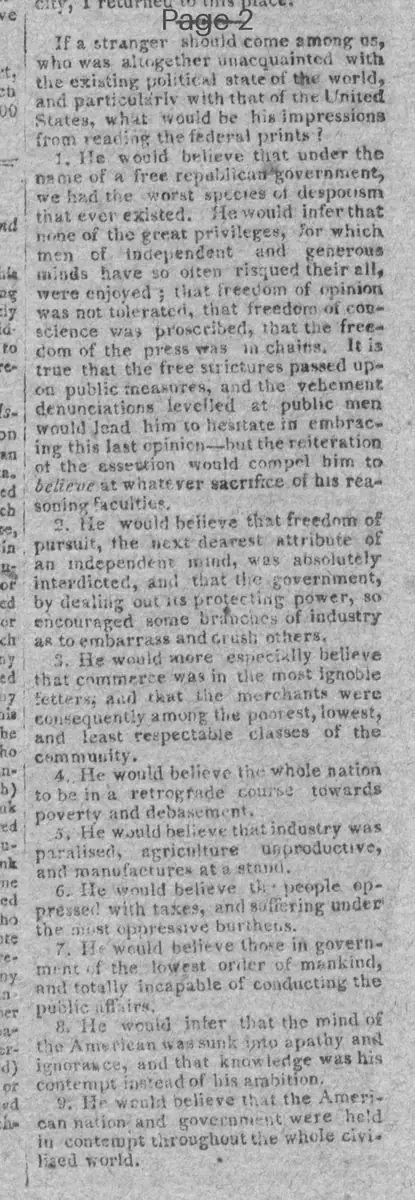
If a stranger should come among us, who was altogether unacquainted with the existing political state of the world, and particularly with that of the United States, what would be his impressions from reading the federal prints?
1. He would believe that under the name of a free republican government, we had the worst species of despotism that ever existed. He would infer that none of the great privileges, for which men of independent and generous minds have so often risqued their all, were enjoyed; that freedom of opinion was not tolerated, that freedom of conscience was proscribed, that the freedom of the press was in chains. It is true that the free strictures passed upon public measures, and the vehement denunciations levelled at public men would lead him to hesitate in embracing this last opinion—but the reiteration of the assertion would compel him to believe at whatever sacrifice of his reasoning faculties.
2. He would believe that freedom of pursuit, the next dearest attribute of an independent mind, was absolutely interdicted, and that the government, by dealing out its protecting power, so encouraged some branches of industry as to embarrass and crush others.
3. He would more especially believe that commerce was in the most ignoble fetters; and that the merchants were consequently among the poorest, lowest, and least respectable classes of the community.
4. He would believe the whole nation to be in a retrograde course towards poverty and debasement.
5. He would believe that industry was paralysed, agriculture unproductive, and manufactures at a stand.
6. He would believe the people oppressed with taxes, and suffering under the most oppressive burthens.
7. He would believe those in government of the lowest order of mankind, and totally incapable of conducting the public affairs.
8. He would infer that the mind of the American was sunk into apathy and ignorance, and that knowledge was his contempt instead of his ambition.
9. He would believe that the American nation and government were held in contempt throughout the whole civilized world.
And he would naturally exclaim "miserable people for whom nature and a kind Providence have done every thing—but who have done nothing for yourselves! Thy glory is extinguished. In infancy thou feelest the decrepitude of age. Better had it been for thee and the human race, hadst thou never asserted an independence thou knowest not how to maintain."
But what would the astonishment of our moralising stranger be, on employing his own senses and judging for himself from indisputable facts and observations, to find—
1. That every man, from the highest to the lowest, was permitted to enjoy an unlimited freedom of opinion, political as well as religious, and that the press was suffered, with impunity, not merely to utter the truth, but to propagate the most flagrant untruths, to declare public measures to have been taken which never were adopted, to ascribe motives to public men which never influenced them, and not satisfied with this, to attack their private lives with the basest calumnies. What would be his astonishment to find, although the first magistrate possessed a private character without a stain, that this licensed organ had tortured ingenuity to multiply and aggravate the number and degree of vices ascribed to him? Would not his astonishment be extreme to hear, that notwithstanding the atrocity of these calumnies and the almost universal reverence entertained for the character of the chief magistrate, and notwithstanding the existence of laws fully competent to the punishment of calumniators, not a single prosecution had been instituted by him or his friends.
2. What would be his astonishment to learn that freedom of pursuit was not only exempt from any positive restraint, but that it was absolutely protected and guaranteed by habits and institutions unknown to any other nation—that there is not a single legalised monopoly—that there are no entailed estates—that there are no established orders—that the road to office is equally open to all—that every useful occupation of life is held in estimation—that there is no preference whatever given to one pursuit over another, and that such preference is actually prohibited by the letter and spirit of our institutions.
3. What would be his astonishment to find that trade was almost as free as air, that the field of enterprize at home as well as abroad was almost entirely unrestricted, that it was in a state of prosperity without a precedent, that no people so young had ever been so commercial; and that the merchants, instead of being the poorest, the lowest, and the least respectable class in the community, were unquestionably, for their numbers, the richest, and that they lived in a style of elevation and enjoyment unknown to any other part of the nation, enjoying the best tables, living in the largest houses, the most splendidly furnished, keeping their carriages, and retiring in the summer to their gay villas, and living there with even more elegance than in town?
Would he not almost disbelieve his senses, when, partaking of their cheer, and surrounded by all the delicacies of the season, and the more costly luxuries of the foreign world, he heard these men, instead of expressing their gratitude; cursing the chief magistrate of their country, holding their country itself up to scorn, and bewailing their unfortunate and depraved condition.
Having his eyes in some measure opened by this strange exhibition, what would be his surprize on appealing to official documents, to find—
That in a period of 20 years the population had increased from 2,500,000 to 5,156,000.
That the dwelling houses had in the same period increased from 650,000 to 1,225,000,
That the improved lands had risen from 21,500,000 to 39,400,000 acres.
That the average price per acre had risen from two to six dollars.
That the number of horses had increased from 600,000 to 1,200,000; and the horned cattle from 1,200,000 to 2,950,000.
That the merchant vessels had increased from 250,000 tons to 1,107,000.
That the imports had risen from eleven to eighty millions of dollars.
That the exports of domestic production had increased from nine to forty-one millions.
And the exports of foreign goods from one to thirty six millions.
That the national revenues had increased in a period of twelve years from eight to thirteen millions of dollars—
while the expenditures, making an allowance for the extinguishment of the principal of the debt, have been nearly stationary.
That the specie in circulation has risen in a period of twenty years from ten to seventeen millions.
Would he not on imbibing such information, indignantly shun the society of men, so lost to character, so lost to truth, so lost to patriotism, so lost to every honorable feeling? And would he not, freed from this contagion, acknowledge, no matter what country gave him birth, that the existing situation of the United States presents the most illustrious commentary on the principles of the republican system, and demonstration of its superiority to all others, Would he not have the magnanimity to admit that in no other country has there been such a rapid progress to wealth and power, such an astonishing advance in the products of agriculture and the extension of commerce.
4. As to oppressive burthens a single glance at the annual official statements, would shew him that in amount the taxes are infinitely lighter than those of any other nation, and that in their actual operation they are, from their nature, so scarcely felt—for being equal and impartial, and collected at a very inconsiderable expence, they by no means press on each individual to the amount he pays, or take so much money from his pocket, but are in fact virtually reduced to an amount comparatively small, by every man actually charging them, to a considerable degree, in the price fixed by him upon his labor. It is for this reason that there is no country under heaven in which the taxes are so unoppressive,
5. After contemplating these effects, after passing through the country and beholding an unexampled prosperity from one end of it to the other, and more than all after looking back upon a period in which the whole civilised world has been in convulsion, and this nation alone exempt from the calamities of war, and in the undisturbed enjoyment of peace, although often threatened by the conduct of the most formidable powers of Europe, would he not acknowledge those at the head of our affairs at least as capable of guiding the helm of state as any of the administrations of Europe?
Would he not go further, and judging of the actions of men by their effects, which in a period of any tolerable length is a correct criterion, however unjust in a single case, allow that the American government had pursued a more enlightened policy than any other government on earth, and was consequently composed of men possessed either of greater virtue or greater talent than any other country could during the same time boast? He would not, with the federalists, ascribe every thing to chance, but judging with an impartial eye, he would have but two alternatives—He would either believe the American government the most enlightened on earth, or the American people the most virtuous and best informed. Without acknowledging one or both of these propositions, every thing around him would appear miraculous.
6. Studying the character, and contemplating the pursuits of the respective classes of the Americans, he would perceive an activity and enterprize never at rest, that by daring every thing overcame all obstacles, that with equal ease and success struck the harpoon into the whale, cultivated the earth, pursued the mechanical arts, filled with honor the learned professions, or discharged the more arduous functions of government; talents which imply no inconsiderable share of natural sagacity, and require a large share of acquired knowledge. Would he not be forced to acknowledge, on contemplating this picture, that apathy was unknown, and that an universal and almost insatiable thirst for knowledge pervaded all ranks
7. Finally, he would be induced to ask himself this question: Can it be that a nation which marches with such unprecedented strides to numbers, to wealth and to power, by developing her solid resources, of which nothing can deprive her, which has maintained peace while the whole surrounding world has been in arms, which has added to her original territory a country of perhaps superior extent without drawing the sword, or causing the felicity of a single individual, which has in no instance violated the rights of others, or sacrificed her own—can it be that such a nation is held in contempt throughout the whole civilised world? If this be true, what else does it prove but that the whole civilised world is destitute of honor and principle, and that consequently to be despised by such a world, instead of being disgraceful, is in the highest degree honorable. But he would deny the fact. How, he would say, can this be the case, when we behold this very civilised world paying more respect to the rights of America than to those of any other nation? It is true her rights are frequently trampled upon; but comparing the aggressions committed on her with those committed on the powers of Europe, we behold only the traces of the hare compared with those of the elephant.
Would he not, acknowledging his deception, exclaim—"Happy people, who, although you have received the most prodigal favors from nature, have not relaxed your own exertions, but who have, greatly to your honor, felt the one as the strongest excitement to the other. Your name is on the roll of fame. Though young, you advance with the steps of manhood. Maintain, as you hitherto have done, the independence you so gloriously acquired, and the world will pronounce you its best, its most illustrious benefactor."
1. He would believe that under the name of a free republican government, we had the worst species of despotism that ever existed. He would infer that none of the great privileges, for which men of independent and generous minds have so often risqued their all, were enjoyed; that freedom of opinion was not tolerated, that freedom of conscience was proscribed, that the freedom of the press was in chains. It is true that the free strictures passed upon public measures, and the vehement denunciations levelled at public men would lead him to hesitate in embracing this last opinion—but the reiteration of the assertion would compel him to believe at whatever sacrifice of his reasoning faculties.
2. He would believe that freedom of pursuit, the next dearest attribute of an independent mind, was absolutely interdicted, and that the government, by dealing out its protecting power, so encouraged some branches of industry as to embarrass and crush others.
3. He would more especially believe that commerce was in the most ignoble fetters; and that the merchants were consequently among the poorest, lowest, and least respectable classes of the community.
4. He would believe the whole nation to be in a retrograde course towards poverty and debasement.
5. He would believe that industry was paralysed, agriculture unproductive, and manufactures at a stand.
6. He would believe the people oppressed with taxes, and suffering under the most oppressive burthens.
7. He would believe those in government of the lowest order of mankind, and totally incapable of conducting the public affairs.
8. He would infer that the mind of the American was sunk into apathy and ignorance, and that knowledge was his contempt instead of his ambition.
9. He would believe that the American nation and government were held in contempt throughout the whole civilized world.
And he would naturally exclaim "miserable people for whom nature and a kind Providence have done every thing—but who have done nothing for yourselves! Thy glory is extinguished. In infancy thou feelest the decrepitude of age. Better had it been for thee and the human race, hadst thou never asserted an independence thou knowest not how to maintain."
But what would the astonishment of our moralising stranger be, on employing his own senses and judging for himself from indisputable facts and observations, to find—
1. That every man, from the highest to the lowest, was permitted to enjoy an unlimited freedom of opinion, political as well as religious, and that the press was suffered, with impunity, not merely to utter the truth, but to propagate the most flagrant untruths, to declare public measures to have been taken which never were adopted, to ascribe motives to public men which never influenced them, and not satisfied with this, to attack their private lives with the basest calumnies. What would be his astonishment to find, although the first magistrate possessed a private character without a stain, that this licensed organ had tortured ingenuity to multiply and aggravate the number and degree of vices ascribed to him? Would not his astonishment be extreme to hear, that notwithstanding the atrocity of these calumnies and the almost universal reverence entertained for the character of the chief magistrate, and notwithstanding the existence of laws fully competent to the punishment of calumniators, not a single prosecution had been instituted by him or his friends.
2. What would be his astonishment to learn that freedom of pursuit was not only exempt from any positive restraint, but that it was absolutely protected and guaranteed by habits and institutions unknown to any other nation—that there is not a single legalised monopoly—that there are no entailed estates—that there are no established orders—that the road to office is equally open to all—that every useful occupation of life is held in estimation—that there is no preference whatever given to one pursuit over another, and that such preference is actually prohibited by the letter and spirit of our institutions.
3. What would be his astonishment to find that trade was almost as free as air, that the field of enterprize at home as well as abroad was almost entirely unrestricted, that it was in a state of prosperity without a precedent, that no people so young had ever been so commercial; and that the merchants, instead of being the poorest, the lowest, and the least respectable class in the community, were unquestionably, for their numbers, the richest, and that they lived in a style of elevation and enjoyment unknown to any other part of the nation, enjoying the best tables, living in the largest houses, the most splendidly furnished, keeping their carriages, and retiring in the summer to their gay villas, and living there with even more elegance than in town?
Would he not almost disbelieve his senses, when, partaking of their cheer, and surrounded by all the delicacies of the season, and the more costly luxuries of the foreign world, he heard these men, instead of expressing their gratitude; cursing the chief magistrate of their country, holding their country itself up to scorn, and bewailing their unfortunate and depraved condition.
Having his eyes in some measure opened by this strange exhibition, what would be his surprize on appealing to official documents, to find—
That in a period of 20 years the population had increased from 2,500,000 to 5,156,000.
That the dwelling houses had in the same period increased from 650,000 to 1,225,000,
That the improved lands had risen from 21,500,000 to 39,400,000 acres.
That the average price per acre had risen from two to six dollars.
That the number of horses had increased from 600,000 to 1,200,000; and the horned cattle from 1,200,000 to 2,950,000.
That the merchant vessels had increased from 250,000 tons to 1,107,000.
That the imports had risen from eleven to eighty millions of dollars.
That the exports of domestic production had increased from nine to forty-one millions.
And the exports of foreign goods from one to thirty six millions.
That the national revenues had increased in a period of twelve years from eight to thirteen millions of dollars—
while the expenditures, making an allowance for the extinguishment of the principal of the debt, have been nearly stationary.
That the specie in circulation has risen in a period of twenty years from ten to seventeen millions.
Would he not on imbibing such information, indignantly shun the society of men, so lost to character, so lost to truth, so lost to patriotism, so lost to every honorable feeling? And would he not, freed from this contagion, acknowledge, no matter what country gave him birth, that the existing situation of the United States presents the most illustrious commentary on the principles of the republican system, and demonstration of its superiority to all others, Would he not have the magnanimity to admit that in no other country has there been such a rapid progress to wealth and power, such an astonishing advance in the products of agriculture and the extension of commerce.
4. As to oppressive burthens a single glance at the annual official statements, would shew him that in amount the taxes are infinitely lighter than those of any other nation, and that in their actual operation they are, from their nature, so scarcely felt—for being equal and impartial, and collected at a very inconsiderable expence, they by no means press on each individual to the amount he pays, or take so much money from his pocket, but are in fact virtually reduced to an amount comparatively small, by every man actually charging them, to a considerable degree, in the price fixed by him upon his labor. It is for this reason that there is no country under heaven in which the taxes are so unoppressive,
5. After contemplating these effects, after passing through the country and beholding an unexampled prosperity from one end of it to the other, and more than all after looking back upon a period in which the whole civilised world has been in convulsion, and this nation alone exempt from the calamities of war, and in the undisturbed enjoyment of peace, although often threatened by the conduct of the most formidable powers of Europe, would he not acknowledge those at the head of our affairs at least as capable of guiding the helm of state as any of the administrations of Europe?
Would he not go further, and judging of the actions of men by their effects, which in a period of any tolerable length is a correct criterion, however unjust in a single case, allow that the American government had pursued a more enlightened policy than any other government on earth, and was consequently composed of men possessed either of greater virtue or greater talent than any other country could during the same time boast? He would not, with the federalists, ascribe every thing to chance, but judging with an impartial eye, he would have but two alternatives—He would either believe the American government the most enlightened on earth, or the American people the most virtuous and best informed. Without acknowledging one or both of these propositions, every thing around him would appear miraculous.
6. Studying the character, and contemplating the pursuits of the respective classes of the Americans, he would perceive an activity and enterprize never at rest, that by daring every thing overcame all obstacles, that with equal ease and success struck the harpoon into the whale, cultivated the earth, pursued the mechanical arts, filled with honor the learned professions, or discharged the more arduous functions of government; talents which imply no inconsiderable share of natural sagacity, and require a large share of acquired knowledge. Would he not be forced to acknowledge, on contemplating this picture, that apathy was unknown, and that an universal and almost insatiable thirst for knowledge pervaded all ranks
7. Finally, he would be induced to ask himself this question: Can it be that a nation which marches with such unprecedented strides to numbers, to wealth and to power, by developing her solid resources, of which nothing can deprive her, which has maintained peace while the whole surrounding world has been in arms, which has added to her original territory a country of perhaps superior extent without drawing the sword, or causing the felicity of a single individual, which has in no instance violated the rights of others, or sacrificed her own—can it be that such a nation is held in contempt throughout the whole civilised world? If this be true, what else does it prove but that the whole civilised world is destitute of honor and principle, and that consequently to be despised by such a world, instead of being disgraceful, is in the highest degree honorable. But he would deny the fact. How, he would say, can this be the case, when we behold this very civilised world paying more respect to the rights of America than to those of any other nation? It is true her rights are frequently trampled upon; but comparing the aggressions committed on her with those committed on the powers of Europe, we behold only the traces of the hare compared with those of the elephant.
Would he not, acknowledging his deception, exclaim—"Happy people, who, although you have received the most prodigal favors from nature, have not relaxed your own exertions, but who have, greatly to your honor, felt the one as the strongest excitement to the other. Your name is on the roll of fame. Though young, you advance with the steps of manhood. Maintain, as you hitherto have done, the independence you so gloriously acquired, and the world will pronounce you its best, its most illustrious benefactor."
What sub-type of article is it?
Partisan Politics
Economic Policy
Press Freedom
What keywords are associated?
Federalist Press
American Prosperity
Republican Government
Freedom Of Press
Economic Growth
Political Calumnies
National Achievements
Taxation Lightness
What entities or persons were involved?
Federal Prints
Chief Magistrate
American Government
Merchants
Federalists
Editorial Details
Primary Topic
Defense Of Republican Government Against Federalist Press Distortions
Stance / Tone
Strongly Pro Administration And Patriotic, Anti Federalist
Key Figures
Federal Prints
Chief Magistrate
American Government
Merchants
Federalists
Key Arguments
Federalist Press Creates False Impression Of Despotism And Lack Of Freedoms
Actual Unlimited Freedom Of Opinion, Conscience, And Press Exists, Including Tolerance Of Calumnies Against The Chief Magistrate
Freedom Of Pursuit Is Protected Without Monopolies Or Preferences
Commerce Is Prosperous And Unrestricted, Merchants Are The Richest Class
Population, Agriculture, Livestock, Shipping, Imports, Exports, And Revenues Have Doubled Or More In 20 Years
Taxes Are Lighter And Less Oppressive Than In Other Nations
Government Leaders Are Capable, Pursuing Enlightened Policy Amid Global Wars
American People Exhibit Activity, Enterprise, And Thirst For Knowledge
Us Achieves Rapid Growth, Peace, And Territorial Expansion Without Violating Rights
Nation Is Respected Internationally Despite Occasional Aggressions