Thank you for visiting SNEWPapers!
Sign up free
Daily National Republican
Washington, District Of Columbia
What is this article about?
1865 Board of Visitors report on U.S. Military Academy at West Point details inspections, praises drill and discipline, notes academic deficiencies, and recommends reforms including opening superintendency to all army branches, increasing cadets to 400, raising admission standards, ending hazing, and memorial tablets for fallen officers.
Clipping
OCR Quality
Full Text
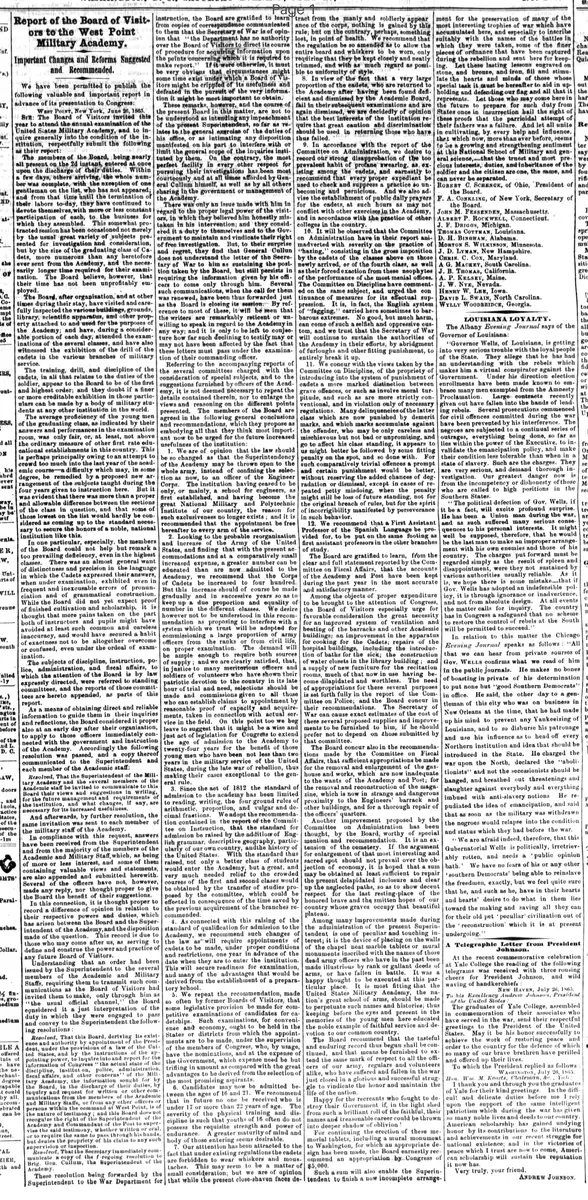
We have been permitted to publish the following valuable and important report in advance of its presentation to Congress:
WEST POINT, New York, June 26, 1865.
SIR: The Board of Visitors invited this year to attend the annual examination of the United States Military Academy, and to inquire generally into the condition of the institution, respectfully submit the following as their report:
The members of the Board, being nearly all present on the 2d instant, entered at once upon the discharge of their duties. Within a few days, others arriving, the whole number was complete, with the exception of one gentleman on the list, who has not appeared; and from that time until the termination of their labors to-day, they have continued to devote themselves, with more or less constant participation of each, to the business for which they assembled. This somewhat protracted session has been occasioned not merely by the usual great variety of subjects presented for investigation and consideration, but by the size of the graduating class of Cadets, more numerous than any heretofore ever sent from the Academy, and the necessarily longer time required for their examination. The Board believe, however, that their time has not been unprofitably employed.
The Board, after organization, and at other times during their stay, have visited and carefully inspected the various buildings, grounds, library, scientific apparatus, and other property attached to and used for the purposes of the Academy; and have, during a considerable portion of each day, attended the examinations of the several classes, and have also witnessed the exhibition of the drill of the cadets in the various branches of military service.
The training, drill, and discipline of the cadets, in all that relates to the duties of the soldier, appear to the Board to be of the first and highest order; and they doubt if a finer or more creditable exhibition in those particulars can be made by a body of military students at any other institution in the world.
The average proficiency of the young men of the graduating class, as indicated by their answers and performances in the examination room, was only fair, or, at least, not above the ordinary measure of other first rate educational establishments in this country. This is perhaps principally owing to an attempt to crowd too much into the last year of the academic course—a difficulty which may, in some degree, be remedied by a proposed new arrangement of the subjects taught during the four years given to instruction here. But it was evident that there was more than a proper and allowable difference between the sections of the class in question, and that some of those lowest on the list would hardly be considered as coming up to the standard necessary to secure the honors of a noble, national institution like this.
In one particular, especially, the members of the Board could not help but remark a too prevailing deficiency, even in the highest classes. There was an almost general want of distinctness and precision in the language in which the Cadets expressed their answers, when under examination, exhibited even in frequent and inexcusable errors of pronunciation and of grammatical construction. While the Board did not yet expect proof of finished cultivation and scholarship, it is thought that more pains taken on the part of both of instructors and pupils might have avoided at least such common and careless inaccuracy, and would have secured a habit of exactness not to be altogether overcome or confused, even under the ordeal of examination.
The subjects of discipline, instruction, police, administration, and fiscal affairs, to which the attention of the Board is by law expressly directed, were referred to standing committees, and the reports of those committees are hereto appended, as parts of this report.
As a means of obtaining direct and reliable information to guide them in their inquiries and reflections, the Board considered it proper also at an early day after their organization, to apply to those officers immediately connected with the government and instruction of the Academy. Accordingly the following resolution was passed, and a copy thereof communicated to the Superintendent and each member of the Academic staff:
Resolved, That the Superintendent of the Military Academy and the several members of the Academic staff be invited to communicate to this Board their views and suggestions in writing, for the future management and requirements of the institution, and what changes, if any, are necessary for its increased usefulness.
And afterwards, by further resolution, the same invitation was sent to each member of the military staff of the Academy.
In compliance with this request, answers have been received from the Superintendent and from the majority of the members of the Academic and Military Staff, which, as being of more or less interest, and some of them containing valuable views and statements, are also appended and submitted herewith. Several of the officers have not, however, made any reply, nor thought proper to give the Board the benefit of their suggestions.
In this connection, it is thought proper to record a difference of opinion in relation to their respective powers and duties, which has arisen between the Board and the Superintendent of the Academy, and the disposition made of the question. This record is due to those who may come after us, as serving to define and construe the power and practice of any future Board of Visitors.
Understanding that an order had been issued by the Superintendent to the several members of the Academic and Military Staffs, requiring them to transmit such communications as the Board of Visitors had invited them to make, only through him as "the usual official channel," the Board considered it a just interpretation of the duty in which they were engaged to pass and convey to the Superintendent the following resolutions:
Resolved, That this Board, deriving its existence and authority by appointment of the President, under the provisions of a law of the United States, and by the instructions of the appointing power, to inquire into and report for the information of Congress "the actual state of the discipline, instruction, police, administration, fiscal affairs, and other concerns" of the Military Academy, the information sought for by the Board, in the discharge of their duties, by inquiry and request for written or other communications from the members of the Academic and Military Staffs, or from any other officers or persons within the command at West Point, is of the nature of testimony; and this Board does not recognize the right of the Superintendent of the Academy and Commandant of the Post to supervise the said testimony, whether written or oral, or to require the same to pass through his hands, but denies the propriety of his claim to any such supervision or inspection.
Resolved, That the Secretary immediately communicate a copy of the foregoing resolution to Brig. Gen. Cullum, the Superintendent of the Academy.
These resolutions being forwarded by the Superintendent to the War Department for instruction, the Board are gratified to learn from copies of correspondence communicated to them that the Secretary of War is of opinion that "the Department has no authority over the Board of Visitors to direct its course of procedure for acquiring information upon the points concerning which it is required to make report." If it were otherwise, it must be very obvious that circumstances might some time exist under which a Board of Visitors might be crippled of its usefulness and defeated in the pursuit of the very information it might be most important to obtain.
These remarks, however, and the course of the present Board in this matter, are not to be understood as intending any impeachment of the present Superintendent, so far as relates to the general exercise of the duties of his office, or as intimating any disposition manifested on his part to interfere with or limit the general scope of the inquiries instituted by them. On the contrary, the most perfect facility in every other respect for pursuing their investigations has been most courteously and at all times afforded by General Cullum himself, as well as by all others sharing in the government or management of the Academy.
There was only an issue made with him in regard to the proper legal power of the visitors, in which they believed him honestly mistaken in his intervention; and they considered it a duty to themselves and to the Government to maintain and vindicate their right of free investigation. But, to their surprise and regret, they find that General Cullum does not understand the letter of the Secretary of War to him as sustaining the position taken by the Board, but still persists in requiring the information given by his officers to come only through him. Several such communications, when the call for them was renewed, have been thus forwarded just as the Board is closing its session: By reference to most of these, it will be seen that the writers are remarkably reticent or unwilling to speak in regard to the Academy in any way; and it is only to be left to conjecture how far such declining to testify may or may not have been affected by the fact that these letters must pass under the examination of their commanding officer.
Referring to the accompanying reports of the several committees charged with the consideration of special subjects, and to the suggestions furnished by officers of the Academy, it is not deemed necessary to repeat the details contained therein, nor to enlarge the views and reasoning on the different points presented. The members of the Board are agreed in the following general conclusions and recommendations, which they propose as embodying all that they think most important now to be urged for the future increased usefulness of the institution:
1. We are of opinion that the law should be so changed as that the Superintendency of the Academy may be thrown open to the whole army, instead of confining the selection as now, to an officer of the Engineer Corps. The institution having ceased to be only, or mainly, a school for engineers, as first established, and having become the great National Military and Polytechnic Institute of our country, the reason for such exclusiveness no longer exists; and it is recommended that the appointment be free hereafter to every arm of the service.
2. Looking to the probable reorganization and increase of the Army of the United States, and finding that with the present accommodations and at a comparatively small increased expense, a greater number can be educated than are now admitted to the Academy, we recommend that the Corps of Cadets be increased to four hundred. But this increase should of course be made gradually and in successive years so as to keep up a due proportion and equality of number in the different classes. We desire however not to be understood in this recommendation as proposing to interfere with a system which we trust will be adopted for commissioning a large proportion of army officers from the ranks or from civil life, on proper examination. The demand will be ample enough to require both sources of supply; and we are clearly satisfied, that, in justice to many meritorious officers and soldiers of volunteers who have shown their patriotic devotion to the country in its late hour of trial and need, selections should be made and commissions given to all those who can establish claims to appointment by reasonable proof of capacity and acquirements, taken in connection with actual service in the field. On this point too we beg leave to suggest that it might be a wise and just act of legislation for Congress to extend the age of admission to the Academy to twenty-four years for the benefit of those young men who have been not less than two years in the military service of the United States, during the late war of rebellion, thus making their cases exceptional to the general rule.
3. Since the act of 1812 the standard of admission to the academy has been limited to reading, writing, the four ground rules of arithmetic, proportion, and vulgar and decimal fractions. We adopt the recommendation contained in the report of the Committee on Instruction, that the standard for admission be raised by the addition of English grammar, descriptive geography, particularly of our own country, and the history of the United States. With the standard thus raised, not only a better class of students would enter the Academy, but a great, and very much needed relief to the crowded courses of the first and second classes would be obtained by the transfer of studies proposed by the committee, which could be effected in consequence of the time saved by the previous acquirement of the branches recommended.
4. As connected with this raising of the standard of qualification for admission to the Academy, we recommend such changes of the law as will require appointments of cadets to be made, under proper conditions and restrictions, one year in advance of the date when they are to enter the institution. This will secure readiness for examination, and many of the advantages that would be derived from the establishment of a preparatory school.
5. We repeat the recommendation, made so often by former Boards of Visitors, that some legislative provision be made for competitive examinations of candidates for cadetships. Such examinations, for convenience and economy, ought to be held in the States or districts from which the appointments are to be made, under the supervision of the members of Congress, who, by usage, have the nominations, and at the expense of the Government, which expense need be but trifling in amount as compared with the great advantages to be derived from the selection of the most promising aspirants.
6. Candidates may now be admitted between the ages of 16 and 21. We recommend that in future no one be received who is under 17 or more than 22 years of age. The severity of the physical training and discipline is such that youths of 16 often do not possess the requisite strength and power of endurance. A greater maturity of mind and body of those entering seems desirable.
7. Our attention has been attracted to the fact that under existing regulations the cadets are forbidden to wear whiskers and mustaches. This may seem to be a matter of small consideration; but we are of opinion that while the present close-shaven faces detract from the manly and soldierly appearance of the corps, nothing is gained by the rule; but on the contrary, perhaps, something lost, in point of health. We recommend that the regulation be so amended as to allow the entire beard and whiskers to be worn, only requiring that they be kept closely and neatly trimmed, and with as much regard as possible to uniformity of style.
8. In view of the fact that a very large proportion of the cadets, who are returned to the Academy after having been found deficient and dismissed by the Academic Board, fail in their subsequent examinations and are again dismissed, we are decidedly of opinion that the best interests of the institution require that great caution and discrimination should be used in returning those who have thus failed.
9. In accordance with the report of the Committee on Administration, we desire to record our strong disapprobation of the too prevalent habit of profane swearing, as existing among the cadets, and earnestly to recommend that every proper expedient be used to check and suppress a practice so unbecoming and pernicious. And we also advise the establishment of public daily prayers for the cadets, at such hours as may not conflict with other exercises in the Academy, and in accordance with the practice of other colleges in the country.
10. It will be observed that the Committee on Administration have in their report animadverted with severity on the practice of "hazing," consisting in the gross imposition by the cadets of the classes above on those newly arrived, or of the fourth class, as well as their forced exaction from these neophytes of the performance of the most menial offices. The Committee on Discipline have commented on the same subject, and urged the continuance of measures for its effectual suppression. It is, in fact, the English system of "fagging," carried here sometimes to barbarous extremes. No good, but much harm, can come of such a selfish and oppressive custom, and we trust that the Secretary of War will continue to sustain the authorities of the Academy in their efforts, by abridgment of furloughs and other fitting punishment, to entirely break it up.
11. We concur with the views taken by the Committee on Discipline, of the propriety of introducing into the system of punishment of cadets a more marked distinction between grave offences, or such as involve moral turpitude, and such as are more strictly conventional, and in violation only of necessary regulations. Many delinquencies of the latter class which are now punished by demerit marks, and which marks accumulate against the offender, who may be only careless and mischievous but not bad or unpromising, and go to affect his class standing, it appears to us might better be followed by some fitting penalty on the spot, and so done with. For such comparatively trivial offences a prompt and certain punishment would be better, without reserving the added chances of degradation or dismissal, except in cases of repeated petty misdoing, when the penalty might still be loss of future standing, not for the original breach of rules, but for the spirit of incorrigibility manifested by perseverance in such behavior.
12. We recommend that a First Assistant Professor of the Spanish Language be provided for, to be put on the same footing as first assistant professors in the other branches of study.
The Board are gratified to learn, from the clear and full statement reported by the Committee on Fiscal Affairs, that the accounts of the Academy and Post have been kept during the past year in the most accurate and satisfactory manner.
Among the objects of proper expenditure to be brought to the attention of Congress, the Board of Visitors especially urge for favorable consideration the great necessity for an improved system of ventilation and heating of the barracks and other Academic buildings; an improvement in the apparatus for cooking for the Cadets; repairs of the hospital buildings, including the introduction of baths for the sick; the construction of water closets in the library building; and a supply of new furniture for the recitation rooms, much of that now in use having become dilapidated and worthless. The need of appropriations for these several purposes is set forth fully in the report of the Committee on Police; and the Board concur in their recommendations. The Secretary of War can cause exact estimates of the cost of these several proposed supplies and improvements to be furnished to him, if he should prefer not to depend on those submitted by that committee.
The Board concur also in the recommendations made by the Committee on Fiscal Affairs, that sufficient appropriations be made for the removal and enlargement of the gas-house and works, which are now inadequate to the wants of the Academy and Post; for the removal and reconstruction of the magazine, which is now in strange and dangerous proximity to the Engineers' barrack and other buildings, and for a thorough repair of the officers' quarters.
Another improvement proposed by the Committee on Administration has been thought, by the Board, worthy of special mention and recommendation. It is an extension of the cemetery. If the argument for enlargement of that most interesting and sacred spot should not prevail over the objection of economy, it is hoped that a sum may be obtained at least sufficient to repair the present dilapidated inclosure and clear up the neglected paths, so as to show decent respect for the last resting-place of the honored brave and the smitten hopes of our country whose graves occupy that beautiful plateau.
Among many improvements made during the administration of the present Superintendent is one of peculiar and touching interest; it is the device of placing on the walls of the chapel neat marble tablets or mural monuments inscribed with the names of those dead army officers who have in the past been made illustrious by rank or gallant deeds of arms, or have fallen in battle. It was a happy thought to be executed at this particular place. It is most fitting that the United States Military Academy, the nation's great school of arms, should be made to perpetuate such names and histories; thus keeping before the eyes and present in the memories of the young men here educated the noble example of faithful service and devotion to our common country.
The Board recommend that the tasteful and enduring record thus begun shall be continued, and that means be furnished to extend the same mark of respect to all the officers of our army, regulars and volunteers alike, who have suffered and fallen in the war just closed in a glorious and successful struggle to vindicate the honor and maintain the life of the nation.
Happy for the recreants who fought to destroy their Government if, in the light shed from such a brilliant roll of the faithful, their names and treasonable career could be thrown into deeper shadow of oblivion!
For continuing the erection of these memorial tablets, including a mural monument to Washington, for which an appropriate design has been made, the Board earnestly recommend an appropriation by Congress of $5,000.
Such a sum will also enable the Superintendent to finish a now incomplete arrangement for the preservation of many of the most interesting trophies of war which have accumulated here, and especially to inscribe suitably with the names of the battles in which they were taken, some of the finer pieces of ordnance that have been captured during the rebellion and sent here for keeping. Let these lasting lessons engraved on stone, and bronze, and iron, fill and stimulate the hearts and minds of those whose special task it must be hereafter to aid in upholding and defending our flag and all that it represents. Let those who may come here in the future to prepare for such duty from States once in insurrection hail the sight of these proofs that the parricidal attempt of their fathers was a failure. And let all unite in cultivating, by every help and influence, that which now, more than ever before, seems to be a growing and strengthening sentiment at this National School of Military and general science—that the truest and most precious interests, duties, and inheritance of the soldier and the citizen are one, the same, and can never be separated.
ROBERT C. SCHENCK, of Ohio, President of the Board.
F. A. CONKLING, of New York, Secretary of the Board.
John M. FESSENDEN, Massachusetts
ALBERT P. ROCKWELL, Connecticut.
J. F. DRIGGS, Michigan.
THOMAS COTTMAN, Louisiana.
D. H. BINAHAM, Alabama.
MORTON S. WILKINSON, Minnesota.
J. D. LYMAN, New Hampshire.
CHARLES C. COX, Maryland.
A. G. MAGRUDER, South Carolina.
J. B. THOMAS, California
A. P. KELSEY, Maine
J. W. NYE, Nevada.
Henry W. HOFFMAN, Iowa.
David L. SWAIN, North Carolina.
WILLY WOODBRIDGE, Georgia.
What sub-type of article is it?
What themes does it cover?
What keywords are associated?
What entities or persons were involved?
Where did it happen?
Story Details
Key Persons
Location
West Point, New York
Event Date
June 26, 1865
Story Details
The Board of Visitors inspects the U.S. Military Academy, praises military training, critiques academic proficiency and language skills, resolves disputes with Superintendent Cullum over information access, and recommends reforms including broadening superintendency eligibility, increasing cadet numbers, raising admission standards, competitive exams, age adjustments, allowing beards, caution in readmissions, suppressing swearing and hazing, punishment distinctions, Spanish professor, facility improvements, and memorial tablets for fallen officers.