Thank you for visiting SNEWPapers!
Sign up free
The Rhode Islander
Newport, Newport County, Rhode Island
What is this article about?
In chapters 11 and 12 of 'Jonce Smiley: The Boy Who Had No Friends,' Jonathan Smiley, once a despised boy, is elected to Congress after 20 years. Reflecting on his past, he returns to Hardscrabble, reunites with Margaret Smith, forgives old enemies like the deceased Peltiah Perkins, and marries her. The story contrasts rapid American progress with old-world stagnation, emphasizing friendship, politics, and social redemption.
Clipping
OCR Quality
Full Text
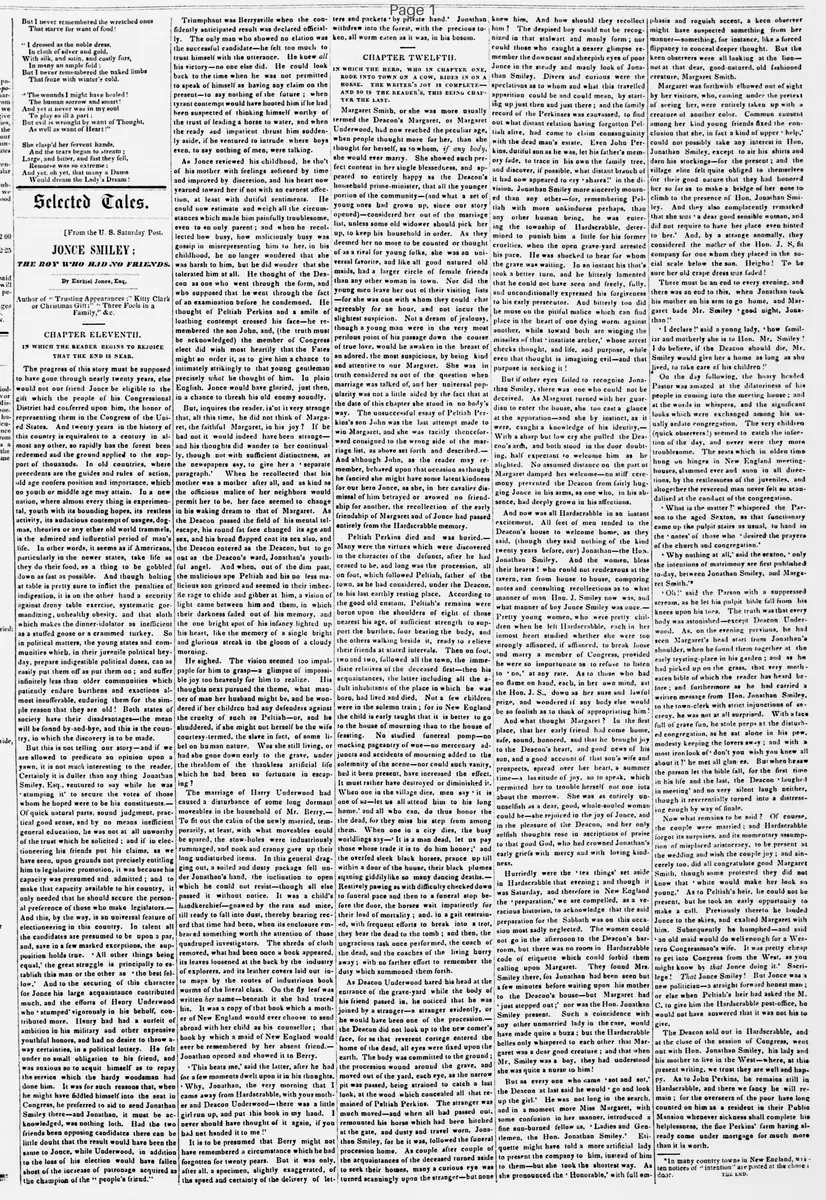
[From the U. S. Saturday Post.]
JONCE SMILEY:
THE BOY WHO HAD NO FRIENDS.
By Ezekiel Jones, Esq.,
Author of "Trusting Appearances:" "Kitty Clark or Christmas Gift:" "Three Fools in a Family," &c.
CHAPTER ELEVENTH,
IN WHICH THE READER BEGINS TO REJOICE THAT THE END IS NEAR.
The progress of this story must be supposed to have gone through nearly twenty years, else would not our friend Jonce be eligible to the gift which the people of his Congressional District had conferred upon him, the honor of representing them in the Congress of the United States. And twenty years in the history of this country is equivalent to a century in almost any other, so rapidly has the forest been redeemed and the ground applied to the support of thousands. In old countries, where precedents are the guides and rules of action, old age confers position and importance, which no youth or middle age may attain. In a new nation, where almost every thing is experimental, youth with its bounding hopes, its restless activity, its audacious contempt of usages, dogmas, theories or any other old world trammels, is the admired and influential period of man's life. In other words, it seems as if Americans, particularly in the newer states, take life as they do their food, as a thing to be gobbled down as fast as possible. And though bolting at table is pretty sure to inflict the penalties of indigestion, it is on the other hand a security against drowsy table exercise, systematic gorgmandizing, unhealthy obesity, and that sloth which makes the dinner-idolator as inefficient as a stuffed goose or a crammed turkey.
So in political matters, the young states and communities which, in their juvenile political heyday, prepare indigestible political doses, can as easily put them off as put them on; and suffer infinitely less than older communities which patiently endure burthens and exactions almost insufferable, enduring them for the simple reason that they are old! Both states of society have their disadvantages--the mean will be found by-and-bye, and this is the country in which the discovery is to be made.
But this is not telling our story--and if we are allowed to predicate an opinion upon a yawn, it is not much interesting to the reader. Certainly it is duller than any thing Jonathan Smiley, Esq., ventured to say while he was 'stumping it' to secure the votes of those whom he hoped were to be his constituents.-- Of quick natural parts, sound judgment, practical good sense, and by no means inefficient general education, he was not at all unworthy of the trust which he solicited; and if in electioneering his friends put his claims, as we have seen, upon grounds not precisely entitling him to legislative promotion, it was because his capacity was presumed and admitted; and to make that capacity available to his country, it only needed that he should secure the personal preference of those who make legislators.-- And this, by the way, is an universal feature of electioneering in this country. In talent all the candidates are presumed to be upon a par, and, save in a few marked exceptions, the supposition holds true. 'All other things being equal,' the great struggle is principally to establish this man or the other as 'the best fellow.' And to the securing of this character for Jonce his large acquaintance contributed much, and the efforts of Henry Underwood who 'stumped' vigorously in his behalf, contributed more. Henry had had a surfeit of ambition in his military and other expensive youthful honors, and had no desire to throw away certainties, in a political lottery. He felt under no small obligation to his friend, and was anxious so to acquit himself as to repay the service which the hardy woodsman had done him. It was for such reasons that, when he might have fiddled himself into the seat in Congress, he preferred to aid to send Jonathan Smiley there--and Jonathan, it must be acknowledged, was nothing loth.
Had the two friends been opposing candidates there can be little doubt that the result would have been the same to Jonce, while Underwood, in addition to the loss of his election would have fallen short of the increase of patronage acquired as the champion of the "people's friend."
Triumphant was Berrysville when the confidently anticipated result was declared officially. The only man who showed no elation was the successful candidate--he felt too much to trust himself with the utterance. He knew all his victory--no one else did. He could look back to the time when he was not permitted to speak of himself as having any claim on the present--to say nothing of the future; when tyrant contempt would have hooted him if he had been suspected of thinking himself worthy of the trust of leading a horse to water, and when the ready and impatient thrust him suddenly aside, if he ventured to intrude where boys even, to say nothing of men, were talking.
As Jonce reviewed his childhood, he tho't of his mother with feelings softened by time and improved by discretion, and his heart now yearned toward her if not with an earnest affection, at least with dutiful sentiments. He could now estimate and weigh all the circumstances which made him painfully troublesome, even to an only parent; and when he recollected how busy, how maliciously busy was gossip in misrepresenting him to her, in his childhood, he no longer wondered that she was harsh to him, but he did wonder that she tolerated him at all. He thought of the Deacon as one who went through the form, and who supposed that he went through the fact of an examination before he condemned. He thought of Peltiah Perkins and a smile of loathing contempt crossed his face--he remembered the son John, and, (the truth must be acknowledged) the member of Congress elect did wish most heartily that the Fates might so order it, as to give him a chance to intimately strikingly to that young gentleman precisely what he thought of him. In plain English, Jonce would have gloried, just then, in a chance to thresh his old enemy soundly.
But, inquires the reader, isn't it very strange that, all this time, he did not think of Margaret, the faithful Margaret, in his joy? If he had not it would indeed have been strange-- and his thoughts did wander to her continually, though not with sufficient distinctness, as the newspapers say, to give her a 'separate paragraph.'
When he recollected that his mother was a mother after all, and as kind as the officious malice of her neighbors would permit her to be, her face seemed to change in his waking dream to that of Margaret. As the Deacon passed the field of his mental telescope, his round fat face changed its age and sex, and his broad flapped coat its sex also, and the Deacon entered as the Deacon, but to go out as the Deacon's ward, Jonathan's youthful angel.
And when, out of the dim past, the malicious ape Peltiah and his no less malicious son grinned and seemed in their imbecile rage to chide and gibber at him, a vision of light came between him and them, in which their darkness faded out of his memory, and the one bright spot of his infancy lighted up his heart, like the memory of a single bright and glorious streak in the gloom of a cloudy morning.
He sighed. The vision seemed too impalpable for him to grasp--a glimpse of impossible joy too heavenly for him to realize. His thoughts next pursued the theme, what manner of man her husband might be, and he wondered if her children had any defenders against the cruelty of such as Peltiah--or, and he shuddered, if she might not herself be the wife courtesy-termed, the slave in fact, of some libel on human nature.
Was she still living, or had she gone down early to the grave, under the thraldom of the thankless artificial life which he had been so fortunate in escaping?
The marriage of Harry Underwood had caused a disturbance of some long dormant moveables in the household of Mr. Berry,-- To fit out the cabin of the newly married, temporarily, at least, with what moveables could be spared, the stow-holes were industriously rummaged, and nook and cranny gave up their long undisturbed items. In this general dragging out, a soiled and dusty package fell under Jonathan's hand, the inclination to open which he could not resist--though all else passed it without notice. It was a child's handkerchief--gnawed by the rats and mice, till ready to fall into dust, thereby bearing record that time had been, when its enclosure embraced something worth the attention of those quadruped investigators. The shreds of cloth removed, what had been once a book appeared, its leaves loosened at the back by the industry of explorers, and its leather covers laid out into maps by the routes of industrious book worms of the literal class. On the flyleaf was written her name--beneath it she had traced his. It was a copy of that book which a mother of New England would ever choose to send abroad with her child as his counsellor; that book by which a maid of New England would ever be remembered by her absent friend.--
Jonathan opened and showed it to Berry.
"This beats mine," said the latter, after he had for a few moments dwelt upon it in his thoughts. "Why, Jonathan, the very morning that I came away from Hardscrabble, with your mother and Deacon Underwood--there was a little girl run up, and put this book in my hand. I never should have thought of it again, if you had not handed it to me!"
It is to be presumed that Berry might not have remembered a circumstance which he had forgotten for twenty years. But it was only, after all, a specimen, slightly exaggerated, of the speed and certainty of the delivery of letters and packets 'by private hand.' Jonathan withdrew into the forest, with the precious token, all worm eaten as it was, in his bosom.
CHAPTER TWELFTH.
IN WHICH THE HERO, WHO IN CHAPTER ONE, RODE INTO TOWN ON A COW, RIDES IN ON A HORSE. THE WRITER'S JOY IS COMPLETE-- AND SO IS THE READER'S, THIS BEING CHAPTER THE LAST.
Margaret Smith, or she was more usually termed the Deacon's Margaret, or Margaret Underwood, had now reached the peculiar age, when people thought more for her, than she thought for herself, as to whom, if any body, she would ever marry. She showed such perfect content in her single blessedness, and appeared so entirely happy as the Deacon's household prime-minister, that all the younger portion of the community--(and what a set of young ones had grown up, since our story opened)--considered her out of the marriage list, unless some old widower should pick her up, to keep his household in order. As they deemed her no more to be counted or thought of as a rival for young folks, she was a universal favorite, and like all good natured old maids, had a larger circle of female friends than any other woman in town. Nor did the young men leave her out of their visiting lists--for she was one with whom they could chat agreeably for an hour, and not incur the slightest suspicion. Not a dream of jealousy, though a young man were in the very most perilous point of his passage down the course of true love, would be awaken in the breast of an adored, the most suspicious, by being kind and attentive to our Margaret. She was in truth considered as out of the question when marriage was talked of, and her universal popularity was not a little aided by the fact that at the date of this chapter she stood in no body's way. The unsuccessful essay of Peltiah Perkins's son John was the last attempt made to win Margaret, and she was tacitly thenceforward consigned to the wrong side of the marriage list, as above set forth and described.-- And although John, as the reader may remember, behaved upon that occasion as though he fancied she might have some latent kindness for our hero Jonce, as she, in her cavalier dismissal of him betrayed or avowed no friendship for another, the recollection of the early friendship of Margaret and of Jonce had passed entirely from the Hardscrabble memory.
Many were the virtues which were discovered in the character of the defunct, after he had ceased to be, and long was the procession, all on foot, which followed Peltiah, father of the town, as he had considered, under the Deacon, to his last earthly resting place. According to the good old custom, Peltiah's remains were borne upon the shoulders of eight of those nearest his age, of sufficient strength to support the burthen, four bearing the body, and the others walking beside it, ready to relieve their friends at stated intervals. Then on foot, two and two, followed all the town, the immediate relatives of the deceased first--then his acquaintances, the latter including all the adult inhabitants of the place in which he was born, had lived and died. Not a few children were in the solemn train; for in New England the child is early taught that it is better to go to the house of mourning than to the house of feasting.
No studied funereal pomp--no mocking pageantry of woe--no mercenary adjuncts and accidents of mourning added to the solemnity of the scene--nor could such vanity, had it been present, have increased the effect. It must rather have destroyed or diminished it. When one in the village dies, men say 'it is one of us--let us all attend him to his long home,' and all who can, do thus honor the dead, for they miss his step from among them.
When one in a city dies, the busy worldlings say--'It is a man dead, let us pay those whose trade it is to do him honor;' and the overfed sleek black horses prance up till within a door of the house, their black plumes swaying giddily like so many dancing deaths.-- Restively pawing as with difficulty checked down to funeral pace and then to a funeral stop before the door, the horses wait impatiently for their load of mortality; and, in a gait restrained, with frequent efforts to break into a trot, they bear the dead to the tomb; and then, the ungracious task once performed, the coach of the dead, and the coaches of the living hurry away; with no farther effort to remember the duty which summoned them forth.
As Deacon Underwood bared his head at the entrance of the grave-yard while the body of his friend passed in, he noticed that he was joined by a stranger--a stranger evidently, or he would have been one of the procession.-- The Deacon did not look up to the new comer's face, or as that reverent cortege entered the home of the dead, all eyes were fixed upon the earth. The body was committed to the ground; the procession wound around the grave, and moved out of the yard, each eye, as the narrow pit was passed, being strained to catch a last look, at the wood which concealed all that remained of Peltiah Perkins. The stranger was much moved--and when all had passed out, remounted his horse which had been hitched at the gate, and dusty and travel worn, Jonathan Smiley, for be it was, followed the funeral procession home. As couple after couple of the acquaintances of the deceased turned aside to seek their homes, many a curious eye was turned scanningly upon the stranger--but none knew him. And how should they recollect him? The despised boy could not be recognized in that stalwart and manly form; nor could those who caught a nearer glimpse remember the downcast and sheepish eyes of poor Jonce in the steady and manly look of Jonathan Smiley. Divers and curious were the speculations as to whom and what this travelled apparition could be and could mean, by starting up just then and just there; and the family record of the Perkinses was canvassed, to find out what distant relation having forgotten Peltiah alive, had come to claim consanguinity with the dead man's estate. Even John Perkins, dutiful son as he was, let his father's memory fade, to trace in his own the family tree, and discover, if possible, what distant branch of it had now appeared to cry 'shares!' in the division. Jonathan Smiley more sincerely mourned than any other--for, remembering Peltiah with more unkindness perhaps, than any other human being, he was entering the township of Hardscrabble, determined to punish him a little for his former cruelties, when the open grave-yard arrested his pace. He was shocked to hear for whom the grave was waiting. In an instant his thoughts took a better turn, and he bitterly lamented that he could not have seen and freely, fully, and unconditionally expressed his forgiveness to his early persecutor. And bitterly too did he muse on the pitiful malice which can find place in the heart of one dying worm against another, while toward both are winging the missiles of that 'insatiate archer,' whose arrest checks thought, and life, and purpose, while even that thought is imagining evil--and that purpose is seeking it!
But if other eyes failed to recognise Jonathan Smiley, there was one who could not be deceived. As Margaret turned with her guardian to enter the house, she too cast a glance at the apparition--and she by instinct, as it were, caught a knowledge of his identity,-- With a sharp but low cry she pulled the Deacon's arm, and both stood in the door doubting, half expectant to welcome him as he alighted. No assumed distance on the part of Margaret damped her welcome--no stiff ceremony prevented the Deacon from fairly hugging Jonce in his arms, as one who, in his absence, had deeply grown in his affections.
And now was all Hardscrabble in an instant excitement. All feet of men tended to the Deacon's house to welcome home, as they said, (though they said nothing of the kind twenty years before, our) Jonathan--the Hon. Jonathan Smiley. And the women, bless their hearts! who could not rendezvous at the tavern, ran from house to house, comparing notes and consulting recollections as to what manner of man Hon. J. Smiley now was, and what manner of boy Jonce Smiley was once.-- Pretty young women, who were pretty children when he left Hardscrabble, each in her inmost heart studied whether she were too strongly affianced, if affianced, to break loose and marry a member of Congress, provided he were so importunate as to refuse to listen to 'no,' at any rate. As to those who had no flame on hand, each, in her own mind, sat the Hon. J. S., down as her sure and lawful prize, and wondered if anybody else would be so foolish as to think of appropriating him: And what thought Margaret? In the first place, that her early friend had come home, safe, sound, honored, and that he brought joy to the Deacon's heart, and good news of his son, and a good account of that son's wife and prospects, spread over her heart, a summer time--a lassitude of joy, so to speak, which permitted her to trouble herself not one jota about the morrow.
She was as entirely unselfish as a dear, good, whole-souled woman could be--she rejoiced in the joy of Jonce, and in the pleasure of the Deacon, and her only selfish thoughts rose in ascriptions of praise to that good God, who had crowned Jonathan's early griefs with mercy and with loving kindness.
Hurriedly were the 'tea things' set aside in Hardscrabble that evening; and though it was Saturday, and therefore in New England the 'preparation,' we are compelled, as a veracious historian, to acknowledge that the said preparation for the Sabbath was on this occasion most sadly neglected. The women could not go in the afternoon to the Deacon's bar-room, but there was no rule in Hardscrabble code of etiquette which could forbid them calling upon Margaret. They found Mrs. Smiley there, for Jonathan had been seen but a few minutes before waiting upon his mother to the Deacon's house--but Margaret had 'just stepped out;' nor was the Hon. Jonathan Smiley present. Such a coincidence with any other unmarried lady in the case, would have made quite a buzz; but the Hardscrabble belles only whispered to each other that Margaret was a dear good creature; and that when Mr. Smiley was a boy, they had understood she was quite a nurse to him! But as every one who came 'sat and sat,' the Deacon at last said he would go and look up the girl.' He was not long in the search, and in a moment more Miss Margaret, with some confusion in her manner, introduced a fine sun-burned fellow as, 'Ladies and Gentlemen, the Hon. Jonathan Smiley.'
Etiquette might have told a more artificial lady to present the company to him, instead of him to them--but she took the shortest way. As she pronounced the 'Honorable,' with full emphasis and roguish accent, a keen observer might have suspected something from her manner--something, for instance, like a forced flippancy to conceal deeper thought. But the keen observers were all looking at the lion-- not at that dear, good-natured, old fashioned creature, Margaret Smith.
Margaret was forthwith elbowed out of sight by her visitors, who, coming under the pretext of seeing her, were entirely taken up with a creature of another color. Common consent among her kind young friends fixed the conclusion that she, in fact a kind of upper 'help,' could not possibly take any interest in Hon. Jonathan Smiley, except to air his shirts and darn his stockings--for the present; and the village elite felt quite obliged to themselves for their good nature that they had honored her so far as to make a bridge of her person to climb to the presence of Hon. Jonathan Smiley. And they also complacently remarked that she was 'a dear good sensible woman, and did not require to have her place even hinted to her.' And, by a strange anomaly, they considered the mother of the Hon. J. S. fit company for one whom they placed in the social scale below the son. Heigho! To be sure her old crape dress was faded!
There must be an end to every evening, and there was an end to this, when Jonathan took his mother on his arm to go home, and Margaret bade Mr. Smiley good night, Jonathan!'
'I declare!' said a young lady, 'how familiar and motherly she is to Hon. Mr. Smiley I do believe, if the Deacon should die, Mr. Smiley would give her a home as long as she lived, to take care of his children!'
On the day following, the hoary headed Pastor was amazed at the dilatoriness of his people in coming into the meeting house: and at the words in whispers, and the significant looks which were exchanged among his usually sedate congregation. The very children (quick observers!) seemed to catch the infection of the day, and never were they more troublesome. The seats which in olden time hung on hinges in New England meeting-houses, slammed ever and anon in all directions, by the restlessness of the juveniles, and altogether the reverend man never felt so scandalised at the conduct of the congregation.
'What is the matter?' whispered the Parson to the aged Sexton, as that functionary came up the pulpit stairs as usual, to hand in the 'notes' of those who desired the prayers of the church and congregation.'
'Why nothing at all,' said the sexton, 'only the intentions of matrimony are first published to-day, between Jonathan Smiley, and Margaret Smith.'
'Oh!' said the Parson with a suppressed scream, as he let his pulpit bible fall from his knees upon his toes. The truth was that every body was astonished--except Deacon Underwood. As, on the evening previous, he had seen Margaret's head start from Jonathan's shoulder, when he found them together at the early trysting-place in his garden; and as he had picked up on the grass, that very moth-eaten bible of which the reader has heard before; and furthermore as he had carried a written message from Hon. Jonathan Smiley, to the town-clerk with strict injunctions of secrecy, he was not at all surprised. With a face full of grave fun, he stole peeps at the disturbed congregation, as he sat alone in his pew, modesty keeping the lovers away: and with a most iron look of 'don't you wish you knew all about it?' he met all glances. But when he saw the parson let the bible fall, for the first time in his life and the last, the Deacon 'laughed in meeting'--and no very silent laugh neither, though it reverentially turned into a distressing cough by way of finale.
Now what remains to be said? Of course, the couple were married; and Hardscrabble forgot its surprises, and its momentary assumption of misplaced aristocracy, to be present at the wedding and wish the couple joy; and sincerely too, did all congratulate good Margaret Smith, though some protested they did not know that 'white would make her look so young.' As to Peltiah's heir, he could not be present, but he took an early opportunity to make a call. Previously thereto he lauded Jonce to the skies, and exalted Margaret with him. Subsequently he humphed--and said 'an old maid would do well enough for a Western Congressman's wife. It was pretty cheap to get into Congress from the West, as you might know by that Jonce doing it.' Sacrilege! That Jonce Smiley! But Jonce was a new politician--a straight forward honest man; or else when Peltiah's heir had asked the M. C. to give him the Hardscrabble post-office, he would not have answered that it was not his to give.
The Deacon sold out in Hardscrabble, and at the close of the session of Congress, went out with Hon. Jonathan Smiley, his lady and his mother to live in the West--where, at this present writing, we trust they are well and happy. As to John Perkins, he remains still in Hardscrabble, and there we fancy he will remain; for the overseers of the poor have long counted on him as a resident in their Public Mansion whenever sickness shall complete his helplessness, the fine Perkins' farm having already come under mortgage for much more than it is worth.
"In many country towns in New England, written notices of 'intention' are posted at the church door."
THE END.
What sub-type of article is it?
What themes does it cover?
What keywords are associated?
What entities or persons were involved?
Literary Details
Title
Jonce Smiley: The Boy Who Had No Friends.
Author
By Ezekiel Jones, Esq., Author Of "Trusting Appearances:" "Kitty Clark Or Christmas Gift:" "Three Fools In A Family," &C.
Form / Style
Serialized Novel Chapters In Narrative Prose
Key Lines