Thank you for visiting SNEWPapers!
Sign up free
Literary
June 5, 1790
Gazette Of The United States
New York, New York County, New York
What is this article about?
John Adams' essay concludes Discourses on Davila, exploring how societies seek honor beyond merit through land, offices, and families, critiquing European nobility's role in checking despotism, and warning against concentrating sovereignty in single assemblies to avoid tyranny.
Clipping
OCR Quality
98%
Excellent
Full Text
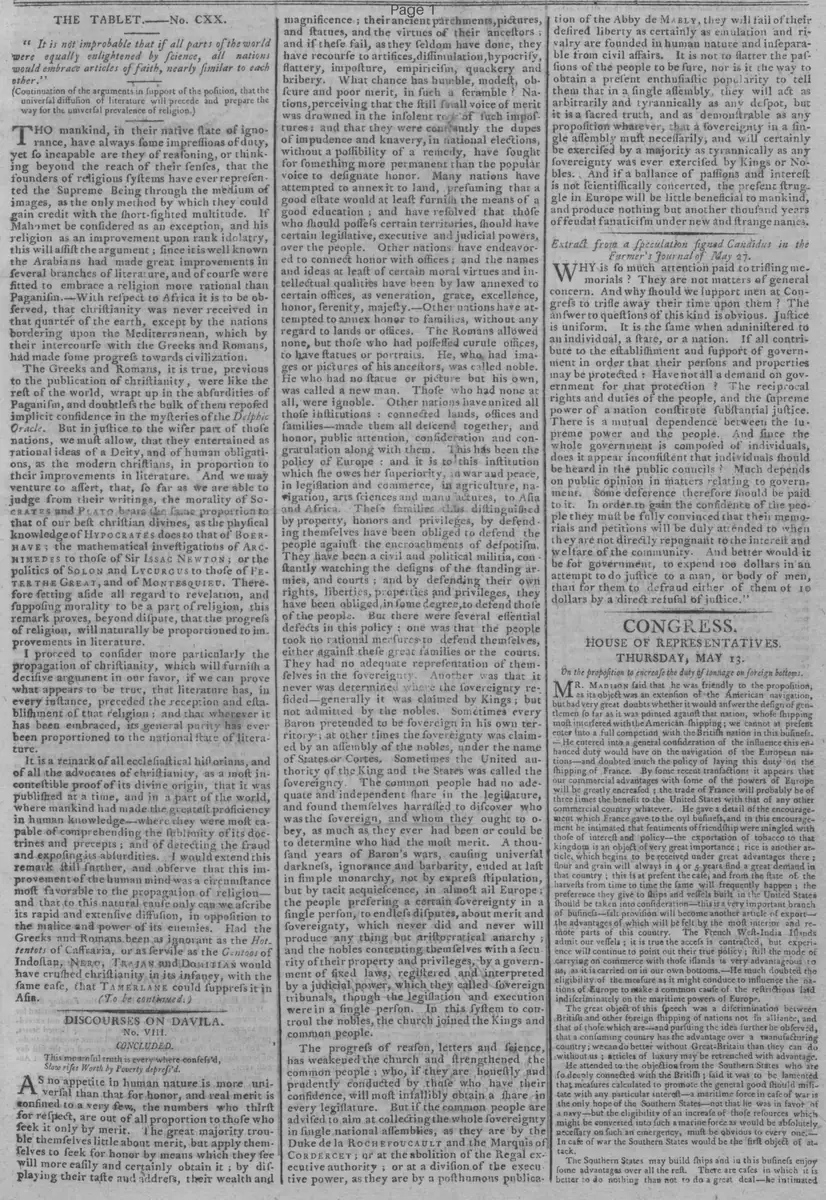
DISCOURSES ON DAVILA.
No. VIII.
CONCLUDED.
This mournful truth is every where confess'd,
Slow rises Worth by Poverty depress'd.
As no appetite in human nature is more universal than that for honor, and real merit is confined to a very few, the numbers who thirst for respect, are out of all proportion to those who seek it only by merit. The great majority trouble themselves little about merit, but apply themselves to seek for honor by means which they see will more easily and certainly obtain it; by displaying their state and address, their wealth and magnificence; their ancient parchments, pictures, and statues, and the virtues of their ancestors; and if these fail, as they seldom have done, they have recourse to artifices, dissimulation, hypocrisy, flattery, imposture, empiricism, quackery and bribery. What chance has humble, modest, obscure and poor merit, in such a scramble? Nations, perceiving that the still small voice of merit was drowned in the insolent shriek of such impostures: and that they were constantly the dupes of impudence and knavery, in national elections, without a possibility of a remedy, have sought for something more permanent than the popular voice to designate honor. Many nations have attempted to annex it to land, presuming that a good estate would at least furnish the means of a good education; and have resolved that those who should possess certain territories, should have certain legislative, executive and judicial powers, over the people. Other nations have endeavored to connect honor with offices; and the names at least of certain moral virtues and intellectual qualities have been by law annexed to certain offices, as veneration, grace, excellence, honor, serenity, majesty. Other nations have attempted to annex honor to families, without any regard to lands or offices. The Romans allowed none, but those who had possessed curule offices, to have statues or portraits. He, who had images or pictures of his ancestors, was called noble. He who had no statue or picture but his own, was called a new man. Those who had none at all, were ignoble. Other nations have united all those institutions: connected lands, offices and families—made them all descend together, and honor, public attention, consideration and congratulation along with them. This has been the policy of Europe: and it is to this institution which she owes her superiority, in war and peace, in legislation and commerce, in agriculture, navigation, arts sciences and manufactures, to Asia and Africa. These families thus distinguished by property, honors and privileges, by defending themselves have been obliged to defend the people against the encroachments of despotism. They have been a civil and political militia, constantly watching the designs of the standing armies, and courts; and by defending their own rights, liberties, properties and privileges, they have been obliged, in some degree, to defend those of the people. But there were several essential defects in this policy: one was that the people took no rational measures to defend themselves, either against these great families or the courts. They had no adequate representation of themselves in the sovereignty. Another was that it never was determined where the sovereignty resided—generally it was claimed by Kings; but not admitted by the nobles. Sometimes every Baron pretended to be sovereign in his own territory; at other times the sovereignty was claimed by an assembly of the nobles, under the name of States or Cortes. Sometimes the united authority of the King and the States was called the sovereignty. The common people had no adequate and independent share in the legislature, and found themselves harassed to discover who was the sovereign, and whom they ought to obey, as much as they ever had been or could be to determine who had the most merit. A thousand years of Baron's wars, causing universal darkness, ignorance and barbarity, ended at last in simple monarchy, not by express stipulation, but by tacit acquiescence, in almost all Europe; the people preferring a certain sovereignty in a single person, to endless disputes, about merit and sovereignty, which never did and never will produce any thing but aristocratical anarchy; and the nobles contenting themselves with a security of their property and privileges, by a government of fixed laws, registered and interpreted by a judicial power, which they called sovereign tribunals, though the legislation and execution were in a single person. In this system to control the nobles, the church joined the Kings and common people.
The progress of reason, letters and science, has weakened the church and strengthened the common people; who, if they are honestly and prudently conducted by those who have their confidence, will most infallibly obtain a share in every legislature. But if the common people are advised to aim at collecting the whole sovereignty in single national assemblies, as they are by the Duke de la ROCHEFOUCAULT and the Marquis de CONDORCET; or at the abolition of the Regal executive authority; or at a division of the executive power, as they are by a posthumous publication of the Abby de Mably, they will fail of their desired liberty as certainly as emulation and rivalry are founded in human nature and inseparable from civil affairs. It is not to flatter the passions of the people to be sure, nor is it the way to obtain a present enthusiastic popularity to tell them that in a single assembly, they will act as arbitrarily and tyrannically as any despot, but it is a sacred truth, and as demonstrable as any proposition whatever, that a sovereignty in a single assembly must necessarily, and will certainly be exercised by a majority as tyrannically as any sovereignty was ever exercised by Kings or Nobles. And if a balance of passions and interests is not scientifically concerted, the present struggle in Europe will be little beneficial to mankind, and produce nothing but another thousand years of feudal fanaticism under new and strange names.
No. VIII.
CONCLUDED.
This mournful truth is every where confess'd,
Slow rises Worth by Poverty depress'd.
As no appetite in human nature is more universal than that for honor, and real merit is confined to a very few, the numbers who thirst for respect, are out of all proportion to those who seek it only by merit. The great majority trouble themselves little about merit, but apply themselves to seek for honor by means which they see will more easily and certainly obtain it; by displaying their state and address, their wealth and magnificence; their ancient parchments, pictures, and statues, and the virtues of their ancestors; and if these fail, as they seldom have done, they have recourse to artifices, dissimulation, hypocrisy, flattery, imposture, empiricism, quackery and bribery. What chance has humble, modest, obscure and poor merit, in such a scramble? Nations, perceiving that the still small voice of merit was drowned in the insolent shriek of such impostures: and that they were constantly the dupes of impudence and knavery, in national elections, without a possibility of a remedy, have sought for something more permanent than the popular voice to designate honor. Many nations have attempted to annex it to land, presuming that a good estate would at least furnish the means of a good education; and have resolved that those who should possess certain territories, should have certain legislative, executive and judicial powers, over the people. Other nations have endeavored to connect honor with offices; and the names at least of certain moral virtues and intellectual qualities have been by law annexed to certain offices, as veneration, grace, excellence, honor, serenity, majesty. Other nations have attempted to annex honor to families, without any regard to lands or offices. The Romans allowed none, but those who had possessed curule offices, to have statues or portraits. He, who had images or pictures of his ancestors, was called noble. He who had no statue or picture but his own, was called a new man. Those who had none at all, were ignoble. Other nations have united all those institutions: connected lands, offices and families—made them all descend together, and honor, public attention, consideration and congratulation along with them. This has been the policy of Europe: and it is to this institution which she owes her superiority, in war and peace, in legislation and commerce, in agriculture, navigation, arts sciences and manufactures, to Asia and Africa. These families thus distinguished by property, honors and privileges, by defending themselves have been obliged to defend the people against the encroachments of despotism. They have been a civil and political militia, constantly watching the designs of the standing armies, and courts; and by defending their own rights, liberties, properties and privileges, they have been obliged, in some degree, to defend those of the people. But there were several essential defects in this policy: one was that the people took no rational measures to defend themselves, either against these great families or the courts. They had no adequate representation of themselves in the sovereignty. Another was that it never was determined where the sovereignty resided—generally it was claimed by Kings; but not admitted by the nobles. Sometimes every Baron pretended to be sovereign in his own territory; at other times the sovereignty was claimed by an assembly of the nobles, under the name of States or Cortes. Sometimes the united authority of the King and the States was called the sovereignty. The common people had no adequate and independent share in the legislature, and found themselves harassed to discover who was the sovereign, and whom they ought to obey, as much as they ever had been or could be to determine who had the most merit. A thousand years of Baron's wars, causing universal darkness, ignorance and barbarity, ended at last in simple monarchy, not by express stipulation, but by tacit acquiescence, in almost all Europe; the people preferring a certain sovereignty in a single person, to endless disputes, about merit and sovereignty, which never did and never will produce any thing but aristocratical anarchy; and the nobles contenting themselves with a security of their property and privileges, by a government of fixed laws, registered and interpreted by a judicial power, which they called sovereign tribunals, though the legislation and execution were in a single person. In this system to control the nobles, the church joined the Kings and common people.
The progress of reason, letters and science, has weakened the church and strengthened the common people; who, if they are honestly and prudently conducted by those who have their confidence, will most infallibly obtain a share in every legislature. But if the common people are advised to aim at collecting the whole sovereignty in single national assemblies, as they are by the Duke de la ROCHEFOUCAULT and the Marquis de CONDORCET; or at the abolition of the Regal executive authority; or at a division of the executive power, as they are by a posthumous publication of the Abby de Mably, they will fail of their desired liberty as certainly as emulation and rivalry are founded in human nature and inseparable from civil affairs. It is not to flatter the passions of the people to be sure, nor is it the way to obtain a present enthusiastic popularity to tell them that in a single assembly, they will act as arbitrarily and tyrannically as any despot, but it is a sacred truth, and as demonstrable as any proposition whatever, that a sovereignty in a single assembly must necessarily, and will certainly be exercised by a majority as tyrannically as any sovereignty was ever exercised by Kings or Nobles. And if a balance of passions and interests is not scientifically concerted, the present struggle in Europe will be little beneficial to mankind, and produce nothing but another thousand years of feudal fanaticism under new and strange names.
What sub-type of article is it?
Essay
What themes does it cover?
Political
Liberty Freedom
Moral Virtue
What keywords are associated?
Honor
Merit
Nobility
Sovereignty
Political Liberty
Despotism
European Policy
Literary Details
Title
Discourses On Davila. No. Viii. Concluded.
Key Lines
This Mournful Truth Is Every Where Confess'd, Slow Rises Worth By Poverty Depress'd.
What Chance Has Humble, Modest, Obscure And Poor Merit, In Such A Scramble?
A Sovereignty In A Single Assembly Must Necessarily, And Will Certainly Be Exercised By A Majority As Tyrannically As Any Sovereignty Was Ever Exercised By Kings Or Nobles.