Thank you for visiting SNEWPapers!
Sign up free
Story
December 19, 1891
The Weekly Intelligencer
Lexington, Lafayette County, Missouri
What is this article about?
Report on the Farmers' Institute in Odessa, Missouri, detailing exhibits of produce, speeches by experts on transportation, animal health, farming practices, roads, horse breeding, fruit growing, and women's roles in farm management, emphasizing agricultural improvement.
Clipping
OCR Quality
95%
Excellent
Full Text
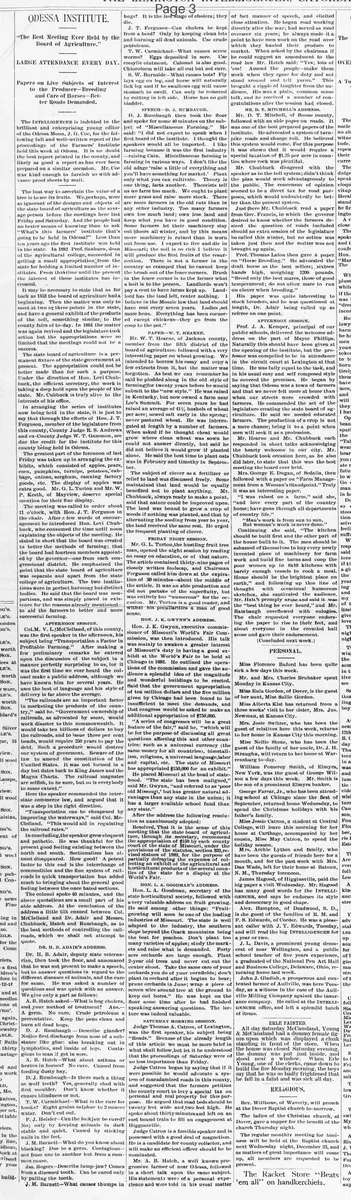
ODESSA INSTITUTE.
"The Best Meeting Ever Held by the Board of Agriculture."
LARGE ATTENDANCE EVERY DAY.
Papers on Live Subjects of Interest to the Producer—Breeding and Care of Horses—Better Roads Demanded.
The INTELLIGENCER is indebted to the brilliant and enterprising young editor of the Odessa Moon, J. G. Coe, for the following full and well-written report of the proceedings of the Farmers' Institute held this week at Odessa. It is no doubt the best report printed in the county, and likely as good a report as has ever been prepared on a similar occasion. Mr. Coe was kind enough to furnish us with advance proof sheets by mail.
The best way to ascertain the value of a tree is to see its fruits. We, perhaps, were as ignorant of the designs and objects of the state board of agriculture as the average person before the meetings here last Friday and Saturday. And the people had no better means of knowing than to ask "What's this farmers' institute that's going to be held in Odessa?" Less than ten years ago the first institute was held in the state. In 1882 Prof. Sanborn, dean of the agricultural college, succeeded in getting a small appropriation from the state for holding a limited number of institutes. From that time until the present the interest of these institutes has increased.
It may be necessary to state that as far back as 1853 the board of agriculture had a beginning. Then the matter was only to meet at two or three points in the state, and have a general exhibit of the products of the soil, something similar to the county fairs of to-day. In 1864 the matter was again revived and the legislature took action but the appropriations were so limited that the meetings could not be a success.
The state board of agriculture is a permanent fixture of the state government at present. The appropriation could not be better made than for such a purpose. Under the direction of Hon. Levi Chubbuck, the efficient secretary, the work is taking a deep hold upon the people of the state. Mr. Chubbuck is truly alive to the interests of his office.
In arranging the series of institutes now being held in the state, it is just to say that through the efforts of Hon. J. T. Ferguson, member of the legislature from this county, County Judge R. S. Andrews and ex-County Judge W. T. Gammon, are due the credit for the institute for this county being held in Odessa.
The greatest part of the forenoon of last Friday was taken up in arranging the exhibits, which consisted of apples, pears, corn, pumpkins, turnips, potatoes, cabbage, onions, sorghum, canning factory goods, etc. The display of apples was extra good. Mr. G. L. Turton and Mr. W. P. Kesth, of Mayview, deserve special mention for their fine display.
The meeting was called to order about 11 o'clock, with Hon. J. T. Ferguson in the chair. After a few words of encouragement he introduced Hon. Levi Chubbuck, who consumed the time until noon explaining the objects of the meeting. He stated in short that the board was created to better the methods of farming; that the board had fourteen members appointed by the governor—one from each congressional district. He emphasized the point that the state board of agriculture was separate and apart from the state college of agriculture. The two institutions were in perfect harmony but distinct bodies. He said that the board was non-partisan, and was simply placed in existence for the reasons already mentioned to aid the farmers to better and more successful farming.
AFTERNOON SESSION
Col. M. V. McClelland, of this county, was the first speaker in the afternoon, his subject being "Transportation a Factor in Profitable Farming." After making a few preliminary remarks he entered upon the discussion of the subject in a manner perfectly surprising to us, for it was the first time we ever heard the colonel make a public address, although we have known him for several years. He uses the best of language and his style of delivery is far above the average.
"The railroads are an important factor in marketing the products of the country," said he. "Government ownership of railroads, as advocated by some, would work disaster to this commonwealth. It would take ten billions of dollars to buy the railroads, and to issue three per cent bonds, would require 250 years to pay the debt. Such a procedure would destroy our system of government. Beware of the law to amend the constitution of the United States. It was not formed in a day but dates back to King James and the Magna Charta. The railroad magnates are selfish, to be sure, but so is everybody to some extent."
Here the speaker commended the inter-state commerce law, and argued that it was a step in the right direction.
"Transportation can be cheapened by improving the waterways," said Col. McClelland. "This would aid in regulating the railroad rates."
In concluding the speaker grew eloquent and pathetic. He was thankful for the present good feeling existing between the north and south. Sectionalism has almost disappeared. How good! A potent factor to this end is the interchange of commodities and the fine system of railroads in quick transportation has added much to bringing about the general good feeling between the once hated sections.
The colonel spoke 40 minutes, and the above quotations are a small part of his able address. At the conclusion of the address a little tilt ensued between Col. McClelland and Dr. Adair and Messrs. Chubbuck, Hatch and Rumbaugh, as to the best methods of controlling the railroads, which we shall not attempt to quote.
Dr. H. B. Adair, deputy state veterinarian, then took the floor, and announced that he was not present to make a speech, but to answer questions in regard to the different diseases of animals, and the cure for same.
He was asked a number of questions and was quick with an answer. We give only a part as follows:
A. B. Hatch asked—What is hog cholera, and your method of treatment? Ans.—A germ. No cure. Crude petroleum a preventative. Keep the pens clean and burn all dead hogs.
D. J. Rumbaugh—Describe glander? Notice first discharge from nose of a substance like glue: also breaking out in lymphatics, and inside of legs. Contagious to man if get in sore.
A. B. Hatch—What about asthma or heaves in horses? No cure. Caused from feeding dusty hay.
D. J. Rumbaugh—Is there such a thing as wolf teeth? Yes, generally shed with first moulder. Don't know whether it causes blindness or not.
T. W. Carmichael—What is the cure for hooks? Eight grains sulphur to 2 ounces water. Don't cut out.
P. J. Heisler—Can the lockjaw be cured? No; only by keeping animals in dark stable and quiet. Caused by sticking nails in the feet.
J. M. Barnett—What do you know about blackleg? Due to a germ. Contagious—not from one to another but from a common cause.
Jas. Rogers—Describe lump-jaw? Comes from a diseased tooth. Can be cured only by pulling the tooth.
J. M. Barnett—What causes thumps in hogs? It is the last stage of cholera; they die.
J. T. Ferguson—Can cholera be kept from a herd? Only by keeping clean lots and burning all dead animals. Use crude petroleum.
T. W. Carmichael—What causes screw worms? Eggs deposited in sore. Use cresylic ointment. Calomel is also good. Chloroform will take all out but not cure.
S. W. Burnside—What causes bots? Fly lays egg on leg, and horse will naturally lick leg and if he swallows egg will cause stomach to swell. Can only be removed by cutting in left side. Horse has no gall bladder.
SPEECH—D. J. RUMBAUGH.
D. J. Rumbaugh then took the floor and spoke for some 40 minutes on the subject of "Miscellaneous Farming."
He said: "I did not expect to speak when I first heard of the institute. I thought the speakers would all be imported. I like farming because it was the first industry—raising Cain. Miscellaneous farming is farming in various ways. I don't like the old adage 'raise a little of everything and you'll have something for market.' Plant only what you can cultivate. Theory is one thing, facts another. Theorists tell us we farm too much. We ought to plant more grass and raise more stock. There are more farmers in the old ruts than in any other industry. Too many farmers own too much land: own less land and keep what you have in good condition. Some farmers let their machinery stay out doors all winter, and by this means more machinery is ruined than is worn out from use. I expect to live and die in Missouri; the soil is so rich I believe it will produce the first fruits of the resurrection.
There is not a farmer in the country so cramped that he cannot keep the brush out of the fence corners. Brush in the fence corner is to the farmer what a boil is to the person. Landlords won't pay a cent to have farms kept up. Landlord has the land left, renter nothing. I believe in the Mosaic law that land should have rest every seven years. Ladies, set more hens. Everything has been cornered except chickens—they go from the coop to the pot."
PAPER—W. T. HEARNE.
Mr. W. T. Hearne, of Jackson county, member from the fifth district of the board of agriculture, followed with a very interesting paper on wheat growing. We intended to borrow his essay and copy a few extracts from it, but the matter was forgotten. As best we can remember he said he plodded along in the old style of farming for twenty years before he would submit to the "new style." He was raised in Kentucky, but now owned a farm near Lee's Summit. For seven years he had raised an average of 41½ bushels of wheat per acre; sowed salt early in the spring; never pastured wheat. He was interrogated at length by a number of farmers. When asked if he thought cheat would grow where clean wheat was sown he could not answer directly, but said he did not believe it would grow if planted alone. He said the best time to plant oats was in February and timothy in September.
The subject of clover as a fertilizer or relief to land was discussed freely. Some maintained that land would be equally benefited not to plant anything.
Mr. Chubbuck, always ready to make a point, said that nature could be improved upon. The land was bound to grow a crop of weeds if nothing was planted, and that by alternating the seeding from year to year the land received the same rest. He urged the frequent planting of clover.
FRIDAY NIGHT SESSION.
Mr. G. L. Turton, the hustling fruit tree man, opened the night session by reading an essay on education, or of that nature. The article contained thirty-nine pages of closely written foolscap, and Chairman Ferguson called him down at the expiration of 30 minutes—about the middle of the article. It was an able production and did not partake of the superfluity, but was entirely too "numerous" for the occasion. Mr. Turton is a good reader, and with all his peculiarities a man of good sense.
HON. J. K. GWYNN'S ADDRESS,
Hon. J. K. Gwynn, executive commissioner of Missouri's World's Fair Commission, was then introduced. His talk was mainly to awaken a greater interest of Missouri's duty in having a good exhibit at the World's Fair to be held at Chicago in 1893. He outlined the operations of the commission and gave the audience a splendid idea of the magnitude and wonderful buildings to be erected. Said that the government appropriation of ten million dollars and the five million given by Chicago had been found to be insufficient to meet the demands, and that congress would be asked to make an additional appropriation of $750,000.
"A series of congresses will be a great feature of the fair," said he, "which will be for the purpose of discussing all great questions affecting this and other countries: such as a universal currency (the same money for all countries), bimetallism, religions, a universal language, labor and capital, etc. The state of Missouri has appropriated $150,000 for an exhibit."
He placed Missouri at the head of statehood.
"The state has been maligned," said Mr. Gwynn, "and referred to as 'poor old Missouri,' but has greater natural advantages than any state in the union; it has a larger available school fund than any state."
After the address the following resolution was unanimously adopted:
Resolved, That it is the sense of this meeting that the state board of agriculture, through its secretary, recommend the appropriation of $150 by each county court of the state of Missouri, under the provisions of the statutes, section 332, revised statutes of 1889, for the purpose of partially defraying the expenses of collecting an exhibit of the agricultural and horticultural products of the several counties of the state for a display at the World's Fair.
HON. L. A. GOODMAN'S ADDRESS.
Hon. L. A. Goodman, secretary of the state horticultural society, followed with a very valuable address on fruit growing. He said among other things: "Fruit-growing will soon be one of the leading industries of Missouri. The state is well adapted to the industry, the southern slope beyond the Ozark mountains being the best for peaches. Don't plant too many varieties of apples; study the market and raise what is demanded. Forty acre orchards are large enough. Plant 2-year old trees and never cut out the center shoot. Take the same care of your orchards you do of your cornfields; don't plant in orchard after it begins to bear; prune orchards in June; wrap a piece of screen wire around tree at the ground to keep out bores." He was kept on the floor some time after he had finished speaking answering questions. The lecture was indeed valuable.
SATURDAY MORNING SESSION.
Judge Thomas A. Catron, of Lexington, was the first speaker, his subject being "Roads." Because of the already length of this article we must be more brief in what shall follow, but let it be understood that the proceedings of Saturday were of no less importance than Friday.
Judge Catron began by saying that if it were possible he would advocate a system of macadamized roads in this county, and suggested that the farmers petition the county court to levy a special tax on personal and real property for thus purpose. He argued that road beds should be twenty feet wide and two feet high. He spoke about thirty minutes and left on an east bound train to fill an engagement at Higginsville.
Judge Catron is a forcible speaker and is possessed with a good deal of magnetism. He is a candidate for county collector, and will make an efficient officer should he be nominated.
Mr. A. B. Hatch, a well known progressive farmer of near Odessa, followed in a short talk upon the same subject. His statements were of a personal experience and were told in his usual matter of fact manner of speech, and elicited close attention. He began road working directly after the war; had served as road overseer six years; he always made it a point to have men work on the road over which they hauled their produce to market. When asked by the chairman if he could suggest an amendment to the road law Mr. Hatch said: "Yes; lots of 'em! Amend the people—make them work when they come for duty and not stand around and tell yarns." This brought a ripple of laughter from the audience. His was a plain, common sense talk, and he received a number of congratulations after the session had closed.
MR. D. T. MITCHELL'S ADDRESS.
Mr. D. T. Mitchell, of Boone county, followed with an able paper on roads. It was one of the best prepared papers of the institute. He advocated a system of turnpike roads and charge toll. He believed this system would come. For this purpose it was shown that it would require a special taxation of $1.25 per acre in counties where rock was plentiful.
Mr. Chubbuck disagreed with the speaker as to the toll system; didn't think the plan would work advantageously to the public. The consensus of opinion seemed to be a direct tax for road purposes, which would undoubtedly be better than the present system.
Just there Mr. Chubbuck read a paper from Gov. Francis, in which the governor desired to know whether the farmers desired the question of roads included should an extra session of the legislature be called this winter, but no action was taken just then and the matter was not brought up again.
Prof. Thomas Lafon then gave a paper on "Horse Breeding."
He advocated the draft horse as the best sellers; sixteen hands high, weighing 1200 pounds.
"Breed only the best mares, those of good temperament; do not allow mare to run on clover when breeding."
His paper was quite interesting to stock breeders, and he was questioned at length, Dr. Adair being called up as referee on one point.
AFTERNOON SESSION.
Prof. J. A. Kemper, principal of our public schools, delivered the welcome address on the part of Mayor Phillips. Naturally this should have been given at the opening of the institute, but the professor was compelled to be in attendance in the circuit court at Lexington at that time. He was fully equal to the task, and in his usual easy and self composed style he covered the premises. He began by saying that Odessa was a town of farmers and that we never felt more at home than when our streets were crowded with farmers. He commended the act of the legislature creating the state board of agriculture. He said we needed educated farmers. The production of a crop is not a mere chance; bring it to a point when men will seek it as a profession.
Mr. Hearne and Mr. Chubbuck each responded in short talks acknowledging the hearty welcome in our city. Mr. Chubbuck took occasion here, as he also did later, to state that this was the best meeting the board ever held.
Mrs. George E. Dugan, of Sedalia, then followed with a paper on "Farm Management from a Woman's Standpoint." Truly it was an interesting paper.
"I was raised on a farm," said she, "and love every part of the country home; have gone through all departments of country life."
"Man's work is from sun to sun, But woman's work is never done."
Continuing she said, "The kitchen should be built first and the other part of the house built to it. The men should be ashamed of themselves to buy every newly invented piece of machinery for farm work and build fine barns and coop the poor women up in 8x10 kitchens with barely enough vessels to cook a meal. Home should be the brightest place on earth," and following up this line of thought, with occasional humorous sketches, she captivated the audience.
Mr. Hatch promptly arose and said it was the "best thing he ever heard," and Mr. Rumbaugh overflowed with eulogies. The chair requested everyone endorsing the paper to rise to their feet, and about everyone in the crowded hall arose and gave their endorsement.
[Concluded next week.]
"The Best Meeting Ever Held by the Board of Agriculture."
LARGE ATTENDANCE EVERY DAY.
Papers on Live Subjects of Interest to the Producer—Breeding and Care of Horses—Better Roads Demanded.
The INTELLIGENCER is indebted to the brilliant and enterprising young editor of the Odessa Moon, J. G. Coe, for the following full and well-written report of the proceedings of the Farmers' Institute held this week at Odessa. It is no doubt the best report printed in the county, and likely as good a report as has ever been prepared on a similar occasion. Mr. Coe was kind enough to furnish us with advance proof sheets by mail.
The best way to ascertain the value of a tree is to see its fruits. We, perhaps, were as ignorant of the designs and objects of the state board of agriculture as the average person before the meetings here last Friday and Saturday. And the people had no better means of knowing than to ask "What's this farmers' institute that's going to be held in Odessa?" Less than ten years ago the first institute was held in the state. In 1882 Prof. Sanborn, dean of the agricultural college, succeeded in getting a small appropriation from the state for holding a limited number of institutes. From that time until the present the interest of these institutes has increased.
It may be necessary to state that as far back as 1853 the board of agriculture had a beginning. Then the matter was only to meet at two or three points in the state, and have a general exhibit of the products of the soil, something similar to the county fairs of to-day. In 1864 the matter was again revived and the legislature took action but the appropriations were so limited that the meetings could not be a success.
The state board of agriculture is a permanent fixture of the state government at present. The appropriation could not be better made than for such a purpose. Under the direction of Hon. Levi Chubbuck, the efficient secretary, the work is taking a deep hold upon the people of the state. Mr. Chubbuck is truly alive to the interests of his office.
In arranging the series of institutes now being held in the state, it is just to say that through the efforts of Hon. J. T. Ferguson, member of the legislature from this county, County Judge R. S. Andrews and ex-County Judge W. T. Gammon, are due the credit for the institute for this county being held in Odessa.
The greatest part of the forenoon of last Friday was taken up in arranging the exhibits, which consisted of apples, pears, corn, pumpkins, turnips, potatoes, cabbage, onions, sorghum, canning factory goods, etc. The display of apples was extra good. Mr. G. L. Turton and Mr. W. P. Kesth, of Mayview, deserve special mention for their fine display.
The meeting was called to order about 11 o'clock, with Hon. J. T. Ferguson in the chair. After a few words of encouragement he introduced Hon. Levi Chubbuck, who consumed the time until noon explaining the objects of the meeting. He stated in short that the board was created to better the methods of farming; that the board had fourteen members appointed by the governor—one from each congressional district. He emphasized the point that the state board of agriculture was separate and apart from the state college of agriculture. The two institutions were in perfect harmony but distinct bodies. He said that the board was non-partisan, and was simply placed in existence for the reasons already mentioned to aid the farmers to better and more successful farming.
AFTERNOON SESSION
Col. M. V. McClelland, of this county, was the first speaker in the afternoon, his subject being "Transportation a Factor in Profitable Farming." After making a few preliminary remarks he entered upon the discussion of the subject in a manner perfectly surprising to us, for it was the first time we ever heard the colonel make a public address, although we have known him for several years. He uses the best of language and his style of delivery is far above the average.
"The railroads are an important factor in marketing the products of the country," said he. "Government ownership of railroads, as advocated by some, would work disaster to this commonwealth. It would take ten billions of dollars to buy the railroads, and to issue three per cent bonds, would require 250 years to pay the debt. Such a procedure would destroy our system of government. Beware of the law to amend the constitution of the United States. It was not formed in a day but dates back to King James and the Magna Charta. The railroad magnates are selfish, to be sure, but so is everybody to some extent."
Here the speaker commended the inter-state commerce law, and argued that it was a step in the right direction.
"Transportation can be cheapened by improving the waterways," said Col. McClelland. "This would aid in regulating the railroad rates."
In concluding the speaker grew eloquent and pathetic. He was thankful for the present good feeling existing between the north and south. Sectionalism has almost disappeared. How good! A potent factor to this end is the interchange of commodities and the fine system of railroads in quick transportation has added much to bringing about the general good feeling between the once hated sections.
The colonel spoke 40 minutes, and the above quotations are a small part of his able address. At the conclusion of the address a little tilt ensued between Col. McClelland and Dr. Adair and Messrs. Chubbuck, Hatch and Rumbaugh, as to the best methods of controlling the railroads, which we shall not attempt to quote.
Dr. H. B. Adair, deputy state veterinarian, then took the floor, and announced that he was not present to make a speech, but to answer questions in regard to the different diseases of animals, and the cure for same.
He was asked a number of questions and was quick with an answer. We give only a part as follows:
A. B. Hatch asked—What is hog cholera, and your method of treatment? Ans.—A germ. No cure. Crude petroleum a preventative. Keep the pens clean and burn all dead hogs.
D. J. Rumbaugh—Describe glander? Notice first discharge from nose of a substance like glue: also breaking out in lymphatics, and inside of legs. Contagious to man if get in sore.
A. B. Hatch—What about asthma or heaves in horses? No cure. Caused from feeding dusty hay.
D. J. Rumbaugh—Is there such a thing as wolf teeth? Yes, generally shed with first moulder. Don't know whether it causes blindness or not.
T. W. Carmichael—What is the cure for hooks? Eight grains sulphur to 2 ounces water. Don't cut out.
P. J. Heisler—Can the lockjaw be cured? No; only by keeping animals in dark stable and quiet. Caused by sticking nails in the feet.
J. M. Barnett—What do you know about blackleg? Due to a germ. Contagious—not from one to another but from a common cause.
Jas. Rogers—Describe lump-jaw? Comes from a diseased tooth. Can be cured only by pulling the tooth.
J. M. Barnett—What causes thumps in hogs? It is the last stage of cholera; they die.
J. T. Ferguson—Can cholera be kept from a herd? Only by keeping clean lots and burning all dead animals. Use crude petroleum.
T. W. Carmichael—What causes screw worms? Eggs deposited in sore. Use cresylic ointment. Calomel is also good. Chloroform will take all out but not cure.
S. W. Burnside—What causes bots? Fly lays egg on leg, and horse will naturally lick leg and if he swallows egg will cause stomach to swell. Can only be removed by cutting in left side. Horse has no gall bladder.
SPEECH—D. J. RUMBAUGH.
D. J. Rumbaugh then took the floor and spoke for some 40 minutes on the subject of "Miscellaneous Farming."
He said: "I did not expect to speak when I first heard of the institute. I thought the speakers would all be imported. I like farming because it was the first industry—raising Cain. Miscellaneous farming is farming in various ways. I don't like the old adage 'raise a little of everything and you'll have something for market.' Plant only what you can cultivate. Theory is one thing, facts another. Theorists tell us we farm too much. We ought to plant more grass and raise more stock. There are more farmers in the old ruts than in any other industry. Too many farmers own too much land: own less land and keep what you have in good condition. Some farmers let their machinery stay out doors all winter, and by this means more machinery is ruined than is worn out from use. I expect to live and die in Missouri; the soil is so rich I believe it will produce the first fruits of the resurrection.
There is not a farmer in the country so cramped that he cannot keep the brush out of the fence corners. Brush in the fence corner is to the farmer what a boil is to the person. Landlords won't pay a cent to have farms kept up. Landlord has the land left, renter nothing. I believe in the Mosaic law that land should have rest every seven years. Ladies, set more hens. Everything has been cornered except chickens—they go from the coop to the pot."
PAPER—W. T. HEARNE.
Mr. W. T. Hearne, of Jackson county, member from the fifth district of the board of agriculture, followed with a very interesting paper on wheat growing. We intended to borrow his essay and copy a few extracts from it, but the matter was forgotten. As best we can remember he said he plodded along in the old style of farming for twenty years before he would submit to the "new style." He was raised in Kentucky, but now owned a farm near Lee's Summit. For seven years he had raised an average of 41½ bushels of wheat per acre; sowed salt early in the spring; never pastured wheat. He was interrogated at length by a number of farmers. When asked if he thought cheat would grow where clean wheat was sown he could not answer directly, but said he did not believe it would grow if planted alone. He said the best time to plant oats was in February and timothy in September.
The subject of clover as a fertilizer or relief to land was discussed freely. Some maintained that land would be equally benefited not to plant anything.
Mr. Chubbuck, always ready to make a point, said that nature could be improved upon. The land was bound to grow a crop of weeds if nothing was planted, and that by alternating the seeding from year to year the land received the same rest. He urged the frequent planting of clover.
FRIDAY NIGHT SESSION.
Mr. G. L. Turton, the hustling fruit tree man, opened the night session by reading an essay on education, or of that nature. The article contained thirty-nine pages of closely written foolscap, and Chairman Ferguson called him down at the expiration of 30 minutes—about the middle of the article. It was an able production and did not partake of the superfluity, but was entirely too "numerous" for the occasion. Mr. Turton is a good reader, and with all his peculiarities a man of good sense.
HON. J. K. GWYNN'S ADDRESS,
Hon. J. K. Gwynn, executive commissioner of Missouri's World's Fair Commission, was then introduced. His talk was mainly to awaken a greater interest of Missouri's duty in having a good exhibit at the World's Fair to be held at Chicago in 1893. He outlined the operations of the commission and gave the audience a splendid idea of the magnitude and wonderful buildings to be erected. Said that the government appropriation of ten million dollars and the five million given by Chicago had been found to be insufficient to meet the demands, and that congress would be asked to make an additional appropriation of $750,000.
"A series of congresses will be a great feature of the fair," said he, "which will be for the purpose of discussing all great questions affecting this and other countries: such as a universal currency (the same money for all countries), bimetallism, religions, a universal language, labor and capital, etc. The state of Missouri has appropriated $150,000 for an exhibit."
He placed Missouri at the head of statehood.
"The state has been maligned," said Mr. Gwynn, "and referred to as 'poor old Missouri,' but has greater natural advantages than any state in the union; it has a larger available school fund than any state."
After the address the following resolution was unanimously adopted:
Resolved, That it is the sense of this meeting that the state board of agriculture, through its secretary, recommend the appropriation of $150 by each county court of the state of Missouri, under the provisions of the statutes, section 332, revised statutes of 1889, for the purpose of partially defraying the expenses of collecting an exhibit of the agricultural and horticultural products of the several counties of the state for a display at the World's Fair.
HON. L. A. GOODMAN'S ADDRESS.
Hon. L. A. Goodman, secretary of the state horticultural society, followed with a very valuable address on fruit growing. He said among other things: "Fruit-growing will soon be one of the leading industries of Missouri. The state is well adapted to the industry, the southern slope beyond the Ozark mountains being the best for peaches. Don't plant too many varieties of apples; study the market and raise what is demanded. Forty acre orchards are large enough. Plant 2-year old trees and never cut out the center shoot. Take the same care of your orchards you do of your cornfields; don't plant in orchard after it begins to bear; prune orchards in June; wrap a piece of screen wire around tree at the ground to keep out bores." He was kept on the floor some time after he had finished speaking answering questions. The lecture was indeed valuable.
SATURDAY MORNING SESSION.
Judge Thomas A. Catron, of Lexington, was the first speaker, his subject being "Roads." Because of the already length of this article we must be more brief in what shall follow, but let it be understood that the proceedings of Saturday were of no less importance than Friday.
Judge Catron began by saying that if it were possible he would advocate a system of macadamized roads in this county, and suggested that the farmers petition the county court to levy a special tax on personal and real property for thus purpose. He argued that road beds should be twenty feet wide and two feet high. He spoke about thirty minutes and left on an east bound train to fill an engagement at Higginsville.
Judge Catron is a forcible speaker and is possessed with a good deal of magnetism. He is a candidate for county collector, and will make an efficient officer should he be nominated.
Mr. A. B. Hatch, a well known progressive farmer of near Odessa, followed in a short talk upon the same subject. His statements were of a personal experience and were told in his usual matter of fact manner of speech, and elicited close attention. He began road working directly after the war; had served as road overseer six years; he always made it a point to have men work on the road over which they hauled their produce to market. When asked by the chairman if he could suggest an amendment to the road law Mr. Hatch said: "Yes; lots of 'em! Amend the people—make them work when they come for duty and not stand around and tell yarns." This brought a ripple of laughter from the audience. His was a plain, common sense talk, and he received a number of congratulations after the session had closed.
MR. D. T. MITCHELL'S ADDRESS.
Mr. D. T. Mitchell, of Boone county, followed with an able paper on roads. It was one of the best prepared papers of the institute. He advocated a system of turnpike roads and charge toll. He believed this system would come. For this purpose it was shown that it would require a special taxation of $1.25 per acre in counties where rock was plentiful.
Mr. Chubbuck disagreed with the speaker as to the toll system; didn't think the plan would work advantageously to the public. The consensus of opinion seemed to be a direct tax for road purposes, which would undoubtedly be better than the present system.
Just there Mr. Chubbuck read a paper from Gov. Francis, in which the governor desired to know whether the farmers desired the question of roads included should an extra session of the legislature be called this winter, but no action was taken just then and the matter was not brought up again.
Prof. Thomas Lafon then gave a paper on "Horse Breeding."
He advocated the draft horse as the best sellers; sixteen hands high, weighing 1200 pounds.
"Breed only the best mares, those of good temperament; do not allow mare to run on clover when breeding."
His paper was quite interesting to stock breeders, and he was questioned at length, Dr. Adair being called up as referee on one point.
AFTERNOON SESSION.
Prof. J. A. Kemper, principal of our public schools, delivered the welcome address on the part of Mayor Phillips. Naturally this should have been given at the opening of the institute, but the professor was compelled to be in attendance in the circuit court at Lexington at that time. He was fully equal to the task, and in his usual easy and self composed style he covered the premises. He began by saying that Odessa was a town of farmers and that we never felt more at home than when our streets were crowded with farmers. He commended the act of the legislature creating the state board of agriculture. He said we needed educated farmers. The production of a crop is not a mere chance; bring it to a point when men will seek it as a profession.
Mr. Hearne and Mr. Chubbuck each responded in short talks acknowledging the hearty welcome in our city. Mr. Chubbuck took occasion here, as he also did later, to state that this was the best meeting the board ever held.
Mrs. George E. Dugan, of Sedalia, then followed with a paper on "Farm Management from a Woman's Standpoint." Truly it was an interesting paper.
"I was raised on a farm," said she, "and love every part of the country home; have gone through all departments of country life."
"Man's work is from sun to sun, But woman's work is never done."
Continuing she said, "The kitchen should be built first and the other part of the house built to it. The men should be ashamed of themselves to buy every newly invented piece of machinery for farm work and build fine barns and coop the poor women up in 8x10 kitchens with barely enough vessels to cook a meal. Home should be the brightest place on earth," and following up this line of thought, with occasional humorous sketches, she captivated the audience.
Mr. Hatch promptly arose and said it was the "best thing he ever heard," and Mr. Rumbaugh overflowed with eulogies. The chair requested everyone endorsing the paper to rise to their feet, and about everyone in the crowded hall arose and gave their endorsement.
[Concluded next week.]
What sub-type of article is it?
Historical Event
What themes does it cover?
Moral Virtue
What keywords are associated?
Farmers Institute
Agriculture
Odessa
Horse Breeding
Roads
Animal Diseases
Fruit Growing
Wheat Production
What entities or persons were involved?
J. G. Coe
Levi Chubbuck
J. T. Ferguson
R. S. Andrews
W. T. Gammon
M. V. Mcclelland
H. B. Adair
D. J. Rumbaugh
W. T. Hearne
G. L. Turton
J. K. Gwynn
L. A. Goodman
Thomas A. Catron
A. B. Hatch
D. T. Mitchell
J. A. Kemper
George E. Dugan
Where did it happen?
Odessa, Missouri
Story Details
Key Persons
J. G. Coe
Levi Chubbuck
J. T. Ferguson
R. S. Andrews
W. T. Gammon
M. V. Mcclelland
H. B. Adair
D. J. Rumbaugh
W. T. Hearne
G. L. Turton
J. K. Gwynn
L. A. Goodman
Thomas A. Catron
A. B. Hatch
D. T. Mitchell
J. A. Kemper
George E. Dugan
Location
Odessa, Missouri
Event Date
Last Friday And Saturday
Story Details
Report of the Farmers' Institute proceedings, including exhibits, speeches on transportation, animal diseases, miscellaneous farming, wheat growing, education, World's Fair exhibit, fruit growing, roads, horse breeding, welcome address, and farm management from a woman's standpoint.