Thank you for visiting SNEWPapers!
Sign up free
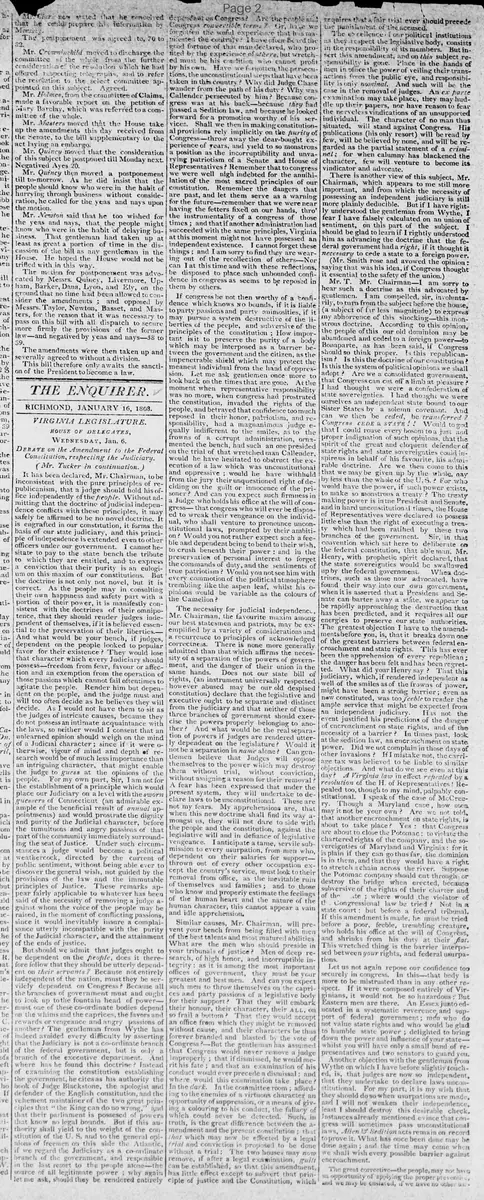
The Enquirer
Richmond, Henrico County, Virginia
What is this article about?
In the Virginia House of Delegates on January 6, 1808, Mr. Tucker argues against an amendment allowing Congress to remove federal judges by two-thirds vote, emphasizing judicial independence to protect against legislative overreach and past unconstitutional acts like the Sedition Law. Mr. Smith counters, advocating for judicial accountability to the people via representatives while maintaining separation of powers.
Merged-components note: These components form a continuous narrative story on the Virginia Legislature's debate over judiciary amendments to the federal constitution, in sequential reading order across pages.
Clippings
1 of 2
OCR Quality
Full Text
RICHMOND, JANUARY 16, 1808.
VIRGINIA LEGISLATURE.
HOUSE OF DELEGATES,
WEDNESDAY, Jan. 6.
Debate on the Amendment to the Federal Constitution, respecting the Judiciary.
(Mr. Tucker in continuation.)
It has been declared, Mr. Chairman, to be inconsistent with the pure principles of republicanism, that a judge should hold his office independently of the people. Without admitting that the doctrine of judicial independence conflicts with these principles, it may safely be affirmed to be no novel doctrine. It is engrafted in our constitution, it forms the basis of our state judiciary, and this principle of independence is extended even to other officers under our government. I cannot hesitate to pay to the state bench the tribute to which they are entitled, and to express a conviction that their purity is an eulogium on this maxim of our constitutions. But the doctrine is not only not novel, but it is correct. As the people may in consulting their own happiness and safety part with a portion of their power, it is manifestly consistent with the doctrines of their omnipotence, that they should render judges independent of themselves, if it is believed essential to the preservation of their liberties.-- And what would be your bench, if judges, dependent on the people looked to popular favor for their existence? They would lose that character which every Judiciary should possess-freedom from fear, favour or affection and an exemption from the operation of those passions which cannot fail oftentimes to agitate the people. Render him but dependent on the people, and the judge must and will too often decide as he believes they will decide. As I would not have them to sit as the judges of intricate causes, because they do not possess an intimate acquaintance with the laws, so neither would I consent that an unlearned opinion should weigh on the mind of a Judicial character; since if it were otherwise, vigour of mind and depth of research would be of much less importance than an intriguing character, that might enable the judge to guess at the opinions of the people. For my own part, Sir, I am not for the establishment of a principle which would place our Judiciary on a level with the sworn guessers of Connecticut (an admirable example of the beneficial result of annual appointments) and would prostrate the dignity and purity of the Judicial character, before the tumultuous and angry passions of that part of the community immediately surrounding the seat of Justice. Under such circumstances a judge would become a political weathercock, directed by the current of public sentiment, without being able ever to discover the general wish, not guided by the provisions of the law and the immutable principles of Justice. These remarks appear fairly applicable to whatever has been said of the necessity of removing a judge against whom the voice of the people may be raised, in the moment of conflicting passions, since it would inevitably insure a complaisance utterly incompatible with the purity of the Judicial character. and the attainment of the ends of justice.
But should we admit that judges ought to be dependent on the people, does it therefore follow that they should be utterly dependent on their servants? Because not entirely independent of the nation, must they be servilely dependent on Congress? Because all the branches of government must and ought to look up to the fountain head of power— must one of these co-ordinate bodies depend on the whims and the caprices, the favors and rewards or vengeance and angry passions of another? The gentleman from Wythe has indeed avoided every difficulty by asserting that the Judiciary is not a co-ordinate branch of the federal government, but is only a branch of the executive department. And where has he found this doctrine? Instead of examining the constitution establishing the government, he cites as his authority the book of Judge Blackstone, the apologist and defender of the English constitution, and the vehement maintainer of the two great principles that "the King can do no wrong," and that their parliament is possessed of powers that know no legal bounds. But if this authority shall yield to the weight of the constitution of the U. S. and to the general opinions of freemen on this side the Atlantic, if we regard the Judiciary as a co-ordinate branch of the government, and responsible in the last resort to the people alone-the source of all legitimate power ; why again let me ask, should they be rendered entirely dependent on Congress? Are the people and Congress convertible terms ?. Or, have we forgotten the word experience that has manifested the contrary? I have often heard the good fortune of that man declared, who profited by the experience of others, but wretched must be his condition who cannot profit by his own. Have we forgotten the persecutions, the unconstitutional steps that have been taken in this country ? Why did Judge Chase wander from the path of his duty ? Why was Callender persecuted by him? Because congress was at his back--because they had passed a Sedition law, and because he looked forward for a promotion worthy of his services. Shall we then in making constitutional provisions rely implicitly on the purity of Congress-throw away the dear-bought experience of years, and yield to so monstrous a position as the incorruptibility and unvarying patriotism of a Senate and House of Representatives? Remember that to congress we were well nigh indebted for the annihilation of the most sacred principles of our constitution. Remember the dangers that are past, and let them serve as a warning for the future--remember that we were near having the fetters fixed on our hands. thro' the instrumentality of a congress of those times : and that if another administration had succeeded with the same principles, Virginia at this moment might not have possessed an independent existence. I cannot forget these things : and I am sorry to find they are wearing out of the recollection of others--Nor can I at this time and with these reflections, be disposed to place such unbounded confidence in congress as seems to be reposed in them by others.
If congress be not then worthy of a confidence which knows no bounds. if it is liable to party passions and party animosities, if it may pursue a system destructive of the liberties of the people, and subversive of the principles of the constitution ; How important is it to preserve the purity of a body which may be interposed as a barrier between the government and the citizen, as the impenetrable shield which may protect the meanest individual from the hand of oppression. Let me ask gentlemen once more to look back on the times that are gone. At the moment when representative responsibility was no more, when congress had prostrated the constitution, invaded the rights of the people, and betrayed that confidence too much reposed in their honor, patriotism, and responsibility, had a magnanimous judge equally indifferent to the smiles, as to the frowns of a corrupt administration, ornamented the bench, had such an one presided on the trial of that wretched man Callender. would he have hesitated to obstruct the execution of a law which was unconstitutional and oppressive ; would he have withheld from the jury their unquestioned right of deciding on the guilt or innocence of the prisoner? And can you expect such firmness in a Judge who holds his office at the will of congress-- that congress who will ever be disposed to wreak their vengeance on the individual, who shall venture to pronounce unconstitutional laws, prompted by their ambition? Would you not rather expect such a feeble and dependent being to bend to their wish, to crush beneath their power : and in the preservation of personal interest to forget the commands of duty, and the sentiments of true patriotism ? Would you not see him with every commotion of the political atmosphere trembling like the aspen leaf, whilst his opinions would be variable as the colours of the Chameleon?
The necessity for judicial independence, Mr. Chairman, the favourite maxim among our best statesmen and patriots, may be exemplified by a variety of considerations and a recurrence to principles of acknowledged correctness. There is none more generally admitted than that which affirms the necessity of a separation of the powers of government. and the danger of their union in the same hands. Does not our state bill of rights, (an instrument universally respected however abused may be our old despised constitution) declare that the legislative and executive ought to be separate and distinct from the judiciary and that neither of those three branches of government should exercise the powers properly belonging to another? And what would be the real separation of powers if judges are rendered utterly dependent on the legislature? Would it not be a separation in name alone? Can gentlemen believe that Judges will oppose themselves to the power which may destroy them without trial, without conviction without assigning a reason for their removal?
A fear has been expressed that under the present system. they will undertake to declare laws to be unconstitutional. These are not my fears. My apprehensions are, that when this new doctrine shall find its way amongst us, they will not dare to side with the people and the constitution, against the legislative will and in defiance of legislative vengeance. I anticipate a tame, servile submission to every usurpation, from men who, dependent on their salaries for support- thrown out of every other occupation except the country's service, must look to their removal from office, as the inevitable ruin of themselves and families; and to those who know and properly estimate the feelings of the human heart and the nature of the human character, this cannot appear a vain and idle apprehension.
Similar causes, Mr. Chairman, will prevent your bench from being filled with men of the best talents and most matured abilities What are the men who should preside in your tribunals of justice? Men of deep research, of high honor, and incorruptible integrity: as it is among the most important offices of government, they must be your greatest and best men. And can you expect such men to throw themselves on the caprices and party passions of a legislative body for their support? That they will embark their honour, their character, their ALL, on so frail a bottom? That they would accept an office from which they might be removed without cause, and their characters be thus forever branded and blasted by the vote of Congress?-But the gentleman has assumed that Congress would never remove a judge improperly : that if dismissed, he would merit his fate : and that an examination of his conduct would ever precede a dismissal: and where would this examination take place? In the dark. In the committee room : affording to the enemies of a virtuous character an opportunity of suppression, or a means of giving a colouring to his conduct. the fallacy of which could never be detected. Such, in truth, is the great difference between the amendment and the present constitution : that that which may now be effected by a legal trial and conviction is proposed to be done without a trial: The two houses may now remove, if after a legal examination, guilt can be established, so that this amendment, has little effect except to subvert that principle of justice and the Constitution, which requires that a fair trial ever should precede the punishment of the accused
The excellence of our political institutions as they respect the legislative body, consists in the responsibility of its members. But insert this amendment, and on this subject responsibility is gone. Place in the hands of men in office the power of veiling their transactions from the public eye, and responsibility is only nominal. And such will be the case in the removal of judges. An ex parte examination may take place, they may huddle up their papers, nor have reason to fear the nerveless vindications of an unsupported individual. The character of no man thus situated, will stand against Congress. His publications (his only resort) will be read by few, will be believed by none, and will be regarded as the partial statement of a criminal; for when calumny has blackened the character, few will venture to become its vindicator and advocate.
There is another view of this subject, Mr. Chairman, which appears to me still more important, and from which the necessity of possessing an independent judiciary is still more plainly deducible. But if I have rightly understood the gentleman from Wythe, I fear I have falsely calculated on an union of sentiment, on this part of the subject. I should be glad to learn if I rightly understood him as advancing the doctrine that the federal government had a right, if it thought it necessary to cede a state to a foreign power.
(Mr. Smith rose and avowed the opinion: saying that was his idea, if Congress thought it essential to the safety of the union.)
Mr. T. Mr. Chairman-I am sorry to hear such a doctrine as this advocated by gentlemen. I am compelled, sir, involuntarily, to turn from the subject before the house, (a subject of far less magnitude) to express my abhorrence of this shocking-this monstrous doctrine. According to this opinion, the people of this our old dominion may be abandoned and ceded to a foreign power--to Bonaparte, as has been said, if Congress should so think proper. Is this republicanism? Is this the doctrine of our constitution? Is this the system of political opinions we shall adopt ? Are we a consolidated government, that Congress can cut off a limb at pleasure? I had thought we were a confederation of state sovereignties. I had thought we were ourselves an independent state bound to our Sister States by a solemn covenant. And can we then be ceded, be transferred ? Congress cede a STATE!! Would to God that I could rouse every bosom to a just and proper indignation of such opinions, that the spirit of the great and eloquent defender of state rights and state sovereignties could inspire us in behalf of his favourite, his admirable doctrine. Are we then come to this that we may be given up by the whole, or by less than the whole of the U.S. ? For who would have the power, if such power exists, to make so monstrous a treaty ? The treaty making power is in the President and Senate, and in hard unconstitutional times, the House of Representatives were declared to possess little else than the right of executing a treaty which had been ratified by these two branches of the government. Sir, in that convention which sat here to deliberate on the federal constitution, that able man, Mr. Henry, with prophetic spirit declared, that the state sovereignties would be swallowed up by the federal government. When doctrines, such as those now advocated, have found their way into our own government, when it is asserted that a President and Senate can barter away a state, we appear to be rapidly approaching the destruction that has been predicted, and it requires all our energies to preserve our state authorities.
The greatest objection I have to the amendments before you, is, that it breaks down one of the greatest barriers between federal encroachment and state rights. This has ever been the apprehension of every republican; the danger has been felt and has been regretted. What did your Henry say ? That this judiciary, which, if rendered independent as well of the smiles as of the frowns of power, might have been a strong barrier; even as now constituted, was too feeble to render the ample service that might be expected from an independent judiciary. Has not the event justified his predictions of the danger of encroachment on state rights, and of the necessity of a barrier ? In times past, look at the sedition law, an encroachment on state power. Did we not complain in those days of other invasions ? If I mistake not, the carriage tax was believed to be liable to similar objections. And what do we see even at this day? A Virginia law in effect repealed by a resolution of the H. of Representatives! Repealed too, though to my mind, palpably constitutional. I speak of the case of McCree ry. Though a Maryland case, how soon may it not be your own ? Are we not told, that another encroachment on state rights, is about to take place? Yes : that Congress are about to close the Potomac: to violate the chartered rights of the company, and the sovereignties of Maryland and Virginia: for it is plain if they can go thus far, the dominion is in them, and that they would have a right to stretch a chain across the river. Suppose the Potomac company should cut through or destroy the bridge when erected, because subversive of the rights of their charter and of the state : where would the violator of the Congressional law be tried? Not in a state court : but before a federal tribunal. If this amendment is made, he must be tried before a poor, feeble, trembling creature, who holds his office at the will of Congress, and shrinks from his duty at their fiat. This wretched thing is the barrier interposed between your rights, and federal usurpations.
Let us not again repose our confidence too securely in congress. In this--that body is more to be mistrusted than in any other respect. If it were composed entirely of Virginians, it would not be so hazardous: But Eastern men are there. An Essex junto educated in a systematic reverence, and support of federal government: men who do not value state rights and who would be glad to humble state power : delighted to bring down the power and influence of your state- whilst you will have only a small band of representatives and two senators to guard you.
Another objection with the gentleman from Wythe on which I have before slightly touched, is, that judges are now so independent, that they undertake to declare laws unconstitutional. For my part, it is my wish that they should do so when usurpations are made, and I will not weaken their independence, lest I should destroy this desirable check. Instances already mentioned evince that congress will sometimes pass unconstitutional laws, Alien Sedition acts remain on record to prove it. What has once been done may be done again: and the time may come when we shall wish every possible barrier against encroachment.
The great corrective-the people, may not have an opportunity of applying the proper preventive, and we may be enslaved, if we have no other ba.
Perhaps a change of rulers can save us. I ask gentlemen to look to times past, when most of our states believed that our liberties were hastening to their destruction. If they have not seen usurpation following usurpation, it must have proceeded from a species of political infatuation, which I had hoped was fast wearing away.
Should such things again be? Compare, I pray you, the situation of an independent judiciary with that which the present amendment would produce. The one afraid to be turned out of office and shifting his opinions to suit the prejudices of the times and the exigencies of his situation: The other pure, incorruptible, firm and dignified; distributing the fountains of justice through its various channels, without favor or affection, and pursuing the path of duty with an unvarying step.
Without temptation to seduce, or dangers to alarm, who, so likely to stand between the government and the culprit, and to protect the rights of the citizen from unforeseen or meditated destruction? To my mind, there is little danger that a judge thus situated will link himself to vice without advantage, and prevent the execution of constitutional laws without an object. Believing this, I do not see the danger of vesting this power in such judges, instead of Congress. From its constitution & its powers, from its activity, which enables it to do wrong, while the judiciary is ever passive; from the violence of party-heat and party-animosity, which too often pervades our legislative bodies, from the eagerness with which they endeavor to effectuate their ends—often regardless of the consequences, I confess I do not hesitate to prefer an independent judiciary to the Congress of the United States, as the tribunal to determine the constitutionality of laws. If the legislative body was invariably the representative of the purity of the people, it might be otherwise, but by the constitution itself they are supposed to be liable to error and to abuse of power, and for this reason restrictions are placed upon their authority.
But the right to decide on the unconstitutionality of a law, is admitted when we compel a judge to swear to decide according to the law of the land, and to maintain the sacred instrument under which he is created. If it be true that his decisions are to be consonant to law, and the constitution is the supreme law, must he not compare that instrument with those acts which purport to be made under it? But the gentleman had advanced this other incomprehensible doctrine, that treaties and the laws of Congress are superior or at least equal to the constitution. We have already seen to what monstrous opinions this doctrine has led him, and I trust that no man here will for a moment hesitate to believe the constitution paramount to any law, which conflicts with its provisions. Is it come to this—that in debating on amendments, we shall hear the supremacy of the laws of Congress maintained in derogation of the dignity of the constitution? The doctrine will not stand the test of argument, and may safely be assumed to be incorrect.
Sir, the doctrine of the right of the courts to decide on the constitutionality of a law, is admitted further, by the position once so strenuously contended for, that the jury had that right. In the case of Callender, the doctrine was contended for, and the republicans of those days maintained its correctness—And on what principle? Not that the judges had usurped power, and that the jury had a right to partake of the usurpation, but on the broad ground, that the jury had a right to decide both law and fact; and that in deciding the law they were necessarily empowered to pronounce on its constitutionality. It was advocated on the principle that in criminal trials, jurors were also judges, and that this, among other rights of the judge were devolved upon the juror. How is it that we are now for the adoption of a principle that must sap the rights of the jury?—Again; if the judge cannot decide on the question of constitutionality, he cannot instruct the jury in any other way than to support the law against the constitution; and when in the prosecution of their rights, they demand his advice on the question of the validity of a law, he cannot legally extend it to them. Thus the adoption of principles like these, leads us inevitably to the overthrow of all those maxims we have ever regarded most sacred.
It is not possible, from the lateness of the hour, to answer many other remarks of the gentleman: But if the time of the committee will permit, I shall take some other opportunity of doing so. I shall now content myself with a few general observations.
If this amendment finds its way into your constitution, the independence of the judiciary is gone forever. Those provisions which have been held sacred among us, which have been thought necessary to secure a virtuous administration of justice, and which were framed with a view to the vices, the weakness and frailties of human nature, will be no more. If we could fill our benches with Catos who would fulfil the duties of office with unshrinking firmness—unawed by the frown of usurpers or the resentment of the crowd who might surround the seat of justice—and looking only to the approbation of the great body of the nation, who honestly decide, when uninfluenced by passion, we should have little need of provisions to secure judicial independence. But as mankind are vicious, frail and corrupt we must secure vice from temptation and fortify virtue with the strongest barriers.
Twenty years ago—no man would have ventured to assail this principle of our constitution. Who in our convention would have dared the lightning of Henry's eloquence, by attempting to cut away this pillar of our liberties? Would not men at that time have started not less at a proposition like this, than we should now do at an attempt to destroy biennial elections, or to create a president for life. I am not, Mr. Chairman, to be understood as the enemy of all amendments;—But I would approach our constitution with caution, and unless cool and calm reflection should establish the necessity of alteration, I would adhere to that instrument: I would hesitate to destroy the established maxims of our ancestors. But in truth the tide of time seems to be gradually washing away the foundations of our government, with parricidal hands we are hastening the destruction. Fifty years hence, not one of our sacred maxims may be left. There is no principle which we reverence—none which we may not destroy—none which is interwoven with the affections of the nation. And without this what is a constitution? Of little more worth than the parchment on which it is written! Ambition and cunning will at all times find reasons sufficient to justify changes in the frame of government till the temple of our liberty shall be no more.
Look but to Great Britain. Every great principle gone, except the trial by jury:—political liberty no more; but personal liberty, and personal protection secured by that admirable mode of trial. This has been preserved in the hearts of the people amidst the wreck of the few principles of liberty of which they ever could boast, and it is now their protection and defence. It is engrafted in their prejudices, in their habits, and the ministry who can rob them of every thing else, had as well attempt to grasp the forked lightning, as snatch from them this inestimable blessing. Let us, I pray you, hold sacred these great maxims of our ancestors, of men whose practical knowledge was superior to ours, because they had felt the hand of tyranny, nor on light and trivial grounds destroy one of the firmest pillars in the temple of our liberty.
Mr. Smith (of King and Queen) spoke to the following effect:
MR. CHAIRMAN,
Notwithstanding the extreme indisposition, which the committee have already manifested, to hear any further discussion of the interesting subjects now under their consideration, my duty to myself, my constituents and my country urges me to avail myself of this opportunity of assigning the reasons which will decide my vote. I hope that I shall be indulged with the attention of the committee whilst I submit to them such remarks as occur to my mind.—In the course which I shall pursue I shall be governed by the dictates of my own judgment. I shall not ground my opinion upon the authority of great names. I shall not enquire what were the prevailing political tenets in the U. S. twenty years previous to this time. I shall not enquire what were the opinions of the Sages and Patriots who sat in the Virginia convention. It is of no importance to me what was thought by the celebrated Patrick Henry—Pendleton—Monroe—Madison—Wythe or Jefferson—names which I shall ever revere—I shall exercise the privilege of judging for myself, of advancing such doctrines as are approved by my understanding and supporting such opinions as are sanctioned by my best judgement. Nor shall I, Mr. Chairman, in the course of my observations, attempt to refute the arguments advanced a few days since by the worthy members from Orange and Frederick. I shall not do this for two reasons—Because some gentlemen will no doubt come after me who will be much better qualified to perform this task of exposing error and sophistry (as far indeed as it will be necessary to expose them on this occasion) than I can possibly be and because in reality I heard nothing like solid argument or systematic reasoning from either of the gentlemen. I was pleased with their display of fancy—I was delighted with their eloquence; but on subjects like these I look for something more than fancy and eloquence—I look for solid argument; Where I could discover any thing like reasoning—the ideas of the gentlemen seemed to me to be at war with each other—they reminded me of the fable of the brothers who sprang up from the teeth of a famous ancient serpent and destroyed each other. Those of them which remain I shall not touch but leave them to stand as monuments of the weakness of the cause which those gentlemen have espoused.
Of the two resolutions which are now under the consideration of the committee—but one has been the subject of discussion—The first resolution has for its object an amendment of the constitution of the U. S. so as to render judges of the supreme and inferior federal courts liable to removal from office on vote of two thirds of both branches of Congress. The second resolution proposes to amend the constitution, so as to render senators in Congress removable, on address of two thirds present of both branches of the respective state legislatures. Gentlemen who have already addressed the chair have shaped the course which I shall pursue. They have confined their remarks exclusively to the first resolution, and in this respect, I shall follow their example. I beg leave, however, before I enter upon the discussion of the first resolution to make such general remarks as I deem applicable to both resolutions.
In the U. States, Mr. Chairman, it is admitted by all sects and denominations of Politicians, that all power resides in the people, belongs to them and flows from them as its true source. It has never been questioned that our liberty depends upon the entire preservation of our representative system of government. It has never been denied that public functionaries should be accountable to the people whom they represent and serve. These, sir, are fundamental, elementary, principles of government that are as eternal as the laws of matter. In vain shall sophistry strive to shake them and in vain may I attempt to strengthen them by any thing which I can say.—The good old republican maxims that the principles of representation, responsibility should be reduced to practice as far as possible, I hope never to see abandoned in the U. States—a rigid adherence to these maxims is essential to our existence and happiness as a free nation—the moment we abandon them, we become unfit to be freemen—we may humble ourselves at the footstool of a Throne. These, sir, some gentlemen may consider as old fashioned ideas in these days of refinement, but I shall not on that account be more unwilling to avow them; as well might we expect that the great universe of which the earth is a component part, would preserve its regularity and order without a power of gravitation, as that the movements of our little political world will be in harmonious concert when these, its essential laws, are impaired. Our government is intended to secure the rights of the people, and the means by which it effects this object, are the delegation of power to representatives and the responsibility of those representatives to those from whom they derive forever. I need not support these truths by an elaborate train of reasoning. I will assume them as political axioms and by them I will test the correctness of my opinions.
I will, sir, make a few more general remarks which are equally important, as they apply to the first and as they apply to the second resolution now before the committee. Gentlemen tell us a great deal about the danger of touching our Constitution—We are terrified with apprehensions—we are alarmed with imaginary evils. Let us see if there is no provision in that sacred instrument, the Constitution of the United States for its own amendment. Constitution of the United States, article V. "The Congress, whenever two thirds of both Houses shall deem it necessary, shall propose amendments to this Constitution, or on application of the Legislatures of two thirds of the several states, shall call a Convention for proposing amendments, which, in either case, shall be valid to all intents and purposes as part of this Constitution, when ratified by the Legislatures of three-fourths of the several states, or by Conventions in three-fourths thereof, as the one or the other mode of ratification may be proposed by Congress."—Thus do we find in the very body of our Constitution a provision for the amendment of its defects—thus do we find, that the sages who formed our Constitution believed themselves liable to error. They knew that their production, like all productions of man, would be imperfect—They did not pretend to form a Constitution which, stamped with perpetuity, should descend unaltered and unamended from generation to generation. But they held this language to their country and to posterity: "We have toiled over the midnight lamp to construct for you as perfect a government as we were capable of forming—We have been aided in this arduous task by the history of other nations—We have attended to the lessons of experience, which other old countries and our own, yet in its infancy, afford us.—The result of our labors has been the formation of a system of government bottomed on the broad basis of natural rights—The machine which we have constructed is a complex one and some of its parts are liable to get out of order—we therefore lodge in your hands the power of repairing it—you must watch its operations and gain knowledge from experience—you must supply those omissions and correct those evils which experience shall discover to you."—Such, Sir, is the language held to us, by the authors of the charter of our liberties. I hope we shall not turn a deaf ear to their admonitions—I hope that we shall keep a vigilant eye over our Constitution; that we shall apply the proper remedies to its defects when we find it defective, and strengthen the barriers which it opposes to power and ambition, when we see them growing weak. I hope that we shall improve our Constitution as the human mind and the science of government progresses; that we shall adapt it to the varying state of our country, and stamp upon it indelibly the will of the people.
After these general remarks which I shall beg the committee to keep in mind when they decide on the important subjects now before them—I shall proceed to discuss the first resolution, and point out the necessity of adopting the proposed amendments to the Constitution of the United States, as it relates to our Federal Judiciary. In the very threshold of this enquiry, a difficulty presents itself to our minds. It is the difficulty of properly arranging and organizing the judiciary branches of all governments: no matter what may be the form of the government—whether it be a monarchy, an oligarchy or a representative republic like ours: this difficulty presents itself to the mind. It arises from the necessity of keeping all the departments of government, legislative, executive and judicial separate and distinct as far as it is practicable. An union of all these powers in one man or in one body of men, is a complete despotism. It arises also from the necessity of making judges duly independent of the temporary fluctuations of popular sentiment, and at the same time sufficiently responsible to the judgment of the people. In England (a country which many of us are fond of going to for examples of judicial purity and judicial independence) it is all important that a judge should be independent of every branch of the government. In England, there is a monarch, possessed of exorbitant and uncontrolled powers; having an immense revenue at his command and disposal, which he can use for purposes of bribery and corruption: his power of appointment to office is almost unlimited; he is consecrated by the maxims that "The King can do no wrong."
If this powerful officer was suffered to interfere with the proceedings of courts, or with the opinions of judges, there could be nothing like justice in that country. A judge in England then should not fear the frowns of the King, nor should he promise himself any compensation or reward from gaining his favor. It is also necessary, Sir, that judges in that country should be independent of Parliament: and why does this necessity exist? Because that body is so constituted as to render any responsibility of judges to them dangerous and destructive. One branch of that body is composed of men who are called the political pillars of society. The house of Lords is composed of men on whom the mere accident of birth has bestowed hereditary honour, office and power and whose control over the judiciary would be scarcely less pernicious than that of the King. Who are the members of the house of commons? If there is any thing like representation in England, the house of commons are representatives. But when it is remembered that the little rotten boroughs of Sarum and Old Sarum send, each, two representatives to Parliament, when neither of them have houses or inhabitants, and that the large, opulent and populous cities of London and Westminster send only four each. The absurdity becomes palpable of supposing that there is any thing like representation in that country.—Both houses of Parliament compose a kind of independent body corporate: who have interests and feelings of their own. Parliament then should have nothing to do with judges; because it is their province to enact laws and not to administer them, and because they are a separate distinct branch of the government, in a great measure irresponsible to any power on earth.
Let us now enquire, Mr. Chairman, how far judges in the United States, can consistently, with the genius and spirit of our government be made independent—let us see, if it is not an arduous task in the U. States, to give to our judges a salutary and practicable independence and enquire whether or not this can be done without sacrificing the principles of our government.—We have here, sir, a President, not it is true, invested with regal powers, elected for limited periods, having a salary fixed and ascertained by law: having comparatively speaking but a small portion of patronage: and from the short term of his service, not feeling a disposition, even if he had the power of introducing corruption into his country. Yet it is essential that United States' judges should be independent of the executive department. A federal judge should be removed beyond executive control. He should be qualified to decide impartially between the President of the United States and the humblest individual in our country. How far, now, sir, is it, that judges should be independent of congress—perhaps it can be satisfactorily established, that judges of the United States ought to be free from the control of Congress as a legislative body, but subjected to them as the immediate representatives of the people. I suppose there is not one member of this committee, however zealous a friend he may be to the indefinite independence of judges, who will not say that our most essential rights, will be sacrificed by rendering any of the officers of any of the departments of our government perfectly unaccountable to the people—none will contend for a doctrine so perfectly at war with the spirit of all our institutions. If then, it will be conceded that judges, like legislators and executive magistrates, are to answer for their conduct, to those for whose benefit they have been raised to honor and to office: The question which forces itself upon our minds, and which it is necessary should be satisfactorily answered, is this—In what manner is this judicial dependence to be reduced to practice? Are judges to account to the people in their aggregate, collective capacity? Are they to assemble en masse, and try a judge for misconduct? Certainly not: ours is a representative government, and acknowledges the impracticability of a scheme like this—it is necessary to delegate power, and constitute proper organs for the expression of public will. If then, judges cannot be tried by the people of the U. States, scattered over an immense territory: In what manner are they to be tried? By those who immediately represent the people, and correctly express their will. They are to be made responsible to the nation through the medium of its representatives. There is, sir, a wide difference between the constitution of Great Britain and the United States. Parliament is an independent body—Congress is a body composed of the representatives of freemen, and therefore is a dependent body. The senate of the United States consists of members elected for six years, and who then return to the station of private citizens. The House of Representatives, are elected biennially—
Whilst, then, judicial officers of the United States, can, with propriety and with safety be made amenable to the Congress of the United States; Judges in England, cannot without a total destruction of public justice, be made dependent on Parliament. But, sir, even if it should be admitted that Congress is the proper tribunal for trying and removing a judge of the United States; Will not our utmost care and attention be requisite to enable us to ascertain precisely what portion of independence our judges should possess, and what degree of responsibility they should feel? To enable our judges to act with purity, with impartiality and firmness, and to give them only such powers as can be safely entrusted to them, is a task difficult indeed to perform—Yet are we now called upon to perform this task. I trust that the importance of this subject will ensure me the attention of the committee, whilst I attempt to shew them that the amendment which it is proposed to engraft into the constitution of the United States, will secure to us these desirable objects.
(Mr. Smith's Speech to be continued.)
What sub-type of article is it?
What themes does it cover?
What keywords are associated?
What entities or persons were involved?
Where did it happen?
Story Details
Key Persons
Location
Richmond, Virginia, House Of Delegates
Event Date
Wednesday, Jan. 6, 1808
Story Details
Debate on proposed amendment to the U.S. Constitution allowing removal of federal judges by two-thirds vote of Congress. Mr. Tucker opposes, arguing for judicial independence to safeguard liberties and state rights against federal overreach, referencing past events like the Sedition Law and trial of Callender. Mr. Smith supports, emphasizing accountability to the people through representatives while preserving separation of powers.