Thank you for visiting SNEWPapers!
Sign up free
Story
August 6, 1838
Lynchburg Virginian
Lynchburg, Virginia
What is this article about?
Criticism of U.S. agent Richard Rush for crafting misleading advertisements to secure James Smithson's bequest for the Smithsonian Institution, potentially defrauding possible heirs of Henry Louis Dickerson in English Court of Chancery proceedings.
Clipping
OCR Quality
95%
Excellent
Full Text
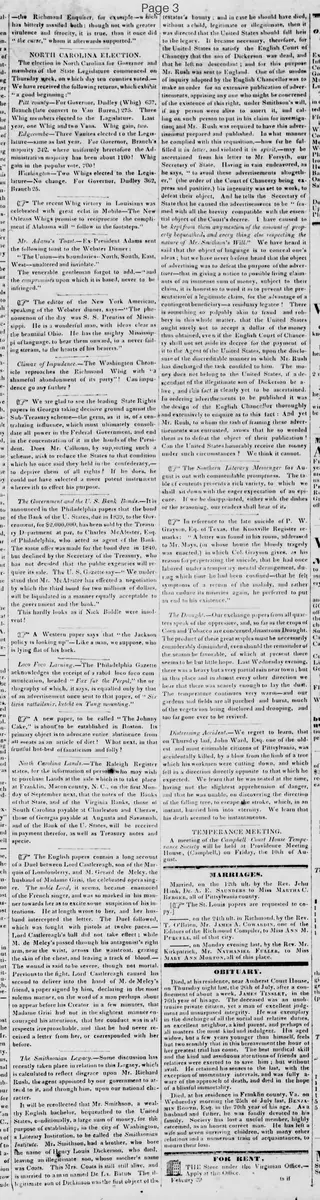
The Smithsonian Legacy.—Some discussion has recently taken place in relation to this legacy, which is calculated to reflect disgrace upon Mr. Richard Rush, the agent appointed by our government to attend to it, and through him, upon our national character.
It will be recollected that Mr. Smithson, a wealthy English bachelor, bequeathed to the United States, conditionally, a large sum of money, for the purpose of establishing, in the city of Washington a Literary Institution, to be called the Smithsonian Institute. Mr. Smithson had a brother, who bore the name of Henry Louis Dickerson, who died, leaving an illegitimate son, whose mother's name was Coats. This Mrs. Coats is still alive, and is married to a man named De La Batut. The illegitimate son of Dickerson was the first object of the testator's bounty; and in case he should have died, without a child, legitimate or illegitimate, then it was directed that the United States should fall heir to the legacy. It became necessary, therefore, for the United States to satisfy the English Court of Chancery that the son of Dickerson was dead, and that he left no descendant: and for this purpose Mr. Rush was sent to England. One of the modes of inquiry adopted by the English Chancellor was to make an order for an extensive publication of advertisements, apprising any one who might be concerned of the existence of this right, under Smithson's will, if any person were alive to assert it, and calling on such person to put in his claim for investigation; and Mr. Rush was required to have this advertisement prepared and published. In what manner he complied with this requisition,—how far he fulfilled it in letter, and violated it in spirit,—may be ascertained from his letter to Mr. Forsyth, our Secretary of State. Having in vain endeavored, as he says, "to avoid these advertisements altogether." (the order of the Court of Chancery being express and positive,) his ingenuity was set to work, to defeat their object. And he tells the Secretary of State that he caused the advertisements to be "framed with all the brevity compatible with the essential object of the Court's decree. I have caused to be kept from them any mention of the amount of property bequeathed, and every thing else respecting the nature of Mr. Smithson's Will." We have heard it said that the object of language is to conceal one's ideas; but we have never before heard that the object of advertising was to defeat the purpose of the advertiser—that in giving a notice to possible living claimants of an immense sum of money, subject to their claim, it is honest so to word it as to prevent the presentation of a legitimate claim, for the advantage of a contingent beneficiary—a residuary legatee! There is something so palpably akin to fraud and robbery in this whole matter, that the United States ought surely not to accept a dollar of the money thus obtained, even if the English Court of Chancery shall not set aside its decree for the payment of it to the Agent of the United States, upon the disclosure of the discreditable manner in which Mr. Rush has discharged the task confided to him. The money does not belong to the United States. If a descendant of the illegitimate son of Dickerson be alive, and this fact is clearly yet to be ascertained. In ordering advertisements to be published it was the design of the English Chancellor thoroughly and extensively to enquire as to this fact: And yet Mr. Rush, to whom the task of framing these advertisements was entrusted, avows that he so worded them as to defeat the object of their publication! Can the United States honorably receive the money under such circumstances? We think it cannot.
It will be recollected that Mr. Smithson, a wealthy English bachelor, bequeathed to the United States, conditionally, a large sum of money, for the purpose of establishing, in the city of Washington a Literary Institution, to be called the Smithsonian Institute. Mr. Smithson had a brother, who bore the name of Henry Louis Dickerson, who died, leaving an illegitimate son, whose mother's name was Coats. This Mrs. Coats is still alive, and is married to a man named De La Batut. The illegitimate son of Dickerson was the first object of the testator's bounty; and in case he should have died, without a child, legitimate or illegitimate, then it was directed that the United States should fall heir to the legacy. It became necessary, therefore, for the United States to satisfy the English Court of Chancery that the son of Dickerson was dead, and that he left no descendant: and for this purpose Mr. Rush was sent to England. One of the modes of inquiry adopted by the English Chancellor was to make an order for an extensive publication of advertisements, apprising any one who might be concerned of the existence of this right, under Smithson's will, if any person were alive to assert it, and calling on such person to put in his claim for investigation; and Mr. Rush was required to have this advertisement prepared and published. In what manner he complied with this requisition,—how far he fulfilled it in letter, and violated it in spirit,—may be ascertained from his letter to Mr. Forsyth, our Secretary of State. Having in vain endeavored, as he says, "to avoid these advertisements altogether." (the order of the Court of Chancery being express and positive,) his ingenuity was set to work, to defeat their object. And he tells the Secretary of State that he caused the advertisements to be "framed with all the brevity compatible with the essential object of the Court's decree. I have caused to be kept from them any mention of the amount of property bequeathed, and every thing else respecting the nature of Mr. Smithson's Will." We have heard it said that the object of language is to conceal one's ideas; but we have never before heard that the object of advertising was to defeat the purpose of the advertiser—that in giving a notice to possible living claimants of an immense sum of money, subject to their claim, it is honest so to word it as to prevent the presentation of a legitimate claim, for the advantage of a contingent beneficiary—a residuary legatee! There is something so palpably akin to fraud and robbery in this whole matter, that the United States ought surely not to accept a dollar of the money thus obtained, even if the English Court of Chancery shall not set aside its decree for the payment of it to the Agent of the United States, upon the disclosure of the discreditable manner in which Mr. Rush has discharged the task confided to him. The money does not belong to the United States. If a descendant of the illegitimate son of Dickerson be alive, and this fact is clearly yet to be ascertained. In ordering advertisements to be published it was the design of the English Chancellor thoroughly and extensively to enquire as to this fact: And yet Mr. Rush, to whom the task of framing these advertisements was entrusted, avows that he so worded them as to defeat the object of their publication! Can the United States honorably receive the money under such circumstances? We think it cannot.
What sub-type of article is it?
Historical Event
Deception Fraud
What themes does it cover?
Deception
Justice
What keywords are associated?
Smithsonian Legacy
Richard Rush
James Smithson
Bequest Controversy
English Chancery
Misleading Advertisements
Heir Claim
What entities or persons were involved?
Richard Rush
James Smithson
Henry Louis Dickerson
Mrs. Coats
De La Batut
Mr. Forsyth
Where did it happen?
England, Washington
Story Details
Key Persons
Richard Rush
James Smithson
Henry Louis Dickerson
Mrs. Coats
De La Batut
Mr. Forsyth
Location
England, Washington
Story Details
Richard Rush, U.S. agent, is accused of wording advertisements misleadingly to prevent claims by potential heirs to James Smithson's bequest, securing it for the United States despite conditional terms favoring Dickerson's descendants.