Thank you for visiting SNEWPapers!
Sign up free
Alexandria Daily Gazette, Commercial & Political
Alexandria, Virginia
What is this article about?
Continuation of Mr. Crawford's speech in the US Senate on November 23, debating repeal of the Embargo Act. He argues against repeal, citing Boston merchants' memorial on British violations of neutral rights, injuries to American commerce from Britain and France, and fallacies in estimates of safe trade post-repeal.
Clipping
OCR Quality
Full Text
Senate of the United States.
Wednesday, November 23.
EMBARGO.
DEBATE on Mr. Hillhouse's motion for a repeal.
[CONTINUED.]
[Mr. Crawford's Speech continued.]
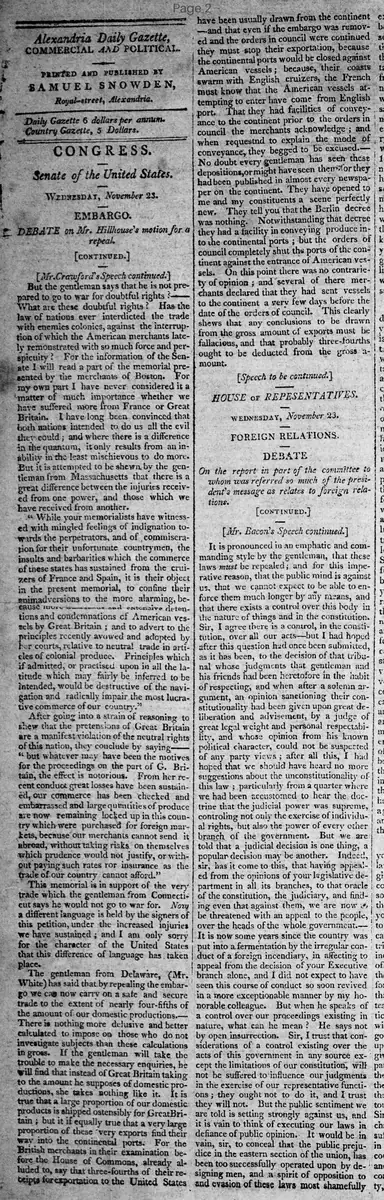
But the gentleman says that he is not prepared to go to war for doubtful rights? What are these doubtful rights? Has the law of nations ever interdicted the trade with enemies colonies, against the interruption of which the American merchants lately remonstrated with so much force and perspicuity? - For the information of the Senate I will read a part of the memorial presented by the merchants of Boston. For my own part I have never considered it a matter of much importance whether we have suffered more from France or Great Britain. I have long been convinced that both nations intended to do us all the evil they could; and where there is a difference in the quantum, it only results from an inability in the least mischievous to do more. But it is attempted to be shewn by the gentleman from Massachusetts that there is a great difference between the injuries received from one power, and those which we have received from another.
"While your memorialists have witnessed with mingled feelings of indignation towards the perpetrators, and of commiseration for their unfortunate countrymen, the insults and barbarities which the commerce of these states has sustained from the cruizers of France and Spain, it is their object in the present memorial, to confine their animadversions to the more alarming, because more unguarded and extensive detentions and condemnations of American vessels by Great Britain; and to advert to the principles recently avowed and adopted by her courts, relative to neutral trade in articles of colonial produce. Principles which if admitted, or practiced upon in all the latitude which may fairly be inferred to be intended, would be destructive of the navigation and radically impair the most lucrative commerce of our country."
After going into a strain of reasoning to shew that the pretensions of Great Britain are a manifest violation of the neutral rights of this nation, they conclude by saying-
"but whatever may have been the motives for the proceedings on the part of G. Britain, the effect is notorious. From her recent conduct great losses have been sustained, our commerce has been checked and embarrassed and large quantities of produce are now remaining locked up in this country which were purchased for foreign markets, because our merchants cannot send it abroad, without taking risks on themselves which prudence would not justify, or without paying such rates for insurance as the trade of our country cannot afford."
This memorial is in support of the very trade which the gentleman from Connecticut says he would not go to war for. Nor a different language is held by the signers of this petition, under the increased injuries we have sustained; and I am only sorry for the character of the United States that this difference of language has taken place.
The gentleman from Delaware. (Mr. White) has said that by repealing the embargo we can now carry on a safe and secure trade to the extent of nearly four-fifths of the amount of our domestic productions. -- There is nothing more delusive and better calculated to impose on those who do not investigate subjects than these calculations in gross. If the gentleman will take the trouble to make the necessary enquiries, he will find that instead of Great Britain taking to the amount he supposes of domestic productions, she takes nothing like it. It is true that a large proportion of our domestic products is shipped ostensibly for Great Britain; but it if equally true that a very large proportion of these very exports find their way into the continental ports. For the British merchants in their examination before the House of Commons, already alluded to, say that three-fourths of their receipts for exportation to the United States have been usually drawn from the continent -and that even if the embargo was removed and the orders in council were continued they must stop their exportation, because the continental ports would be closed against American vessels; because, their coasts swarm with English cruizers, the French must know that the American vessels attempting to enter have come from English port. That they had facilities of conveyance to the continent prior to the orders in council the merchants acknowledge; and when requested to explain the mode of conveyance, they begged to be excused.
No doubt every gentleman has seen these depositions, or might have seen them for they had been published in almost every newspaper on the continent. They have opened to me and my constituents a scene perfectly new. They tell you that the Berlin decree was nothing. Notwithstanding that decree they had a facility in conveying produce into the continental ports; but the orders of council completely shut the ports of the continent against the entrance of American vessels. On this point there was no contrariety of opinion; and several of these merchants declared that they had sent vessels to the continent a very few days before the date of the orders of council. This clearly shews that any conclusions to be drawn from the gross amount of exports must be fallacious, and that probably three-fourths ought to be deducted from the gross amount.
[Speech to be continued.]
What sub-type of article is it?
What themes does it cover?
What keywords are associated?
What entities or persons were involved?
Where did it happen?
Story Details
Key Persons
Location
Senate Of The United States
Event Date
Wednesday, November 23
Story Details
Mr. Crawford continues his speech opposing repeal of the Embargo, questioning 'doubtful rights' of trade with enemy colonies, reading Boston merchants' memorial on British violations of neutral rights and commerce injuries, refuting claims of safe trade post-repeal by citing British merchant depositions on indirect trade routes.