Thank you for visiting SNEWPapers!
Sign up free
Las Vegas Age
Las Vegas, Clark County, Lincoln County, Nevada
What is this article about?
In Turkey, women face challenges adapting to newfound freedoms under Gazi Mustafa Kemal's reforms, leading to mental health issues and suicides. Belgian expert Madame Flore Bocart is establishing vocational schools to train women in professions, handicrafts, stenography, and millinery to stabilize the transition and boost the economy.
Clipping
OCR Quality
Full Text
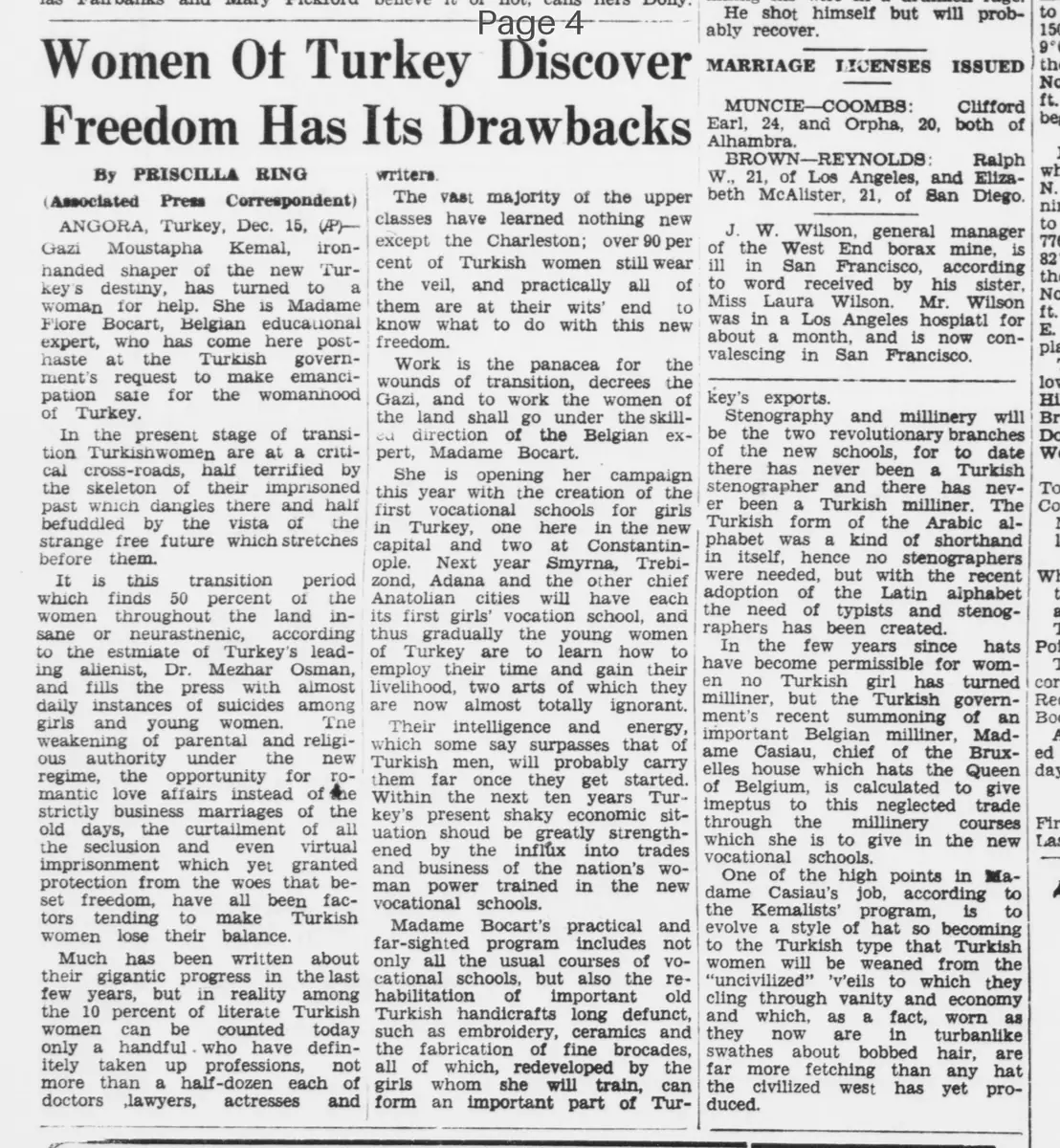
By PRISCILLA RING
(Associated Press Correspondent)
ANGORA, Turkey, Dec. 15. (A.P.) Gazi Moustapha Kemal, iron-handed shaper of the new Turkey's destiny, has turned to a woman for help. She is Madame Flore Bocart, Belgian educational expert, who has come here post-haste at the Turkish government's request to make emancipation safe for the womanhood of Turkey.
In the present stage of transition Turkish women are at a critical cross-roads, half terrified by the skeleton of their imprisoned past which dangles there and half befuddled by the vista of the strange free future which stretches before them.
It is this transition period which finds 50 percent of the women throughout the land insane or neurasthenic, according to the estimate of Turkey's leading alienist, Dr. Mezhar Osman, and fills the press with almost daily instances of suicides among girls and young women.
The weakening of parental and religious authority under the new regime, the opportunity for romantic love affairs instead of the strictly business marriages of the old days, the curtailment of all the seclusion and even virtual imprisonment which yet granted protection from the woes that beset freedom, have all been factors tending to make Turkish women lose their balance.
Much has been written about their gigantic progress in the last few years, but in reality among the 10 percent of literate Turkish women who can be counted today only a handful who have definitely taken up professions, not more than a half-dozen each of doctors, lawyers, actresses and the vast majority of the upper classes have learned nothing new except the Charleston; over 90 per cent of Turkish women still wear the veil, and practically all of them are at their wits' end to know what to do with this new freedom.
Work is the panacea for the wounds of transition, decrees the Gazi, and to work the women of the land shall go under the skillful direction of the Belgian expert, Madame Bocart.
She is opening her campaign this year with the creation of the first vocational schools for girls in Turkey, one here in the new capital and two at Constantinople. Next year Smyrna, Trebizond, Adana and the other chief Anatolian cities will have each its first girls' vocation school, and thus gradually the young women of Turkey are to learn how to employ their time and gain their livelihood, two arts of which they are now almost totally ignorant.
Their intelligence and energy, which some say surpasses that of Turkish men, will probably carry them far once they get started. Within the next ten years Turkey's present shaky economic situation should be greatly strengthened by the influx into trades and business of the nation's woman power trained in the new vocational schools.
Madame Bocart's practical and far-sighted program includes not only all the usual courses of vocational schools, but also the rehabilitation of important old Turkish handicrafts long defunct, such as embroidery, ceramics and the fabrication of fine brocades, all of which, redeveloped by the girls whom she will train, can form an important part of Turkey's exports.
Stenography and millinery will be the two revolutionary branches of the new schools, for to date there has never been a Turkish stenographer and there has never been a Turkish milliner. The Turkish form of the Arabic alphabet was a kind of shorthand in itself, hence no stenographers were needed, but with the recent adoption of the Latin alphabet the need of typists and stenographers has been created.
In the few years since hats have become permissible for women no Turkish girl has turned milliner, but the Turkish government's recent summoning of an important Belgian milliner, Madame Casiau, chief of the Brussels house which hats the Queen of Belgium, is calculated to give impetus to this neglected trade through the millinery courses which she is to give in the new vocational schools.
One of the high points in Madame Casiau's job, according to the Kemalists' program, is to evolve a style of hat so becoming to the Turkish type that Turkish women will be weaned from the "uncivilized" veils to which they cling through vanity and economy and which, as a fact, worn as they now are in turbanlike swathes about bobbed hair, are far more fetching than any hat the civilized west has yet produced.
What sub-type of article is it?
What keywords are associated?
What entities or persons were involved?
Where did it happen?
Foreign News Details
Primary Location
Angora, Turkey
Event Date
Dec. 15
Key Persons
Outcome
50 percent of women estimated insane or neurasthenic; daily suicides among girls and young women; creation of vocational schools to train women in professions and handicrafts, aiming to strengthen turkey's economy within ten years.
Event Details
Turkish women struggle with emancipation under the new regime, facing mental health crises due to loss of traditional protections and authorities. Gazi Mustafa Kemal enlists Belgian expert Madame Flore Bocart to establish vocational schools for girls in major cities, teaching skills like stenography, millinery, and revived handicrafts to help women adapt and contribute economically. Madame Casiau will teach millinery to promote hat-wearing over veils.