Thank you for visiting SNEWPapers!
Sign up free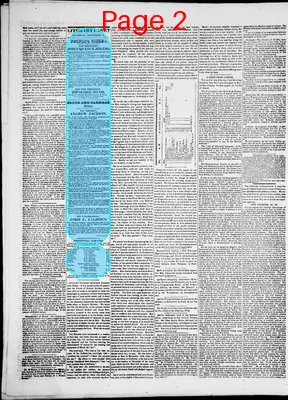
Literary Cadet And Rhode Island Statesman
Providence, Providence County, Rhode Island
What is this article about?
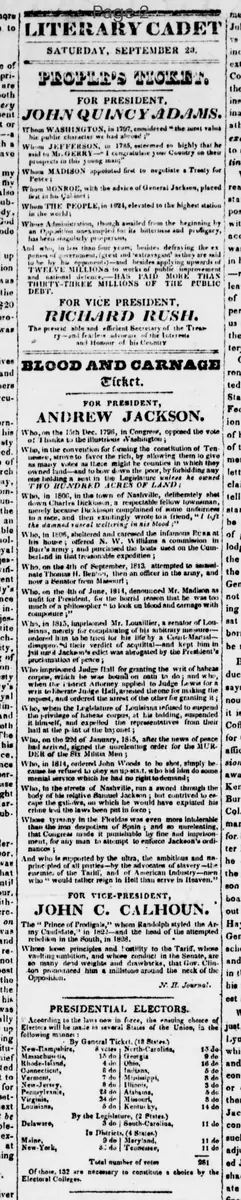
Editorial from the Literary Cadet endorsing John Quincy Adams for president and Richard Rush for vice president, praising Adams' achievements and service. It satirically attacks Andrew Jackson as the 'Blood and Carnage Ticket' for alleged violent acts and tyrannical behavior, and criticizes John C. Calhoun. Includes a table detailing presidential elector voting methods by state for the 1828 election.
Merged-components note: The table details the presidential electors directly referenced and continuing the political editorial on prophecies and candidates.
Clipping
OCR Quality
Full Text
SATURDAY, SEPTEMBER 20.
PROPHECIES TURNED
For President,
JOHN QUINCY ADAMS.
Whom WASHINGTON, in 1796, considered "the most valuable public character we have ever had"
Whom JEFFERSON, in 1785, esteemed so highly that he said to Mr. GERRY—"I congratulate your Country on their prospects in this young man;"
Whom MADISON appointed first to negotiate a Treaty for Peace;
Whom MONROE, with the advice of General Jackson, placed first in his Cabinet;
Whom THE PEOPLE, in 1824, elevated to the highest station in the world;
Whose Administration, though assailed from the beginning by an Opposition unexampled for its bitterness and profligacy, has been singularly prosperous,
And who, in less than four years, besides defraying the expenses of government, (great and 'extravagant' as they are said to be by his opponents)—and besides applying upwards of TWELVE MILLIONS to works of public improvement and national defence—HAS PAID OFF THIRTY-THREE MILLIONS OF THE PUBLIC DEBT.
FOR VICE PRESIDENT,
RICHARD RUSH.
The present able and efficient Secretary of the Treasury and fearless advocate of the Interests and Honour of his Country
BLOOD AND CARNAGE
Ticket.
FOR PRESIDENT,
ANDREW JACKSON.
Who, on the 15th Dec. 1795, in Congress, opposed the vote of thanks to the illustrious Washington;
Who, in the convention for forming the constitution of Tennessee, strove to favor the rich, by allowing them to give as many votes as there might be counties in which they owned land—and to bow down the poor, by forbidding any one holding a seat in the Legislature unless he owned TWO HUNDRED ACRES OF LAND;
Who, in 1806, in the town of Nashville, deliberately shot down Charles Dickinson, a respectable fellow townsman, merely because Dickinson complained of some unfairness in a race, and then exultingly wrote to a friend, "I left the damned rascal cooling in his blood;"
Who, in 1806, sheltered and caressed the infamous Burr at his house: offered N. W. Williams a commission in Burr's army; and guarded the boats used on the Cumberland in that treasonable expedition;
Who, on the 4th of September, 1813, attempted to assassinate Thomas H. Benton, then an officer in the army, and now a senator from Missouri;
Who, on the 4th of June, 1814, denounced Mr. Madison as unfit for President, for the horrid reason that he was too much of a philosopher "to look on blood and carnage with composure;"
Who, in 1815, imprisoned Mr. Louaillier, a senator of Louisiana, merely for complaining of his arbitrary measures: ordered him to be tried for his life by a Court-Martial—disapproved their verdict of acquittal—and kept him in jail until Jackson's edict was abrogated by the President's proclamation of peace;
Who imprisoned Judge Hall for granting the writ of habeas corpus, which he was bound on oath to do; and who, when the District Attorney applied to Judge Lewis for a writ to liberate Judge Hall, arrested the one for making the request, and ordered the arrest of the other for granting it;
Who, when the Legislature of Louisiana refused to suspend the privilege of habeas corpus, at his bidding, suspended it himself, and expelled the representatives from their hall at the point of the bayonet;
Who, on the 22d of January, 1815, after the news of peace had arrived, signed the unrelenting order for the MURDER of the Six Militia Men;
Who, in 1814, ordered John Woods to be shot, simply because he refused to obey an up-start, who bade him do common menial service which he had no right to demand;
Who, in the streets of Nashville, run a sword through the body of his relative Samuel Jackson; but contrived to escape the gallows, of which he would have expiated his crime had the law been put in force;
Whose tyranny in the Floridas was even more intolerable than the iron despotism of Spain: and so unrelenting, that Congress made it punishable by fine and imprisonment, for any man to attempt to enforce Jackson's ordinances
And who is supported by the ultra, the ambitious and unprincipled of all parties—by the advocates of slavery—the enemies of the Tariff, and of American Industry—men who "would rather reign in Hell than serve in Heaven."
FOR VICE-PRESIDENT,
JOHN C. CALHOUN.
The "Prince of Profligates," whom Randolph styled the "Army Candidate," in 1824—and the head of the attempted rebellion in the South, in 1828.
Whose lax principles and hostility to the Tariff, whose vaulting ambition, and whose conduct in the Senate, are so many dead weights and drawbacks, that Gov. Clinton pronounced him a millstone around the neck of the Opposition.
N. I. Journal.
PRESIDENTIAL ELECTORS.
According to the law now in force, the voting chance of Electors will be in several States of the Union, in the
| following manner: | |||
| New-Hampshire, Massachusetts, Rhode Island, Connecticut, Vermont, New-Jersey, Pennsylvania, Virginia, Louisiana, | By General Ticket, (18 States.) | 8 votes | 15 do Georgia Ohio, Indiana, Mississippi, Illinois, Alabama, Missouri, Kentucky, |
| Delaware, | By the Legislature, (2 States.) | 3 do South Carolina, 3 do (4 States.) | 11 do |
| Maine, New-York, | In Districts, (4 States.) | 9 do Maryland, 8 do Tennessee, | 11 do |
| Total number of votes | 261 | ||
| Of those, 132 are necessary to constitute a choice by the Electoral Colleges. |
What sub-type of article is it?
What keywords are associated?
What entities or persons were involved?
Editorial Details
Primary Topic
Endorsement Of John Quincy Adams And Criticism Of Andrew Jackson In 1828 Presidential Election
Stance / Tone
Strongly Pro Adams And Anti Jackson
Key Figures
Key Arguments