Thank you for visiting SNEWPapers!
Sign up free
Editorial
January 18, 1810
The Enquirer
Richmond, Henrico County, Virginia
What is this article about?
The General Republican Committee of New-York defends U.S. government measures and leaders Jefferson and Madison against accusations of French influence, citing John Adams' testimony of their integrity. It argues for the wisdom and impartiality of neutral policy amid Anglo-French war aggressions starting 1793.
Clipping
OCR Quality
95%
Excellent
Full Text
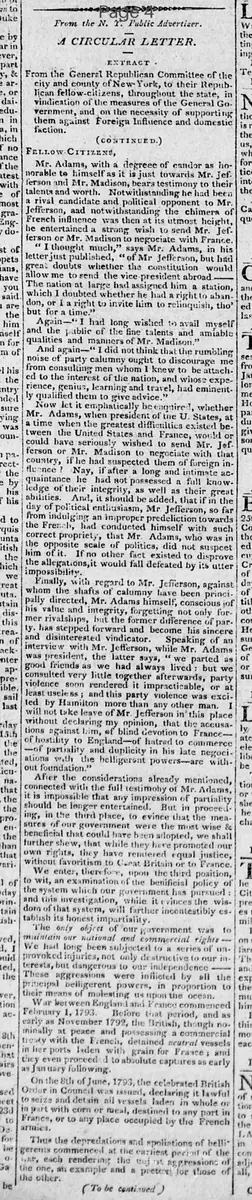
From the N. Y. Public Advertiser.
A CIRCULAR LETTER.
EXTRACT.
From the General Republican Committee of the city and county of New-York, to their Republican fellow-citizens, throughout the state, in vindication of the measures of the General Government, and on the necessity of supporting them against Foreign Influence and domestic faction.
(Continued.)
Fellow-Citizens,
Mr. Adams, with a degree of candor as honorable to himself as it is just towards Mr. Jefferson and Mr. Madison, bears testimony to their talents and worth. Notwithstanding he had been a rival candidate and political opponent to Mr. Jefferson, and notwithstanding the chimera of French influence was then at its utmost height, he entertained a strong wish to send Mr. Jefferson or Mr. Madison to negotiate with France.
"I thought much," says Mr. Adams, in his letter just published, "of Mr. Jefferson, but had great doubts whether the constitution would allow me to send the vice-president abroad. — The nation at large had assigned him a station, which I doubted whether he had a right to abandon, or I a right to invite him to relinquish, tho' but for a time."
Again — "I had long wished to avail myself and the public of the fine talents and amiable qualities and manners of Mr. Madison."
And again — "I did not think that the rumbling noise of party calumny ought to discourage me from consulting men whom I knew to be attached to the interest of the nation, and whose experience, genius, learning and travel, had eminently qualified them to give advice."
Now let it emphatically be enquired, whether Mr. Adams, when president of the U. States, at a time when the greatest difficulties existed between the United States and France, would or could have seriously wished to send Mr. Jefferson or Mr. Madison to negotiate with that country, if he had suspected them of foreign influence? Nay, if after a long and intimate acquaintance he had not possessed a full knowledge of their integrity, as well as their great abilities. And, it should be added, that if in the day of political enthusiasm, Mr. Jefferson, so far from indulging an improper predilection towards the French, had conducted himself with such correct propriety, that Mr. Adams, who was in the opposite scale of politics, did not suspect him of it. If no other fact existed to disprove the allegations, it would fall defeated by its utter impossibility.
Finally, with regard to Mr. Jefferson, against whom the shafts of calumny have been principally directed, Mr. Adams himself, conscious of his value and integrity, forgetting not only former rivalships, but the former difference of party, has stepped forward and become his sincere and disinterested vindicator. Speaking of an interview with Mr. Jefferson, while Mr. Adams was president, the latter says, "we parted as good friends as we had always lived: but we consulted very little together afterwards, party violence soon rendered it impracticable, or at least useless; and this party violence was excited by Hamilton more than any other man. I will not take leave of Mr. Jefferson in this place without declaring my opinion, that the accusations against him, of blind devotion to France — of hostility to England — of hatred to commerce — of partiality and duplicity in his late negotiations with the belligerent powers — are without foundation."
After the considerations already mentioned, connected with the full testimony of Mr. Adams, it is impossible that any impression of partiality should be longer entertained. But in proceeding, in the third place, to evince that the measures of our government were the most wise & beneficial that could have been adopted, we shall further shew, that while they have promoted our own rights, they have rendered equal justice, without favoritism to Great Britain or to France.
We enter, therefore, upon the third position, to wit, an examination of the beneficial policy of the system which our government has pursued: and this investigation, while it evinces the wisdom of that system, will farther incontestibly establish its honest impartiality.
The only object of our government was to maintain our national and commercial rights — We had long been subjected to a series of unprovoked injuries, not only destructive to our interests, but dangerous to our independence — These aggressions were inflicted by all the principal belligerent powers, in proportion to their means of molesting us upon the ocean.
War between England and France commenced February 1, 1793. Before that period, and as early as November 1792, the British, though nominally at peace and possessing a commercial treaty with the French, detained neutral vessels laden with grain for France: and they even proceeded to absolute captures as early as January following.
On the 8th of June, 1793, the celebrated British Order in Council was issued, declaring it lawful to seize and detain all vessels laden in whole or in part with corn or meal, destined to any port in France, or to any place occupied by the French armies.
Thus the depredations and spoliations of belligerents commenced at the earliest period of the war, each rendering the unjust aggressions of the one, an example and a pretext for those of the other.
A CIRCULAR LETTER.
EXTRACT.
From the General Republican Committee of the city and county of New-York, to their Republican fellow-citizens, throughout the state, in vindication of the measures of the General Government, and on the necessity of supporting them against Foreign Influence and domestic faction.
(Continued.)
Fellow-Citizens,
Mr. Adams, with a degree of candor as honorable to himself as it is just towards Mr. Jefferson and Mr. Madison, bears testimony to their talents and worth. Notwithstanding he had been a rival candidate and political opponent to Mr. Jefferson, and notwithstanding the chimera of French influence was then at its utmost height, he entertained a strong wish to send Mr. Jefferson or Mr. Madison to negotiate with France.
"I thought much," says Mr. Adams, in his letter just published, "of Mr. Jefferson, but had great doubts whether the constitution would allow me to send the vice-president abroad. — The nation at large had assigned him a station, which I doubted whether he had a right to abandon, or I a right to invite him to relinquish, tho' but for a time."
Again — "I had long wished to avail myself and the public of the fine talents and amiable qualities and manners of Mr. Madison."
And again — "I did not think that the rumbling noise of party calumny ought to discourage me from consulting men whom I knew to be attached to the interest of the nation, and whose experience, genius, learning and travel, had eminently qualified them to give advice."
Now let it emphatically be enquired, whether Mr. Adams, when president of the U. States, at a time when the greatest difficulties existed between the United States and France, would or could have seriously wished to send Mr. Jefferson or Mr. Madison to negotiate with that country, if he had suspected them of foreign influence? Nay, if after a long and intimate acquaintance he had not possessed a full knowledge of their integrity, as well as their great abilities. And, it should be added, that if in the day of political enthusiasm, Mr. Jefferson, so far from indulging an improper predilection towards the French, had conducted himself with such correct propriety, that Mr. Adams, who was in the opposite scale of politics, did not suspect him of it. If no other fact existed to disprove the allegations, it would fall defeated by its utter impossibility.
Finally, with regard to Mr. Jefferson, against whom the shafts of calumny have been principally directed, Mr. Adams himself, conscious of his value and integrity, forgetting not only former rivalships, but the former difference of party, has stepped forward and become his sincere and disinterested vindicator. Speaking of an interview with Mr. Jefferson, while Mr. Adams was president, the latter says, "we parted as good friends as we had always lived: but we consulted very little together afterwards, party violence soon rendered it impracticable, or at least useless; and this party violence was excited by Hamilton more than any other man. I will not take leave of Mr. Jefferson in this place without declaring my opinion, that the accusations against him, of blind devotion to France — of hostility to England — of hatred to commerce — of partiality and duplicity in his late negotiations with the belligerent powers — are without foundation."
After the considerations already mentioned, connected with the full testimony of Mr. Adams, it is impossible that any impression of partiality should be longer entertained. But in proceeding, in the third place, to evince that the measures of our government were the most wise & beneficial that could have been adopted, we shall further shew, that while they have promoted our own rights, they have rendered equal justice, without favoritism to Great Britain or to France.
We enter, therefore, upon the third position, to wit, an examination of the beneficial policy of the system which our government has pursued: and this investigation, while it evinces the wisdom of that system, will farther incontestibly establish its honest impartiality.
The only object of our government was to maintain our national and commercial rights — We had long been subjected to a series of unprovoked injuries, not only destructive to our interests, but dangerous to our independence — These aggressions were inflicted by all the principal belligerent powers, in proportion to their means of molesting us upon the ocean.
War between England and France commenced February 1, 1793. Before that period, and as early as November 1792, the British, though nominally at peace and possessing a commercial treaty with the French, detained neutral vessels laden with grain for France: and they even proceeded to absolute captures as early as January following.
On the 8th of June, 1793, the celebrated British Order in Council was issued, declaring it lawful to seize and detain all vessels laden in whole or in part with corn or meal, destined to any port in France, or to any place occupied by the French armies.
Thus the depredations and spoliations of belligerents commenced at the earliest period of the war, each rendering the unjust aggressions of the one, an example and a pretext for those of the other.
What sub-type of article is it?
Partisan Politics
Foreign Affairs
War Or Peace
What keywords are associated?
Adams Testimony
Jefferson Vindication
French Influence
Neutral Policy
Anglo French War
Belligerent Aggressions
Republican Committee
What entities or persons were involved?
Mr. Adams
Mr. Jefferson
Mr. Madison
Hamilton
General Republican Committee
Great Britain
France
Editorial Details
Primary Topic
Vindication Of Government Measures Against Foreign Influence And Domestic Faction
Stance / Tone
Defensive And Supportive Of Republican Leaders And Neutral Policy
Key Figures
Mr. Adams
Mr. Jefferson
Mr. Madison
Hamilton
General Republican Committee
Great Britain
France
Key Arguments
Adams' Testimony Affirms Jefferson And Madison's Integrity Despite Political Rivalries
Adams Wished To Appoint Jefferson Or Madison As Negotiators With France, Disproving French Influence Suspicions
Party Violence Excited By Hamilton Hindered Consultations
Accusations Against Jefferson Of Devotion To France And Hostility To England Are Unfounded
Government Policy Maintains National And Commercial Rights Impartially Against Belligerent Aggressions
British Aggressions Began Early In 1793 War With Detentions And Captures Of Neutral Vessels