Thank you for visiting SNEWPapers!
Sign up free
The National Intelligencer And Washington Advertiser
Washington, District Of Columbia
What is this article about?
French Moniteur article criticizes English journalists for fomenting discord, complaining about French actions in Switzerland and Germany, and ignoring treaties like Luneville and Amiens. It defends continental peace and France's role, warning against English alliances that have harmed European powers.
Merged-components note: Continuation of the article from the Moniteur on foreign intelligence.
Clipping
OCR Quality
Full Text
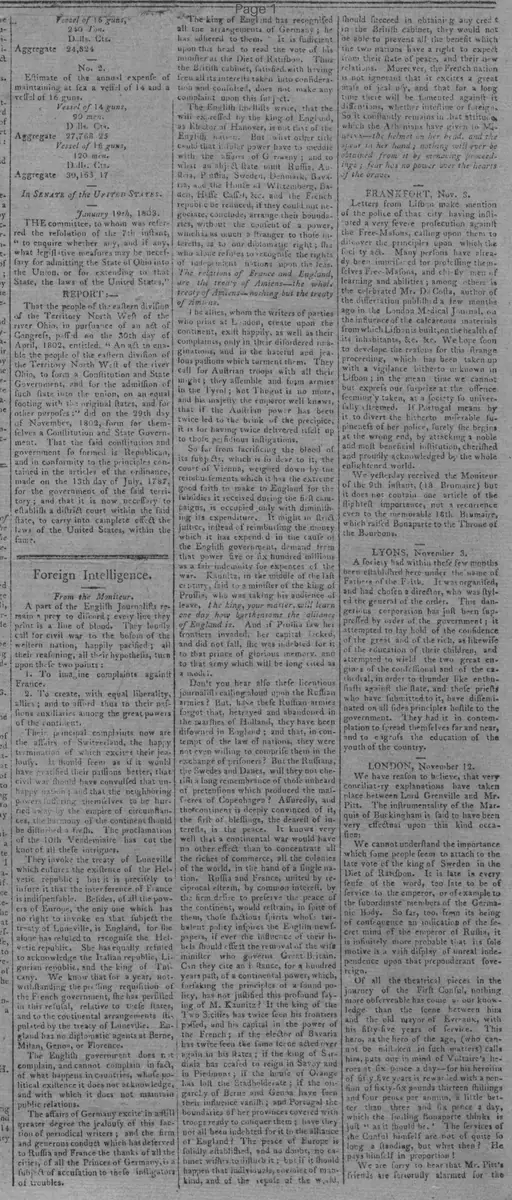
From the Moniteur.
A part of the English Journalists remain a prey to discord; every line they print is a line of blood. They loudly call for civil war to the bosom of the western nation, happily pacified; all their reasoning, all their hypothesis, turn upon these two points:
1. To imagine complaints against France.
2. To create, with equal liberality, allies; and to afford thus to their passions auxiliaries among the great powers of the continent.
Their principal complaints now are the affairs of Switzerland, the happy termination of which excites their jealousy. It should seem as if it would have gratified their passions better, that civil war should have convulsed that unhappy nation; and that the neighboring powers suffering themselves to be hurried away by the empire of circumstances, the harmony of the continent should be disturbed afresh. The proclamation of the 10th Vendemiaire has cut the knot of all these intrigues.
They invoke the treaty of Luneville which ensures the existence of the Helvetic republic; but it is precisely to ensure it that the interference of France is indispensable. Besides, of all the powers of Europe, the only one which has no right to invoke on that subject the treaty of Luneville, is England, for she alone has refused to recognize the Helvetic republic. She has equally refused to acknowledge the Italian republic, Ligurian republic, and the king of Tuscany. We know that for a year, notwithstanding the pressing requisition of the French government, she has persisted in this refusal, relative to these states, and to the continental arrangements stipulated by the treaty of Luneville. England has no diplomatic agents at Berne, Milan, Genoa, or Florence.
The English government does not complain, and cannot complain in fact, of what happens in countries, whose political existence it does not acknowledge, and with which it does not maintain public relations.
The affairs of Germany excite in still greater degree the jealousy of this faction of periodical writers; and the firm and generous conduct which has deserved to Russia and France the thanks of all the cities, of all the Princes of Germany, is a subject of accusation to these instigators of troubles.
The king of England has recognized all the arrangements of Germany; he has adhered to them. It is sufficient upon this head to read the vote of his minister at the Diet of Ratisbon. Thus the British cabinet, satisfied with having seen all its interests taken into consideration and consulted, does not make any complaint upon this subject.
The English libellers write, that the will expressed by the king of England, as Elector of Hanover, is not that of the English nation. But what other title could that singular power have to meddle with the affairs of Germany; and to what an absurd state must Russia, Austria, Prussia, Sweden, Denmark, Bavaria, and the House of Wirtemberg, Baden, Hesse Cassel, &c. and the French republic be reduced, if they could not negotiate, conclude, arrange their boundaries, without the consent of a power, which is as much a stranger to those interests, as to our diplomatic rights: the who alone refuses to recognize the rights of independent nations upon the seas.
The relations of France and England, are the treaty of Amiens—the whole treaty of Amiens—nothing but the treaty of Amiens.
The allies, whom the writers of parties who print at London, create upon the continent, exist happily, as well as their complaints, only in their disordered imaginations, and in the hateful and jealous passions which torment them. They call for Austrian troops with all their might; they assemble and foam armies in the Tyrol; but Thugut is no more, and his majesty the emperor well knows, that if the Austrian power has been twice led to the brink of the precipice, it is for having twice delivered itself up to those perfidious instigations.
So far from sacrificing the blood of its subjects, which is so dear to it, the court of Vienna, weighed down by the reimbursements which it has the extreme good faith to make to England for the subsidies it received during the first campaigns, is occupied only with diminishing its expenditure. It might in strict justice, instead of reimbursing the money which it has expended in the cause of the English government, demand from that power five or six hundred millions as a fair indemnity for expenses of the war. Kaunitz, in the middle of the last century, said to a minister of the king of Prussia, who was taking his audience of leave, The king, your master, will learn one day how burdensome the alliance of England is. And if Prussia saw her frontiers invaded, her capital sacked, and did not fall, she was indebted for it to that prince of glorious memory, and to that army which will be long cited as a model.
Don't you hear also these licentious journalists calling aloud upon the Russian armies? But, have these Russian armies forgot that, betrayed and abandoned in the marshes of Holland, they have been drowned in England: and that, in contempt of the law of nations, they were not even willing to comprise them in the exchange of prisoners? But the Russians, the Swedes and Danes, will they not cherish a long remembrance of those unheard of pretensions which produced the massacres of Copenhagen? Assuredly, and the continent is deeply convinced of it, the first of blessings, the dearest of interests, is the peace. It knows very well that a continental war would have no other effect than to concentrate all the riches of commerce, all the colonies of the world, in the hand of a single nation. Russia and France, united by reciprocal esteem, by common interest, by the firm desire to preserve the peace of the continent, would restrain, in spite of them, those factious spirits whose turbulent policy inspires the English news.papers, if ever the influence of their libels should effect the removal of the wise minister who governs Great-Britain.
Can they cite an instance, for a hundred years past, of a continental power, which, forsaking the principles of a sound policy, has not justified this profound saying of M. Kaunitz? If the king of the Two Sicilies has twice seen his frontiers passed, and his capital in the power of the French: if the elector of Bavaria has twice seen the same scene acted over again in his states; if the king of Sardinia has ceased to reign in Savoy and in Piedmont; if the house of Orange has lost the Stadtholdership; if the aristocracies of Berne and Genoa have seen their influence vanish; and Portugal the boundaries of her provinces covered with troops ready to conquer them; have they not all been indebted for it to the alliance of England? The peace of Europe is solidly established, and no doubt, no cabinet wishes, to disturb it; but if it should happen that individuals, enemies of mankind, and of the repose of this world.
should succeed in obtaining any credit in the British cabinet, they would not be able to prevent all the benefit which the two nations have a right to expect from their state of peace, and their new relations. Moreover, the French nation is not ignorant that it excites a great mass of jealousy, and that for a long time these will be fomented against it divisions, whether intestine or foreign. So it constantly remains in that attitude which the Athenians have given to Minerva—the helmet on her head, and the spear in her hand; nothing will ever be obtained from it by menacing proceedings; fear has no power over the hearts of the brave.
What sub-type of article is it?
What keywords are associated?
What entities or persons were involved?
Where did it happen?
Foreign News Details
Primary Location
Continent
Event Date
Proclamation Of The 10th Vendemiaire
Key Persons
Outcome
peace of europe solidly established
Event Details
English journalists criticized for inciting civil war and complaining about French interventions in Switzerland and Germany; France defends its actions under Treaty of Luneville and emphasizes Treaty of Amiens; continental powers urged to maintain peace against English influences.