Thank you for visiting SNEWPapers!
Sign up free
Domestic News
May 29, 1840
Morning Herald
New York, New York County, New York
What is this article about?
Letter from Salem, Massachusetts, dated May 21, 1840, to J. G. Bennett discussing Down East opinions on the bankrupt law, inclusion of corporations for uniform currency, criticism of politicians like Webster, and preference for state banking systems over a national bank.
Clipping
OCR Quality
95%
Excellent
Full Text
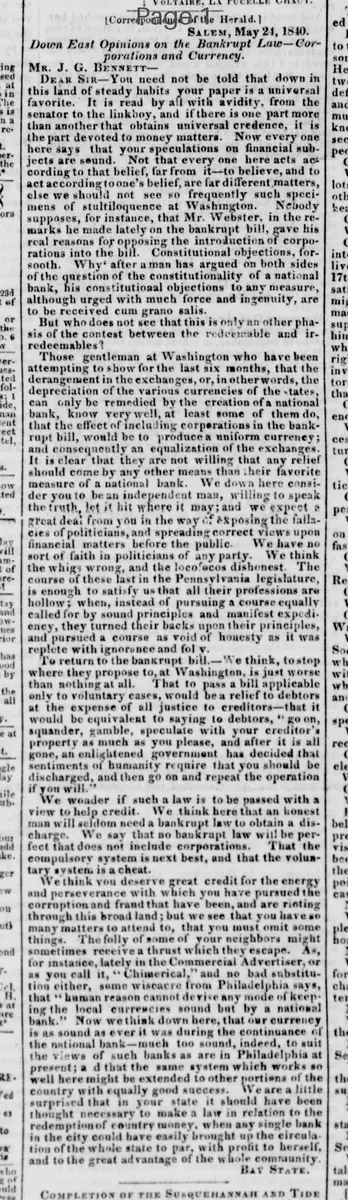
[Correspondence of the Herald.]
SALEM, May 21, 1840.
Down East Opinions on the Bankrupt Law-Corporations and Currency:
Mr. J. G. Bennett-
Dear Sir-You need not be told that down in this land of steady habits your paper is a universal favorite. It is read by all with avidity, from the senator to the linkboy, and if there is one part more than another that obtains universal credence, it is the part devoted to money matters. Now every one here says that your speculations on financial subjects are sound. Not that every one here acts according to that belief, far from it--to believe, and to act according to one's belief, are far different matters, else we should not see so frequently such specimens of stultiloquence at Washington. Nobody supposes, for instance, that Mr. Webster, in the remarks he made lately on the bankrupt bill, gave his real reasons for opposing the introduction of corporations into the bill. Constitutional objections, forsooth. Why, after a man has argued on both sides of the question of the constitutionality of a national bank, his constitutional objections to any measure, although urged with much force and ingenuity, are to be received cum grano salis.
But who does not see that this is only another phase of the contest between the redeemable and irredeemables?
Those gentlemen at Washington who have been attempting to show for the last six months, that the derangement in the exchanges, or, in other words, the depreciation of the various currencies of the states, can only be remedied by the creation of a national bank, know very well, at least some of them do, that the effect of including corporations in the bankrupt bill, would be to produce a uniform currency; and consequently an equalization of the exchanges.
It is clear that they are not willing that any relief should come by any other means than their favorite measure of a national bank. We down here consider you to be an independent man, willing to speak the truth, let it hit where it may; and we expect a great deal from you in the way of exposing the fallacies of politicians, and spreading correct views upon financial matters before the public. We have no sort of faith in politicians of any party. We think the whigs wrong, and the locofocos dishonest. The course of these last in the Pennsylvania legislature, is enough to satisfy us that all their professions are hollow: when, instead of pursuing a course equally called for by sound principles and manifest expediency, they turned their backs upon their principles, and pursued a course as void of honesty as it was replete with ignorance and folly.
To return to the bankrupt bill.-We think, to stop where they propose to, at Washington, is just worse than nothing at all. That to pass a bill applicable only to voluntary cases, would be a relief to debtors at the expense of all justice to creditors-that it would be equivalent to saying to debtors, "go on, squander, gamble, speculate with your creditor's property as much as you please, and after it is all gone, an enlightened government has decided that sentiments of humanity require that you should be discharged, and then go on and repeat the operation if you will."
We wonder if such a law is to be passed with a view to help credit. We think here that an honest man will seldom need a bankrupt law to obtain a discharge. We say that no bankrupt law will be perfect that does not include corporations. That the compulsory system is next best, and that the voluntary system is a cheat.
We think you deserve great credit for the energy and perseverance with which you have pursued the corruption and fraud that have been, and are rioting through this broad land; but we see that you have so many matters to attend to, that you must omit some things. The folly of some of your neighbors might sometimes receive a thrust which they escape. As, for instance, lately in the Commercial Advertiser, or as you call it, "Chimerical," and no bad substitution either, some wiseacre from Philadelphia says, that "human reason cannot devise any mode of keeping the local currencies sound but by a national bank." Now we think down here, that our currency is as sound as ever it was during the continuance of the national bank-much too sound, indeed, to suit the views of such banks as are in Philadelphia at present; and that the same system which works so well here might be extended to other portions of the country with equally good success. We are a little surprised that in your state it should have been thought necessary to make a law in relation to the redemption of country money, when any single bank in the city could have easily brought up the circulation of the whole state to par, with profit to herself, and to the great advantage of the whole community.
Bay State.
SALEM, May 21, 1840.
Down East Opinions on the Bankrupt Law-Corporations and Currency:
Mr. J. G. Bennett-
Dear Sir-You need not be told that down in this land of steady habits your paper is a universal favorite. It is read by all with avidity, from the senator to the linkboy, and if there is one part more than another that obtains universal credence, it is the part devoted to money matters. Now every one here says that your speculations on financial subjects are sound. Not that every one here acts according to that belief, far from it--to believe, and to act according to one's belief, are far different matters, else we should not see so frequently such specimens of stultiloquence at Washington. Nobody supposes, for instance, that Mr. Webster, in the remarks he made lately on the bankrupt bill, gave his real reasons for opposing the introduction of corporations into the bill. Constitutional objections, forsooth. Why, after a man has argued on both sides of the question of the constitutionality of a national bank, his constitutional objections to any measure, although urged with much force and ingenuity, are to be received cum grano salis.
But who does not see that this is only another phase of the contest between the redeemable and irredeemables?
Those gentlemen at Washington who have been attempting to show for the last six months, that the derangement in the exchanges, or, in other words, the depreciation of the various currencies of the states, can only be remedied by the creation of a national bank, know very well, at least some of them do, that the effect of including corporations in the bankrupt bill, would be to produce a uniform currency; and consequently an equalization of the exchanges.
It is clear that they are not willing that any relief should come by any other means than their favorite measure of a national bank. We down here consider you to be an independent man, willing to speak the truth, let it hit where it may; and we expect a great deal from you in the way of exposing the fallacies of politicians, and spreading correct views upon financial matters before the public. We have no sort of faith in politicians of any party. We think the whigs wrong, and the locofocos dishonest. The course of these last in the Pennsylvania legislature, is enough to satisfy us that all their professions are hollow: when, instead of pursuing a course equally called for by sound principles and manifest expediency, they turned their backs upon their principles, and pursued a course as void of honesty as it was replete with ignorance and folly.
To return to the bankrupt bill.-We think, to stop where they propose to, at Washington, is just worse than nothing at all. That to pass a bill applicable only to voluntary cases, would be a relief to debtors at the expense of all justice to creditors-that it would be equivalent to saying to debtors, "go on, squander, gamble, speculate with your creditor's property as much as you please, and after it is all gone, an enlightened government has decided that sentiments of humanity require that you should be discharged, and then go on and repeat the operation if you will."
We wonder if such a law is to be passed with a view to help credit. We think here that an honest man will seldom need a bankrupt law to obtain a discharge. We say that no bankrupt law will be perfect that does not include corporations. That the compulsory system is next best, and that the voluntary system is a cheat.
We think you deserve great credit for the energy and perseverance with which you have pursued the corruption and fraud that have been, and are rioting through this broad land; but we see that you have so many matters to attend to, that you must omit some things. The folly of some of your neighbors might sometimes receive a thrust which they escape. As, for instance, lately in the Commercial Advertiser, or as you call it, "Chimerical," and no bad substitution either, some wiseacre from Philadelphia says, that "human reason cannot devise any mode of keeping the local currencies sound but by a national bank." Now we think down here, that our currency is as sound as ever it was during the continuance of the national bank-much too sound, indeed, to suit the views of such banks as are in Philadelphia at present; and that the same system which works so well here might be extended to other portions of the country with equally good success. We are a little surprised that in your state it should have been thought necessary to make a law in relation to the redemption of country money, when any single bank in the city could have easily brought up the circulation of the whole state to par, with profit to herself, and to the great advantage of the whole community.
Bay State.
What sub-type of article is it?
Politics
Economic
What keywords are associated?
Bankrupt Law
National Bank
Uniform Currency
Corporations
Financial Speculation
Political Corruption
What entities or persons were involved?
J. G. Bennett
Mr. Webster
Where did it happen?
Salem
Domestic News Details
Primary Location
Salem
Event Date
May 21, 1840
Key Persons
J. G. Bennett
Mr. Webster
Event Details
Correspondence expressing opinions on the bankrupt bill, advocating inclusion of corporations for uniform currency, criticizing politicians' opposition linked to national bank interests, distrust of whigs and locofocos, and praising local currency systems over national bank.