Thank you for visiting SNEWPapers!
Sign up free
The Hillsdale Standard
Hillsdale, Hillsdale County, Michigan
What is this article about?
The London Times reports that Russia's declaration to Austria rejects peace propositions from the Four Powers, insisting on direct negotiations with Turkey via Prince Gortschakoff. This dashes hopes for peace in the Eastern War. Russian forces prepare intensified assaults on Turkish positions along the Danube, including at Kalafat and near Galatz.
Clipping
OCR Quality
Full Text
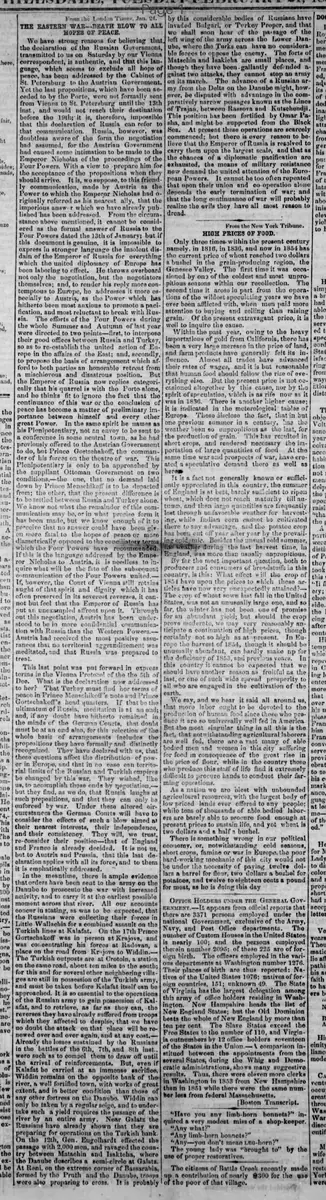
THE EASTERN WAR--DEATH BLOW TO ALL HOPES OF PEACE.
We have strong reasons for believing that the declaration of the Russian Government, transmitted to us on Saturday by our Vienna correspondent, is authentic, and that this language, which seems to exclude all hope of peace, has been addressed by the Cabinet of St. Petersburg to the Austrian Government.
Yet the last propositions, which have been acceded to by the Porte, were not formally sent from Vienna to St. Petersburg until the 13th inst. and would not reach their destination before the 19th: it is, therefore, impossible that this declaration of Russia can refer to that communication. Russia, however, was doubtless aware of the form the negotiation had assumed, for the Austrian Government had caused some intimation to be made to the Emperor Nicholas of the proceedings of the Four Powers. With a view to prepare him for the acceptance of the propositions when they should arrive. It is, we suppose, to this friendly communication, made by Austria as the most anxious to promote a pacification, and most reluctant to break with Russia.
The efforts of the Four Powers during the whole Summer and Autumn of last year were directed to two points—first, to interpose their good offices between Russia and Turkey, so as to re-establish the united action of Europe in the affairs of the East; and, secondly, to propose the basis of arrangement which afford to both parties an honorable retreat from a mischievous and disastrous position. But the Emperor of Russia now replies categorically that his quarrel is with the Porte alone, and he thinks fit to ignore the fact that the continuance of this war or the conclusion of peace has become a matter of preliminary importance between himself and every other great Power. In the same spirit he names as his Plenipotentiary, not an envoy to be sent to a conference in some neutral town, as he had previously offered to the Austrian Government to do, but Prince Gortschakoff, the commander of his forces on the theatre of war. This Plenipotentiary is only to be approached by the suppliant Ottoman Government on two conditions,-the one, that no demand laid down by Prince Menschikoff is to be departed from: the other, that the present difference is to be settled between Russia and Turkey alone.
We know not what the remainder of this communication may be, or in what precise form it has been made, but we know enough of it to perceive that no answer could have been given more fatal to the hopes of peace or more diametrically opposed to the conciliatory terms which the Four Powers have recommended.
If this is the language addressed by the Emperor Nicholas to Austria, it is needless to inquire what will be the fate of the subsequent communication of the Four Powers united.- If, however, the Court of Vienna still retains aught of that spirit and dignity which it has often preserved in its severest reverses, it cannot but feel that the Emperor of Russia has put an unexampled affront upon it. Throughout this negotiation, Austria has been understood to be in more confidential communication with Russia than the Western Powers.-- Austria had received the most positive assurances that no territorial aggrandizement was meditated, and that Russia was prepared to treat.
This last point was put forward in express terms in the Vienna Protocol of the 5th of Dec. What is the declaration now addressed to her? That Turkey must find her terms of peace in Prince Menschikoff's note and Prince Gortschakoff's head quarters. If that be the ultimatum of Russia, negotiation is at an end: and, if any doubt have hitherto remained in the minds of the German Courts, that doubt must be at an end also, for this rejection of the whole basis of arrangements includes the propositions they have formally and distinctly recognized. They have declared with us, that these questions affect the distribution of power in Europe, and that in no case can territorial limits of the Russian and Turkish empires be changed by this war. They wished, like us, to accomplish those ends by negotiation.-- but they find, as we do, that Russia laughs at such propositions, and that they can only be enforced by war. Under these altered circumstances the German Courts will have to consider the effects of such a blow aimed at their nearest interests, their independence, and their consistency. They will, we trust, re-consider their position-that of England and France is already decided. It is not us, but to Austria and Prussia, that this last declaration applies with all its force, and to them it is emphatically addressed.
In the meantime, there is ample evidence that orders have been sent to the army on the Danube to prosecute the war with increased activity, and to carry it at the earliest possible moment across that river. All our accounts concur in stating, as was to be expected, that the Russians were collecting their forces in Little Wallachia for a combined assault on the Turkish lines at Kalafat. On the 17th Prince Gortschakoff was in person at Krajova, and was concentrating his forces at Radovan, a place on the road from Krajova to Widdin.-- The Turkish outposts are at Crotova, a station on the same road, about ten miles to the south; for this and for several other neighboring villages are still in possession of the Turkish army, and must be taken before Kalafat itself can be approached. It is so essential to the operations of the Russian army to gain possession of Kalafat, and to retrieve, as far as they can, the reverses they have already suffered from troops which they affected to despise, that we have no doubt the attack on that place will be renewed over and over again, and at any cost.- Already the losses sustained by the Russians in the battles of the 6th, 7th, and 8th inst., were such as to compel them to draw off until the arrival of reinforcements. But, even if Kalafat be carried at an immense sacrifice, Widdin remains on the opposite bank of the river, a well fortified town, with works of great extent, and in better condition than those of any other fortress on the Danube. Widdin can only be taken by a regular siege, and to undertake such a yield requires the passage of the river by an entire army.
Near Galatz the Russians have already shown that they are preparing for operations on the Turkish bank. On the 12th, Gen. Engelhardt effected the passage with 2,000 men, and ravaged the country between Matachin and Isaktcha, where the Danube describes a semi-circle at Galatz. At Reni, on the extreme corner of Bessarabia, formed by the Pruth and the Danube, troops were also preparing to cross. It is probably by this considerable bodies of Russians have invaded Bulgaria, or Turkey Proper, and that we shall soon hear of the passage of the left wing of the army across the Lower Danube, where the Turks can have no considerable forces to oppose the enemy. The forts of Matschin and Isakicha are small places, and though they have been gallantly defended against two attacks, they cannot stop an army on its march. The advance of a Russian army from the Delta on the Danube might, however, be disputed with advantage in the comparatively narrow passages known as the Lines of Trajan, between Rassova and Kotschandji. This position has been fortified by Omar Pasha, and might be supported from the Black Sea. At present these operations are scarcely commenced; but there is every reason to believe that the Emperor of Russia is resolved to carry them upon the largest scale, and that as the chances of a diplomatic pacification are exhausted, the means of military resistance now demand the united attention of the European Powers. It cannot be too often repeated that upon their union and co-operation alone depends the early termination of war; and that the long continuance of war will probably realize the evils they have all most reason to dread.
What sub-type of article is it?
What keywords are associated?
What entities or persons were involved?
Where did it happen?
Foreign News Details
Primary Location
Danube
Event Date
January 1854
Key Persons
Outcome
russia rejects peace propositions from the four powers, insisting on direct settlement with turkey; russian forces suffer losses in battles of january 6-8 but prepare renewed assaults on kalafat and crossings near galatz; hopes for diplomatic pacification exhausted, war to continue.
Event Details
Russia's declaration to Austria excludes hope of peace, rejecting Four Powers' propositions acceded to by Turkey and demanding negotiations solely with the Porte via Prince Gortschakoff on Menschikoff's terms. Austria feels affronted despite prior assurances. Russian army on Danube ordered to intensify operations, concentrating for assault on Kalafat after recent reverses; preparations for crossings near Galatz and Reni to invade Bulgaria; Turkish defenses at Lines of Trajan.