Thank you for visiting SNEWPapers!
Sign up free
Editorial
September 18, 1930
Watauga Democrat
Boone, Watauga County, North Carolina
What is this article about?
Whimsical tribute to apples in American culture, highlighting their widespread growth, varieties, culinary versatility in pies and dumplings, and export to Europe, with a subtle reference to cider amid Prohibition.
Clipping
OCR Quality
98%
Excellent
Full Text
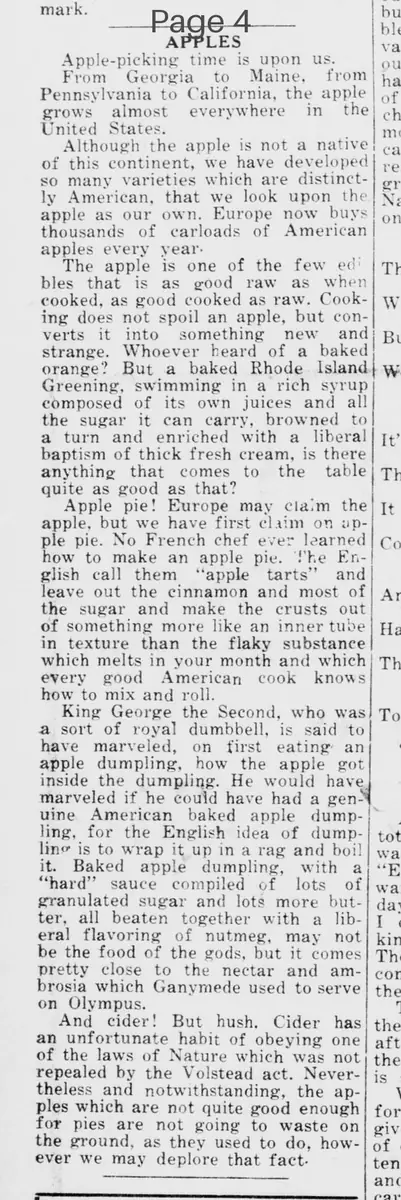
APPLES
Apple-picking time is upon us. From Georgia to Maine, from Pennsylvania to California, the apple grows almost everywhere in the United States.
Although the apple is not a native of this continent, we have developed so many varieties which are distinctly American, that we look upon the apple as our own. Europe now buys thousands of carloads of American apples every year.
The apple is one of the few edibles that is as good raw as when cooked, as good cooked as raw. Cooking does not spoil an apple, but converts it into something new and strange. Whoever heard of a baked orange? But a baked Rhode Island Greening, swimming in a rich syrup composed of its own juices and all the sugar it can carry, browned to a turn and enriched with a liberal baptism of thick fresh cream, is there anything that comes to the table quite as good as that?
Apple pie! Europe may claim the apple, but we have first claim on apple pie. No French chef ever learned how to make an apple pie. The English call them "apple tarts" and leave out the cinnamon and most of the sugar and make the crusts out of something more like an inner tube in texture than the flaky substance which melts in your mouth and which every good American cook knows how to mix and roll.
King George the Second, who was a sort of royal dumbbell, is said to have marveled, on first eating an apple dumpling, how the apple got inside the dumpling. He would have marveled if he could have had a genuine American baked apple dumpling, for the English idea of dumpling is to wrap it up in a rag and boil it. Baked apple dumpling, with a "hard" sauce composed of lots of granulated sugar and lots more butter, all beaten together with a liberal flavoring of nutmeg, may not be the food of the gods, but it comes pretty close to the nectar and ambrosia which Ganymede used to serve on Olympus.
And cider! But hush. Cider has an unfortunate habit of obeying one of the laws of Nature which was not repealed by the Volstead act. Nevertheless and notwithstanding, the apples which are not quite good enough for pies are not going to waste on the ground, as they used to do. However we may deplore that fact.
Apple-picking time is upon us. From Georgia to Maine, from Pennsylvania to California, the apple grows almost everywhere in the United States.
Although the apple is not a native of this continent, we have developed so many varieties which are distinctly American, that we look upon the apple as our own. Europe now buys thousands of carloads of American apples every year.
The apple is one of the few edibles that is as good raw as when cooked, as good cooked as raw. Cooking does not spoil an apple, but converts it into something new and strange. Whoever heard of a baked orange? But a baked Rhode Island Greening, swimming in a rich syrup composed of its own juices and all the sugar it can carry, browned to a turn and enriched with a liberal baptism of thick fresh cream, is there anything that comes to the table quite as good as that?
Apple pie! Europe may claim the apple, but we have first claim on apple pie. No French chef ever learned how to make an apple pie. The English call them "apple tarts" and leave out the cinnamon and most of the sugar and make the crusts out of something more like an inner tube in texture than the flaky substance which melts in your mouth and which every good American cook knows how to mix and roll.
King George the Second, who was a sort of royal dumbbell, is said to have marveled, on first eating an apple dumpling, how the apple got inside the dumpling. He would have marveled if he could have had a genuine American baked apple dumpling, for the English idea of dumpling is to wrap it up in a rag and boil it. Baked apple dumpling, with a "hard" sauce composed of lots of granulated sugar and lots more butter, all beaten together with a liberal flavoring of nutmeg, may not be the food of the gods, but it comes pretty close to the nectar and ambrosia which Ganymede used to serve on Olympus.
And cider! But hush. Cider has an unfortunate habit of obeying one of the laws of Nature which was not repealed by the Volstead act. Nevertheless and notwithstanding, the apples which are not quite good enough for pies are not going to waste on the ground, as they used to do. However we may deplore that fact.
What sub-type of article is it?
Agriculture
Temperance
What keywords are associated?
Apples
Apple Pie
Apple Dumpling
Cider
Volstead Act
American Cuisine
What entities or persons were involved?
King George Ii
American Cooks
Europeans
Editorial Details
Primary Topic
Celebration Of American Apples And Cuisine
Stance / Tone
Enthusiastic And Patriotic
Key Figures
King George Ii
American Cooks
Europeans
Key Arguments
Apples Are Distinctly American Despite Non Native Origin
American Apple Preparations Superior To European
Apple Pie And Dumplings Exemplify American Culinary Excellence
Cider Production Persists Despite Prohibition