Thank you for visiting SNEWPapers!
Sign up free
The Pacific Commercial Advertiser
Honolulu, Honolulu County, Hawaii
What is this article about?
The 'Southern Cross,' a unique cluster of nine pearls forming a Latin cross, discovered in West Australia, was buried by its superstitious first owner but unearthed in 1874 and exhibited in 1879, valued at $500,000 by Australian syndicate.
Clipping
OCR Quality
Full Text
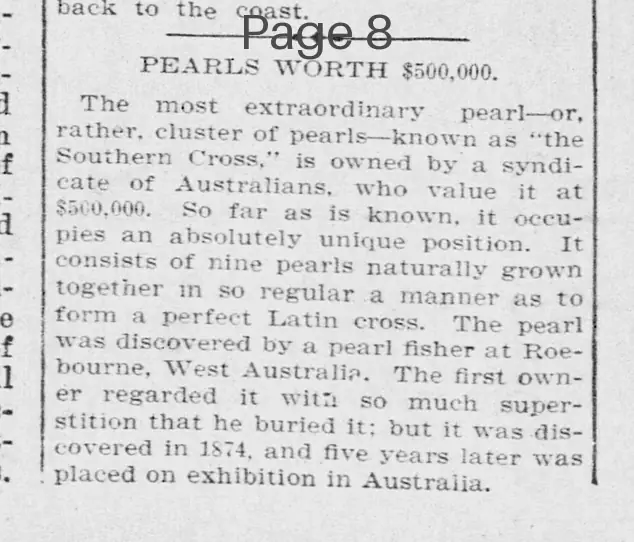
The most extraordinary pearl—or rather, cluster of pearls—known as "the Southern Cross," is owned by a syndicate of Australians, who value it at $500,000. So far as is known, it occupies an absolutely unique position. It consists of nine pearls naturally grown together in so regular a manner as to form a perfect Latin cross. The pearl was discovered by a pearl fisher at Roebourne, West Australia. The first owner regarded it with so much superstition that he buried it; but it was discovered in 1874, and five years later was placed on exhibition in Australia.
What sub-type of article is it?
What themes does it cover?
What keywords are associated?
What entities or persons were involved?
Where did it happen?
Story Details
Key Persons
Location
Roebourne, West Australia; Australia
Event Date
Discovered In 1874, Exhibited In 1879
Story Details
A unique cluster of nine pearls forming a perfect Latin cross, known as 'the Southern Cross,' was discovered by a pearl fisher in Roebourne, West Australia. The first owner buried it due to superstition, but it was unearthed in 1874 and exhibited in Australia five years later, valued at $500,000 by an Australian syndicate.