Thank you for visiting SNEWPapers!
Sign up free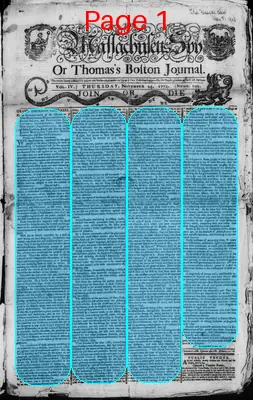
The Massachusetts Spy, Or, Thomas's Boston Journal
Boston, Suffolk County, Massachusetts
What is this article about?
The Delegates of the Continental Congress address American colonists, outlining British legislative and executive actions since the end of the last war that impose taxes, expand admiralty courts, maintain a standing army, and undermine colonial rights and assemblies, justifying collective resistance while affirming past loyalty.
Clipping
OCR Quality
Full Text
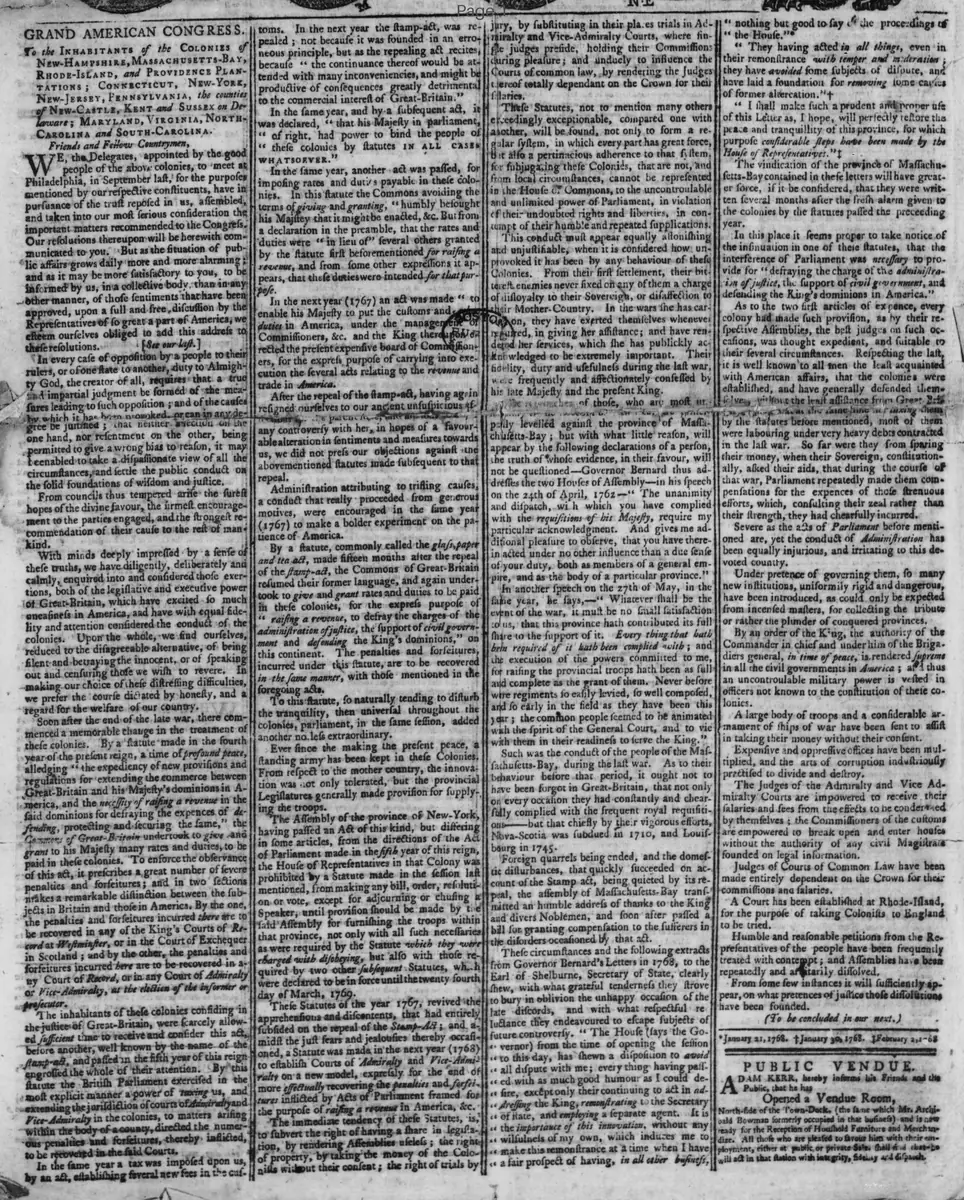
To the Inhabitants of the Colonies of
New-Hampshire, Massachusetts-Bay,
Rhode-Island, and Providence Plantations: Connecticut, New-York,
New-Jersey, Pennsylvania, the counties
of New-Castle, Kent, and Sussex on Delaware;
Maryland, Virginia, North-Carolina and South-Carolina.
Friends and Fellow Countrymen,
We, the Delegates, appointed by the good
people of the above colonies, to meet at
Philadelphia, in September last, for the purpose
mentioned by our respective constituents, have in
pursuance of the trust reposed in us, assembled.
and taken into our most serious consideration the
important matters recommended to the Congress.
Our resolutions thereupon will be herewith communicated to you. But as the situation of public
affairs grows daily more and more alarming;
and as it may be more satisfactory to you, to be informed by us, in a collective body, than in any
other manner, of those sentiments that have been
approved, upon a full and free discussion by the
Representatives of so great a part of America, we
therefore esteem ourselves obliged to add this address to
our resolutions.
[We pass over our last.]
In every case of opposition by a people to their
rulers, or of one state to another, duty to Almighty
God, the creator of all, requires that a true
and impartial judgment be formed of the measures leading to such opposition; and of the causes
by which it has been provoked. Or can in any degree be justified; that neither affection on the
one hand, nor resentment on the other, being
permitted to give a wrong bias to reason, it may
be enabled to take a dispassionate view of all the
circumstances, and settle the public conduct on
the solid foundations of wisdom and justice.
From councils thus tempered arise the surest
hopes of the divine favour, the firmest encouragement to the parties engaged, and the strongest recommendation of their cause to the rest of mankind.
With minds deeply impressed by a sense of
these truths, we have diligently, deliberately and
calmly, enquired into and considered those exertions,
both of the legislative and executive power
of Great-Britain, which have excited so much
uneasiness in America, and have with equal fidelity
and attention considered the conduct of, the
colonies. Upon the whole, we find ourselves,
reduced to the disagreeable alternative, of being
silent and betraying the innocent, or of speaking
out and censuring those we wish to revere. In
making our choice of these distressing difficulties,
we prefer the course dictated by honesty, and a
regard for the welfare of our country.
Soon after the end of the late war, there commenced a memorable change in the treatment of
these colonies. By a statute made in the fourth
year of the present reign, a time of profound peace,
alleging "the expediency of new provisions and
regulations for extending the commerce between
Great-Britain and his Majesty's dominions in America,
and the necessity of raising a revenue in the
said dominions for defraying the expenses of defending,
protecting and securing the same," the
Governors of Great-Britain undertook to give and
grant to his Majesty many rates and duties, to be
paid in these colonies. To enforce the observance
of this act, it prescribes a great number of severe
penalties and forfeitures; and in two sections
makes a remarkable distinction between the subjects
in Britain and those in America. By the one,
the penalties and forfeitures incurred there are to
be recovered in any of the King's Courts of Record at Westminster, or in the Court of Exchequer
in Scotland; and by the other, the penalties and
forfeitures incurred here are to be recovered in any Court of Record, or in any Court of Admiralty
or Vice-Admiralty, at the election of the informer or
prosecutor.
The inhabitants of these colonies confiding in
the justice of Great-Britain, were scarcely allowed sufficient time to receive and consider this act.
before another, well known by the name of the
stamp-act, and passed in the fifth year of this reign
engrossed the whole of their attention. By this
statute the British Parliament exercised in the most explicit manner a power of taxing us, and
extending the jurisdiction of courts of Admiralty and
Vice-Admiralty in the colonies, to matters arising
within the body of a county, directed the numerous penalties and forfeitures, thereby inflicted,
to be recovered in the said Courts.
In the same year a tax was imposed upon us,
by an act, establishing several new fees in the customs. In the next year the stamp-act, was repealed;
not because it was founded in an erroneous
principle, but as the repealing act recites
because "the continuance thereof would be attended with many inconveniencies, and might be
productive of consequences greatly detrimental
to the commercial interest of Great-Britain."
In the same year, and by a subsequent act, it
was declared. "that his Majesty in parliament.
"of right. had power to bind the people of
"these colonies by statutes IN ALL CASES
WHATSOEVER."
In the same year, another act was passed, for
imposing rates and duties payable in these colonies. In this statute the Commons avoiding the
terms of giving and granting, "humbly besought
his Majesty that it might be enacted, &c. But from
a declaration in the preamble, that the rates and
duties were "in lieu of" several others granted
by the statute first beforementioned for raising a
revenue, and from some other expressions it appears, that these duties were intended for that purpose.
In the next year (1767) an act was made "to
enable his Majesty to put the customs and
duties in America, under the management of
Commissioners, &c. and the King thereupon appointed the present expensive board of Commissioners, for the express purpose of carrying into execution the several acts relating to the revenue and
trade in America.
After the repeal of the stamp-act, having again
resigned ourselves to our ancient auspicious faith
in any controversy with her, in hopes of a favourable alteration in sentiments and measures towards
us, we did not press our objections against the
abovementioned statutes made subsequent to that
repeal.
Administration attributing to trifling causes.
a conduct that really proceeded from generous
motives, were encouraged in the same year
(1767) to make a bolder experiment on the patience
of America.
By a statute, commonly called the glass, paper
and tea act, made fifteen months after the repeal
of the stamp-act, the Commons of Great-Britain
resumed their former language, and again undertook
to give and grant rates and duties to be paid
in these colonies, for the express purpose of
"raising a revenue, to defray the charges of the
administration of justice, the support of civil government and defending the King's dominions," on
this continent. The penalties and forfeitures,
incurred under this statute, are to be recovered
in the same manner, with those mentioned in the
foregoing acts.
To this statute, so naturally tending to disturb
the tranquility, then universal throughout the
colonies, parliament, in the same session, added
another no less extraordinary.
Ever since the making the present peace, a
standing army has been kept in these Colonies.
From respect to the mother country, the innovation was not only tolerated, but the provincial
Legislatures generally made provision for supplying the troops.
The Assembly of the province of New-York
having passed an Act of this kind, but differing
in some articles, from the directions of the Act
of Parliament made in the fifth year of this reign,
the House of Representatives in that Colony was
prohibited by a Statute made in the session last
mentioned, from making any bill, order, resolution
or vote, except for adjourning or choosing a
Speaker; until provision should be made by the
said Assembly for furnishing the troops. within
that province, not only with all such necessaries
as were required by the Statute with which they were charged with disobeying, but also with those required by two other subsequent Statutes, which
were declared to be in force until the twenty fourth
day of March, 1769.
These Statutes of the year 1767, revived the
apprehensions and discontents, that had entirely
subsided on the repeal of the Stamp-Act; and a-
midst the just fears and jealousies thereby occasioned, a Statute was made in the next year (1768)
to establish Courts of Admiralty and Vice-Admiralty on a new model, expressly for the end of
more effectually recovering the penalties and forfei-
tures inflicted by Acts of Parliament framed for
the purpose of raising a revenue in America, &c.
The immediate tendency of these Statutes, is,
to subvert the right of having a Share in legislation, by rendering Assemblies useless; the right
of property, by taking the money of the Colonies
without their consent; the right of trials by
jury, by substituting in their places trials in Admiralty and Vice-Admiralty Courts, where single
judges preside, holding their Commissions
during pleasure; and uncuely to influence the
Courts of common law, by rendering the Judges
thereof totally dependant on the Crown for their
salaries.
These Statutes, not to mention many others
exceedingly exceptionable, compared one with
another, will be found, not only to form a regular system, in which every part has great force,
but also a pertinacious adherence to that system.
for subjugating these Colonies, that are not, and
from local circumstances, cannot be represented
in the House of Commons, to the uncontroulable
and unlimited power of Parliament, in violation
of their undoubted rights and liberties, in contempt of their humble and repeated supplications.
This conduct must appear equally astonishing
and unjustifiable, when it is considered how un-
provoked it has been by any behaviour of the
Colonies. From their first settlement, their bitterest enemies never fixed on any of them a charge
of disloyalty to their Sovereign, or disaffection to
their Mother Country. In the wars he has carried on, they have exerted themselves whenever
required, in giving her assistance; and have rendered her services, which she has publickly ac-
knowledged to be extremely important. Their
fidelity, duty and usefulness during the last war
were frequently and affectionately confessed by
his late Majesty and the present King.
We are grieved to observe of those, who are most un-
pailly levelled against the province of Massachu-
setts-Bay: but with what little reason, will
appear by the following declarations of a person,
the truth of whose evidence, in their favour, will
not be questioned--Governor Bernard thus addressed the two Houses of Assembly in his speech
on the 24th of April, 1762--"The unanimity
and dispatch, with which you have complied
with the requisitions of his Majesty, require my
particular acknowledgment. And gives me additional pleasure to observe, that you have there-
in acted under no other influence than a due sense
of your duty, both as members of a general em-
pire, and as the body of a particular province."
In another speech on the 27th of May, in the
same year, he says,--"Whatever shall be the
event of the war, it must be no small satisfaction
to us, that this province hath contributed its full
share to the support of it. Every thing that hath
been required of it hath been complied with; and
the execution of the powers committed to me,
for raising the provincial troops hath been as full
and complete as the grant of them. Never before
were regiments so easily levied, so well composed,
and so early in the field as they have been this
year; the common people seemed to be animated
with the spirit of the General Court, and to vie
with them in their readiness to serve the King.
Such was the conduct of the people of the Massachusetts-Bay, during the last war. As to their
behaviour before that period, it ought not to
have been forgot in Great-Britain, that not only
on every occasion they had constantly and chear-
fully complied with the request royal requisitions--but that chiefly by their vigorous efforts,
Nova-Scotia was subdued in 1710, and Louisbourg in 1745.
Foreign quarrels being ended, and the domestic disturbances, that quickly succeeded on account of the Stamp act, being quieted by its repeal, the assembly of Massachusetts-Bay transmitted an humble address of thanks to the King
and divers Noblemen, and soon after passed a
bill for granting compensation to the sufferers in
the disorders occasioned by that act.
These circumstances and the following extracts
from Governor Bernard's Letters in 1768, to the
Earl of Shelburne, Secretary of State, clearly
shew, with what grateful tenderness they strove
to bury in oblivion the unhappy occasion of the
late discords, and with what respectful re-
luctance they endeavoured to escape subjects of
future controversy. "The House (says the Go-
vernor) from the time of opening the session
to this day, has shewn a disposition to avoid
all dispute with me; every thing having passed with as much good humour as I could desire, except only their continuing to act in addressing the King, remonstrating to the Secretary
of State, and employing a separate agent. It is
the importance of this innovation, without any
wilfulness of my own, which induces me to
make this remonstrance at a time when I have
as a fair prospect of having, in all other business,
"nothing but good to say of the proceedings of
the House."
"They having acted in all things, even in
their remonstrance with temper and moderation;
they have avoided some subjects of dispute, and
have laid a foundation for removing some causes
of former altercation."
"I shall make such a prudent and proper use
of this Letter as, I hope, will perfectly restore the
peace and tranquillity of this province, for which
purpose considerable steps have been made by the
House of Representatives."
The vindication of the province of Massachusetts-Bay contained in these letters will have greater force, if it be considered. that they were written several months after the fresh alarm given to
the colonies by the statutes passed the preceding
year.
In this place it seems proper to take notice of
the insinuation in one of these statutes, that the
interference of Parliament was necessary to provide for "defraying the charge of the administration of justice, the support of civil government, and
defending the King's dominions in America."
As to the two first articles of expense, every
colony had made such provision, as by their respective Assemblies, the best judges on such occasions, was thought expedient, and suitable to
their several circumstances. Respecting the last,
it is well known to all but the least acquainted
with American affairs. that the colonies were
established, and have generally defended them-
themselves without the least assistance from Great Britain. By the statutes before mentioned, most of them
were labouring under very heavy debts contracted
in the last war. So far were they from sparing
their money, when their Sovereign, constitution-
ally, asked their aids. that during the course of
that war, Parliament repeatedly made them compensations for the expenses of those strenuous
efforts, which, consulting their zeal rather than
their strength, they had cheerfully incurred.
Severe as the acts of Parliament before mentioned are, yet the conduct of Administration has
been equally injurious, and irritating to this devoted country.
Under pretence of governing them, so many
new institutions, uniformly rigid and dangerous,
have been introduced, as could only be expected
from incensed masters, for collecting the tribute
or rather the plunder of conquered provinces.
By an order of the King, the authority of the
Commander in chief and under him of the Brigadiers general, in time of peace, is rendered supreme
in all the civil governments in America; as thus
an uncontroulable military power is vested in
officers not known to the constitution of these colonies.
A large body of troops and a considerable armament of ships of war have been sent to assist
in taking their money without their consent.
Expensive and oppressive offices have been multiplied, and the arts of corruption industriously
practised to divide and destroy.
The Judges of the Admiralty and Vice Admiralty Courts are impowered to receive. their
salaries and fees from the effects to be condemned
by themselves; the Commissioners of the customs
are empowered to break open and enter houses
without the authority of any civil Magistrate
founded on legal information.
Judges of Courts of Common Law have been
made entirely dependent on the Crown for their
commissions and salaries.
A Court has been established at Rhode-Island.
for the purpose of taking Colonists to England
to be tried.
Humble and reasonable petitions from the Representatives of the people have been frequently
treated with contempt; and Assemblies have been
repeatedly and arbitrarily dissolved.
From some few instances it will sufficiently appear, on what pretences of justice those dissolutions have been founded.
(To be concluded in our next.)
What sub-type of article is it?
What themes does it cover?
What keywords are associated?
What entities or persons were involved?
Where did it happen?
Story Details
Key Persons
Location
Philadelphia And The American Colonies
Event Date
September 1774
Story Details
The Continental Congress delegates address colonists, detailing British statutes from 1764 onward imposing taxes, duties, and admiralty jurisdictions without consent, maintaining armies, and dissolving assemblies, while highlighting colonial loyalty and contributions to past wars to justify opposition.