Thank you for visiting SNEWPapers!
Sign up free
Story
October 27, 1875
The Central Presbyterian
Richmond, Virginia
What is this article about?
The authentic account of the nursery rhyme 'Mary Had a Little Lamb,' told by Mary at age 70. As a child, she rescued a twin lamb that followed her to school, inspiring John Roulston to compose the verses. The lamb grew into a flock, symbolizing her lifelong kindness.
Clipping
OCR Quality
98%
Excellent
Full Text
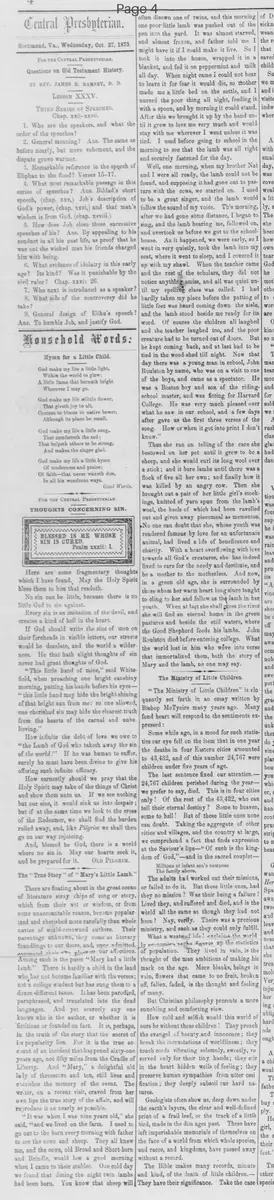
The "True Story" of "Mary's Little Lamb."
There are floating about in the great ocean of literature stray chips of song or story, which from their wit or wisdom, or from some unaccountable reason, become popularized and cherished more carefully than whole navies of world-renowned authors. Their parentage unknown, they come as literary foundlings to our doors, and, once admitted. command their own place in our affections.
Among such is the poem "Mary had a little lamb." There is hardly a child in the land who has not become familiar with the verses; not a college student but has sung them to a dozen different tunes. It has been parodied, paraphrased, and translated into the dead languages.
And yet scarcely any one knows who is the author, or whether it is fictitious or founded on fact. It is, perhaps, in the truth of the story that its popularity lies. For it is the true account of an incident that happened sixty-one years ago, not fifty miles from the Cradle of Liberty. And "Mary," a delightful old lady of threescore and ten, still lives and cherishes the memory of the event. The writer, on a recent visit, craved from her own lips the true story of the affair, and will reproduce it as nearly as possible.
"It was when I was nine years old," she said, "and we lived on the farm. I used to go out to the barn every morning with father to see the cows and sheep. They all knew me, and the cows, old Broad and Short-horn and Brindle, would low a good morning when I came to their stables. One cold day we found that during the night twin lambs had been born. You know that sheep will often disown one of twins, and this morning one poor little lamb was pushed out of the pen into the yard. It was almost starved, and almost frozen, and father told me I might have it if I could make it live. So I took it into the house, wrapped it in a blanket, and fed it on peppermint and milk all day. When night came I could not bear to leave it for fear it would die, so mother made me a little bed on the settle, and I nursed the poor thing all night, feeding it with a spoon, and by morning it could stand. After this we brought it up by the hand until it grew to love me very much and would stay with me wherever I went unless it was tied. I used before going to school in the morning to see that the lamb was all right and securely fastened for the day.
Well, one morning, when my brother Nat and I were all ready, the lamb could not be found, and supposing it had gone out to pasture with the cows, we started on. I used to be a great singer, and the lamb would follow the sound of my voice. This morning, after we had gone some distance, I began to sing, and the lamb hearing me, followed on, and overtook us before we got to the school-house. As it happened, we were early, so I went in very quietly, took the lamb into my seat, where it went to sleep, and I covered it up with my shawl. When the teacher came and the rest of the scholars, they did not notice anything amiss, and all was quiet until my spelling class was called. I had hardly taken my place before the patting of little feet was heard coming down the aisle, and the lamb stood beside me ready for its word. Of course the children all laughed and the teacher laughed too, and the poor creature had to be turned out of doors. But he kept coming back, and at last had to be tied in the wood-shed till night. Now that day there was a young man in school, John Roulston by name, who was on a visit to one of the boys, and came as a spectator. He was a Boston boy and son of the riding-school master, and was fitting for Harvard College. He was very much pleased over what he saw in our school, and a few days after gave us the first three verses of the song.
How or when it got into print I don't know."
Thus she ran on telling of the care she bestowed on her pet until it grew to be a sheep, and she would curl its long wool over a stick; and it bore lambs until there was a flock of five all her own; and finally how it was killed by an angry cow. Then she brought out a pair of her little girl's stockings, knitted of yarn spun from the lamb's wool, the heels of which had been ravelled out and given away piecemeal as mementos.
No one can doubt that she, whose youth was rendered famous by love for an unfortunate animal, had lived a life of beneficence and charity. With a heart overflowing with love towards all God's creatures, she has indeed lived to care for the needy and destitute, and be a mother to the motherless. And now, in a green old age, she is surrounded by these whom her warm heart long since taught to cling to her and follow as the lamb in her youth. When at last she shall cross the river she will find an eternal home, in the green pastures and beside the still waters, where the Good Shepherd feeds his lambs. John Roulston died before entering college. What the world lost in him who wove into verse that immortalized them, both the story of Mary and the lamb, no one may say.
There are floating about in the great ocean of literature stray chips of song or story, which from their wit or wisdom, or from some unaccountable reason, become popularized and cherished more carefully than whole navies of world-renowned authors. Their parentage unknown, they come as literary foundlings to our doors, and, once admitted. command their own place in our affections.
Among such is the poem "Mary had a little lamb." There is hardly a child in the land who has not become familiar with the verses; not a college student but has sung them to a dozen different tunes. It has been parodied, paraphrased, and translated into the dead languages.
And yet scarcely any one knows who is the author, or whether it is fictitious or founded on fact. It is, perhaps, in the truth of the story that its popularity lies. For it is the true account of an incident that happened sixty-one years ago, not fifty miles from the Cradle of Liberty. And "Mary," a delightful old lady of threescore and ten, still lives and cherishes the memory of the event. The writer, on a recent visit, craved from her own lips the true story of the affair, and will reproduce it as nearly as possible.
"It was when I was nine years old," she said, "and we lived on the farm. I used to go out to the barn every morning with father to see the cows and sheep. They all knew me, and the cows, old Broad and Short-horn and Brindle, would low a good morning when I came to their stables. One cold day we found that during the night twin lambs had been born. You know that sheep will often disown one of twins, and this morning one poor little lamb was pushed out of the pen into the yard. It was almost starved, and almost frozen, and father told me I might have it if I could make it live. So I took it into the house, wrapped it in a blanket, and fed it on peppermint and milk all day. When night came I could not bear to leave it for fear it would die, so mother made me a little bed on the settle, and I nursed the poor thing all night, feeding it with a spoon, and by morning it could stand. After this we brought it up by the hand until it grew to love me very much and would stay with me wherever I went unless it was tied. I used before going to school in the morning to see that the lamb was all right and securely fastened for the day.
Well, one morning, when my brother Nat and I were all ready, the lamb could not be found, and supposing it had gone out to pasture with the cows, we started on. I used to be a great singer, and the lamb would follow the sound of my voice. This morning, after we had gone some distance, I began to sing, and the lamb hearing me, followed on, and overtook us before we got to the school-house. As it happened, we were early, so I went in very quietly, took the lamb into my seat, where it went to sleep, and I covered it up with my shawl. When the teacher came and the rest of the scholars, they did not notice anything amiss, and all was quiet until my spelling class was called. I had hardly taken my place before the patting of little feet was heard coming down the aisle, and the lamb stood beside me ready for its word. Of course the children all laughed and the teacher laughed too, and the poor creature had to be turned out of doors. But he kept coming back, and at last had to be tied in the wood-shed till night. Now that day there was a young man in school, John Roulston by name, who was on a visit to one of the boys, and came as a spectator. He was a Boston boy and son of the riding-school master, and was fitting for Harvard College. He was very much pleased over what he saw in our school, and a few days after gave us the first three verses of the song.
How or when it got into print I don't know."
Thus she ran on telling of the care she bestowed on her pet until it grew to be a sheep, and she would curl its long wool over a stick; and it bore lambs until there was a flock of five all her own; and finally how it was killed by an angry cow. Then she brought out a pair of her little girl's stockings, knitted of yarn spun from the lamb's wool, the heels of which had been ravelled out and given away piecemeal as mementos.
No one can doubt that she, whose youth was rendered famous by love for an unfortunate animal, had lived a life of beneficence and charity. With a heart overflowing with love towards all God's creatures, she has indeed lived to care for the needy and destitute, and be a mother to the motherless. And now, in a green old age, she is surrounded by these whom her warm heart long since taught to cling to her and follow as the lamb in her youth. When at last she shall cross the river she will find an eternal home, in the green pastures and beside the still waters, where the Good Shepherd feeds his lambs. John Roulston died before entering college. What the world lost in him who wove into verse that immortalized them, both the story of Mary and the lamb, no one may say.
What sub-type of article is it?
Biography
Curiosity
Personal Triumph
What themes does it cover?
Moral Virtue
Survival
Love
What keywords are associated?
Mary Little Lamb
True Story
Lamb Follows To School
Nursery Rhyme Origin
Saving Twin Lamb
What entities or persons were involved?
Mary
John Roulston
Nat
Where did it happen?
Farm Not Fifty Miles From The Cradle Of Liberty
Story Details
Key Persons
Mary
John Roulston
Nat
Location
Farm Not Fifty Miles From The Cradle Of Liberty
Event Date
Sixty One Years Ago
Story Details
Mary, at age nine, saved a rejected twin lamb on her family's farm, nursed it to health, and it followed her to school, leading to laughter and the lamb being tied outside. John Roulston, a visitor, wrote the first three verses of the poem based on the incident.