Thank you for visiting SNEWPapers!
Sign up free
Literary
July 7, 1830
Morning Star
Limerick, York County, Maine
What is this article about?
Cyrus Whitney's reflective prose account of a winter evening walk pondering God's creation, leading to a solemn evening prayer meeting in his village, emphasizing Christian devotion, grace, and the benefits of social worship. Written in 1829 shortly before his death.
Clipping
OCR Quality
95%
Excellent
Full Text
MORNING STAR.
For the Morning Star.
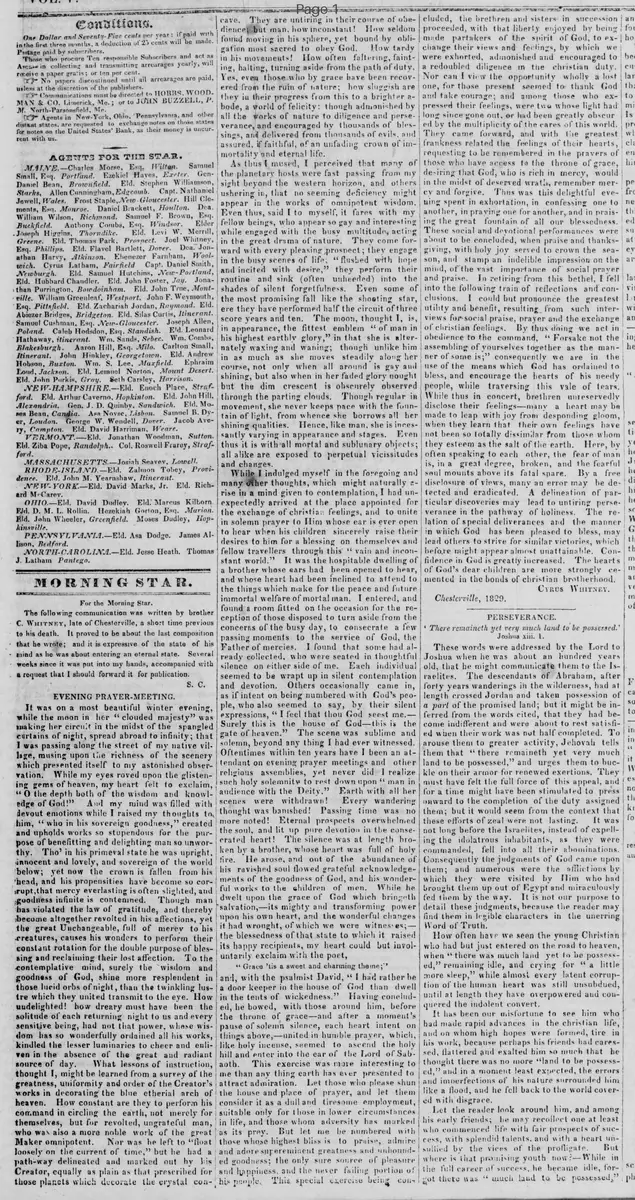
The following communication was written by brother C. Whitney, late of Chesterville, a short time previous to his death. It proved to be about the last composition that he wrote; and it is expressive of the state of his mind as he was about entering an eternal state. Several weeks since it was put into my hands, accompanied with a request that I should forward it for publication.
S. C.
EVENING PRAYER-MEETING.
It was on a most beautiful winter evening, while the moon in her "clouded majesty" was making her circuit in the midst of the spangled curtains of night, spread abroad to infinity; that I was passing along the street of my native village, musing upon the richness of the scenery which presented itself to my astonished observation. While my eyes roved upon the glistening gems of heaven, my heart felt to exclaim, "O the depth both of the wisdom and knowledge of God!" And my mind was filled with devout emotions while I raised my thoughts to him, "who in his sovereign goodness," created and upholds works so stupendous for the purpose of benefitting and delighting man so unworthy. Tho' in his primeval state he was upright, innocent and lovely, and sovereign of the world below; yet now the crown is fallen from his head, and his propensities have become so corrupt, that mercy everlasting is often slighted, and goodness infinite is contemned. Though man has violated the law of gratitude, and thereby become altogether revolted in his affections, yet the great Unchangeable, full of mercy to his creatures, causes his wonders to perform their constant rotation for the double purpose of blessing and reclaiming their lost affection. To the contemplative mind, surely the wisdom and goodness of God, shine more resplendent in those lucid orbs of night, than the twinkling lustre which they united transmit to the eye. How undelightful! how dreary must have been the solitude of each returning night to us and every sensitive being, had not that power, whose wisdom has so wonderfully ordained all his works, kindled the lesser luminaries to cheer and enliven in the absence of the great and radiant source of day. What lessons of instruction, thought I, might be learned from a survey of the greatness, uniformity and order of the Creator's works in decorating the blue ethereal arch of heaven. How constant are they to perform his command in circling the earth, not merely for themselves, but for revolted, ungrateful man, who was also a more noble work of the great Maker omnipotent. Nor was he left to "float loosely on the current of time," but he had a path-way delineated and marked out by his Creator, equally as plain as that prescribed for those planets which decorate the crystal concave. They are untiring in their course of obedience but man, how inconstant! How seldom found moving in his sphere, yet bound by obligation most sacred to obey God. How tardy in his movements! How often faltering, fainting, halting, turning aside from the path of duty. Yes, even those who by grace have been recovered from the ruin of nature; how sluggish are they in their progress from this to a brighter abode, a world of felicity: though admonished by all the works of nature to diligence and perseverance and encouraged by thousands of blessings, and delivered from thousands of evils, and assured, if faithful, of an unfading crown of immortality and eternal life.
As thus I mused, I perceived that many of the planetary hosts were fast passing from my sight beyond the western horizon, and others ushering in, that no seeming deficiency might appear in the works of omnipotent wisdom. Even thus, said I to myself, it fares with my fellow beings, who appear so gay and interesting while engaged with the busy multitude, acting in the great drama of nature. They come forward with every pleasing prospect; they engage in the busy scenes of life; "flushed with hope and incited with desire," they perform their routine and sink (often unheeded) into the shades of silent forgetfulness. Even some of the most promising fall like the shooting star, ere they have performed half the circuit of three score years and ten. The moon, thought I, is in appearance, the fittest emblem "of man in his highest earthly glory," in that she is alternately waxing and waning; though unlike him in as much as she moves steadily along her course, not only when all around is gay and shining, but also when in her faded glory nought but the dim crescent is obscurely observed through the parting clouds. Though regular in movement, she never keeps pace with the fountain of light, from whence she borrows all her shining qualities. Hence, like man, she is incessantly varying in appearance and stages. Even thus it is with all mortal and sublunary objects; all alike are exposed to perpetual vicissitudes and changes.
While I indulged myself in the foregoing and many other thoughts, which might naturally arise in a mind given to contemplation. I had unexpectedly arrived at the place appointed for the exchange of christian feelings, and to unite in solemn prayer to Him whose ear is ever open to hear when his children sincerely raise their desires to him for a blessing on themselves and fellow travellers through this "vain and inconstant world." It was the hospitable dwelling of a brother whose ears had been opened to hear, and whose heart had been inclined to attend to the things which make for the peace and future immortal welfare of mortal man. I entered, and found a room fitted on the occasion for the reception of those disposed to turn aside from the concerns of the busy day, to consecrate a few passing moments to the service of God, the Father of mercies. I found that some had already collected, who were seated in thoughtful silence on either side of me. Each individual seemed to be wrapt up in silent contemplation and devotion. Others occasionally came in, as if intent on being numbered with God's people, who also seemed to say, by their silent expressions, "I feel that thou God seest me.—Surely this is the house of God this is the gate of heaven." The scene was sublime and solemn, beyond any thing I had ever witnessed. Oftentimes within ten years have I been an attendant on evening prayer meetings and other religious assemblies, yet never did I realize such holy solemnity to rest down upon "man in audience with the Deity." Earth with all her scenes were withdrawn! Every wandering thought was banished! Passing time was no more noted! Eternal prospects overwhelmed the soul, and lit up pure devotion in the consecrated heart! The silence was at length broken by a brother, whose heart was full of holy fire. He arose, and out of the abundance of his ravished soul flowed grateful acknowledgements of the goodness of God, and his wonderful works to the children of men. While he dwelt upon the grace of God which bringeth salvation,—its mighty and transforming power upon his own heart, and the wonderful changes it had wrought, of which we were witnesses;—the blessedness of that state to which it raised its happy recipients, my heart could but involuntarily exclaim with the poet,
"Grace 'tis a sweet and charming theme;"
and, with the psalmist David, "I had rather be a door keeper in the house of God than dwell in the tents of wickedness." Having concluded, he bowed, with those around him, before the throne of grace—and after a moment's pause of solemn silence, each heart intent on things above,—united in humble prayer, which, like holy incense, seemed to ascend the holy hill and enter into the ear of the Lord of Sabaoth. This exercise was more interesting to me than any thing earth has ever presented to attract admiration. Let those who please shun the house and place of prayer, and let them consider it as a dull and tiresome employment, suitable only for those in lower circumstances in life, and those whom adversity has marked as its prey. But let me be numbered with those whose highest bliss is to praise, admire and adore supreme greatness and unbounded goodness; the only sure source of pleasure and happiness, and the never failing portion of his people. This special exercise being concluded, the brethren and sisters in succession proceeded, with that liberty enjoyed by being made partakers of the spirit of God, to exchange their views and feelings, by which we were exhorted, admonished and encouraged to a redoubled diligence in the christian duty. Nor can I view the opportunity wholly a lost one, for those present seemed to thank God and take courage: and among those who expressed their feelings, were two whose light had long since gone out, or had been greatly obscured by the multiplicity of the cares of this world. They came forward, and with the greatest frankness related the feelings of their hearts, requesting to be remembered in the prayers of those who have access to the throne of grace, desiring that God, who is rich in mercy, would in the midst of deserved wrath, remember mercy and forgive. Thus was this delightful evening spent in exhortation, in confessing one to another, in praying one for another, and in praising the great fountain of all our blessedness. These social and devotional performances were about to be concluded, when praise and thanksgiving, with holy joy, served to crown the season, and stamp an indelible impression on the mind, of the vast importance of social prayer and praise. In retiring from this bethel, I fell into the following train of reflections and conclusions. I could but pronounce the greatest utility and benefit, resulting from such interviews for social praise, prayer and the exchange of christian feelings. By thus doing we act in obedience to the command, "Forsake not the assembling of yourselves together as the manner of some is;" consequently we are in the use of the means which God has ordained to bless, and encourage the hearts of his needy people, while traversing this vale of tears. While thus in concert, brethren unreservedly disclose their feelings—many a heart may be made to leap with joy from desponding gloom, when they learn that their own feelings have not been so totally dissimilar from those whom they esteem as the salt of the earth. Here, by often speaking to each other, the fear of man is, in a great degree, broken, and the fearful soul mounts above its fatal snare. By a free disclosure of views, many an error may be detected and eradicated. A delineation of particular discoveries may lead to untiring perseverance in the pathway of holiness. The relation of special deliverances and the manner in which God has been pleased to bless, may lead others to strive for similar victories, which before might appear almost unattainable. Confidence in God is greatly increased. The hearts of God's dear children are more strongly cemented in the bonds of christian brotherhood.
Cyrus Whitney.
Chesterville, 1829.
For the Morning Star.
The following communication was written by brother C. Whitney, late of Chesterville, a short time previous to his death. It proved to be about the last composition that he wrote; and it is expressive of the state of his mind as he was about entering an eternal state. Several weeks since it was put into my hands, accompanied with a request that I should forward it for publication.
S. C.
EVENING PRAYER-MEETING.
It was on a most beautiful winter evening, while the moon in her "clouded majesty" was making her circuit in the midst of the spangled curtains of night, spread abroad to infinity; that I was passing along the street of my native village, musing upon the richness of the scenery which presented itself to my astonished observation. While my eyes roved upon the glistening gems of heaven, my heart felt to exclaim, "O the depth both of the wisdom and knowledge of God!" And my mind was filled with devout emotions while I raised my thoughts to him, "who in his sovereign goodness," created and upholds works so stupendous for the purpose of benefitting and delighting man so unworthy. Tho' in his primeval state he was upright, innocent and lovely, and sovereign of the world below; yet now the crown is fallen from his head, and his propensities have become so corrupt, that mercy everlasting is often slighted, and goodness infinite is contemned. Though man has violated the law of gratitude, and thereby become altogether revolted in his affections, yet the great Unchangeable, full of mercy to his creatures, causes his wonders to perform their constant rotation for the double purpose of blessing and reclaiming their lost affection. To the contemplative mind, surely the wisdom and goodness of God, shine more resplendent in those lucid orbs of night, than the twinkling lustre which they united transmit to the eye. How undelightful! how dreary must have been the solitude of each returning night to us and every sensitive being, had not that power, whose wisdom has so wonderfully ordained all his works, kindled the lesser luminaries to cheer and enliven in the absence of the great and radiant source of day. What lessons of instruction, thought I, might be learned from a survey of the greatness, uniformity and order of the Creator's works in decorating the blue ethereal arch of heaven. How constant are they to perform his command in circling the earth, not merely for themselves, but for revolted, ungrateful man, who was also a more noble work of the great Maker omnipotent. Nor was he left to "float loosely on the current of time," but he had a path-way delineated and marked out by his Creator, equally as plain as that prescribed for those planets which decorate the crystal concave. They are untiring in their course of obedience but man, how inconstant! How seldom found moving in his sphere, yet bound by obligation most sacred to obey God. How tardy in his movements! How often faltering, fainting, halting, turning aside from the path of duty. Yes, even those who by grace have been recovered from the ruin of nature; how sluggish are they in their progress from this to a brighter abode, a world of felicity: though admonished by all the works of nature to diligence and perseverance and encouraged by thousands of blessings, and delivered from thousands of evils, and assured, if faithful, of an unfading crown of immortality and eternal life.
As thus I mused, I perceived that many of the planetary hosts were fast passing from my sight beyond the western horizon, and others ushering in, that no seeming deficiency might appear in the works of omnipotent wisdom. Even thus, said I to myself, it fares with my fellow beings, who appear so gay and interesting while engaged with the busy multitude, acting in the great drama of nature. They come forward with every pleasing prospect; they engage in the busy scenes of life; "flushed with hope and incited with desire," they perform their routine and sink (often unheeded) into the shades of silent forgetfulness. Even some of the most promising fall like the shooting star, ere they have performed half the circuit of three score years and ten. The moon, thought I, is in appearance, the fittest emblem "of man in his highest earthly glory," in that she is alternately waxing and waning; though unlike him in as much as she moves steadily along her course, not only when all around is gay and shining, but also when in her faded glory nought but the dim crescent is obscurely observed through the parting clouds. Though regular in movement, she never keeps pace with the fountain of light, from whence she borrows all her shining qualities. Hence, like man, she is incessantly varying in appearance and stages. Even thus it is with all mortal and sublunary objects; all alike are exposed to perpetual vicissitudes and changes.
While I indulged myself in the foregoing and many other thoughts, which might naturally arise in a mind given to contemplation. I had unexpectedly arrived at the place appointed for the exchange of christian feelings, and to unite in solemn prayer to Him whose ear is ever open to hear when his children sincerely raise their desires to him for a blessing on themselves and fellow travellers through this "vain and inconstant world." It was the hospitable dwelling of a brother whose ears had been opened to hear, and whose heart had been inclined to attend to the things which make for the peace and future immortal welfare of mortal man. I entered, and found a room fitted on the occasion for the reception of those disposed to turn aside from the concerns of the busy day, to consecrate a few passing moments to the service of God, the Father of mercies. I found that some had already collected, who were seated in thoughtful silence on either side of me. Each individual seemed to be wrapt up in silent contemplation and devotion. Others occasionally came in, as if intent on being numbered with God's people, who also seemed to say, by their silent expressions, "I feel that thou God seest me.—Surely this is the house of God this is the gate of heaven." The scene was sublime and solemn, beyond any thing I had ever witnessed. Oftentimes within ten years have I been an attendant on evening prayer meetings and other religious assemblies, yet never did I realize such holy solemnity to rest down upon "man in audience with the Deity." Earth with all her scenes were withdrawn! Every wandering thought was banished! Passing time was no more noted! Eternal prospects overwhelmed the soul, and lit up pure devotion in the consecrated heart! The silence was at length broken by a brother, whose heart was full of holy fire. He arose, and out of the abundance of his ravished soul flowed grateful acknowledgements of the goodness of God, and his wonderful works to the children of men. While he dwelt upon the grace of God which bringeth salvation,—its mighty and transforming power upon his own heart, and the wonderful changes it had wrought, of which we were witnesses;—the blessedness of that state to which it raised its happy recipients, my heart could but involuntarily exclaim with the poet,
"Grace 'tis a sweet and charming theme;"
and, with the psalmist David, "I had rather be a door keeper in the house of God than dwell in the tents of wickedness." Having concluded, he bowed, with those around him, before the throne of grace—and after a moment's pause of solemn silence, each heart intent on things above,—united in humble prayer, which, like holy incense, seemed to ascend the holy hill and enter into the ear of the Lord of Sabaoth. This exercise was more interesting to me than any thing earth has ever presented to attract admiration. Let those who please shun the house and place of prayer, and let them consider it as a dull and tiresome employment, suitable only for those in lower circumstances in life, and those whom adversity has marked as its prey. But let me be numbered with those whose highest bliss is to praise, admire and adore supreme greatness and unbounded goodness; the only sure source of pleasure and happiness, and the never failing portion of his people. This special exercise being concluded, the brethren and sisters in succession proceeded, with that liberty enjoyed by being made partakers of the spirit of God, to exchange their views and feelings, by which we were exhorted, admonished and encouraged to a redoubled diligence in the christian duty. Nor can I view the opportunity wholly a lost one, for those present seemed to thank God and take courage: and among those who expressed their feelings, were two whose light had long since gone out, or had been greatly obscured by the multiplicity of the cares of this world. They came forward, and with the greatest frankness related the feelings of their hearts, requesting to be remembered in the prayers of those who have access to the throne of grace, desiring that God, who is rich in mercy, would in the midst of deserved wrath, remember mercy and forgive. Thus was this delightful evening spent in exhortation, in confessing one to another, in praying one for another, and in praising the great fountain of all our blessedness. These social and devotional performances were about to be concluded, when praise and thanksgiving, with holy joy, served to crown the season, and stamp an indelible impression on the mind, of the vast importance of social prayer and praise. In retiring from this bethel, I fell into the following train of reflections and conclusions. I could but pronounce the greatest utility and benefit, resulting from such interviews for social praise, prayer and the exchange of christian feelings. By thus doing we act in obedience to the command, "Forsake not the assembling of yourselves together as the manner of some is;" consequently we are in the use of the means which God has ordained to bless, and encourage the hearts of his needy people, while traversing this vale of tears. While thus in concert, brethren unreservedly disclose their feelings—many a heart may be made to leap with joy from desponding gloom, when they learn that their own feelings have not been so totally dissimilar from those whom they esteem as the salt of the earth. Here, by often speaking to each other, the fear of man is, in a great degree, broken, and the fearful soul mounts above its fatal snare. By a free disclosure of views, many an error may be detected and eradicated. A delineation of particular discoveries may lead to untiring perseverance in the pathway of holiness. The relation of special deliverances and the manner in which God has been pleased to bless, may lead others to strive for similar victories, which before might appear almost unattainable. Confidence in God is greatly increased. The hearts of God's dear children are more strongly cemented in the bonds of christian brotherhood.
Cyrus Whitney.
Chesterville, 1829.
What sub-type of article is it?
Essay
What themes does it cover?
Religious
Moral Virtue
What keywords are associated?
Evening Prayer Meeting
Religious Reflection
Gods Creation
Christian Devotion
Social Worship
Grace And Salvation
Contemplation Of Nature
What entities or persons were involved?
Cyrus Whitney
Literary Details
Title
Evening Prayer Meeting.
Author
Cyrus Whitney
Subject
Reflections On A Winter Evening Prayer Meeting And God's Creation
Form / Style
Prose Narrative Reflection On Religious Experience
Key Lines
"O The Depth Both Of The Wisdom And Knowledge Of God!"
"Grace 'Tis A Sweet And Charming Theme;"
"I Had Rather Be A Door Keeper In The House Of God Than Dwell In The Tents Of Wickedness."
"Forsake Not The Assembling Of Yourselves Together As The Manner Of Some Is;"