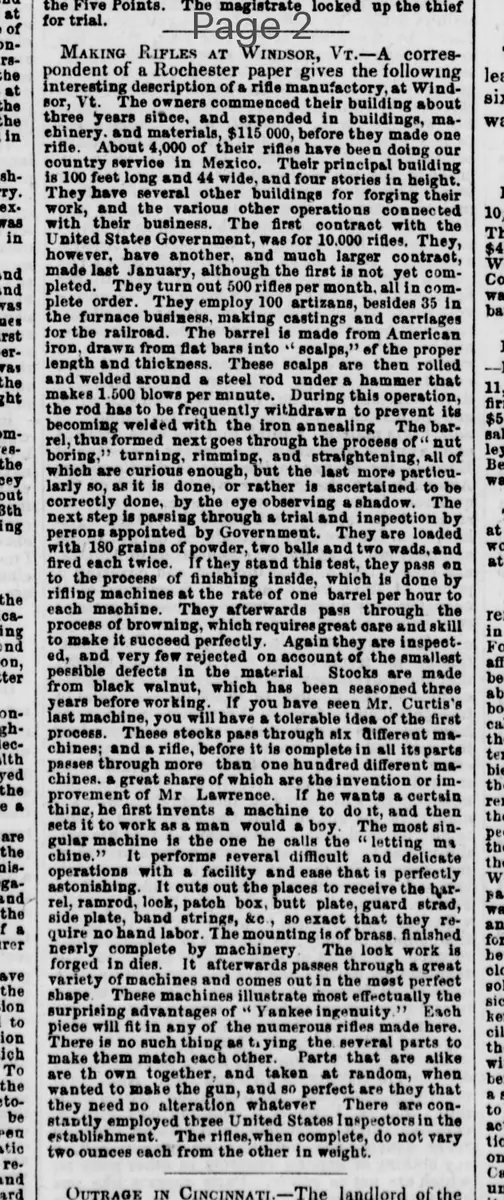
Making Rifles at Windsor, VT.—A correspondent of a Rochester paper gives the following interesting description of a rifle manufactory, at Windsor, Vt. The owners commenced their building about three years since, and expended in buildings, machinery, and materials, $115,000, before they made one rifle. About 4,000 of their rifles have been doing our country service in Mexico. Their principal building is 100 feet long and 44 wide, and four stories in height. They have several other buildings for forging their work, and the various other operations connected with their business. The first contract with the United States Government, was for 10,000 rifles. They, however, have another, and much larger contract, made last January, although the first is not yet completed. They turn out 500 rifles per month, all in complete order. They employ 100 artizans, besides 35 in the furnace business, making castings and carriages for the railroad. The barrel is made from American iron, drawn from flat bars into "scalps," of the proper length and thickness. These scalps are then rolled and welded around steel rod under a hammer that makes 1,500 blows per minute. During this operation, the rod has to be frequently withdrawn to prevent its becoming welded with the iron annealing The barrel, thus formed next goes through the process of "nut boring, turning, rimming, and straightening, all of which are curious enough, but the last more particularly so, as it is done, or rather is ascertained to be correctly done, by the eye observing a shadow. The next step is passing through a trial and inspection by persons appointed by Government. They are loaded with 180 grains of powder, two balls and two wads, and fired each twice. If they stand this test, they pass on to the process of finishing inside, which is done by rifling machines at the rate of one barrel per hour to each machine. They afterwards pass through the process of browning, which requires great care and skill to make it succeed perfectly. Again they are inspected, and very few rejected on account of the smallest possible defects in the material Stocks are made from black walnut, which has been seasoned three years before working. If you have seen Mr. Curtis's last machine, you will have a tolerable idea of the first process. These stocks pass through six different machines; and a rifle, before it is complete in all its parts passes through more than one hundred different machines, a great share of which are the invention or improvement of Mr Lawrence. If he wants a certain thing, he first invents a machine to do it, and then sets it to work as a man would a boy. The most singular machine is the one he calls the "letting machine." It performs several difficult and delicate operations with a facility and ease that is perfectly astonishing. It cuts out the places to receive the barrel, ramrod, lock, patch box, butt plate, guard strap, side plate, band springs, &c, so exact that they require no hand labor. The mounting is of brass, finished nearly complete by machinery The lock work is forged in dies. It afterwards passes through a great variety of machines and comes out in the most perfect shape These machines illustrate most effectually the surprising advantages of "Yankee ingenuity." Each piece will fit in any of the numerous rifles made here. There is no such thing as trying the several parts to make them match each other. Parts that are alike are thrown together, and taken at random, when wanted to make the gun, and so perfect are they that they need no alteration whatever There are constantly employed three United States Inspectors in the establishment. The rifles, when complete, do not vary two ounces each from the other in weight.