Thank you for visiting SNEWPapers!
Sign up free
The Rock Island Argus And Daily Union
Rock Island, Rock Island County County, Illinois
What is this article about?
Three Washington women form a corporation to build a multi-auditorium theatre complex in D.C., dedicated to professional children's plays and inspirational entertainment, led by Mrs. Glenna S. Tinnin with experience in youth dramatics.
Clipping
OCR Quality
Full Text
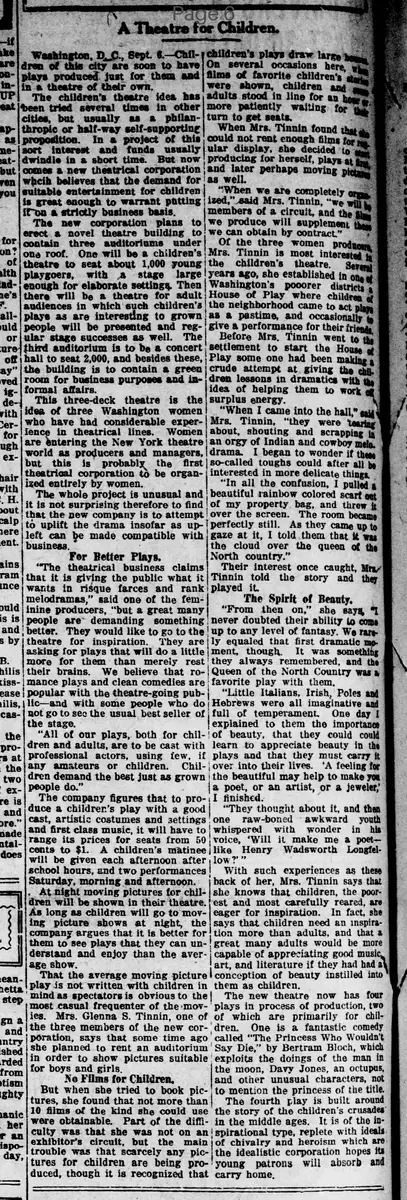
Washington, D.C., Sept 6,—Children of this city are soon to have plays produced just for them and in a theatre of their own.
The children's theatre idea has been tried several times in other cities, but usually as a philanthropic or half-way self-supporting proposition. In a project of this sort interest and funds usually dwindle in a short time. But now comes a new theatrical corporation which believes that the demand for suitable entertainment for children is great enough to warrant putting it on a strictly business basis.
The new corporation plans to erect a novel theatre building to contain three auditoriums under one roof. One will be a children's theatre to seat about 1,000 young playgoers, with a stage large enough for elaborate settings. Then there will be a theatre for adult audiences in which such children's plays as are interesting to grown people will be presented and regular stage successes as well. The third auditorium is to be a concert hall to seat 2,000, and besides these, the building is to contain a green room for business purposes and informal affairs.
This three-deck theatre is the idea of three Washington women who have had considerable experience in theatrical lines. Women are entering the New York theatre world as producers and managers, but this is probably the first theatrical corporation to be organized entirely by women.
The whole project is unusual and it is not surprising therefore to find that the new company is to attempt to uplift the drama insofar as uplift can be made compatible with business.
For Better Plays.
The theatrical business claims that it is giving the public what it wants in risque farces and rank melodramas," said one of the feminine producers. "but a great many people are demanding something better. They would like to go to the theatre for inspiration. They are asking for plays that will do a little more for them than merely rest their brains. We believe that romance plays and clean comedies are popular with the theatre-going public—and with some people who do not go to see the usual best seller of the stage.
"All of our plays, both for children and adults, are to be cast with professional actors, using few, if any amateurs or children. Children demand the best just as grown people do."
The company figures that to produce a children's play with a good cast, artistic costumes and settings and first class music. it will have to range its prices for seats from 50 cents to $1. A children's matinee will be given each afternoon after school hours, and two performances Saturday morning and afternoon
At night moving pictures for children will be shown in their theatre. As long as children will go to moving picture shows at night, the company argues that it is better for them to see plays that they can understand and enjoy than the average show.
That the average moving picture play is not written with children in mind as spectators is obvious to the most casual frequenter of the movies. Mrs. Glenna S. Tinnin, one of the three members of the new corporation, says that some time ago she planned to rent an auditorium in order to show pictures suitable for boys and girls.
No Films for Children
But when she tried to book pictures. she found that not more than 10 films of the kind she could use were obtainable. Part of the difficulty was that she was not on an exhibitor's circuit, but the main trouble was that scarcely any pictures for children are being produced, though it is recognized that children's plays draw large
On several occasions here, films of favorite children's stories were shown, children and adults stood in line for an hour more patiently waiting for turn to get seats.
When Mrs. Tinnin found that she could not rent enough films for regular display, she decided to producing for herself, plays at first and later perhaps moving pictures as well.
When we are completely organized," said Mrs. Tinnin, "we will be members of a circuit, and the films we produce will supplement those we can obtain by contract."
Of the three women producers Mrs. Tinnin is most interested in the children's theatre. Seventeen years ago, she established in one of Washington's poorer districts House of Play where children of the neighborhood came to act plays as a pastime, and occasionally give a performance for their friends
Before Mrs. Tinnin went to the settlement to start the House of Play some one had been making crude attempt at giving the children lessons in dramatics with idea of helping them to work off surplus energy.
"When I came into the hall," said Mrs, Tinnin, "they were tearing about, shouting and scrapping an orgy of Indian and cowboy melodrama. I began to wonder if these so-called toughs could after all be interested in more delicate things,
In all the confusion, I pulled beautiful rainbow colored scarf out of my property bag, and threw it over the screen. The room became perfectly still. As they came up to gaze at it, I told them that it was the cloud over the queen of the North country."
Their interest once caught, Mrs. Tinnin told the story and they played it.
The Spirit of Beauty.
"From then on," she says never doubted their ability to come up to any level of fantasy. We rarely equaled that first dramatic moment, though. It was something they always remembered, and the Queen of the North Country was a favorite play with them,
"Little Italians, Irish, Poles and Hebrews were all imaginative and full of temperament. One day I explained to them the importance jof beauty, that they could learn to appreciate beauty in the plays and that they must carry it over into their lives. 'A feeling for the beautiful may help to make you a poet, or an artist, or a jeweler, I finished.
"They thought about it, and then one raw-boned awkward youth whispered with wonder in his voice, 'Will it make me a poet- like Henry Wadsworth Longfellow?'"
With such experiences as these back of her. Mrs. Tinnin says that she knows that children, the poorest and most carefully reared, are eager for inspiration. In fact, she says that children need an inspiration more than adults, and that a great many adults would be more capable of appreciating good music, art, and literature if they had had a conception of beauty instilled into them as children.
The new theatre now has four plays in process of production, two of which are primarily for children. One is a fantastic comedy called "The Princess Who Wouldn't Say Die," by Bertram Bloch, which exploits the doings of the man in the moon, Davy Jones. an octopus, and other unusual characters, not to mention the princess of the title.
The fourth play is built around the story of the children's crusades in the middle ages. It is of the inspirational type, replete with ideals of chivalry and heroism which are the idealistic corporation hopes its young patrons will absorb and carry home.
What sub-type of article is it?
What themes does it cover?
What keywords are associated?
What entities or persons were involved?
Where did it happen?
Story Details
Key Persons
Location
Washington, D.C.
Event Date
Sept 6
Story Details
Three Washington women, including Mrs. Glenna S. Tinnin, organize a theatrical corporation to erect a building with three auditoriums: one for children's plays seating 1,000, one for adults, and a concert hall for 2,000. They aim to produce professional, inspirational plays for children and adults on a business basis, with matinees and evening moving pictures. Background includes Tinnin's prior work establishing a House of Play in a poor district. Plays in production include 'The Princess Who Wouldn't Say Die' and a story of the children's crusades.