Thank you for visiting SNEWPapers!
Sign up free
Editorial
March 12, 1791
The Kentucky Gazette
Lexington, Fayette County, Kentucky
What is this article about?
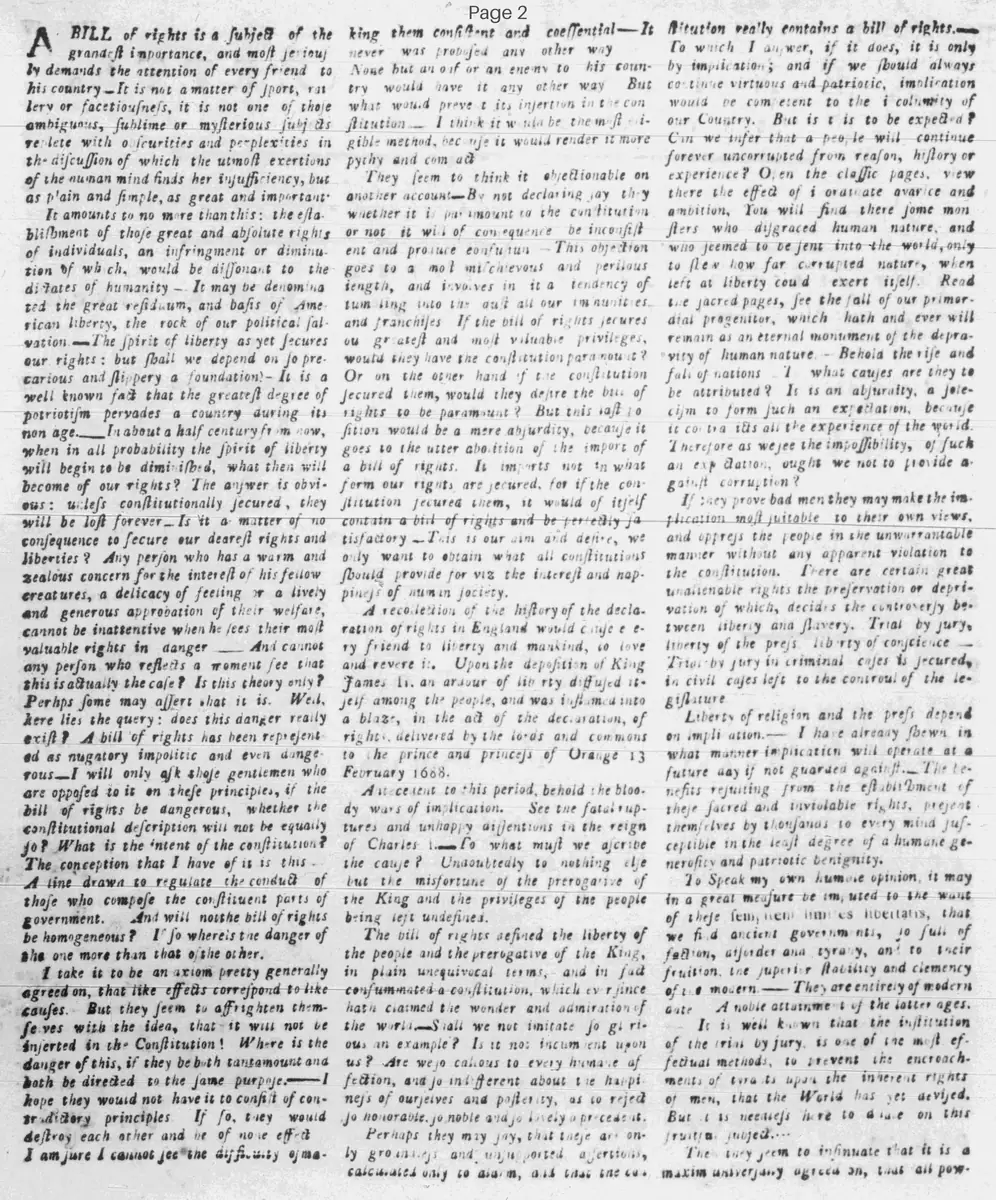
An editorial passionately argues for including a Bill of Rights in the U.S. Constitution to secure fundamental liberties like trial by jury, freedom of press, and religion, drawing on English history and warning against relying on implied protections amid human corruption.
Clipping
OCR Quality
80%
Good
Full Text
Bill of rights is a subject of the grand importance, and most serious. By demands the attention of every friend to his country. It is not a matter of sport, rather servile or facetiousness. it is not one of those ambiguous, sublime or mysterious subjects related with obscurities and perplexities in the discussion of which the utmost exertions of the human mind finds her insufficiency, but as plain and simple, as great and important: It amounts to no more than this: the establishment of those great and absolute rights of individuals, an infringement or diminution of which, would be dissonant to the dictates of humanity. It may be denominated the great residuum, and basis of American liberty, the rock of our political salvation. The spirit of liberty as yet secures our rights: but shall we depend on so precarious and slippery a foundation! It is a well known fact that the greatest degree of patriotism pervades a country during its non age. In about a half century from now, when in all probability the spirit of liberty will begin to be diminished, what then will become of our rights? The answer is obvious: unless constitutionally secured, they will be lost forever. Is it a matter of no consequence to secure our dearest rights and liberties? Any person who has a warm and zealous concern for the interest of his fellow creatures, a delicacy of feeling or a lively and generous approbation of their welfare, cannot be inattentive when he sees their most valuable rights in danger. And cannot any person who reflects a moment see that this is actually the case? Is this theory only? Perhaps some may assert that it is. Well, here lies the query: does this danger really exist? A bill of rights has been represented as nugatory impolitic and even dangerous. I will only ask those gentlemen who are opposed to it on these principles, if the bill of rights be dangerous, whether the constitutional description will not be equally so? What is the intent of the constitution? The conception that I have of it is this - A line drawn to regulate the conduct of those who compose the constituent parts of government. And will not the bill of rights be homogeneous? If so where is the danger of the one more than that of the other. I take it to be an axiom pretty generally agreed on, that like effects correspond to like causes. But they seem to affrighten themselves with the idea, that it will not be inserted in the Constitution! Where is the danger of this, if they be both tantamount and both be directed to the same purpose, I hope they would not have it to consist of contradictory principles. If so, they would destroy each other and be of no effect. I am sure I cannot see the disutility of making them consistent and confidential. It never was proposed any other way. None but an officious or an enemy to his country would have it any other way. But what would prevent its insertion in the constitution? I think it would be the most eligible method, because it would render it more pithy and compact. They seem to think it objectionable on another account. By not declaring any thing whether it is paramount to the constitution or not it will of consequence be inconsistent and produce confusion. This objection goes to a most mischievous and perilous length, and involves in it a tendency of summing up into one all our immunities and franchises. If the bill of rights secures our greatest and most valuable privileges, would they have the constitution paramount it? Or on the other hand if the constitution secured them, would they desire the bill of rights to be paramount? But this supposition would be a mere absurdity, Because it goes to the utter abolition of the import of a bill of rights. It imports not in what form our rights are secured. for if the constitution secures them, it would of itself contain a bill of rights and be perfectly satisfactory. This is our aim and desire. we only want to obtain what all constitutions should provide for viz the interest and happiness of human society.
A recollection of the history of the declaration of rights in England would close every friend to liberty and mankind, to love and revere it. Upon the deposition of King James II. an ardour of liberty diffused itself among the people, and was inflamed into a blaze, in the act of the declaration, of rights delivered by the lords and commons to the prince and princess of Orange 13 February 1688. At certain to this period, behold the bloody wars of implication. See the fatal coups and unhappy adjunctions in the reign of Charles I. as to what must we ascribe the cause? Undoubtedly to nothing else but the misfortune of the prerogative of the King and the privileges of the people being left undefined. The bill of rights defined the liberty of the people and the prerogative of the King, in plain unequivocal terms. and in fact consummated a constitution. which every instance has claimed the wonder and admiration of the world. Shall we not imitate so glorious an example? Is it not incumbent upon us? Are we so callous to every humane affection, and so indifferent about the happiness of ourselves and posterity, as to reject so honorable, so noble and so truly a precedent it. Perhaps they may say, that these are only groans and unsupported assertions, calculated only to alarm, as does the constitution really contains a bill of rights. To which I answer, if it does, it is only by implication; and if we should always continue virtuous and patriotic, implication would be competent to the security of our Country. But is this to be expected? Can we infer that a people will continue forever uncorrupted from reason, history or experience? Open the classic pages, view there the effect of inordinate avarice and ambition, You will find there some monsters who disgraced human nature, and who seemed to be sent into the world, only to show how far corrupted nature, when left at liberty could exert itself. Read the sacred pages, see the fall of our primordial progenitor, which hath and ever will remain as an eternal monument of the depravity of human nature. Behold the rise and fall of nations! what causes are they to be attributed? It is an absurdity, a solecism to form such an expectation. because it contradicts all the experience of the world. Therefore as we see the impossibility, of such an expectation, ought we not to provide against corruption? If they prove bad men they may make the implication most suitable to their own views, and oppress the people in the unwarrantable manner without any apparent violation to the constitution. There are certain great unalienable rights the preservation or deprivation of which, decides the controversy be- tween liberty and slavery. Trial by jury. liberty of the press liberty of conscience - Trial by jury in criminal cases is secured. in civil cases left to the control of the le- gislature. Liberty of religion and the press depend on implication. I have already shown in what manner implication will operate at future day if not guarded against. The benefits resulting from the establishment of these sacred and inviolable rights, present themselves by thousands to every mind susceptible in the least degree of a humane ge- nerosity and patriotic benignity.
To speak my own humble opinion, it may in a great measure be imputed to the want of these eminent images habitatis, that we find ancient governments, so full of fetters, disorder and tyranny, and to their fruition. the superior utility and clemency of the modern. They are entirely of modern date A noble attainment of the latter ages. It is well known that the institution of the trials by jury. is one of the most ef- fectual methods, to prevent the encroach- ments of tyrants upon the inherit rights of men, that the World has yet devised. But it is needless here to dwell on this fruitful subject.... The tory press to insinuate that it is a maxim universally agreed on, thus old power-
A recollection of the history of the declaration of rights in England would close every friend to liberty and mankind, to love and revere it. Upon the deposition of King James II. an ardour of liberty diffused itself among the people, and was inflamed into a blaze, in the act of the declaration, of rights delivered by the lords and commons to the prince and princess of Orange 13 February 1688. At certain to this period, behold the bloody wars of implication. See the fatal coups and unhappy adjunctions in the reign of Charles I. as to what must we ascribe the cause? Undoubtedly to nothing else but the misfortune of the prerogative of the King and the privileges of the people being left undefined. The bill of rights defined the liberty of the people and the prerogative of the King, in plain unequivocal terms. and in fact consummated a constitution. which every instance has claimed the wonder and admiration of the world. Shall we not imitate so glorious an example? Is it not incumbent upon us? Are we so callous to every humane affection, and so indifferent about the happiness of ourselves and posterity, as to reject so honorable, so noble and so truly a precedent it. Perhaps they may say, that these are only groans and unsupported assertions, calculated only to alarm, as does the constitution really contains a bill of rights. To which I answer, if it does, it is only by implication; and if we should always continue virtuous and patriotic, implication would be competent to the security of our Country. But is this to be expected? Can we infer that a people will continue forever uncorrupted from reason, history or experience? Open the classic pages, view there the effect of inordinate avarice and ambition, You will find there some monsters who disgraced human nature, and who seemed to be sent into the world, only to show how far corrupted nature, when left at liberty could exert itself. Read the sacred pages, see the fall of our primordial progenitor, which hath and ever will remain as an eternal monument of the depravity of human nature. Behold the rise and fall of nations! what causes are they to be attributed? It is an absurdity, a solecism to form such an expectation. because it contradicts all the experience of the world. Therefore as we see the impossibility, of such an expectation, ought we not to provide against corruption? If they prove bad men they may make the implication most suitable to their own views, and oppress the people in the unwarrantable manner without any apparent violation to the constitution. There are certain great unalienable rights the preservation or deprivation of which, decides the controversy be- tween liberty and slavery. Trial by jury. liberty of the press liberty of conscience - Trial by jury in criminal cases is secured. in civil cases left to the control of the le- gislature. Liberty of religion and the press depend on implication. I have already shown in what manner implication will operate at future day if not guarded against. The benefits resulting from the establishment of these sacred and inviolable rights, present themselves by thousands to every mind susceptible in the least degree of a humane ge- nerosity and patriotic benignity.
To speak my own humble opinion, it may in a great measure be imputed to the want of these eminent images habitatis, that we find ancient governments, so full of fetters, disorder and tyranny, and to their fruition. the superior utility and clemency of the modern. They are entirely of modern date A noble attainment of the latter ages. It is well known that the institution of the trials by jury. is one of the most ef- fectual methods, to prevent the encroach- ments of tyrants upon the inherit rights of men, that the World has yet devised. But it is needless here to dwell on this fruitful subject.... The tory press to insinuate that it is a maxim universally agreed on, thus old power-
What sub-type of article is it?
Constitutional
What keywords are associated?
Bill Of Rights
Constitution
American Liberty
English Declaration
Trial By Jury
Liberty Of Press
Liberty Of Conscience
Human Corruption
What entities or persons were involved?
King James Ii
Prince And Princess Of Orange
Charles I
Lords And Commons
Tory Press
Editorial Details
Primary Topic
Advocacy For A Bill Of Rights In The Constitution
Stance / Tone
Strongly Supportive Of Explicit Bill Of Rights
Key Figures
King James Ii
Prince And Princess Of Orange
Charles I
Lords And Commons
Tory Press
Key Arguments
Bill Of Rights Establishes Absolute Individual Rights Essential To Liberty
Relying On Spirit Of Liberty Is Precarious; Rights Must Be Constitutionally Secured
Opponents' Fears Of Danger In Bill Of Rights Apply Equally To Constitution
English Bill Of Rights Of 1688 Prevented Conflicts By Defining Rights And Prerogatives
Implied Rights Vulnerable To Corruption; Explicit Protections Needed Against Tyranny
Trial By Jury In Criminal Cases Secured, But Civil Cases And Freedoms Of Religion/Press By Implication Only